demaniak
Members
-
Joined
-
Last visited
Everything posted by demaniak
-
Seems to be working fairly well, thank you. Took a bit of experimentation to find suitable voltage targets for the Deye's Time Of Use settings, but looks like I now got some values in there that balance usage power, DoD ,time and available PV. Maybe somebody has some docs on whatever algorithm Deye implements for these things? As I say, it seems to be working fairly well, but I am curious as to the inverter specifics. For example, it seems the inverter smoothly tapers off the draw on the battery as the Time Of Use segment comes to and end, supplementing with grid while it does so. It might also be doing something "adaptive" if the battery did not make target voltage that day? Drawing less power during the evening than it would otherwise? Or I might just be fooling myself 🤷♂️ Unfortunately the Deye cloud does not capture everything like VRM does, so a bit hard to have clarity over time (3+ days).
-
A follow up question regarding this: to what should I set the "Equalization" settings? Is this even needed for LFP batts? Should I fiddle with the "Batt Resistance" ? Screen shot attached from manual
ManualsLib.png.10863110aa89a96740d1b04b1d2dc63b.png)
-
Unfortunately, the information I'm looking for only comes with time: 3-5+ years. During that period: were there any issues? if there were, what was the support/warranty experience like? how does the stats at that point compare to the baseline you are building now? That said, everything posted so far gives me good feelings regarding the AM16+ that I'm eyeing for possible purchase later this year. Thanks for the efforts and the info sharing!
-
The 1 bothersome thing with voltage mode is that the "time of use" settings on the Deye then get even more miffy, due to the very flat discharge curve of lifion batts. But ok, all of this is temporary, until I get to that part of the upgrade. So as long as the batteries remain protected,then that is ok (well, built-in BMSes should prevent actual disaster at least).
-
I am actually following that thread with interest :) The Hubble AM16+ is currently looking like very good value for money. The local support angle makes it even more attractive - BYD really screwed me over on that front.
-
Thanks. Yeah, aware of the size-problem. This is an inflight, phased upgrade - battery is slotted as the last piece to be replaced (probably with something on the 16kWh spectrum). Luckily load shedding is now a SOLVED problem for ever and will never "darken" our doorways again. Right? Right?? Max charge/discharge has been pegged lower than suggested settings. I HOPE they Deye is smart enough to shutdown if higher demands come in while islanding. I'll look into the voltage mode - as the manual says, there are gotchas with voltage mode to watch out for (esp with LiFion batts), but I hear you about that. The damn installer dodged questions/suggestions about V mode - the more I think about it, the more I believe they actually know very little outside their very specific recipe (hardware/config). thanks again.
-
Thank you for the reply @HennieL As far as I'm aware and can see, the batteries were installed in the cabinet according to the manual ( https://www.manualslib.com/manual/1482649/Byd-B-Box-2-5.html?page=6#manual ) - so busbar, then up to inverter. Have kept an eye on the battery SOC LEDS over the last week or so - it does SEEM like all modules reach full charge (just not when the inverter reckons it is 100% - at that point, batteries are usually still taking as much PV as can be provided). And the oldest module is perhaps struggling a bit more than the newer ones - might simply be seeing effects of age ☹️ I do still believe the inverter's idea of SOC and the real SOC is not always aligned, meaning any inverter setting that is based on SOC is kinda a hit and miss situation. Will also try a cable that I made up that cuts out pins 1 and 2 (RS485), as I got this weird idea that might be a source of confusion for the inverter. Or the battery? The battery BMU DOES have RS485 capability on that rj45 socket (as well as CANbus), but afaik that is only to enable firmware updates (in the times when updates were still available). But since the inverter apparently can also talk RS485 via the comms port - I'm suspecting it does not like what it finds on the BMU side when it tries. Or the battery does not like what IT sees there. I will see when I try my cable. If nothing else, that will eliminate one potential source of trouble. I will take a look at your linked thread, thanks :)
-
As a follow up, I can already say that what I THOUGHT would happen, does seem to be happening. Since there is no coordinating BMS between the battery modules, it looks like the SOC of each module (as shown by the LED indicators) are not in sync. The oldest module seems to be consistently "behind" in terms of charge, as self reported.
-
Good day. Hoping there are still some smart folks around here with experience in the weirder setups. I have recently upgraded from my Victron Multiplus II 3000/48/35 system to a Deye 12kWh hybrid inverter. Installer was full of confidence that the BYD battery will work, no problem! However, problem. Seems the BMU CAN comms are not ayoba with the Deye inverter. If hooked up "correctly" (batteries daisy chained, highest address goes to BMU, BMU goes to inverter) , then battery shuts down when mains fails (or turned of for testing). Which is not very helpful. Installer swears it needs a firmware upgrade. I kinda suspect the inverter is not doing the needed keep-a-live signal, but what do I know. Maybe all of the above. After support calls to BYD(?) (by the installer), they apparently can't do it (on which I call bullshit, but whatever). BYD (or anointed support outfit) can apparently come out and do a firmware upgrade though. Have not asked about costs of THAT yet. FWIW, the previous installer (that did the Victron/BYD system) upgraded the firmware of the battery modules some years back. So I know it is possible. I also know BYD is not exactly forthcoming with firmware+tools for this battery model, so that maybe does say something. I found an 2019 update bundle from a random AU site after MUCH digging. Anyway, the installer got the battery working by bypassing the BMU, and setting 2/3 of the battery module addresses to 0, and the one that has Ethernet cable going to inverter to 1. This feels shaky for me. But again, what do I know. So the questions: 1. Anybody here got experience / advice with a similar setup? Deye with older BYD battery models (circa 2017-2021) 2. Any thoughts/concerns on running the battery as described? Photos can be supplied if needed. Things SEEM to be working ok, but since I can't actually SEE the CAN-supplied data, I can't really verify either way. Thanks in advance. PS: if anybody has a link to an archive of BYD Battery-Box firmware updates and tools... don't be shy?
-
To the best of my knowledge, this is still the status in Tswhane: https://www.tshwane.gov.za/?p=70218 i.e. if you wanna feed power into the grid, then you need to be registered. Otherwise be compliant with general reg regarding electrical installations (and use a reputable installer, and get that CoC ). For how things go in future.. who knows. BUT, I agree with above - it seems sensible to ensure your inverter is on the list of approved inverters (from CoCT list for example). And get that line drawing from the installer. Plus any other relevant info - keep it save. It still seems sensible that when Tshwane one day starts actually enforcing etc, they will crib from other areas.
-
Fin
-
Very cool video, thanks! But it does open a question for me. I have a BYD 2.54kw battery. Now, this thing does cell balancing and calibration when it hits 55v (100% SoC). Or 10% (not sure about voltage). I read this SOMEWHERE in either BYD or Victron manuals btw, please don't ask me for a link now it was late! Anyway, so now the question, if I'm not supposed to charge that up to 100% "all the time", how often is OK? Cell balancing and calibration is also important. Never mind that I can't really set upper charge limit afaik. For the record, currently I'm only going down to 80%, reasoning was that I don't (yet) have enough panels to bring it back up above 90% on a heavy use day.
-
yeah, unfortunately your experience is not unique in terms of trying to find reliable suppliers / installers... At least it you got the first lesson down pat: don't just accept, do your own homework, double check, dig down into details! As for "independent recommendations" - I will tell you freely rhat I am very happy so far (almost a year now) with my (minimal) Victron install, and now that I have data in hand, I will be expanding the system a bit, finances allowing.
-
Unfortunately I couldn't really get much more info on/from them. They do have (had?) some marketing vids floating in youtube. I suspect white-label imports, that is then rebranded as "WiSolar". So what is actually inside is then anybody's guess.. but note this is semi-educated speculation on my part. Anyway, the lack of specifics on their hardware eventually pushed me towards other options, inspite it being more expensive in the short run. Don't hesitate to ask for help/opinions on designing your system on this forum, plenty of clever and experienced persons on here Good luck!
-
In my experience : no. Luck of the draw, but ultimately they all will fail. Best advice: backup regularly ( or always flash 2 cards, store the backup in a "save" place)
-
Well now, you are making interesting statements here @plonkster... Yeah, PHP is.. well.. it exists. and is still a "thing". probably for the same type of reasons that VB still exists. No promises, but if time allows, I might possibly, maybe perhaps start a project on gitlab. or github. or something, somewhere. That may, or may not, have any relation to this post. Hm. Hope that's enough weasel words so nobody gets angry if the day job swallows my time unexpectedly!
-
Hahahaha, yes it seems we have! Small world... We are aiming for the same goals, so I guess if you say you had joy with this approach, I should stop kicking, and start helping! Would you object to putting your script up on github.com maybe? Just a nice way to enable collaboration, and keep track of changes.
-
Thanks for the explanation @plonkster! That sorta makes sense - we must always choose the lesser of two weevils! So, in summary, the docs glossed over some of the ugly details. *sigh*, ok, so my choices are: - close my eyes tightly and ignore the "leak" and continue to (ab)use scheduled charging to "protect" my battery. And continue wishing for either a "scheduled battery discharge" or a "battery power discharge limit" setting im ESS - embedded cronjob that fiddles one of the other parameters to achiece the desired time-based discharge limit/block - External mqtt integration to achieve the same - continuously flip parameters manually throughout the day (madness! ) Well at least there are clear options on the table. Thanks again!
-
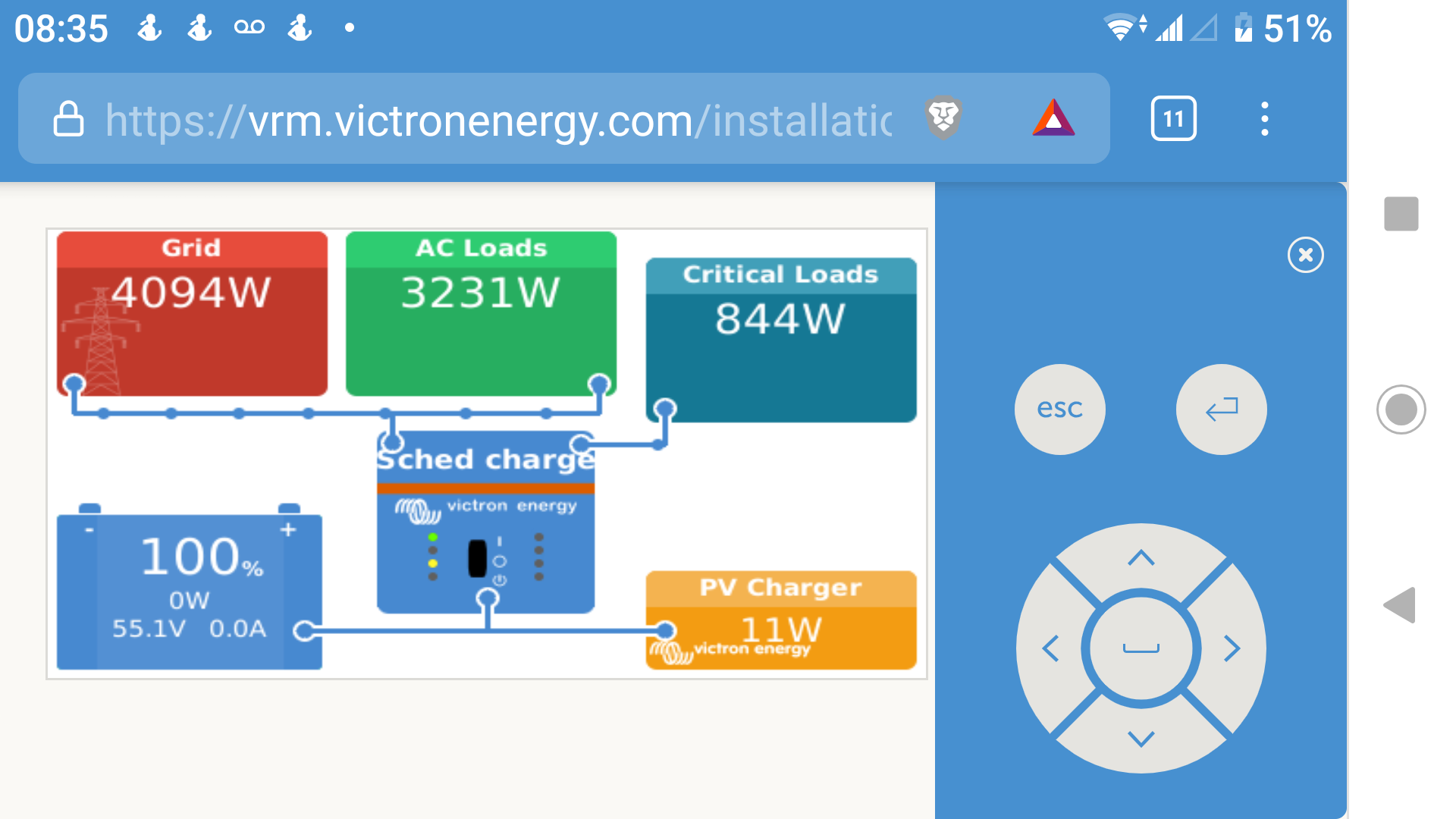
System details : - Victron MultiPlus 2 - DC MPTT coupled - BYD battery - Grid-tied - Grid feedback NOT allowed - DVCC enabled I am using Scheduled Charging to prevent battery discharge during certain times of the day. "Stop on SOC" set to 50%. Min SOC is set to 60%,so while grid is up, should never reach 50%. As I understand the documentation, battery discharge is not allowed while the schedule is active. And this is mostly true - I do not see "large" discharges from the batery. However, I do observe a continuous, fluctuating "trickle" discharge while charge schedule is active. I easily lose 5% SOC to this in a +-6 hour period. In the attached screenshot you can observe a 10W draw, while Scheduled Charging is active. I do NOT see this when min SOC has been reached - then battery draw is zero, as expected. So my question is, is this: 1. a software bug? (venus, mp2, byd BMS) 2. misconfiguration? 3. harware issue of some sort? 4. documentation omission? Anybody else experiencing same? Not? Thanks in advance!

-
@plonkster, best as I can make out from the graphs, it varies from sum minute, to about 3minutes(or so I remember). I'm keeping an eye om all of this via my phone also, which is not ideal (screen size wise etc). The actual meter is installed in the municipal supply box, outside the property. locked mostly. Once I'm physically present again there, I will try to force this condition while stand next to that thing, to check if I can hear those contractors doing anything. For the record, since upping the grid set point, incidents have been lees, BUT it did happen again once today (as far as I can see from the reported data). The graph shows we pushed back some, but no where near the 3amps that seemed to be the previous trigger limit. Also, the pattern I THOUGHT I had identified (specific large loads switching off) did NOT present itself this time. The mystery deepens.
-
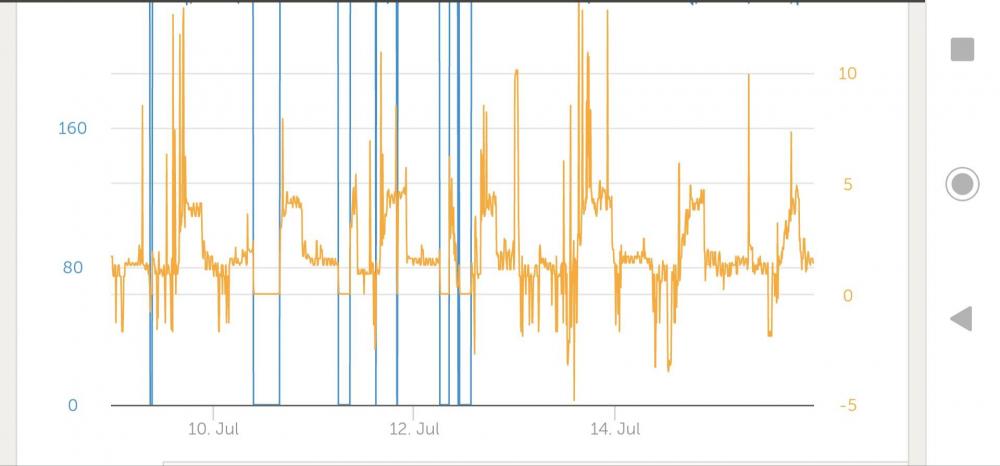
And here is the same graph, over the last 7 days. Blue line (voltage) going to down to 0 is mostly undesirable. As you can see, this was happening way to frequently.
-
Just an update regarding the Conlog prepaid meter Tshwane installed for me. So to date, the thing has not actually tripped, per-se. I initially had the grid-set point at 70w. All was well. It was then lowered to 10w. What I then observed was momentary "dips" on the mains input. I could not immediately make the connection, since my earthleakage was also tripping. This has been resolved (new E/L installed). After the E/L issue was resolved, we still saw the momentary dips on mains. Yesterday, I moved the grid set-point to 50w. So far, so good. Below I attach some graphs screenshots that show the dips I am talking about. It looks like the magic number is 3A feed-in for something like 30min. Your milage will probably vary.

-
Thanks for the comments and suggestions. I have now (as per @plonkster's and installer' s advice) tried the following: - rolledback to v2.31 - disabled the "scheduled charging" schedules that were active Nett effect: no change. It's as if the system is stuck in "keep batteries charged" mode. So at this point I guess I can safely rule out a firmware version problem. Is there any known "weird" thing that can happen when a power failure hits and battery basically hits 0 SOC before mains/PV comes back? I would expect the system to turn off with low battery, and then just resume normal ops(with the inclusion of batteryLife etc) when either mains or pv comes back, right?

-
Thanks @plonkster and @The Terrible Triplett. IF there is actually an issue, it might be related to specific configuration I'm running with (DVCC, BYD battery etc). I'll monitor the situation tomorrow - I'm currently traveling, so I'm hesitant to do anything drastic until I'm physically present again. Anyway, I will report back any conclusions here. Thanks again!
-
So it seems VenusOS 2.32 got released 2 Jul 2019 ( see https://www.victronenergy.com/blog/2019/07/02/venus-os-v2-32-various-fixes/) Auto-update is enabled on my GX, so I got updated. So today, I see PV is not powering loads anymore. Chatted with the installer - apparently he has also picked this up, and chatted with Victron. Seems a boogled was introduced with this update. Anybody else seeing same/similiar problem after updating to 2.32? (Also,just to be clear, 2 days ago loads were being powered nicely from PV).