Van theplanman
Members
-
Joined
-
Last visited
Everything posted by Van theplanman
-
Hi Elangeni You manage to get your wifi box going?
-
How did you "manually restart" it to get Station mode active..? My wifi box was working just fine for the last 2 years. I forgot how I did it the first time... Received a new wifi router and struggle now to get it setup.
-
Ofcourse you need to decide on the number of adjustable positions. If you decide on two, they will need adjustment in March and in September every year. For three positions, they need adjustment 4 times a year. Benefit of the 3 postions is that there is a "middle" position for spring and autumn ...and... if you decide one day to stop the adjustments, just leave them in the "middle" position. I would use the NW side, but definitely at 26deg as base-line, will even consider a frame that they face north. But for some people the esthetics are more important, and sometimes you just can't have both.... Just remember, a horizontal surface area "reduce" by about 50% due to the sun's winter position if kept horizontal, and consequently so will your solar power generation.
-
There are basic two types of lithium batteries, the li-ion and lifepo4 batteries and both are available in 18650 shape. Lifepo4 cells work at 3.2v noninal, that implies that their work range is between 3.7v and 2.7v... To charge lifepo4 cells to 4.2v is like charging li-ion cells to 4.7v - a practice that will garentee premature failure! The low valtage limit from a practical perspective and why I guard against it... Assume a li-ion pack of 14 batteries in series and 10 cells in parallel per battery fully charged, ie 4.2v/cell or 58.8v for the pack. P(watt)=V(volts)×I(amps). Assume a load of 500w, thus 500=58.8xamps =8.5A delivered by 10 parallel cells =0.85A/cell discharge rate... At 3.2v for the same load the amps will be 500w=(3.2×14)×amps = 11.16A or 1.12A/cell. This is all fine but do the maths now at 2.8v and you get that 1 cell has to deliver 500=(2.8×14)×amps÷10 = 1.28amps. This practice will ensure more "stress" on the electrolyte as the C-rate is just getting higher. You will be able to feel the actual temperature increase on the cells!
-
I'm not familiar with the complete off the selve units, just worked with with old bare 18650's. Between google and what I've experience, here is my perception of the best practices for lithium batteries. As you might know, the battery (cell) is made from two plates and between them is the electrolyte, a graphene layer with a chemical composition - google is full of info! Why does a cell getting weaker, deteriorate, what is it in the cell that fails? The electrolyte is the weak link. These cells got a nominal (average) voltage of 3.7v. This implies that 4.2v is max and 3.2v is min. To me, the best practice is not to stress the electrolyte. If the cell charge can be kept 3.7v it will last ....forever I think! So, the trick is to have the cycles as shallow as possible around 3.7v to ensure the minimum "stress" on the electrolyte!! My cells get charged every day to 3.9v max and through the night (and 6kW later) they are discharged to 3.7v! Yes, based on my argument for my consumption I should work between 3.8 and 3.6. However, one have to be practical as well, I don't wanna wake up in the morning, cells on 3.6, its overcast and there is a power outage, I "save" the below 3.7v for true backup! (And yes my BMS is set to start balancing from 3.6v...) There is enough proof in Google, new cells that work in full cycles (4.2 - 3.2), will at best make 600 cycles before it deteriorates to around 60-70% (which is seen as end-of-life)!! Cycles between 3.9v (70%SOC) and 3.5v (70%DOD) will yield 6000+ cycles. If I would bought these complete lithium packs, I will forsure want to know the number of series in it to be able to know the info per cell...!! But @plonkster have good advice - stay in the warranty parameters!
-
Just another thing to put things in perspective.... We (especially DIY-ers like me) tend to start small when we move into the green world, and for that we want to get the maximum for what we put in, and with time we gradually extend our systems.... I've started like that and is still busy extending... Here's the thing for typical town households, we end up with a inverter (R10k-40k), sustainable battery pack of R20-R100k and panels of R18k.. Within 10years, you encounter more costs on the inverter and batteries - but not really on your panels... You see, over time the panels are the small change in the total installation. Therefore, instead of adjusting panels, just install 3 more and you never have to touch them again! (I'm considering installing 3 more panels, but at 45deg towards West, purely to get the afternoon sun, as late as possible. My neighbour build on his property, killing my late afternoon sun....) 12Panels will take you far (I also have 12), for me now is to catch the early morning and late afternoon suns - to have a long as possible solar day.
-
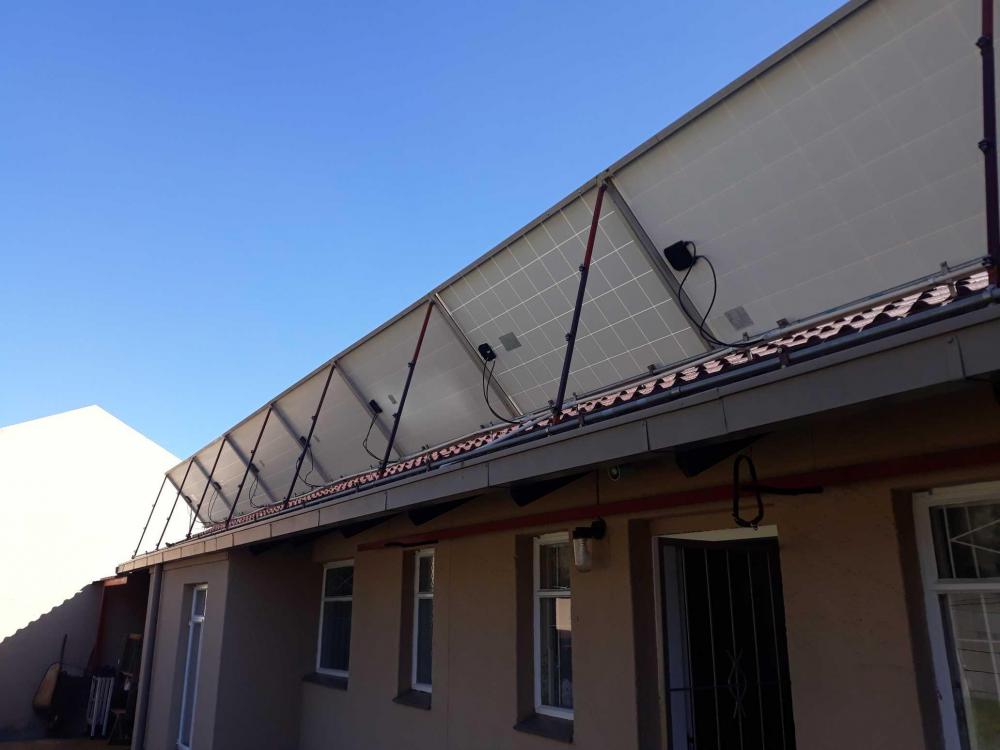
I assume that is 26deg south, yes? Will it be fixed or adjustable panels? I'm definitely not an expert but I will try to use 26deg's or as close as possible. If the roof pitch is 23deg and it will be fixed panels, I would have used that angle... If the roof is fairly flat and you use the 26deg, be aware of windy conditions that the mountings are strong enough. My set-up is adjustable with 3 positions, summer, autumn/spring and winter, and location is 23deg south. If they are installed on the north angle of the roof, the top sections of the panels has to be lifted to accommodate winter position and so the bottom for summer. Autumn and spring will be like "flat" on the roof angle.. To over-come the issue of hinges on both sides, I installed them on the southern side of my roof. ...and with the road on the northern side of my house - panels are not visible from the road. They work just fine! My experience from a practical perspective, a few degrees out is not the end of the world. (Just remember, the clever people will proof that there is a massive analysis behind it..)
-
Agree, my winter is as good as the summer. But for me 2 conditions can kill it, 1) cloudy conditions during winter and 2) panels not adjusted to winter optimum position.
-
My first bank (32p14s) took me about 4 months to strip, pre-test, clean, charge, load-test, assemble and wired up... from old laptop batteries! In April'20 after about 18 months, my 6th bank is installed and functional.... My powerwall currently is a (32×6)p 14s = 2688 cells or in power >2ah x 32 x 6 x 50v = >19.2kw (I hope to have the final 2 remaining banks operable by this year-end)