Wick
Members
-
Joined
-
Last visited
Everything posted by Wick
-
See this VictronConnect informational video. Notice how you can click "remote console" and it will show equivalent display to CCGX, on your phone. On my EasySolar-II GX, I've connected to its wifi network from laptop, gone to http://venus.local in browser, and opened that same CCGX-style view by pressing "pages" at the bottom of the remote menu. So there really are a few ways to make it happen!
-
Per string, maintaining the same current through those 15A rated cables attached to the panels. Yes. For most, people 1 series string will do the trick, and you would generally purchase your series of panels with the MPPT max input voltage in mind (or vice versa if you already have panels), never exceeding the voltage rating on your MPPTs - or even coming close, to play it safe. Series adds voltage. Parallel adds current. More current = more copper = higher cost for cabling. So get away with the highest voltage, lowest current, and shortest cables possible. If this means splitting across 2 MPPTs, do so, although there will be more copper AFTER the MPPTs outputs merge (say 15A x2 = 30A) - the only benefit I can see to two MPPTs (aside from partial shading conditions) is if each panel string's voltage is so high that you cannot run off one MPPT alone.
-
Impp vs Isc - whichever is higher. For my panels 9.89 Impp, I've seen 12-15A suggested due to MPPT adjusting the charge current upward somewhat. Probably just go with 15A in this case - or whatever is inscribed on your factory-attached cables leading out from the panel(mine are 15A 4mm MC4). Re other panels - better to just work with what you've got? 400+W is a decent output. I know JA Solar do similar to Candian Solar at similar costs if you want to look at other 400W. Will be interesting to see what others say about splitting across 2 MPPTs.
-
Put the LiFePo4 battery pairs / 12V series into 48V series last night, today drilled out lugs, cut battery positive and connected 100A fuse, connected phase and neutral, connected to mains ground, tested voltage on input terminals which looked too low, tightened all bolts on busbars, tested again and looked OK at +52.6V. Then the moment of truth - shut the 100A fuse holder - and flipped the on switch (to I, not II, in case any new Victron MP/ES owners read this). Fan hummed gently and GX display came on without error! Connected to its wi-fi network without hassles and will be exploring the EasySolar-II's capabilities further. Thanks to @Bain Viljoen @ Lithium Batteries SA and @Geoff Earnshaw @ Sustainable Energy Solutions for their assistance in sourcing the primary goods: batteries and inverter-charger.


-
*user ignored for gaaning aan and derailing thread further*
-
@Plaasjapie Have answered you privately so as to avoid derailing thread further.
-
@Horsyatza That's P.E. for you. Experienced similar. Email is not a thing in P.E., they just don't reply. It's phone / whatsapp or nothing. I dropped into El Nino Solar in Newton Park, gave them my details and what I was interested in, they promised quotes but I never heard another thing. Google "solar newton park" on google maps... there are quite a few solar shops in Newton Park. Spend an afternoon or three shopping around. Dixon Batteries in Newton Park has the kinds of batteries you need - deep cycle AGM. ACDC in Newton Park is very good, but they are not specifically geared to solar, more general electrical gear. Rubicon in North End is very good, although they are not solar specific, they do stock a lot of useful stuff like MC4, cabling etc. - highly recommend. Around the corner from them (2 min walk) is Cosmotronics who also do specialised electrical equipment. Solar Equipment in North End were actually pretty helpful - maybe give them a call. Bear in mind re the solar suppliers, that even if you shop in P.E., they will need to retrieve stock from JHB/DBN/CPT. So you may want to be ready to test (batteries etc.) if you don't want to miss the 7-14 day returns window.
-
I read your post and understood it very clearly. I'm not sure the reverse could be said, or that you follow the actual issue brought up in this thread yesterday. Prior to that, this thread had been dormant for some time and it was for the sole reason of warning LiFePO4 newcomers that I woke it up. You can find it as offensive as you like: that's what it's called when someone tries to steer a thread in a direction that is self-serving and / or doesn't have to do with the original topic. And the fact remains you _are_ a newbie to LiFePO4. As are many of us. Well, you've been helped and weren't interested in the accurate answers I gave you, given your minimal knowledge of LiFePO4 setups as admitted by you. Indeed your tone is at best unfriendly, at worst aggressive, for reasons I'm not entirely clear on. Remember that it serves the learner to keep an open mind. Plonkster teaches all of us, incidentally. Best of luck to you.
-
Having now clearly stated you're using a PylonTech - you are using a BMS per se - nothing wrong with your setup. Cell-level balancing is happening all the time. Congrats. My claim is that, for newcomers, not using any BMS at all for lithium, is unsafe, as newcomers may not be rigourous about manual cell-balancing and failure to do so can cause problems and loss of durability over the longer term. "BMS / inverter comms or not" is a whole separate discussion from what I broached here yesterday. Hope that clarifies. It is important, given the viewership of sites like this, and quantities of money involved, to advise in the most responsible way possible.
-
It would be interesting to view the variation in profiles between your cells by this stage, especially after 8 months of heavy usage. The main purpose of a BMS is cell-level balancing, which through evening out charge and discharge between cells, ultimately preserves individual cell lifetimes across the pack(s), rather than allowing some to age more quickly than others (through "getting out of balance" relative to one another).
-
@ebrsa Please don't hijack threads; rather start a new one to ask about your specific situation. You mean BMV-7xx series battery monitors, not BMS-700 (it is not a BMS). BMV is only going to offer battery-level monitoring, not cell-level monitoring, and certainly not cell-level balancing (as they are _monitors_ only, they don't control charge / discharge) which is essential for LiFePO4 - hence my remarks above. It is for newbies like you that I gave that warning - DO NOT avoid a BMS with LiFePO4. This is to preserve your cells' lifetime. For lead acid chemistries (which is what you have had in your Trojan), a BMS is purely optional, which is why you don't have one. For lithium chemistries which are very sensitive, BMS are strongly recommended even if not technically mandatory. So in conclusion: your present setup does not address all requirements for LiFePO4, since your lead acid setup lacks a BMS for cell level balancing.
-
LiFePO4 cells (16x 2p) on lower shelf / tray. Riveted 2mm gauge angle onto all 4 lower edges, creating strength so chequer plate shelf now holds 100 kg of cells without flex. Will soon connect in series, through 100A HRC fuse, then to Victron EasySolar-II unit for its first run. Right now cells are just resting / balancing after paralleling.

-
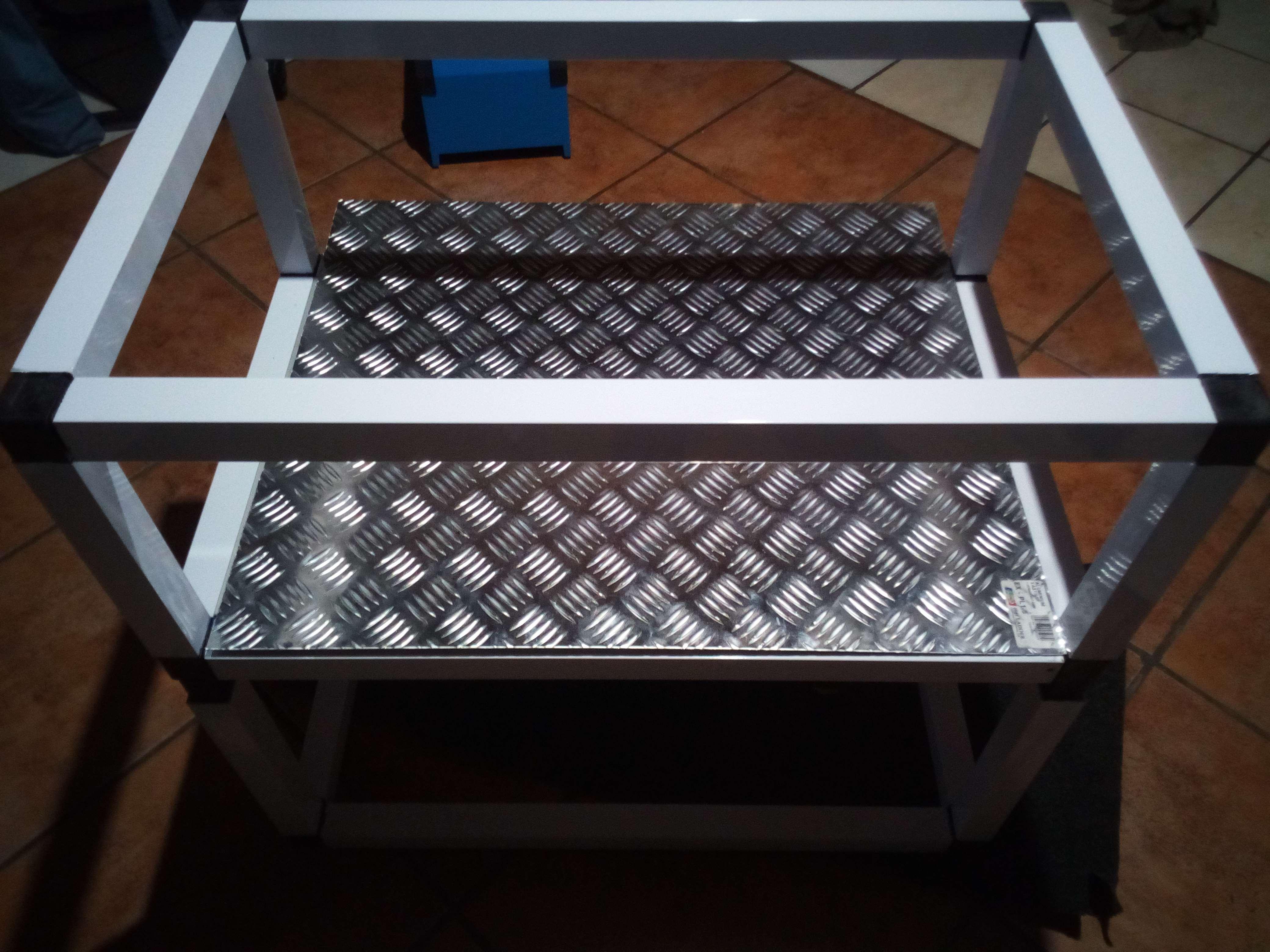
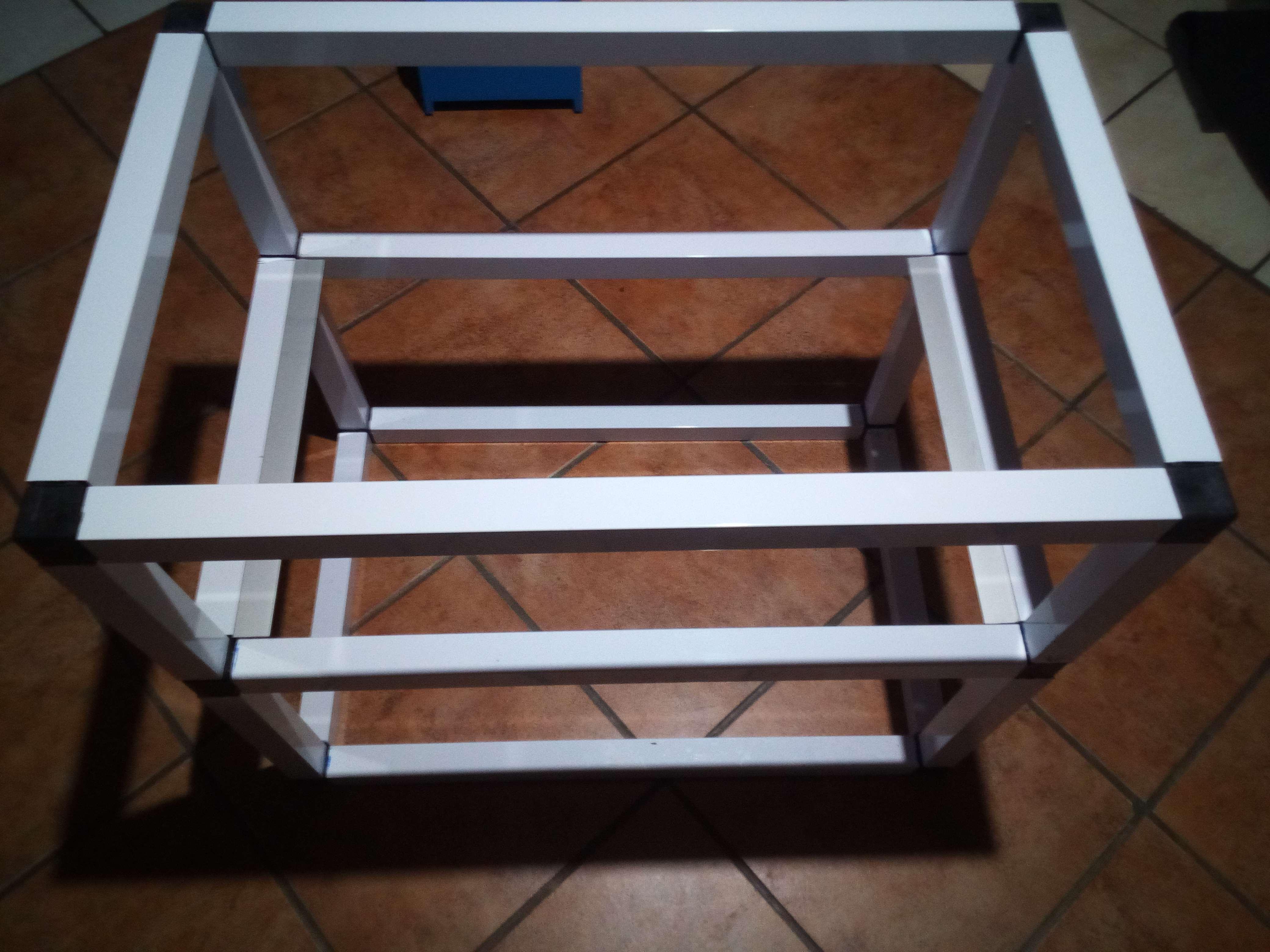
With due respect, I cannot possibly agree... certainly not with the conclusion that a BMS is somehow "optional albeit useful" as regards lithium. OP makes a valid point. From a cost vs lifetime perspective, active cell-level balancing is absolutely essential - and this is not something your inverter charger is going to do for you - not even a fancy Victron. They will see only the overall battery, not the individual cells. Caveat emptor, unless you want to risk severely unbalanced cells and the knock-on effects of that over time (cells with permanently different profiles, at best resulting in capacities reduced to the lowest common denominator). For a few days' test though? Fine without. Manually rebalance your cells and carry on. Put another way: after spending $2000+ on cells, are you really going to skimp on spending another $100 (passive) to $200 (smart) dollars on a half decent BMS to perform cell level balancing? Bottom line for newcomers - be wise - get a BMS that can talk your inverter. Always. In 2020 (onward) there is very little reason not to. (And no, I don't buy that older lithium systems that were set up without BMS & only inverter settings, are "just fine", unless that means only functional... functional does not imply optimal. If it were optimal, then BMS technology and sales wouldn't be advancing at a rapid pace... BMS would be no more than a curious side feature of the lithium market.)This afternoon: built bottom section for battery cells. 2 sets of 16 cells - space for all to sit on the floor of the bottom shelf, or can be separated into 2 sub-shelves. Floor for bottom also to be chequer plate sealed with silicone, to prevent potentially corrosive gases escaping. Top and bottom will each have their own separate venting systems - likely just large 220VAC fans on front and back creating a pressure gradient, with foam filters to catch dust.


 Just the beginning... started building this little unit today to keep the inverter / charger, fuse box and other wiring protected. Will probably push the Easysolar-II back slightly (3-4 cm) as there is a recess in the wall of my motorhome, so that the top vent extrudes a bit... this means the bottom shifts up and I can wire downward from the glands visible at bottom of photo no. 1. The lip is riveted onto both short side (left and right of photos 1 & 2) to allow the chequer plate (that's vastrap to you) to slide in and out.

 OK, I'm reading up and trying to understand this. A 250VDC fuse rating means that we can suppress arcing up to and include 250VDC - but not beyond? Is that correct? But if over that figure, we're in trouble? So we then want the highest fuse voltage rating that we could get, so as to suppress arcing up to 400, 600VDC and so on, if we could get that at the same cost as 250VDC ?I'm confused too, because I don't get why one would use a 250VDC fuse on connection to a 66VDC (max, 58VDC nominal) input on the inverter. It seems to defeat over-voltage protection... unless there is something I'm not grokking here? I'm trying to protect the EasySolar's input port. Certainly if it were 100-120V (2x) protection even, I could swing that. But 250VDC is 4x higher than the rated voltage on that wire. About the disconnect - which I presume you mean by physically decoupling the fuse from its holder, or swinging out the holder if it is the hinged sort - noted.OK, sure, clarified. So here's my quibble with that. Those are all rated 400VAC / 250VDC and upward. Don't get me wrong - I'd love to - as they're available for collection here in P.E. with holders (58mm) and I could go buy them tomorrow and get started - but they're not at anywhere near a 60-100V rating. My EasySolar's rated inverter input is max 66VDC. I would rather fuse accordingly?Yes, referring to the internal fuse in the Victron EasySolar-II unit, should that blow. Mine is 3kva so may need external fusing too. Hmm, I've been assuming I should use a 100-125A 58V fuse on battery positive. But if that's already what's inside the EasySolar...? I think you previously recommended 500V ceramic fuses? Do you still stand by this or should I get a voltage rating closer to the max current passing through (5500W peak @ 50+V = 100-110A)? Still seeking 58V fuses at reasonable cost... Victron MIDIs were not available locally...What is the difference between those fuses, and fuses on the greater circuit? They must be very fast blow, no? I notice Victron does not sell replacements - they have to service the device to replace these. Why can a fast blow fuse on the circuit, not serve the same purpose?Addition for other folks who might browse this thread... Use "high rupture current" (HRC) DC fuses between battery bank and inverter / charger / other devices, especially for high discharge rate / low internal resistance battery like LiFePO4. Why? When a DC fuse breaks, there can still be an electrical arc powerful enough to "jump the gap" - which means your fuse has failed in its task and your goodies on the other end, like your inverter charger, will likely be fried. HRC prevents this. 3A fuse can have a rupture current of as high as 40 000A! Obviously special case, but illustrates the point. This relates to @plonkster's mention of ceramic fuses - the highest rupture current fuses are nearly always ceramic. Locally, these include Bussman tubular and box fuses, and Littelfuse (also Pudenz) bolt/box fuses. So far, we have been talking about DC fuses sensitive only to current. ... Now, as a specific category of HRC, there are semiconductor DC fuses. MIDI and MEGA fuses should generally support high rupture current - but it's on you to check, based on your setup. Semiconductor fuses are made of semiconductor materials that are sensitive to both current AND voltage. For example, you will see voltage ratings on Victron DC fuses but not on all Bussmann DC fuses - that is the difference in construction talking. Semiconductor DC fuses and ceramic fuses are typically different in construction, rupture time and current rating . If you're not sure - look on the fuse to see if a voltage rating is displayed. If not, best be careful and get something that is specifically voltage-rated to your application. If you're not too worried, an AC circuit breaker generally does the same job - current AND voltage based trip - although depending on conditions, it may take longer to trip (higher current) or shorter (higher voltage) as compared with a simple fuse. This delay can mean the difference between your equipment being good or scrap.Grandmaster @plonkster , what sayest thou of ANT + Victron connection via RS485? Hast thou arcane knowledge hereof?Correct but only 19 units available. So do you know if they can talk to Victron?One belated question for you @Gerlach, have you ever connected Smart ANT BMS to Victron MultiPlus / MultiGrid / EasySolar? I'm wondering if they can chat.