


Powerforum Store
Members
-
Joined
-
Last visited
Everything posted by Powerforum Store
-
Revov Bundle Special 2 x REVOV 19 inch Wall mount bracket 1 x 0.3m Link Port communication cable for Revov batteries 2 x REVOV Lithium R100 5.1kWh 51.2V Battery 1C Version 1 x 3m CAN BMS cable for Solis,sunsynk & Pylontech Lithium batteries Price R29 606,89 Vat Included Excluding Delivery Contact Wimpie Bronkhorst [email protected] or 067 189 7084 Cell or Whats app ! 3-REVOV-R100_SpecV4 1C.pdf

-
Contact Wimpie Bronkhorst on 067 189 7084 Phone or Whats App [email protected] Victron Specials Victron MultiPlus 48-3000-35-32 & SmartSolar MPPT 250/60-Tr 1 x VIC-MULTIPLUS-II-48-3000-35-32 Victron MultiPlus-II 48/3000/35-32 2400W Inverter/Charger 1 x VIC-SMARTSOL-MPPT-250-60-Tr SmartSolar MPPT 250/60-Tr 12/24/36/48V-60A Only R15 294.00 Vat Included Excluding Delivery EasySolar-II 24/3000/70-32 MPPT 250/70 GX Storage Systems - Hybrid Inverter All-in-one solar power solution The Easysolar-II combines an MPPT Charge Controller, inverter and AC distribution in one enclosure. This makes for easier installation and a simpler wiring Integrated equipment description: 1 x 3kVA 24V Multiplus-II Inverter/Charger 1 x 250/70 MPPT Charge Controller 1 x A GX device with a 2x 16 character display Only R20 908.00 Vat Included Excluding Delivery Victron MultiPlus 48-5000-70-50 & SmartSolar MPPT CAN 250/85-Tr Storage Systems - Hybrid Inverter This part is made up of the following items: 1 x VIC-MULTIPLUS-II-48-5000-70-50 Victron MultiPlus-II 48/5000/70-50 4000W Inverter/Charger 1 x VIC-SMARTSOL-MPPT-250-85-Tr-CAN SmartSolar MPPT CAN 250/85-Tr VE.CAN 12/24/36/48V-85A Only R23 182.00 Vat Included Excluding Delivery Victron Multiplus 48-8000-110-100-100 & SmartSolar MPPT CAN 250/100-Tr Storage Systems - Hybrid Inverter This part is made up of the following items: 1 x VIC-MULTIPLUS-II-48-8000-110-100 MultiPlus-II 48/8000/110-100/100 6400W Inverter/Charger 1 x VIC-SMARTSOL-MPPT-250-100-Tr-CAN SmartSolar MPPT CAN 250/100-Tr 12/24/36/48V-100A Only R34 069.00 Vat Included Excluding Delivery Victron Quattro 48-8000-110-100-100 & SmartSolar MPPT CAN 250/100-Tr Storage Systems - Hybrid Inverter This part is made up of the following items: 1 x VIC-QUATTRO-48-8000-110-100-100 Victron Quattro 48/8000/110/100/100 6500W Inverter/Charger 1 x VIC-SMARTSOL-MPPT-250-100-Tr-CAN SmartSolar MPPT CAN 250/100-Tr 12/24/36/48V-100A Only R43 756.00 Vat Included Excluding Delivery Victron Quattro 48-10000-140-100-100 & SmartSolar MPPT RS 450/200 Tr TR Storage Systems - Hybrid Inverter This part is made up of the following items: 1 x VIC-QUATTRO-48-10000-140-100-100 Victron Quattro 48/10000/140/100/100 8000W Inverter/Charger 1 x VIC-SMARTSOL-MPPT-RS450-200TR SmartSolar MPPT RS 450/200 Tr 48V-200A Only R70 165.00 Vat Included Excluding Delivery


-
Hello did you get the turbine and the controller from the same manufacturer? Typically the controller needs to be factory set to match the input voltage range of the turbine if not then you may have a problem. Another factor may be the rated wind speed of the wind turbine if it is rated at 12 meter per second you need a wind in excess of 40 KPH for the turbine to generate its rated capacity and it may be that the wind speed you have is just to low for the turbine to generate any meaningful power. What is the blade Diameter of the turbine? What is the physical weight of the turbine? Post pictures of the product.
-
Hello Everyone here are our Sunsynk Lynx specials money is tight Rand is unstable Prices valid until stocks last! Contact Wimpie Bronkhorst on 067 189 7084 Phone or Whats app or email [email protected] Option 1 Price Including VAT Excluding Delivery optional Collection. ONLY ! R15 862.00 Lots Of Stock Sunsynk Lynks 6kW 48Vdc Single Phase Hybrid Inverter (no battery) Storage Systems - Hybrid Inverter The Lynks is suitable for use with conventional PV’s, wind turbines,and micro inverters, meaning it’s flexibility allows it to be used in just about any scenario. Delivering robust power,this 6000W hybrid inverter efficiently meets various energy requirements. Product FeaturesMax DC input power of 8kWp. Dual MPPT with rated input current of 15A per MPPT. Supporting both lithium-ion and lead-acid batteries, IP41 Ingress protection. Wi-Fi dongle (for remote monitoring) and CT-clamp as standard. Standard 5-year warranty. Installations with Sunsynk products need to be registered here to gain full activation of the warranty. Option 2 Price Including VAT Excluding Delivery optional Collection. ONLY ! R26 586.00 Lots Of Stock Sunsynk Powerlynk X 3.6kW hybrid inverter, 3.84kWh LiFePO4 battery and a 4.5kW MPPT. Storage Systems - Hybrid Inverter An all-in-one module with plug and play connections, the Powerlynk is designed with simplicity in mind to ensure a hassle-free installation process. The 'X' model offers a 3.6kW hybrid inverter along with a 3.84kWh battery. Product features3.6kW Inverter. 3.84kWh Lithium-ion Battery Pack. 2 x MPPT inputs = 4500W. All-in-one solution - simplified and expedited installation. Includes wall-mount brackets. Supporting Wi-Fi monitoring. Up to 6 x units can be connected in parallel. Battery storage expandable (SUN-L5.12 compatible). 10-year Warranty. Installations with Sunsynk products now need to be registered here to gain full activation of the warranty. Sunsynk Mobile_Datasheet_Powerynk Lynks 6kW(2)_AW.pdf powerlynk data sheet.pdf


-
Hi Everyone Here are our Volta Combo Deals for this Month! These systems are not designed just to power the aircon the aircons are just added bonuses! THE AIRCONS ARE FREE WITH THESE BUNDLES !! Contact Wimpie Bronkhorst [email protected] or 067 189 7084 Cell or Whats app ! Combo Deal 1 Combo 1- R86541.00 Inc 1 Deye - 8Kw Single Phase Hybrid Inverter New Design 2 Volta - Battery Lithium Ion 5.1kW 48V 100Ah - Stage 1 - 2nd Gen 1 Volta - Smart Inverter Air Conditioner - 12000BTU 12 Canadian: Solar Panel 555W Half Cell Mono 1 DB Combiner Box - 2 String in / 2 String out 1 Collection only – CPT / Pretoria Combo Deal 2 Combo 2 - R128571.79 Inc 1 Volta - 12kW Hybrid Single Phase Inverter 2 Volta - Battery Lithium Ion 10.2kW 48V 200Ah - Stage 3 - 2nd Gen 1 Volta - Smart Inverter Air Conditioner - 12000BTU 18 Canadian: Solar Panel 555W Half Cell Mono 1 DB Combiner Box - 2 String in / 2 String out 1 Collection only – CPT / Pretoria Combo Deal 3 Combo 3 - R147832.59 Inc 1 Volta - 15kW Hybrid Three Phase Inverter 2 Volta - Battery Lithium Ion 10.2kW 48V 200Ah - Stage 3 - 2nd Gen 1 Volta - Smart Inverter Air Conditioner - 18000BTU 24 Canadian: Solar Panel 555W Half Cell Mono 1 DB Combiner Box - 2 String in / 2 String out 1 Collection only – CPT / Pretoria See attached Data sheets ! Volta Aircon Flyer.pdf Deye Solar Airconditioners - Datasheet.pdf

-
Hello Everyone so I have come up with a harebrained Idea! To start there are some challenges when coupling a DC wind turbine controller to an MPPT on a string or hybrid inverter actually any MPPT that has a Solar algorytm. When the turbine is running at low power production and the MPPT on the Inverter senses the voltage rise within acceptable voltage range the MPPT tries to track the voltage and tries to extract the maximum current at that voltage and power point. The result is because the MPPT tries to draw max current at said voltage as an example 150v at which the turbine can only supply a set amount of current lets say 1.5 amps the MPPT tries to extract 11 Amps instead this causes the turbine to stall and the whole process starts over again. I have done a lot of research to overcome this problem. The obvious solution is make the MPPT Programmable with a set power curve instructing the MPPT to only draw a specific current at a specific voltage because the turbine output via the DC controller is linear in the sense the RPM Voltage and Amps are always directly linked across the rev range of the turbine generator up to argument 360 RMP 360 Volt 2000 Watt. So here comes the IDEA! So what if I can put resistors rated at the current draw of the MPPT say 11 amp draw assuming that's the max draw of the MPPT and I use an Arduino with 2 current sensors and and the resistors in parallel with the MPPT current sensor on the DC controller and a current sensor on the inverter MPPT. this kind of Idea SSR + Arduino: Sense turbine current (e.g., 0.56A at 0.2 kW), MPPT demand (e.g., 11A). If demand > output, activate SSR to divert ~10.44A to resistors. In theory this will sense when the MPPT demand exceeds the available current from the turbine..... in theory We can extend the idea further and program the power curve of the turbine into the Arduino to only allow the correct amps at a specific voltage that matches the power curve data thereby preventing them MPPT from drawing more current than what the turbine can supply at set voltage point argument sake a 20 point power curve from low to nominal RPM this may even eliminate the need for current sensors however we can still use the current sensors for fine tuning and to improve accuracy. We can even take things further and add an Anemometer into the system obviously this fill inflate the cost but for experimental purposes this can give us another accurate data stream to monitor the turbine performance based on the voltage current theoretical RPM and Wind speed. The Arduino can also communicate via modbus the turbine controller coms via modbus with RS485 with stop start functions so this can further enhance the accuracy of the power conversion and energy transfer into the MPPT optimising the system even further even the possibility then to integrate with an energy management system like Home assistant this is where the anemometer and the stop start functions come into play. Some additional thought on this would be appreciated I already have theoretical code parts list and assembly method working on the wiring diagram and layout of the components!
-
I always get a lot of questions from people about a lot of factors around our turbines and why we use the technology and the designs we use my intention is to clear up some misconceptions when it comes to turbine technology hoping this would give you some more clarity on the subject. So here goes Common questions. Question: Why don't just use more blades? There are many reasons why a 3 Blade horizontal axis turbine works better than any other design. Diameter determines KW output potential. To simplify it for better understanding its like an engine a diesel engine produces a lot of torque but low KW output where a petrol engine produces a lot of KW output but not as much torque for the same capacity. When an engine drives a generator the torque does not factor in so much as the KW production of the engine meaning if you are driving a generator the KW output of the Engine will determine how much power the Generator will produce. This same idea applies to wind turbine generators. Amount of turbine blades determine torque output potential and smoothness of power delivery more blades higher torque smoother power delivery lower RPM less blade rigidity More blades means more eddy vortices created by the leading blade this reduces efficiency and potential RPM also increases cost especially in a variable pitch scenario more moving parts required. To mitigate the eddy vortices that cause inefficiency on wind turbine blades you will note that all large scale MW class turbines have 3 blades because that is the best balance between even power delivery and reduced eddy vortices created by the leading blade. Blade design is also very important and there is a gold standard for the blade shape and ratio they call this the blade chord any major variations on this will cause unnecessary turbulence that will reduce the blades ability to transfer energy. Other factors of the blades that are very important is flexibility if the blade is not rigid enough it will deform out of its ideal shape and cause the blade to become less efficient so the more rigid the blade can be the better it is to transfer energy. Blade weight also plays an important part the heavier the blade the higher the torsional and gyroscopic forces are going to be at the blade tips. This will affect how easily the wind turbine can change wind direction and what the loads on the bearings would be when wind direction changes occur. These loads would not only be on the generator bearing but also on the neck bearings that allows the turbine to change direction 360 degrees. Then we have the ever prominent Betz Law this law prevents any wind turbine to be more efficient than 59.3 % Efficiency and they rate the turbines with a Cp Value this just tells us how efficient the turbine is. Our turbines Cp Ratings vary from 0.4 to 0.45 this is very close to the high end of the scale reasons why they can reach this is direct drive less frictional losses weight. The most efficient turbines in the market at the moment are the very Large 3 bladed Vestas machines with Cp values from 0.45 to 0.47 which is very impressive for such large machines that use gearboxes in thier generator drive systems. Question: Why don't you do vertical axis wind turbines they are so much more aesthetically pleasing. Efficiency and cost and size reliability are some of the reasons. Maximum efficiency you can achieve with a fixed bladed variable axis turbine is and this is claimed by very high end brands in the market at high average wind speed outputs between Cp 0.4 and 0.45 however realistically Cp 0.4 Products that can achieve this Ryse Energy N-55 Claims a Cp of 0.4 to 0.45 Cost per KW installed Estimated at R95 000.00 on the lower end and up to R122 550.00 IceWind Freya Claims (Cp 0.40–0.45) Estimated cost per KW as low as R170 430.00 up to R227 430.00 side note these machines are small staring at 600 watt Bergey 10 kW Claims Cp 0.40–0.43 Cost per KW installed Estimated at R95 000.00 All of these machines are rated at 12 Meters Per second and above. People are under the misconception that these small twirly whirly so called 500 watt vertical axis turbines can generate any kind of meaningful power should consider the following. Wind speed 99% of these machines require wind speeds above 12 Meter per second to produce their rated power. 43.2 KPH! Their blades are fixed cannot pitch or yaw meaning if the wind does blow at 90 KPH or 25 MS they cannot slow themselves down and unless they are premium brands like those listed above they will self destruct! Most of the cheap machines in the market have a Cp ~0.36–0.40 much lower than the Horizontal axis turbines. Most of them also do not have decent integration technology with modern lithium and inverter solutions generally they are all designed for lead acid battery applications. Our Own experience shows that it is not financially viable and the cost to keep these types of machines especially the cheap ones does not make it viable besides their low power production at low wind speeds. We prefer tried tested and trusted technology that requires minimum maintenance and the lowest risk with the highest output potential. Question: Have you ever considered Archimedes Screw turbines? There is a lot of advertising claiming that the Archimedes wind turbines are the best thing since sliced cheese. So here is a couple of facts about these types of turbines that people may not know. Best Achieved Cp of 0.26 clearly the lowest efficiency of all the designs sofar. There are a lot of Higher Cp Claims but none has been tested with the highest claim of Cp 0.43 Largest versions max out at 1.5 KW Requires very High wind speeds from 10 to 15 MS in some cases so not practical in the SA market where our winds range from 4MS to 10MS Cost Per KW still on the high side of around R57000.00 excluding mounting and installation you can easily add 40% for those factors. Here are some other factors to consider Wind shifts >30° off-axis drop power output sharply—e.g., a 2016 study showed a 20–30% efficiency loss (Cp falls from 0.43 to ~0.30–0.33) when misaligned >45° before yaw corrects. Response time is ~5–10 seconds (X posts, Dutch installers), slower than active yaw HAWTs (e.g., Bergey, 2–3 seconds). Data: Manufacturer claims “adapts to changing winds,” but no yaw speed spec—real-world urban tests (e.g., 2022 Rotterdam rooftop) report 10–15% annual energy loss in gusty conditions vs. steady wind. Issue: At 1.5 meters, the rotor’s small inertia and light frame (often aluminum/plastic) make it twitchy—rapid shifts can overshoot or oscillate, misaligning blades. Impact: A 2020 Wind Engineering paper noted small HAWTs like AWM lose 5–10% efficiency in variable winds (e.g., 5–15 m/s shifts) due to yaw lag, worse than larger HAWTs (e.g., Bergey 10 kW, 7-meter rotor, stabler). Issue: The helical design aims to smooth airflow and reduce noise, but turbulence—common in urban settings (rooftops, trees)—disrupts lift across the uneven blade surface. Fixed pitch can’t adjust to sudden gusts.
-
Hello everyone just another update on the Wind Turbines and new things happening. So its D Day for SOLIS to provide me with the new firmware release that will fix a lot of problems on the SOLIS hybrid inverters. I attended the SOLAR Expo at Nasrec last week had some very good meetings with the guys at SOLIS also SolaX and Givenergy. All three these manufacturers are looking at providing us with the facility to have programmable Power Curve settings on their inverter MPPT's This will allow for much more feasible MPPT integration of the Wind turbines all of them will look at 32 Point power curve functions and the one manufacturer will be looking at providing us with a micro inverter for the different model turbines to do AC coupling integration with full pre programed power curves for selected turbines. We also has meetings with Distributors and may have some nice surprises lined up for the future however at this point I will remain tight lipped. We are also seriously looking at expanding our wind turbine range and have a special range of turbines built suited for very low average wind speeds. These turbines will all be rated at 6 to 8 meters per second depending on the model. The problem with building wind turbines for low wind speeds are numerous. Low wind power production need large Blade Diameter the larger the blade diameter the lower the wind speed becomes for the same potential power production. As an example our 1 KW turbine produces 1KW at 8 meter per second however for the turbine to produce 1KW at 6 meter per second two things need to be adapted. Blade diameter needs to be scaled up from 4 meter to 4.8 meter this will allow then for a potential to produce 1KW at 6 Meter per second. The second change that would have to be made is the generator. The generator will be turning at a lower RPM but with increased torque thanks to the larger blade diameter so the generator will need to be adapted to produce 1KW at lower RPM yet in the same required voltage range. These two changes will have a few positive effects. The obvious one 1KW production at 6 meter per second wind. Reducing the RPM requirement for the generator will increase the power band of the generator and provide it with a much flatter power curve meaning the turbine will generate more power at a low wind speed of 4 meter per second than it would have in the original configuration when it was rated at 1KW 8 meter per second. The power differential will be significant. The wider power band and flatter power curve would also mean the turbine would be able to start producing at a much lower wind speed. There will also be a reduction in wear and tear because of the lower RPM ratings extending the potential lifespan of the wear and tear components. The down side of these changes are Higher costs due to larger blades and a lower RPM generator. The price difference would not be so high and justifies the massive improvement in power production at low wind speeds. The other down side would be the increased size in blade diameter and weight of the generator. However my belief is that this is the products we need to make wind power more feasible and will increase the viable installation locations because high wind speeds would not be so much of a requirement. We will retain the variable pitch tech to ensure safe operation and longevity. With all this said we will look at developing options for the 1 2 5 and 10 KW models As an example if we do the 10KW model that currently requires a 11.5 Meter per second wind for 10KW with a blade diameter of 7.8 meters at a rotor speed of 200 RPM. The resulting machine would have a 13.4 Meter Blade with a rotor speed of 81 RPM to Generate 10KW at 8 meter per second this is quite a substantial size change and this would directly affect the cost.
-
I look forward in hearing from you
-
So I am and have been totally off grid for 3 Years already that includes all services electricity water sewage garbage etc. Current system 7.3KW PV East West configuration JA Solar all Black panels. 2 x Solis S6 6KW advanced inverters 7 x Hubble AM-2 Batteries 1 x 2KW Odin Wind turbine. My Summer off grid production and consumption hovers around 25 to 30 KWH per day I run 6 Fridges and freezers air fryer microwave oven LED flood lights most are on 24 Hours per day 3 small hydroponics systems CCTV system with 8 cameras laptops wifi equipment laser printer (not useds a lot) Aircon always on in the day in summer and 1 hour at night 3 electric fans always on in the summer 1.8KW Borehole Pump once a day for 30 Minutes 350 Watt pressure pump for Irrigation runs 20 Minutes twice a day 2KW Geyser element always on Element kicks in 6 times over a 24 hour cycle for 10 minutes and 45 Minutes after a Shower I use a electric 1.2 KW lawn mower to mow around 3000 squares of grass once or twice a week I can use my Angle Grinder Welder electric drills skill saw etc almost any time of day. I have a 3KVA petrol generator and in the 3 years that i have been off grid I have only run the generator for about 18 hours Cooking is mostly done on the Gas Oven Stove. We cookc everyday no takeaways here. In winter time my consumption goes down a little to 18 to 20 KWH using the aircon a lot less use gas heaters and a fire for heat in the winter. Adding a Donkey to my system for this coming winter with a piggy back geyser with an 2KW element however the donkey will provide most of the hot water in winter I have tons of decent Black wattle firewood so reducing my need for electric elements will have a small 15 watt solar geyser hot water pump to circulate the hot water between the geysers. The water tank that feeds the main house with water is on a 5 Meter Stand so I don't need pressure pumps to provide pressure on my taps in and around the house. I have a water filtration system for drinking water etc. All our toilet waste goes to a bio digester and we have a grey water system that feeds shower water and dishwashing water into my garden. The reason for the large battery bank is as follows. If you want to have off grid power when using solar only you will need a battery bank equal to your normal 24 hour consumption however this does not cater for overcast and rainy days. Hence the reason I have 35 KWH Storage got this before I got the turbine installed. Because my consumption goes down in winter and my production from the PV in winter is lower the storage is perfect and I never run out of power however if we do have rainy overcast days in winter I would switch the Geyser off to reduce night time consumption and only run it when we need it the Donkey will eliminate this need this coming winter. Because I have the turbine it will help a lot with Winter energy production because my Windy season starts and maintains through winter so my turbine will produce anything between 15 and 25 KWH per day During that time and would make my battery storage and solar power almost obsolete. However in Summer time I rely very much on solar production because the wind power production in summer per day would only be about 1 to 2KW per day. The short and long is if you go solar alone and want to be completely off grid I would say your battery storage needs to be about 150% of the Power Consumption for a 24 Hour cycle that is if you do not want to run a petrol generator for emergency power needs. You can reduce your nightly consumption by adapting your heavy consumption times to when you have solar power available. Certain things you cannot get away from is your 24 hour loads or base loads and you need to cater for those in battery capacity or alternative power generation. My Base loads in winter is a lot lower because the fridges and freezers have lower ambient temperatures so I turn them all down in the winter reduces base load significantly. I don't need the aircon or fans to run all the time and that reduces the base loads at night quite a bit 3 electric fans can run at about 250 watt. Other factors to consider is redundancy for potential failure that is why I have 2 x 6KW inverters if one fails I still have power and all of my appliances can still work with a little management. I hope this gives you some context each person will have varied loads and base loads however it is important to plan you system and size it correctly to suit your specific requirement.
-
Yes as stated in my previous posts Solis Hybrids do support Frequency shifting however the functionality is limited causing frequency shifting to occur to soon based on the SOC of the battery we found at maximum frequency the systems starts to frequency shift at about 80% SOC and lower frequency setting the system will start to frequency shift at 65 to 70 % SOC. We want to be able to set stop start at which SOC point the system frequency shifts. We also want to be able to set a function that allows for exclusive battery charging while using Ac Coupling and obviously a few other features that would make integration more efficient. But Yes SOLIS SA is actively working with us on a couple of additional feature sets for the HYBRID and Grid tied inverters.
-
That is the Idea to stop and start the turbine depending on the required scenario based on SOC and running loads with the option to activate certain loads to utilize additional energy produced by the turbine. Risking overvoltage on the AC Side will definitely cause damage to the Hybrid inverter if there is nowhere for the energy produced to go hence the idea to use something like solar assistant to manage the turbine. However if the frequency settings functionality is improved this will also alleviate the problem and almost automate the process the current version of the software on the solis hybrids does present some Issues that we are working on. SUNSYNK/ DEYE MPPT integration works well however the powercurve is limited and I also hear that DEYE may be dropping the Wind turbine power feature on its inverters soon which would only leave two options for that product direct battery DC integration (Least Efficient) or Micro inverter function on the GEN Port.
-
Yes the Modbus features however the additional functions for frequency shifting and power curve settings for wind turbines are not available yet they are working on that as we speak.
-
The controller comes with a dumpload that activates automatically in that scenario but I am sure one can send the energy to an element or something or activate the pump with a relay automatically if there is wind power available we are looking at a couple of options to automate this.
-
Hello Everyone Just some feedback on how the system has been running. So the frequency shifting function is working well on the Solis Hybrids however I have run into some issues with it as follows. You have very little control over when the systems starts frequency shifting we have set the max frequency to 54HZ then the systems starts shifting frequency at 80% DOD if we set it to the lower end of the scale the frequency shifting starts at 60% DOD. The problem this presents is that the excess wind energy is not available for the system to be used for loads and as soon as it starts slowly forces the turbine to generate less and less energy until it stops the turbine completely. I am currently busy with SOLIS inverters South Africa to look at additional functionality on the frequency shifting function settings that can allow us to manually set when frequency starts based on battery SOC We would also prefer if we could still make the wind energy available for loads instead of stopping the turbine. Other functions we would like SOLIS to integrate is MPPT Power Curve settings on the MPPT that has a wind turbine connected to it this will also improve potential power production via the MPPT we have found the Solar MPPT algorithm limits efficiency when integrating with that method. Currently I am testing the grid tied wind turbine inverter directly on the backup port of the system and have found that this method is the most efficient and it allows the turbine to generate power in the lightest breeze my concern however is when the battery is full and there is not sufficient load to consume the energy may cause the battery BMS to go into fault because the energy would inevitably go to the battery. Especially in off grid mode when grid is attached you can send the excess power back to grid etc. The other option is to utilize something like home assistant or Hubble Cloudlink to manage the production of the wind turbine. The wind turbine inverter supports MODBUS and RS485 Comms and can receive instructions to stop or start the turbine. This would allow turbine integration onto the backup port of almost any inverter using the grid tied wind turbine inverter with its perfect power curve. Where you can start the turbine if the battery is empty or below 100% or where the load on the system is high enough to utilize the wind energy. There are many potential scenarios and options then available to control the turbine and utilize the energy more efficiently. I have access to all the modbus protocols for the wind turbine inverters and controllers and all of them support remote stop start signal via modbus. Other methods could be to use ac contactors to connect and disconnect the ac side of the wind turbine inverter. I am investigating these options further and will get back to everyone on the feasibility of these options.
-
We typically just use the old wind pump tower and fit a Modern Wind turbine on top of it saves a lot of costs and lots of effort. The wind pump towers are very strong and you can go quote large on the turbine you install on it. Trying to work on gearboxes and gear ratios etc is just too much effort and you lose a lot of potential energy due to frictional losses etc.
-
Hello We have MPPT Based wind turbine controllers that can couple to your lithium storage however we will need to have the spec sheet of the battery so the controller and the turbine can be setup to match your Lithium battery. In your case this would be the only way to integrate wind power with your system. you are welcome to contact us and we can provide you with a quote.
-
Hello you will probably find that that turbine is rated at 12 Meter per second wind speed and is only really rated at about 150 watt per hour or less. Have you had any success with the energy production yet?
-
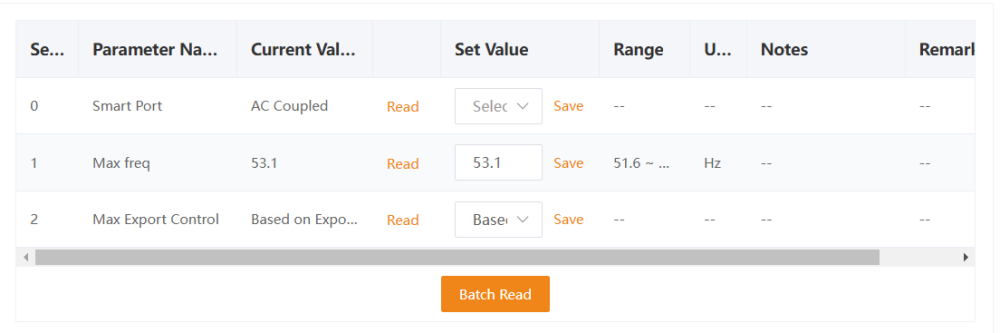
Hey Everyone Just reporting in on certain functionality I have been testing on the SOLIS S6 6KW Hybrids. Frequency Shifting Function. I can confirm that the frequency Shifting Function does work. My Grid tied wind turbine inverter also stops the wind turbine due to the frequency shifting of the SOLIS HYBRIDS. So what the Solis inverters do is ramp up the frequency that you can set to anything between 51.6 and 54HZ I had mine set to 53.1 HZ and when the batteries were full and the load sustained by the solar power the Solis hybrids shifted the frequency to 53.1 HZ and the Wind turbine inverter activated its internal brake to stop the wind turbine from producing power even though I had a nice strong wind blowing the turbine was standing dead still and the Turbine inverterter reported brake activated. So as you can see this is the settings to activate frequency shifting on the SOLIS HYBRID range inverters Inverters Like Victron and the Larger Luxpower Hybrids also support this sort of function for that matter any inverter that supports frequency shifting. Which makes integrating wind power into a system very easy utilizing our Grid Tied Wind turbine inverter controllers. These are some of their features. · 32 point programmable, linearly extrapolated power curve, via inverter display, to match the output of a specific wind turbine. · Ultra wide input voltage range from 20V up to 850V. · Able to respond to very quick input voltage change and very fast output power response as well. · Use current controlled /MPPT inverter technology. · Compact and light design, one-person easy installation. · IP54/IP20/IP31 visually pleasing, suitable for installing in a domestic environment. · Maximum efficiency greater than 94%. · Use our wind turbine specific grid-connection controlling algorithm, running with high efficiency, safety and reliability. · Stackable for possible parallel function. · Highly reliable, numerous protection functions. · Provides both LCD and LED displays for monitoring various parameters. · Modbus and RS485 Communication with optional LAN/GPRS/WIFI communications modules with remote online portal. · Quick and easy to installation, in according with IEEE929-2000, IEEE1547, UL1741,AS4777 regulations
-
Thanks Yes the wind turbines are only worth it if you have the right wind conditions if not it's pretty much a white elephant and of no use if you don't have decent wind speeds. However there are quite a lot of areas in South Africa that wind power is viable and will help with the batteries and sustain loads. In my area we have seasonal wind so Summer time low wind speeds but then my PV system keeps the batteries nice and full however in winter time we have average wind speeds in excess of 9 MS when my PV production is not adequate the wind turbine will come into play and keep the batteries nice and full we experience literally weeks of non stop wind during the winter and then I would be able to generate some nice data to share.
-
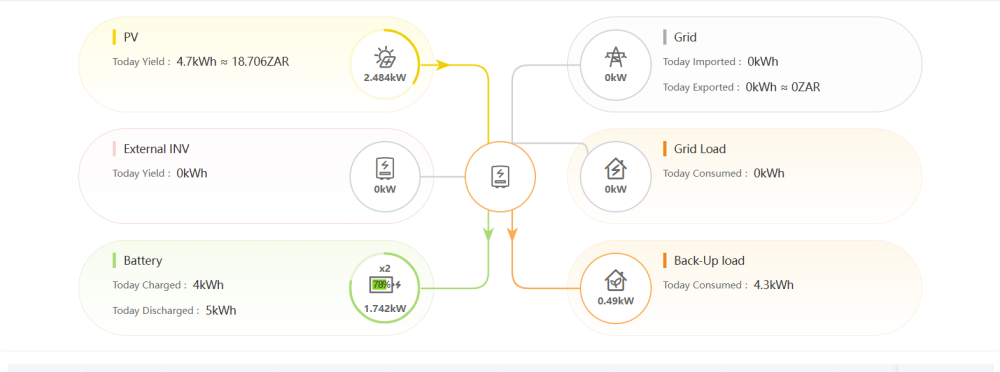
Hello Everyone So I have moved the Grid tied wind turbine inverter to the Genport on the Parallel Solis S6 6KW Hybrid system and have activated the AC Couple functions. I am pleased to say that it now shows the Power Source as external inverter on the portal. See the Picture. However we have not had much wind for the past couple of days so now I am praying for some nice wind. 😅 This will allow is to create some very nice data to illustrate the performance of the wind turbine on the Smart port of the Solis Hybrid inverters. I will enquire with Solis if I can have the External INV renamed to Wind Power. The moment I enabled the AC Couple feature GRID and GRID Load also appeared on the portal even though I have no grid and my inverters are in OFF GRID MODE. I will post pictures of my Power Station once I have tidied up the cables with some trunking everything is still very much in shambles because of all the changes I need to make to do all the different tests.
-
@Kalahari Meerkat Worth the Money yes just like a solar installation you have a relatively high outlay cost especially if you use quality product and not cheap and nasty. If you understand how the tech works then it is relatively easy to work out what the ROI would be on a wind turbine. An decent quality wind turbine like these turbines we sell are very efficient machines. Low RPM Generators this allows for high energy output at low revolutions. Large Surface area to capture as much kinetic energy as possible from the wind. The 1KW turbine has just over 3 square meter of surface area with the wind with a cut in wind speed of 2MS meaning the blades start turning at that wind speed. Variable Pitch Technology allowing the turbine to maintain constant RPM when it reaches its nominal capacity as an example the 1KW turbine produces 1KW @ 8 Meter per second @360 RPM or 28.8 KPH wind speed and will produce 1.2 to 1.3 KW constantly from 8ms to 25ms or 90 KPH Wind speed this allows the turbine to have a much flatter power curve and even power production and voltage output. Additionally because of the fact that the turbine can never exceed its nominal rotational speeds limited by the variable pitch technology that acts much like a governor on a diesel engine means that you have far less wear and tear on the generator bearings. These turbines are down wind turbines eliminating the need for a tail vane advantages of this is the turbine does not get thrown around by gusty wind and much as conventional upwind turbines with tail vanes does. The direction change is a lot smoother reducing load on the wear and tear components on the neck bearings brush kit and slip rings that transfer the energy from the generator to the power cable. The Turbine has Large Brushes that transfer the power from the slip rings that are connected to the generator to the power cable that couples to the controller. Benefit of this is you don't have a cable that will twist in the tower the cable stays static and there is no risk of the cable breaking due to twisting. Some of the downsides to the machines are that they are Large 4 Meter Blade diameter for the 1 and 2 KW units they are heavy 110Kg for the generator and HUB and due to the large surface area of the blades the horizontal loading on these machines are considerable. The 2KW can produce up to 2500 KN horizontal load on the top of the tower in a wind of 25ms or 90KPH meaning the towers or mountings for these turbines need to be very robust and strong. So no slapped together poles with the hope that it won't turn into a fishing rod or fall over. The towers have to be built by a engineer with all the forces taken into consideration to make sure it will keep the turbine perfectly level on the top of the tower at all times this is crucial for the turbine to work at its best efficiency and ensure that it will not fall over or break in heavy storm winds. Some advantages of this turbine over the conventional turbines in the market are. Low wind speed efficiency 99% of turbines in the market require anything from 12 to 13 Meter per second or 43.2 KPH to 46.8 KPH wind to produce their rated capacity. Our 1 KW turbine produces its rated capacity at 8ms or 28.8 KPH with a nice linear power curve from 2ms at 9ms the 1KW will produce 1.2KW. We also sell the Fixed Blade Light weight high revolution 750 RPM HYE Wind turbine this machine makes 1KW at 12ms or 43.2 KPH wind. In comparison to the Variable pitch turbine this turbine is almost 60% less efficient as an example in a low wind speed of 6ms or 21.6 KPH wind the HYE 1 KW will produce 200 Watt and at 8ms or 28.8 KPH 400 Watt per hour the Odin Variable Pitch 1KW will produce 450 Watt per hour at 6MS or 21.6 KPH and 1KW at 8ms or 28.8 KPH. This is a vast difference and justifies the additional cost of the ODIN turbine at R33592 vs the HYE at R27 664.00 for the turbine and its MPPT controller tower costs would also be less on the HYE because its very light at 28 KG and 2 Meter blade diameter. The variable pitch turbine also does not have issues when the wind speed becomes very high. Fixed blade turbines have to use different methods to slow the rotational speed of the generator down otherwize the Voltage and Amps would become to high and either cause cables and windings to overheat and burn off or cause the machine to throw a blade or get a bearing failure and potentially damaging the controller due to over voltage and amperage. The fixed blade machines will the first apply electromechanical braking then it will turn its head out of the wind with the tail vane to turn the machine out of the wind this is not a even process and very violent causing excessive wear and tear on the bearings of the generator and the neck bearing also causing the machine to effectively stop producing power. The Variable pitch machine simply changes the pitch of the blades based on the wind pressure and continues to produce constant power never overstressing bearings nor risking throwing a blade due to excessive RPM and never producing more voltage and amps than it was designed for the dump loads' function on these machines are then used for stopping the machine and to buffer out gusty winds allowing the machine to produce smooth power. All of our turbines were tested by NERL in America at 1500 meter above sea level. All of the data sheets are very accurate and we also have very accurate power curve data available on each size and voltage range. If we integrate with an MPPT that can handle 500 VDC max we do the turbine configured 360 VDC output if the MPPT is a 1000VDC we do the controller at 600 VDC output. If we want to couple to LV Lithium Batteries we use the MPPT Buck Boost controller at 51.2 or 48 VDC. For the Wind turbine inverters we produce the turbines with the highest voltage range possible that would work in conjunction with the chosen controllers voltage range. High voltage thinner cable less loss more efficiency. How we calculate the ROI of the Odin variable pitch turbines are quite simple. We know the turbine will produce a certain amount of power at a certain wind speed. We know what the annual energy prediction of each turbine is with losses added to the calculation for gusty winds and turbulence. We then need to know what the yearly average wind speed where the turbine would be implemented is. We have tools and online applications at our disposal that can give us accurate localised information. Best method is a weather station with an anemometer at the height the turbine will be installed for a couple of months to give us accurate data on the average wind speeds. Once we have this data the calculation would be easy. Let us use the ODIN 1 KW with a 6 meter tower as an Example that would give the worst ROI because the tower cost and accessories cost would be similar for larger machines Let's assume the cost of electricity is estimated on the country average of R3.85 per KWH Then the ODIN 1KW would produce with an AEP of 3900 KWH Per year 10,7 KWH per day on average throughout the year equaling R41.19 per Day the cost of the turbine is R75000.00 ex vat your ROI would be 5 Years @7ms However the 2KW with double the capacity with an estimated Cost of R82000 ex vat at the same wind speed of 7ms the 2KW would have an AEP of 7900 KWH per year and 21.6 KWH per day production producing R83.32 per day reducing the ROI to 2.6 Years instead of 5 Years as for the 1KW Additional benefit would be vastly reduces cycles on the battery system because the turbine can and will produce power at night and also a reduction on the base load potentially reducing the size of the battery requirement for a site.
-
Cost of the 2KW Variable Pitch Turbine for the generator variable pitch hub and blades R31616.00 Ex Vat Shipping and Delivery. 2 KW MPPT Based Constant Voltage controller with 4 KW Dump load Set at 360 VDC and Dump Load set at Max 380VDC R10991.05 Ex Vat Shipping and Delivery. 12 Meter Monopole Guyed wire Wind turbine tower swivel base hot dip galv including guy wires turnbuckles D shackles and thimbles excluding concrete and rebar R32185.55 Ex Vat Shipping and Delivery. CTW -2KVA-BI 2KW MPPT Wind Grid Tie inverter 20 Point Power Profile IP54 5 Year warranty 80V to 450V Voltage Range R18 427,5 Ex Vat Shipping and Delivery. WG-CTW -2KVA-BI 2KW MPPT Grid tied wind turbine inverter with 25 Point Power profile IP54 5 Year warranty 60V to 600V Voltage Range R21908.90 Ex Vat Shipping and Delivery. WGI -2KVA-BI 2KW MPPT Grid tied Wind turbine inverter with 32 Point Power profile IP54 Ultra wide input voltage range from 20V up to 850V R23 341,5 Ex Vat Shipping and Delivery. ---------------------------------------------------------------------------------------------------------------------------------------------------------------------------- We used class 12 LDPE 25mm Plastic pipe to run the 3 lengths of standard 6mm2 Solar cable without joins from the base of the turbine to the controller in the ground there is no risk of water getting into the pipe both ends are covered and protected from moisture. The Wind turbine tower has earth spikes in carbon enriched soil with 35mm2 cable and the earth from the Turbine tower is linked to the common earth with 6mm2 cable to prevent earth potential differential. My Solar system has earth spikes in carbon enriched soil with 16mm2 earth cable each panels' frame is connected to this earth which is also linked to the common earth for the house the house has 3 sets of earth spikes all on common earth. I do not have a municipal power connection. I do have a generator connection and the generator is also earthed on the common earth with a hardwired neutral earth bond at the generator. All the wind turbine Controllers all have very effective lighting surge protection built in which protects the internal circuits from lighting and isolates the DC or Ac outputs from Lighting on top of that I have Type 1 /2 Surge protection between the DC controller and the inverter MPPT and also on the AC output of the wind turbine inverter also on the input and output side of the Parallel hybrid inverters. We have experienced a lot of thunderstorms with heavy lighting and rain and so far things have been holding up. It is almost impossible to have 100% Protection against lightning however we have done as much as possible to mitigate possible damage.
-
Hey Guys Sadly I don't have videos or pictures of us raising the 12 meter tower we just did not have enough hands its a very critical part of the process and one does not want to drop an expensive turbine on the ground. I will post more pictures of the controllers etc. Currently i have the wind turbine coupled to a wind turbine grid tied inverter ac coupled to the back up port of my 2 x Solis S6 6KW advanced inverters and the turbine is constantly pushing a little power into the system I still have two trees to trim down. My windy season starts just before winter so then the turbine will have nice constant 30 to 40 KPH Winds Peak production that i have so far from the machine was 1.7 KW on the DC controller and 900 Watt on the WInd turbine inverter. I also still have to install the HYE 1KW at a later stage and we are also looking at testing a more advanced Grid tied Wind turbine inverter. later this week I will move the current Grid tied wind turbine inverter to the generator port of the Solis Hybrid setup and do some tests with that configuration and the week after I will recieve my Solis 4.6 Grid tied inverter Supplied by Solis South Africa thanks James Frank. With the solis grid tied we will then use the 360VDC DC Controller and couple to the solis 4.6 MPPT and Ac couple to the Solis hybrids. I also have the Solis 5KW Off Grid inverter that I will be testing the 360VDC DC Controller on its MPPT the inverter will have a 5KW Humless battery I am just waiting on some components to finalize the commissioning of that little system which I will also integrate onto my hybrid system.
-


