BrettB
Members
-
Joined
-
Last visited
-
-
-
-
-
-
-
-
-
-
-
That looks awesome! Thanks for sharing. Please also share your temperature results once its up and going?
-
-
I used 12v PC fans for 2 reasons. Firstly because they are the most quite. Decent PC brands put a lot of effort into making their fans quite. Noctua are the best if you can afford and find them them locally. The second reason was because they have PWM speed control. Their is a dedicated wire for the speed control. My thinking was if they were too loud I could slow them down. Mantech have a decent range of 12v and 220v fans. Those fans are not specially built for a PC that would typically sit beside you on your desk. They are somewhat more industrial, more expensive and louder. I considered 220v Fans but the most quite one I could find was 32dB and the ones I used are 25dB max. I also couldn't find any speed adjustable 220v fans. Currently the fans run full speed all the time. I was as going to use a Sonoff Basic like this one https://www.takealot.com/sonoff-basic-smart-switch/PLID48571147 It was wired in but the relay is dodgy and causing issues. I have since taken it out and currently testing an ESP32 with ESPhome to do speed control on the fans using the PWM wire. This is the power supply I used mounted into the essential DB next to the inverter wired through a 6A breaker. https://www.mantech.co.za/ProductInfo.aspx?Item=372M1505
-
Cooler Master Sickleflow 92. I got mine from Wootware. https://www.wootware.co.za/cooler-master-mfx-b9nn-23npk-r1-sickleflow-92mm-black-single-case-fan.html Takealot has too: https://www.takealot.com/cooler-master-sickleflow-92mm-non-led-case-fan-black/PLID72897994?gclid=CjwKCAiAmJGgBhAZEiwA1JZolioy7VLlzRFKgeKaioPjsjegCQrewtrsu1Wi4YM0K6mcaHARS2TklhoC76oQAvD_BwE&gclsrc=aw.ds
-
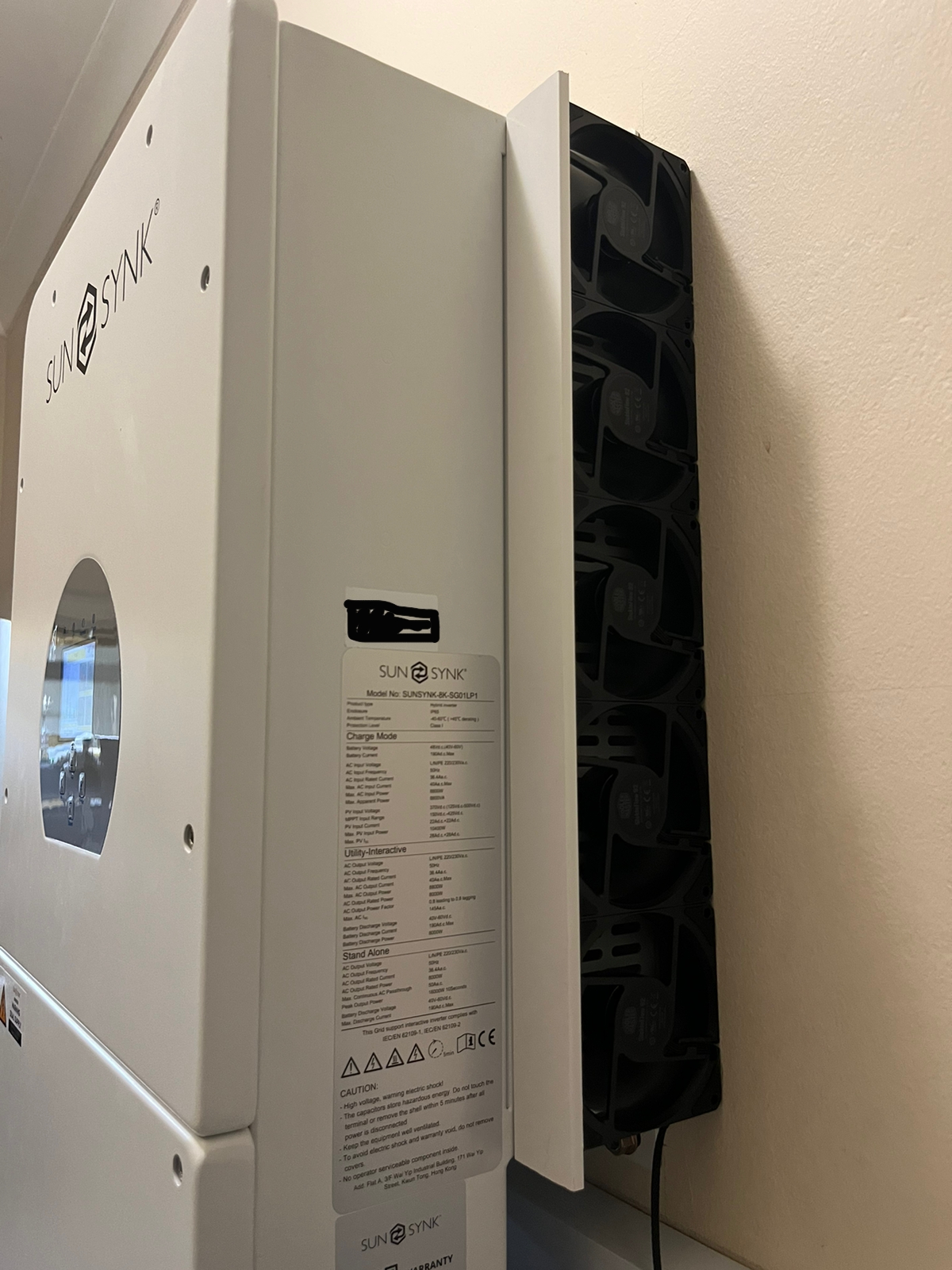
I think you might be OK. The fans are loud and high pitched though. If they disturb then just try this. The input side is just the 3 holes with the 3 built-in fans. They blow into the unit. I didn’t want to interfere with their functionality. My thinking was rather put 5 fans over the much larger exit side and cause less restriction.
-
Here are temp recordings from the last 7 days. I switched on grid export the last 5 days to keep the MPPTs and inverter at max possible load during the day. It didn’t go over 42 degrees. Very stoked. At the begging of the trend you can see the temp at 55 degrees. I had the fans off re-wire them permanently.

-
They are becoming far too common! They work, they are cheap, but man they are not safe! They heavily rely on the sine waveform from an AC supply to function properly. The sudden steep rise of the modified sine waveform actually causes a much higher voltage on output side than its rated for. A well designed switching DC supply shouldn’t be affected by modified sine wave. But how is the average consumer supposed to know what will with modified sine wave. With that said, I agree with you, stay clear unless you know exactly what you are plugging into it.
-
Hi Everyone, Thought I'd share this because I have noticed a few people concerned or frustrated with the fan noise from the 8kw Sunsynk inverter. I couldn't install my inverter in the garage because I do a lot of woodwork in there and I know the dust would cause issues in the fans and heatsinks. So its mounted at the end of our passage where it meets with the garage through the door. The noise at night was really an issue for me. During load shedding the fans would usually kick in. Specially when the aircons where running. This is obviously when the inverter was doing a lot of work and required cooling. Then also after load shedding when the batteries were charging the fans would come on intermittently. Bloody irritating when trying to sleep. The following pics is what I came up with. 5 decent quality 92mm PC fans on the vent side to constantly pull air through. Now these fans don't have the CFM or static pressure rating of the built in fans. But they are dead quite and they keep a constant steady flow of air over the heatsinks. On average, they keep the inverter 10-15 degrees cooler according to solar assistant. I have only had them in for 5 days now and the temperature has never gone over 55 degrees which is the trigger point for the built in fans. I ran all 4 aircons plus the air fryer for 30 mins and the inverter got up to 49 degrees. But when idle, it sits at 35-40 degrees. I am still waiting for a full sun day with load shedding where the MPPT's and the inverter are under a decent constant load to see what happens. Today the MPPT's where hitting around 8kw peaks while charging, and about 4kw on the inverter and it never went over 41 degrees. I have mounted the fans about 10mm of the exit vent so none of the holes get blocked. The idea is that when the internal fans kick in, that air can just blow through my external fans. For now, I have just hot glued the fans to the wall and hot glued a piece of trunking cover to side(proper life hack style =D). I am busy designing a decent 3D printed bracket to hold all 5 fans and clips onto the vent hole at 4 points. No alterations have been done to the inverter at all so no future warranty issues. The fans run off an external 12v supply. I have wired it through a sonoff switch with the idea to control them through home assistant based on inverter load and temps.


-
These two videos explain everything in detail and are really well presented.
-
Because with older battery chemistries like lead acid, the energy(kWh) it delivers varies drastically due to voltage voltage sag and how much current you draw from it. Its almost impossible to rate a lead acid battery in kWh because it would depend on the application. If you look at the rating on a lead acid battery it says 200Ah (0.2A). That means you will get 200Ah from the battery if you constantly draw 0.2A amps from it. Yes 200 milliamperes! that is not a typo. But if you constantly draw 5A from it then you will only get 180Ah out of it. The efficiency of the battery drops like crazy depending on the current draw. If you draw hundreds of amps like in a typical UPS/inverter application you will be lucky to even get half of the 200Ah it’s rated for. In the data sheet of each battery there is graph to show the relationship between capacity and current draw. Also, to calculate the energy in KWh, you need to take the voltage into account. Lead acid batteries have crazy volt drops when high current is drawn which again stuffs up the energy calculation. So I think to keep things simple they stuck to amp hours. lithium batteries are different, the voltage remains relatively constant and you can pull 100’s of amps without effecting it’s efficiency much. So they can use energy in kWh as a rating which is indeed a much better way to rate an energy storage device.
-
That’s normal. There is a contactor inside that switches to isolate the grid connection from the inverter when there is no power from the grid. You are just hearing the contactor
-
Just to clarify. Constantly clicking during loadshedding or just a single click when Eskom goes off?
-
-
for your setup to work like you want “Priority load” must be ticked. “Zero export” ticked. “Solar export” unticked and “limit to load” unticked. Too me it sounds like grid instability. The Sunsynk inverter can’t actually disconnect the non essentials from the grid. Non essential side is connected directly to the grid with Sunsynk connected in parallel so it can “blend” the power into you non essential circuit. So if your oven is freaking out then it’s a grid issue. The LED downlights will flicker when the Sunsynk switches over to UPS mode because the relay inside takes a few milliseconds to switch over. Ours do too. This happens when any of the grid settings go out of range. So if the frequency or voltage from the grid go out the set ranges your inverter will switch to ups mode. At this point the Sunsynk will disconnect the non essentials(grid) from its self.
-
Its not an open system that the end user has access to. The installer programs it. So use a reputable installer. Once the system is up and running you can play around and monitor it to make sure it doing what its supposed too.
-
I have installed and serviced a few systems like this when I was an aircon tech. The damper control system is quite intelligent and it communicates with the indoor unit and outdoor unit to ramp and ramp down according to the heat load. The outdoor unit has variable speed compressor (inverter) which will run slow and consume less power if only 1 room is being cooled. The indoor unit has sensors to determine the required cooling capacity. The damper control system must be programmed correctly though. Most issues I dealt with was due to poorly programmed systems. So to answer your question, its not possible to calculate exactly how much power it will draw per zone. But it will draw less based on the heat load because its an inverter unit. Also, Its maximum power draw from the DB is about 5kw, not 18kw, that's the cooling capacity. It will comfortably go down to 1kw if the required cooling or heating capacity is low.
-
Use a 1p or 2p contactor rather. https://www.em.co.za/ESC225 https://www.acdc.co.za/products/20a-2p-n-o-contactor-230v-din?variant=30482240140 https://www.robotics.org.za/CT1-25 https://britelighting.co.za/products/20a-modular-din-rail-contactor-2-pole