zak687
Members
-
Joined
-
Last visited
Everything posted by zak687
-
So I think the wake up is working as the LCD panel comes on with solar and shows that it is charging the battery but not the supplying the load. But fault mode might be the issue with respect to the load, if it requires that fault code 4 clears in addition to getting over the threshold to restart the output. That requires the voltage to be 4v higher than the low voltage cut-out for the inverter. And that is difficult to emulate without actually running the battery down.
-
Thanks Coulomb. Would one assume this cable is present and functional when supplied as new? In my emulation when I reconnected the solar the battery started charging and the LCD on the inverter came on showing the battery was charging, it just did not restart the output (AC).
-
These are the settings I am changing - the screenshot is for a 24v system, but am setting a) to 47v and b) to 52v. Have bulk, float and equalisation all set at 56v. The watchpower manual says "Back to discharge voltage: When battery voltage is higher than this setting voltage, battery will be allowed to discharge." Not sure which setting b) aligns to but probably 13? Does anyone with an off-grid setup have their system resuming unattended when sun returns?

-
Thanks Talia. Have some remote monitoring (this project), just not all sensors, but it is powered by the inverter and goes down when the inverter goes down. Have considred trying to manage it remotely with more effort to keep the gizmos up when the inverter is down, but would be much easier if the inverter simply came back to life when there was sun, which I was led to believe was possible. Looking for a second battery.....if anyone is flogging a Greenrich P3686, let me know!
-
Yes, SBU is selected (program 1) Or did you mean Program 16 - cannot reall what that is set as, but all the options in the manual suggest solar would be used?
-
We have a Kodak OG 5.48 inverter with a Greenrich 3.68kwh battery in a cabin, completely off-grid, just running refridgerator, wifi and self-consumption (which is surprisingly high for this inverter). After a run of cloudy days the battery was dying at a preset (battery setting) of 45v. When sun returned the system would not wake up unless the battery was power-cycled, but given cabin is unattended in the week, this was not possible. Set up with USER settings rather than pylontech (that is another story but not for now). Using Watchpower, we then tried setting the inverter to switch off at a voltage higher than the battery minimum (we set it at 47v while the battery cut-off remained at 45v) hoping the inverter would switch off but the battery stay on, so that when sun returned the inverter could resume charging the battery which would still be awake. We set the "back to discharge" voltage to 52v hoping that when the battery was being charged again, the inverter would start supplying the AC output once more when the battery reached this voltage. WIth this last run of cloudy days it worked to cut the AC output at 47v with the battery still alive, but when the sun returned the output has not started again. I am not at the inverter to see what is happening, but when I tried to emulate while on site (by disconnecting and reconnecting the solar input), I also observed that the AC output did not start again when the voltage reached the back-to-discharge voltage, unless I power-cycled the inverter. I hoped it was an anomaly in my emulation, but seems not. 1. What is the correct configuration for an off-grid implementation with this inverter which would enable it to auto-recover when sun returns? 2. Are we interpreting the back-to-discharge voltage correctly? 3. Setting the cut-out voltage higher so that the inverter cuts the output while the battery sill has some charge, can result in Fault 04 frequently occuring, as this threshold and the operative voltage are often within 4v of each other. We had wanted to set it higher than 47v, but for this fault. Thanks for the advice.
-
Sadly I am back to where I started. Maybe with sun lower, maybe the FW changes have been reverted to deal with the unintended consequence on the other string..... Has anyone had any success with optimizers and willing to share what they did? Alternatively, has anyone managed to get the DC connection under software control so that the cycling can be automated?

-
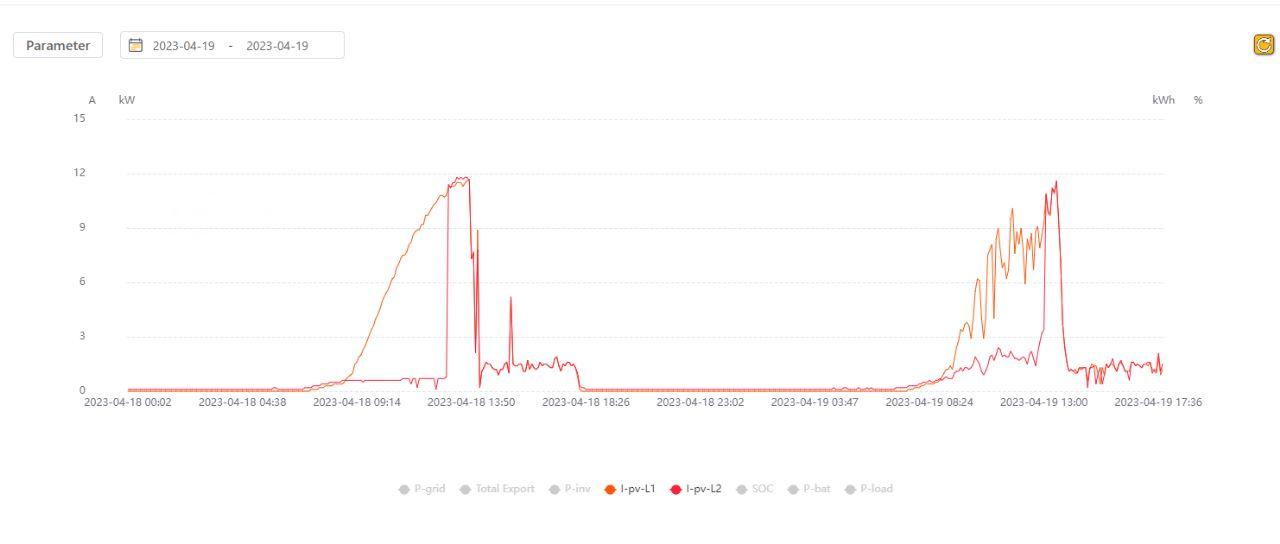
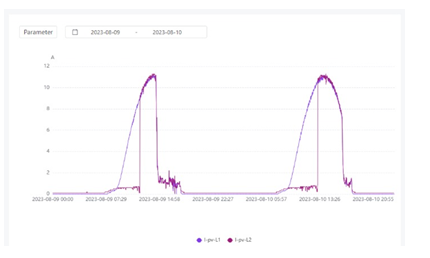
I find that there is an improvement since my original issue whether or not I tick the option in the firmware, but there is an associated problem now in the other string. I am currently querying this with Sunsynk/Deye. I was also advised that they had done all they could on the shading and that I should explore optimizers. But in fact they made a sincere effort to address the issue and got 80% of the way there, and mostly resolved my original issue, just that there is a side effect which needs to be addressed still. My production with partial shading of the one string in the morning changed from this (partial morning shading affecting the purple string): to this after a FW upgrade (see the weird impact on the blue string when the shading recedes on the purple):

-
Meaning I still have the shading, and output is both higher but also closer to what is expected in spite of the shading. Previously the string with the shading would produce 10x less power until the shading disappeared completely later in the day, whereas it is now closer to expected (proportionately less power in line with some bypassing due to shading). Sunsynk asked me to check twice following firmware upgrades and both times did not see an improvement (this was some weeks prior to observing the change), but otherwise claim to be still working on it.
-
-
Has anyone with this issue noticed an improvement of late? Not sure if it is changing seasons and shading, or if one of the firmware upgrades actually made a difference, but am noticing a less dramatic differential on the shaded string than previously, during the time of partial shading. Then weirdly a difference in peak output in favour of the previously shaded string. vs this previously


-
I have a similar issue with the 3.686kwh Greenrich battery in an off-grid scenario with an Axpert King inverter (Kodak branded). If using the lithium settings, as it approaches 100% charge it gets into a loop of charging and then stopping, every 15 to 30s endlessly. In a small cabin it is very annoying as the inverter fans spin up and down constantly. If using the USER settings (voltage driven), this was happening as well if using the bulk and float charge voltages which were originally recommended (57v) but not if using lower voltages. Unfortunately when in BMS coms mode for Lithium or Pylontech, the BMS communicates the voltage to the inverter and even with the BMS upgrade it is still 57v. I eventually used a serial cable and monitored with PBMS tools while it was exhibiting the stop/start behaviour, and could see there that over-voltage protection was kicking in aborting each attempt at resuming charging. The battery distributors have advised that we stick to USER settings with manually configured bulk and float voltages of 56v and 55v instead of the 57v the BMS communicates to the inverter. The downside is that we lose out on the more accurate SoC reported by the battery compared to the voltage-based estimates from the inverter, which in my case are very inaccurate. Not sure ZA Moose if the discharging / charging you are seeing in BMS mode is related in any way to different voltages compared to voltage-based mode, but if you are able to find a cable and monitor the battery directly, if might assist.
-
Does this help? Screengrabbed from PBMS tools Maybe it is this - the ports, lights and buttons look the same as on the unit http://www.pacebms.com/en/index.php/shows/33/12.html


-
Thanks. Yes, we have been using USER settings, but the SoC calculated by the inverter based on voltage is then often way-off. But maybe they can release a firmware update.....
-
Thanks Bronwyn. So confirms the 57v comes from the BMS. With this setting when close to full charge the battery keeps cutting out due to overvoltage protection, and the inverter then tries again to charge. Stop start every few seconds for ages with fans spinning up and down. Elleyhill are now advising 56v.
-
Using OG-PLUS 5.48 with Greenrich UP3686. When using the PYL settings the BMS communications seem to work (hexagon flashes) but Watchpower reports that the bulk and float voltages are 57v which are too high and are not editable with this setting - is it the BMS providing these voltages or is it pre-programmed in the PYL settings? Any advice on how to use lower voltages. We prefer not to use the USE settings as the SoC is then very inaccurate.
-
Trying to get coms working between the Axpert King (Kodak version) and a 3.6kwh Greenrich battery installed off-grid in a cabin. Have the right cable and the hexagon flashes suggesting coms is working. Watchpower app reflects the BMS data as read by the inverter if I set it to Pylon or Lithium B, but the issue is that if I set it to Pylontech, the charge voltage is preset (? in the firmware) to 57v. If I set it to User settings, the SoC calculation is way off and very confusing. We had an issue that when the battery is fully charged or close to fully charged after a few hours of sun, the inverter fans spin up and down every few seconds trying to charge then stopping, repeatedly, sometimes for a few hours. This also happens when the user settings have the bulk and float voltages at 57v or 57.4v which the installer was told were the right voltages for the battery. Later discussion with Elyhill who supply the battery suggest the bulk should be 56v and the float 55v. I finally had a chance to connect a serial cable and monitor with PBMS tools and could see that the stopping and starting when close to full charge were due to overvoltage protection kicking in from the battery BMS when the charge voltage was at 57v (pylontech setting) or higher (on the user setting). Using 56v and 55v as above and the spinning up and down stopped. So now having to chose between wildly inaccurate SoC (user settings) or voltage too high (Pylontech settings). Are the voltages supposed to be this high on the in-built programs, or is it something weird with our inverter? Is there a way to change the inbuilt voltage settings for one of the existing Lithium protocols to be lower, or another way to support SoC from the BMS coms while still being able to lower the voltages?
-
I've just found this thread now. I have two AM-5's with an 8kw SunSynk inverter. I noticed that the SoC after a few days of bad weather without getting to full charge from the sun (my time-based settings are not set to charge to 100% from the grid) would fluctuate widely - up and down by a fixed percentage, 10 or 15%. Would usually start at lower voltages and then jump up and down until fully charged for a while. These batteries are supposed to have an additional reserve margin which supports an apparent 100% DoD within the usable 100aH, but that is meaningless if the SoC can randomly drop 20% when you are already at 10%, and trigger inverter alarms etc. Hubble suggested a firmware upgrade. I got the cable and did the upgrade, but it is unchanged. They then suggested not discharging below 20%, in spite of the reserve margin. They are now suggesting I use voltage based settings rather than BMS coms. So a few questions for those who have travelled this journey. 1) How accurate is the SoC without the BMS coms? 2) For the BMS to manage the voltages correctly within the battery , does the cable need to be unplugged, or can one simply change the inverter setting from Lithium to AGM V or %? 3) What else do we lose without the battery communication in place? 4) The warranty is very clear that it is voided if one connects to the battery, so I have been reluctant to connect with PBMS tools or similar - is this other people's understanding as well? 4) Given that I bought these batteries with the expectation of being able to use the full 100AH, and utilise accurate SoC through BMS-inverter coms, are these not grounds for a refund if neither is possible due to this (presumably BMS) fault?

-
Update: Still waiting on a response from both Sunsynk and the installer on a remediation from either, but I did try the approach of the OP (rfl) of cycling the DC power and sure enough the offending string went from 200w to 2000w with no change to the shading, which does kind of point to it being an issue on the inverter optimization side. Is there a safe way to cycle the DC without powering down the inverter - weary of cutting breakers under load?
-
Thanks Modina. My installer is going to love your suggestions! But maybe I should suggest they swap the panels around in case by bad luck the shaded panel has faulty built-in bypass diodes.
-
I have a similar problem, better tracking of two strings (each 6x545w) on a cloudy day, but unbelievable separation on a cloudless day, until there is no shading at all. The extent of shading for most of the period (until about 1pm) is a small section of just one panel from an adjacent chimney. Quite considerable loss of generation capacity throught he morning when we have most of our loads active. Would a DC optimizer or whole-panel bypass diode on the offending panel help? Any suggestions besides moving the panels at quite considerable effort and cost. I haven't tried cycling the strings with the breakers to see if I have the same pattern as rfl. Using essentially the same inverter fwiw (Sunsynk 8kw vs Deye)

-
Thanks! The new formula fixed it. I'll update the whole card with the latest version. But I am still confused as to what that value represents (LD on the Sunsynk grid screen, and the 40W in my screenshot above) when there is no load on the non-essentials, if different from and larger than the grid external power.
-
Huge thanks SlipX for the flow card which I am using with ESPHome/RS485 as the datafeed. I am struggling to understand something in my setup which I have not seen replicated on any of the other examples shared, with respect to the non-essential power. When there is no load from the non-essentials (stove and geyser), the inverter shows a positive grid inverter load which is greater than the grid external power. It makes it appear as if the external load is supplementing the grid by a small amount (represented by a negative number), as below (-20W). The inverter is set to draw 20W from the grid even when not needed. Where is the extra 20W (the amount varies but consistently < 50w) coming from, or what could be wrong with either my setup, implementation of the card, or understanding? For interest the sunsynk flow on the inverter shows the same value for the inverter load (LD in the grid menu) but shows zero for the non-essentials - so still has the larger inverter load than external power, but does not show the reverse flow from non-essentials which this card does by virtue of the calculation.

-
Thanks I84RiS for the detailed response. Hugely helpful.
-
I have a new setup with 2 AM-5 batteries linked to a SunSynk 8kw inverter. I was initially under the impression these (and most batteries) should ideally not be discharged below 20% and the installer set this as the cut-off on the inverter. While there is no specific statement about DoD in the warranty or technical specifications, a few vendors advertise these as being able to support 100% DoD alongside the 10-year unlimited charge-discharge cycle warranty. The warranty does not seem to have any Ts and Cs related to DoD, and states "The Battery has a built-in reserve margin capacity to ensure the Battery life span is maximised, and the Battery is thus rated to deliver at least 100ah of power when new." . So a few questions if anyone can assist: 1) What is the supported DoD which will not void the warranty (granted people on this forum don't place much faith in the warranty)? 2) Given the stated reserve margin, will it accelerate decline in SoH if the batteries were not infrequently discharged overnight to say 10%? 3) Where can one access the SoH of the batteries? Many thanks for the advice