display_Name
Members
-
Joined
-
Last visited
-
-
-
Appreciate the feedback. My thinking is that the better specs and pricing probably outweigh the downsides here. I wasn't expecting to be looking at Solis again. This thread has me very interested again. Thanks all!
-
-
-
There's a subscription now? I've not seen this for mine yet?
-
Holy shit. A year ago when I was looking at Solis, they didn't have a 12KW. I was investigating 2 x 6kW Solis inverters. They do now and the specs are insane. Sunsynk 12kW is capped at 15.6kWp PV array, while the Solis is 19.2kW usable with a 24kW max PV array size... It has 6 Strings on 3 MPPTs. How's the software? I suppose I should check out their battery compatibility list. Wonder if they are compatible with Volta batteries? Decent Pricing as well.
-
-
My current system uses a 12kW Single Phase Sunsynk Hybrid Inverter with Volta Stage 4 Battery. I am very happy with my setup, even through I need to add one or two extra batteries. I'm looking to install another 2 systems for family sometime soon. I'm also looking to potentially upgrade mine as I switch to EVs. I can always go with sunsynk for the new installs, but my installer has warned me that they are starting to experience long lead times for repairs (he took one out the box not too long ago... it was faulty, and sunsynk took 9 weeks to repair it). Perhaps they are getting pretty popular and this is putting pressure on repairs, I dunno. So far, I've had no issues with mine. One option I have is to switch to Sungrow and move to a High Voltage solution, then move my system to my parents place as my inverter / battery combo is more than they need. Downside is that the only sungrow inverters that work with Batteries are maxed out at 10kW. So I'd need to install 2 of them, and then I would no longer be able to feed back into the grid as i have a 60A breaker and need to stay below 13.8kW. Then I was looking at the Deye units... they are a bunch cheaper than Sunsynk, and they seem to have a new app now? From a cost effectiveness perspective, it's attractive to look at Deye, when they are essentially the same hardware as sunsynk. So... question time. Does anyone have experience with Sungrow? What's the support / app experience like with Deye in 2025?
-
I'm sure now that these unnamed sources have spoken without authority to do so... electronics designers and scientists will look at these devices and put actionable information in the public domain. Really doesn't help that they don't mention specific brands and specific exploits. That just throws a blanket over all chinese product, which could be a pretty suspect move as it is. I'd like some details first. Would be interesting seeing the guys from Sunsynk for example comment on this.
-
yeah, found the same. Feels off not having a contact number of whatsapp line
-
Yeah this is exactly why I do my checking first. UtilityPal stocked the volta way cheaper than the competition, but I could call and speak to them, and they were legit fantastic to work with. These guys may or may not be.. I don't want to jump to a conclusion first without actually verifying it, hence the ask. I'll mail them in the week, get a number and follow up from there... may get someone in PE to go visit.
-
Hey. Whenever I come across a website selling a unit that I'm interested in for way less than the competition, I want to do some due diligence and check them out first before buying. Has anyone heard of sun4safe.com? Apparently in PE, but there's no street number on their address and I can't find them on google street view. Also no telephone number listed and I can't get the owner of the domain as that info is listed. So I wondered if anyone here in PE had heard of them? Their Volta Stage 4 batteries are well below the next lowest priced supplier that I know of that is legit (UtilityPal), so I am curious what the deal is. I'll reach out in the week and sus it out, but if anyone here in the area knows them, please drop me a note. Much appreciated.
-
Thanks. Holding off for their inclusion then. Seems like that would be something they need to sort out before they can tackle the market.
-
-
I have a Volta Stage 4 battery. It's great and I'll be getting a second one. I see there are now Volta Inverters on the market. Specs look like they can take 20kWp of panels where my sunsynk can take 15.6kWp. Happy with my sunsynk for my current install, but may want to try the Volta for another install coming up. I can see a datasheet on the unit: https://e8b52f8d-0371-4a2d-9032-3c2c5431d55f.usrfiles.com/ugd/e8b52f_cbbe2369ce804e21955bb3de0dff67c8.pdf But I have a few questions: 1. Who is the distributor? Are these inverters CoCT approved? I can't find an up to date approved inverter list for the City of Cape Town 2. Has anyone here used one? If so, what is it like?
-
-
@ToxxycDid you make any final decisions on your system yet?
-
-
-
-
-
-
Yeah, I really wanted to understand what the deal was with it so I mailed and called people until I got through to a pretty senior engineer in the Energy Directorate managing service connections. I was super thankful that he spent this much effort explaining it so clearly. I understand their position pretty clearly now, and I can't say I argue with any of it. Could things change? Sure... but it will take changing the infrastructure, and planning properly for feedback. With that in mind, they really aren't doing a bad job.
-
Cape Town. Limit is from the SSEG program. They limit to 25% of the breaker (My 60A breaker = 15A export limit = 3.45kVA). I'll be buying one or two more 14.2 kWh batteries (in prep for next winter and ideally and electric car next year). Any excess that those batteries store I'll just feed out to the grid, allowing me to push out longer if not more in one go. As for the limit, COCT doesn't look likely to get rid of that 25% limit any time soon. Here is some feedback from them on the topic: Hi <Redacted> This is actually such a highly technical and complex matter that one could write a masters or even a PHD thesis on it. However, I will try to provide a brief and simple explanation: 1. Transmission and distribution transformers are designed for power flow from high to low voltage. They can only cope with a limited amount of reverse power flow (exactly how much depends on each transformer design – thus nobody, globally, can provide a definitive answer) before overheating results in premature aging or catastrophic failure. Replacing all of the City’s transformers with units designed to cater for 100% capacity in both directions (these are difficult to design and costly to manufacture) would cost in excess of R 20 Billion. 2. LV reticulation networks are designed to cater for loads and to ensure that at peak load the clients will all receive power within the national parameters, particularly the voltage being 230V +- 10%. For residential areas this peak load occurs on winter evenings, when SSEG does not contribute anything, and the system is designed to ensure that network volt-drop does not result in the customer furthest from a substation experiencing a supply voltage below 207V. During summer days, when the load is low, energy export to the grid would cause the voltage to rise and if too much power is exported the voltage could exceed 253V resulting in damage to appliances. 3. A national working group, taking cognisance of international practices and problems into consideration, developed a document called NRS-097. This national standard is applicable to all aspects of SSEG and includes the 25% of NMD export limit for clients connected to shared infrastructure. 4. In order to cope with the volume of SSEG installations we have established a streamlined on-line and semi-automated application process such that we only need to spend 1 to 2 man-hours on each of the smaller SSEG applications. That 25% export limit avoids having to do a grid hosting capacity and power-flow study (which takes approximately 100 man-hours) for each application in order to avoid grid voltage instability and excessive reverse power flow across distribution and transmission transformers, at least until such time that specific areas have received a high SSEG penetration, which we can see on our GIS SSEG Record map. 5. Those limits also serve the purpose of avoiding situations that compel us to forbid export of energy to the grid by the latest applicants in an electricity network segment because earlier applicants had been granted permission for high power export quantities. 6. Several countries, despite having imposed policies and restrictions similar to ours, are in locations of high SSEG installation volumes experiencing electricity infrastructure problems caused by power export to the grid that they had to implement further restrictions or actively control client’s SSEG system performance. In view of the above, that 25% of NMD export limit will not be lifted in the foreseeable future.
-
I mean yeah... the money flowing back should average around R1K per month at the moment (perhaps a little less in winter) once I get a full month under the belt. If they decide to make it NOT worth my while to feed back by raising the fees, I'll stop. I thought about that previously and I'm ok with that.
-
-
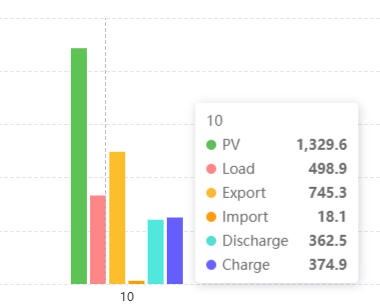
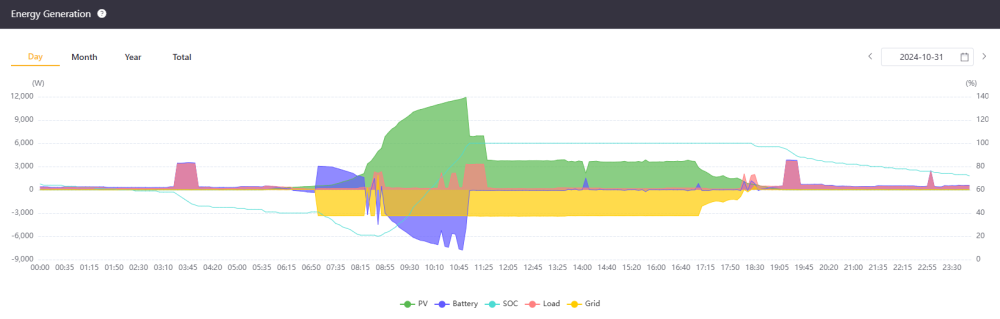
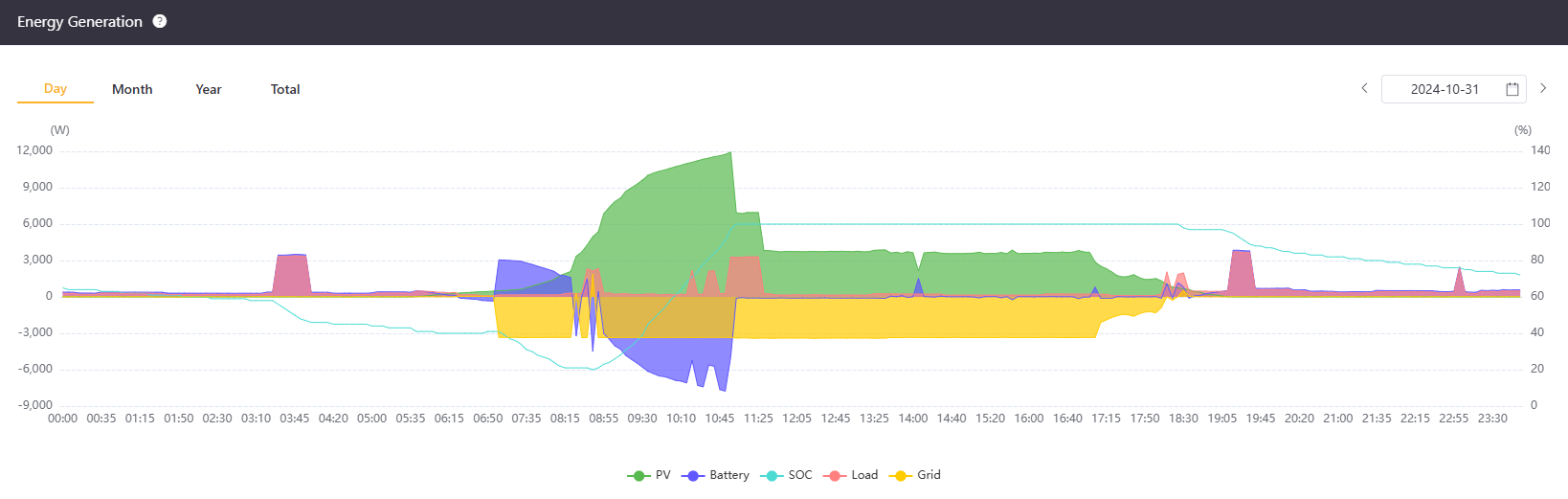
I joined you this month for the first time now that I am feeding back: But... that was only from the 8th, and with an export limit of 3.45kVA. This month I'm exporting for the full month. If I was able to push all my excess out however, I'd be able to push roughly 3 times this to the grid. Yesterday's generation (note the wasted potential... I need more battery) Sunsynk 12kW Single Phase 14.2 kWh Volta Stage 4 15.6 kWp (28 x 550W Jinko Mono panels) To answer the OP.... My electricity bill this month will be negative for the fist time, taking the fixed costs into account. And my fixed financing cost is already at least R1k cheaper than my eskom cost was... so I'm saving from day 1. When I get my second battery, I'll obviously use the excess to feed back in the grid in the evening / morning... but I will use that in winter for more overnight use with heaters. As it stands, with heaters, the current battery is not enough to get through the whole night in winter. At the moment in summer, I still have 50% SOC in the morning, which I push to grid at 7am. I installed in August, and got the tail end of winter... there was not a single day that I didn't fill the battery for overnight use. Generally in full cloud with rain I'm still generating 2kW.