burgduino
Members
-
Joined
-
Last visited
-
-
I use the second NC contact to turn on a yellow indicator showing local N-G bonding :) Actually, there is a LOT of discussion lately on Greek social media and YT about this matter and I'm trying to figure out which inverter models can or cannot be "salvaged" using this method It seems unless the inverter has internally connected neutrals (in-out) this is not possible and bridging them externally is not something I would do unless I know for sure it will not blow up the inverter as some people say it will.. I know on some models this is in fact possible.. anyway My 4k anenji works nice too although, silent is not one of its traits :) if you exceed 1.5-2kW its clearly noticeable..
-
You can see my installation here feel free to subscribe to the channel :) got more videos on the electrical installation and neutral-ground bonding dynamically
-
It works nicely .. I can easily recommend it.
-
Has anyone measured voltage between neutral and ground on this inverter (3 measurements .. one with grid connected but on battery/solar output, one with bypass and a third one without grid connected).... a friend seems to have a serious problem with this one as it measures 110V between N-E and RCD does not trip! Any solution?
-
-
I wonder if anyone makes sense from the barcodes on the stickers found on all voltronic (and off brand/clones/rebranded) inverters.. Searching online does not bring up any findings of a product match for any barcode I have searched for .. Is there a way to verify which model each inverter is ie by their serial numbers? but then.. where are those serial numbers usually?
-
-
-
-
They told me current stock comes with the AC PSU board The problem with this kind is 1. potentially coil noise 2. increased power consumption and 3. raising temperature also because of 2. I have a similar available actually two.. same brand.. one big 63A and a smaller 25A.. applying power to the smaller one's coil works nicely, no heat no noise.. the big one is literally operating as a freakin' vibrator! the one from LG is listed as "suitable for nuclear plants" so I hope it is in fact solid.. fun fact, exactly same "design" visually at least comes from at least couple much cheaper chinese manufacturers so who knows who manufactures what for whom or copies them... I plan including a 1A MCB for the coil power and a T2-T3 SPD for coil protection plus an indicator controlled by the leftover 1NC contact powered from inverter output.. would be ON when NG bond is established.. a second indicator will show when there is power going to the inverter from grid.. one on at a time.. should be more than plenty
-
-
So far I have i have finished the electrical installation but I don't have any panels to start normal operation :) I do have 2 small 175W panels and an external mppt with which I am charging the battery (2x12V 300Ah) getting 1kWh on a good day.. I set it to operate in UTI mode meaning its an expensive UPS atm :) But it does work nicely, even when I try to abuse it a little.. There are a few things to consider especially about battery and how much current you draw from it but so far I am more than happy with it When I first got it I tried to plug it to grid to play with its menus etc but it didnt work.. I spoke with Anenji and they told me the units they sold last year didn't have an (AC UPS board) which they send me for free and once installed it works 100% as expected. Without it, if you don't have battery it will only work during the day Then, once installed and wired I measured NG voltage but, with grid present it was always 0V regardless of power source.. when I disconnected grid though both L & N it showed 120V at its output N. In Greece RCBO must disconnect both L & N so I cannot use a single pole one (I see those in UK?) and I must have one to comply with regulation.. but, with an RCBO at the input of the inverter in case it trips it will break NG bond so I came up with the solution of a relay with 2NO & 2NC ... someone just told me this might be "dangerous" and it is not safe to have the relays coil energized practically permanently etc.. which, to me is crap really when you use industrial grade relays ... the Metasol LG MC-32A is listed as relay for Power Plants FFS.. if its good for that use, its certainly good for mine! Back to the Anenji, its 4kW only and I have set my battery to charge/discharge with only up to 1kW ... few days back I went to cook and turned on two appliances drawing 5.3kW! It simply went to bypass and worked for a few min without any problem, I then turned off one device to play safe.. the internal bypass relays are 40A rated though so nothing happened.. I plan repeating this "experiment" but with the inverter cover removed and having a thermal camera to see what is actually happening inside it. It should be fine ... The other problem is that while you can set battery discharge current so you don't stress your battery this is problematic if there is no grid present at the time.. it simply ignores the setting so you must at least provide thick cables for the battery up to the inverter power rating to avoid them melting even if in normal use you only draw 1/4! I have installed a 63A fuse on the battery just to prevent this from happening.. this can be more elegant using current monitors and disconnecting part of the load if you can leaving only essentials..
-
I got my Anenji 4kW 24V inverter installed alright, everything works nicely and I am testing and measuring the installation to make sure its 100% safe. With power connected to the inverter and, regardless if its in bypass or battery/solar mode I measure 0V between output N and Ground which is what one would expect. If I simulate a grid power loss (breaking Live line) I also get 0V which is fine.. The problem is I get ~120V if I disconnect both Live & Neutral .. this is the case where an RCBO connected at the input of the inverter trips. As far as I know and from all I am told, an RCD/RCBO disconnecting both Live & Neutral is mandatory immediately after the main grid breaker and fuse here in Greece.. I know single pole RCBO do exist but they are not used or even sold locally here in Greece.. something like that would possibly solve the problem. My alternative solution is to use a good quality industrial relay such as MC-32a by Metasol LG using its 2NO contacts to connect Live-Neutral to the inverter when grid is present and disconnect them when its no and use one of its NC contacts to connect Inverter's output Neutral to Ground when for any reason grid power is not present.. Do you think this will work? Is there any other workaround?
-
Could an ESP32 be used instead which is also much cheaper and upload data to say IoTplotter for basic monitoring?
-
-
-
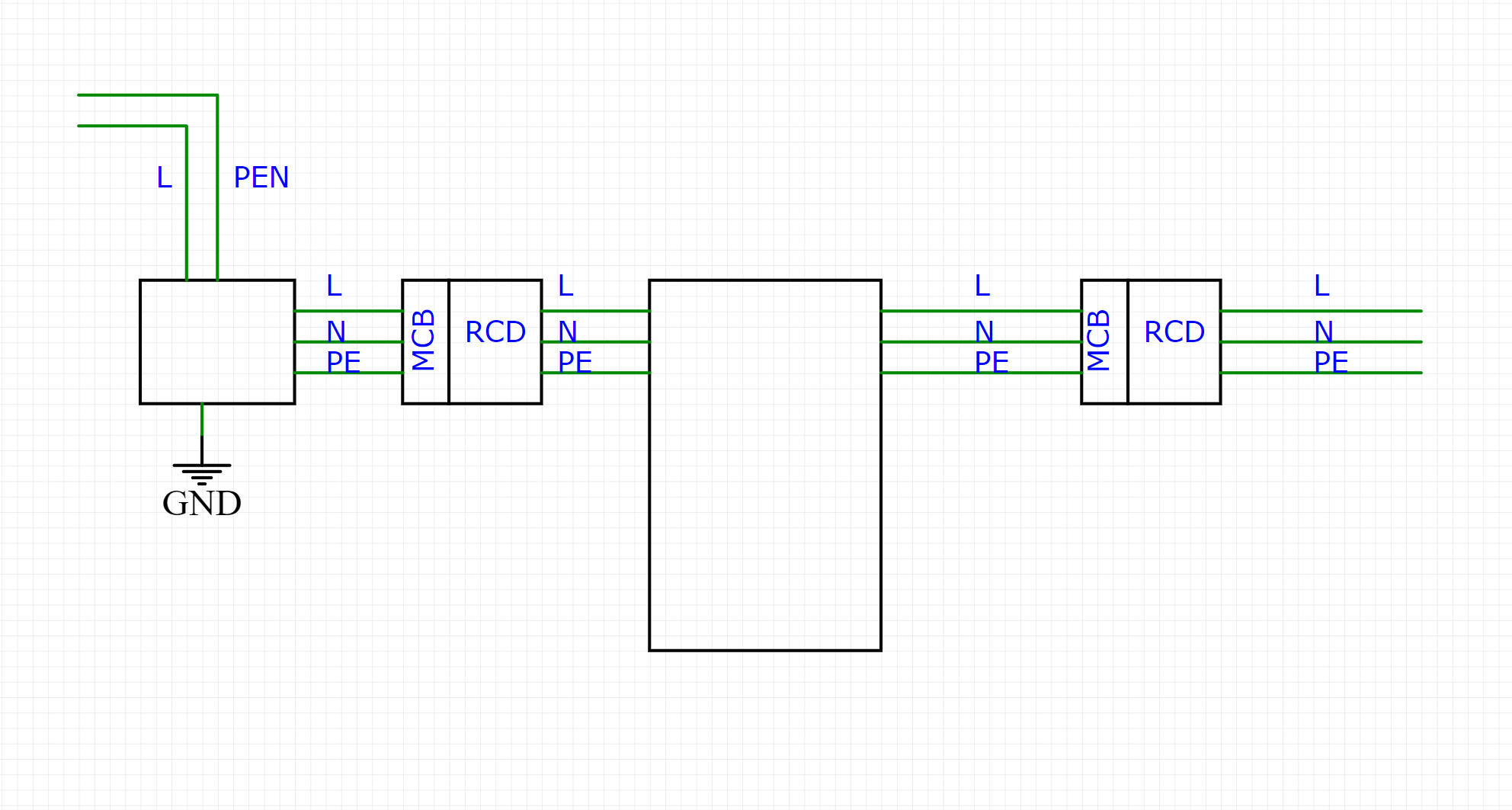
Is this a viable installation diagram? Grid power is going into meter to the left, there it PEN/ is turned to PE/N and PE is connected to earth ground rod 3 wires are now going to a small electrical box with an MCB/RCD to protect anything connected to grid power.. 3 wires are going to the inverter (and also to some grid powered devices in the same installation - inverter is only supplying hald the loads essentially). Assuming the inverter has the internal PE/N contact relay 3 wires go to an MCB/RCD to the output of the inverter and from them to the loads. AC connections to the inverter would look like this withinput PE cable connected to the terminals but, output PE cable connected to the inverter chasis ..... Since the inverter does not have a dry contact, is it logical to assume it has the internal relay for PE/N bonding in battery mode? If that proves not to be the case how can one add a relay to bond PE/N at the output of the inverter in battery mode?? I intent to use this in SBU mode meaning it will either run on solar/battery OR grid when battery is empty. Is there a problem having two RCD in series when in grid power mode? The inverter will be in a small closet/storage room and I plan having a grid powered outlet as well as an inverter powered outlet for local use (mainly lights or electrical tools) so the RCD on grid side makes sense right? plus, it grid will still be supplying power to half the appliances in the building for a good few months at least until the system is completed with additional batteries and solar panels...


-
While there are several inverters with 450-500V mppt input sometimes in higher power units even two of them, I cannot find and standalone mppt charge controllers with 450-500V input .. is there any out there at a reasonable price?
-
I am now talking with FCHAO they have a 6.2kW inverter which does not look anything like the voltronics clones and impressively has embedded MCB/RCD/DC Isolation/Surge protection and solar panel fuses etc.. looks very neat and is not expensive for all the extra hardware but unfortunately cannot be paralleled.. to my surprise the manual LCD icons etc appear to be similar to voltronics spin-offs so, its very confusing.. they have a descent product record according to my limited internet search for comments etc and I'd love to try the inverter but unless my cousin gets interested I don't see this happening anytime soon I wouldn't go that deep messing with an inverter as rewinding coils but I am expecting an older model with damage to repair and if I succeed doing that I might as well change mosfet/igbt & capacitors just for the fun of it and to satisfy my curiocity I have never stepped on MPPT Solar and I would never take it as a brand name as there are many solar chargers without any branding that say "MPPT SOLAR" on them!!! is it a brand or a description LOL What makes me sceptical though is that you say MPP Solar is a genuince brand.. I get it that they are offering a better quality product and have notices lots of positive word out there but, to the best of my understanding they use the voltronics lineup of inverters no? perhaps better made and supported but they are still selling a better version of the same product no? At least I have not seen anything they make that could potentially be their own in house developed product.
-
A cross reference catalogue would be very handy LOL There are at least 5-6 brands I know that look like twins Anern,Anenji, Daxtromn, MPP Solar, Easun to name just a few.. unfortunately you can only guess by the model name each vendor uses, the datasheet and manual and comparing seemingly similar models is tough as well.. Is there any of the extented family members that is available in the EU that one could really recommend?? I need an inverter I can parallel to reach at least a dependable 8-9kW power range and has 450-500V mppt that will not break the bank ..
-
-
Regarding their power rating I plan getting 2 of them to use in parallel so I never need to really exceed perhaps 75% of what they claim they can deliver I have seen several of these naked too and I have the impression that they are not too difficult or costly to "upgrade" in a sense replacing all their electroletic capacitors with "good" ones and all the mosfet & IGBT with better variants aiming for lower losses, a bit better thermal performance and hopefully longer life-span... someone with more in depth knowledge of their schematic might even be able to improve them further perhaps in order to reduce their "idle power consumption".. I don't really know I'd like to take that path that is for sure I might get my hands on a broken older model which needs to be fixed anyway and I might have some fun trying to repair it and if I manage to make it work go for an "upgrade" of shorts to see how it improves if it improves in the first place that is LOL I am still a mess trying to understand SUB/SBU to the detail I think though running the inverter in SBU is the way to go for me.. Solar, battery and utility as last resort.. The model I'm looking for claims battery-less operation which makes things even more complicated.. I will get two inverters and later a 3rd one .. of the first two, one is for me and will power half the house (part with less demanding but constant loads aprox 400-3000W) and the second will go to a cousin who might need to operate for a few months without a battery until he gets his from China... when I get the 3rd one, I plan paralleling them and feeding power to all the house which will run at a steady load between 600-4000W and up to 6000-8000W when ie cooking or ironing etc. So to me at least its not clear what to expect from this running without a battery in SUB mode... I hope it will use all solar power available to it to feed power to the house and when load demand exceeds solar production it will mix with grid power.. in which case I also hope it will not backfeed... but I seriously doubt that that's even possible (to not backfeed) and I would then hope SBU does the trick even without the battery.. if I get it right it will use all solar power to power the loads and since battery is missing instead of going to use battery power and solar it will go to grid power but I suspect grid power alone.... I would really love it if someone who has one of these and has tried all the option took the time to share his knowledge and experience with the the world I'm expecting a 2.5kWh rack battery first which will be upgraded over time with more 2.5 & 5kWh packs but, in the beggining when alone it can only deliver constant 2,5kW/50A If I'm careful it will not be a problem until I get the second inverter and by then hopefully at least 2-3 more batteries to cope with the loads I really thing SBU is the way to go.. until I install additional solar panels and battery capacity for lets say a year or so my system will be sub-optimal and my goal would be to run on solar, when possible, drain the battery then go to grid .. if there's still solar power but its not enough for the loads, I understand it will simply use solar power to recharge the battery until it exceeds "re-connect" threshold so, I think I am not loosing solar power .. in the scenario of lets say having a weeks bad weather with just say couple of hours with adequate solar power I expect this to run the house on grid power while recharging the battery.. once the battery is over the threshold it will go back to using battery power and solar if available and I am happy if that's the case..
-
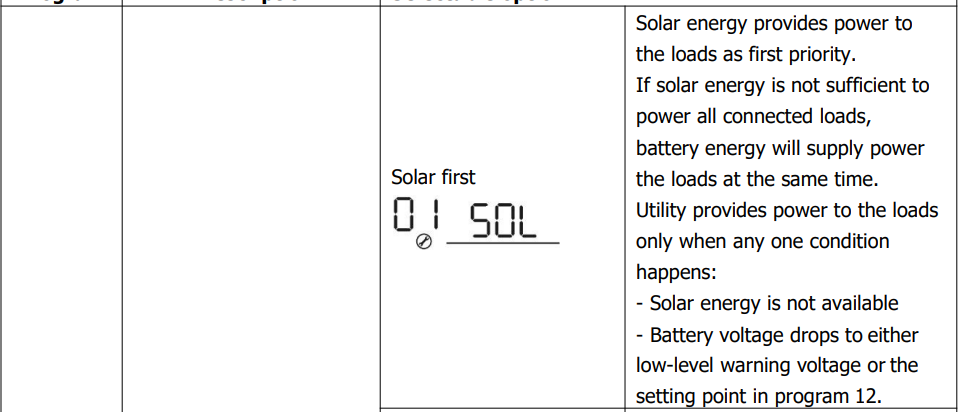
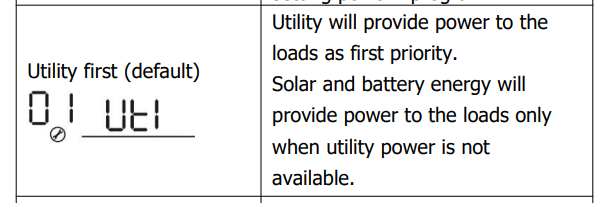
In the manual SOL setting states So, it turns to grid when there is no solar power despite the battery is full? it says ANY ONE CONDITION but, I would understand it if it was both conditions!!!! UTL on the other hand, I understand completely, its straight forward I think.. its a solar powered UPS.. you charge the battery with solar, and if grid fails solar if available and battery if full supply the loads instead.. simple... SUB and SBU are a bit confusing..