RhysMcW
Members
-
Joined
-
Last visited
Everything posted by RhysMcW
-
Does anyone know the specs of the original fans in the Infinisolar 3kW Plus, specifically the Amp and air flow ratings? I've been looking around for fans, there is a fairly wide range in terms of Amps and air flow and quite a price range too...
-
The likes of the Mersen and Keto also act as a convenient disconnect (switch) which is useful when attaching the cables to the inverter. When I first did mine I had a good fuse but no switch/disconnect so when I was attaching the cables to the inverter I got a nice arc between the inverter contact point and the bolt with the cable lug as it got close enough, got quite a fright. A battery disconnect is actually a good idea, partly for what I just mentioned but also if you need to disconnect the battery from the inverter for some reason.
-
ensure your battery cables are correctly rated for the potential current draw, then use fuses rated under the cable spec, so that the fuse(s) blow before the cable heats up and ignites... I believe it's okay to use a single fuse, I have only 1 fuse on my positive battery cable but I'm about to install a 2 pole battery disconnect with fuses on both poles. I've been looking at the Keto (manufactured by Jean Muller) disconnect but also the Mersen Keto - https://www.google.com/search?client=firefox-b-d&q=Fuse-switch-disconnector+KETO Mersen - https://www.google.com/search?client=firefox-b-d&q=Battery+Disconnect+Mersen
-
yeah, when I got the inverter back from Mustek and powered it on I immediately noticed the fans were blowing down instead of up, being mounted at the bottom they will never achieve enough trying to suck hot air down. I changed the fans over myself easily enough, but mainly because I wasn't going to take the inverter back to Mustek as I'm sure they would've taken another month just to turn the fans around, the inverter is way out of warranty so wasn't concerned on that front... I will try source suitable replacements but will still add the extra external fans, with a simple temperature controller to run them... @Coulomb, read that post, it's amazing that a manufacturer would even mount fans at the bottom and have them try suck the air down. I'm certainly no expert but even I know hot air rises, so rather make the fans push the air up and out if they mounted at the bottom...
-
@Coulomb, yeah, that's my thinking too. The fans were replaced by Mustek, took them over a month to "test" and agree the fans needed replacing then about 2 weeks to source fans, which they kept complying about being difficult to source due to their Amp ratings. They mentioned the original fans had a rating of 0.3A and fans they tried with different Amp ratings kept triggering the error code 27 (fan fault) and then fitted R100 fans. I'm no expert but I thought that a rating of 0.3A or higher would work as the specs of fans I found mention "max current" and what I could find in 3-wire and with the current rating 0.3A or higher were around R300 or more... @Mark, here's my graph for roughly the same time frame as yours I currently run on grid during the night (batteries need replacing), that increase in temp at around 07:30 was when the PV kicked in so the MPPT would've started charging the batteries so doing a bit more work than simple bypass... For the second half of August last year the average temp was 38 with it peaking at 46 only so that pretty much confirms for me the air flow from the fans is lower than the originals. I think I'm going to install extra fans above to suck and below to blow more air through as I can't be bothered trying to deal with Mustek again...

-
Hi All, Does anyone know at what inverter internal temperature to start being concerned? I have an Infinisolar 3kWPlus and the cooling fans have just been replaced, initially installed upside-down, but they don't seem to be blowing as hard as the previous (original) fans. I am monitoring the inverter temperature and have set an alarm trigger at 55 Celsius but yesterday evening it triggered, reached 58 and the air temp was around 14. It was working a bit having just been brought back online... I see reference in the manual to "over temperature" but cannot find what value they consider to be "over" and there is the following in the manual too This implies the unit can get very hot, certainly way over 60, so I'm wondering if I don't need to worry as much when I see the temp in the upper 50's??? The highest temp recorded in the past year has been 67 Celsius...
-
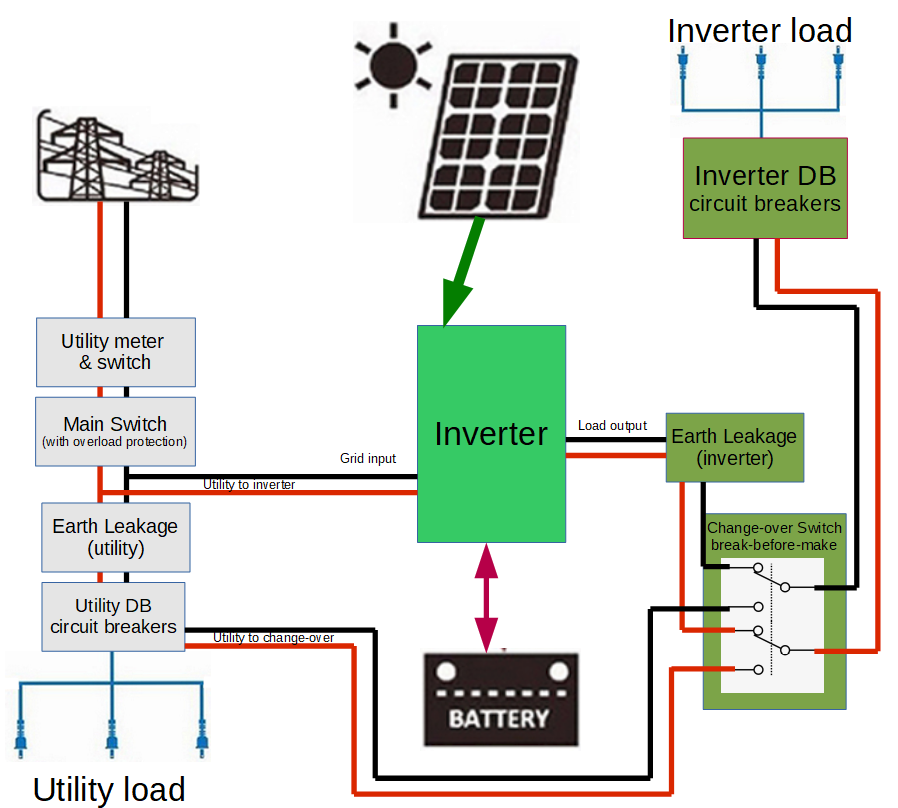
Here's a basic diagram of my layout. I found out that it's crucial to have the inverter input feed from before the utility side earth leakage (RCD) else the RCD keeps tripping. I put the inverter load output RCD before the change-over switch, just to avoid having 2 RCDs when changed over to utility, it's not normally a major issue though as far as I know... The top of the following post has quite a nice diagram of the wiring setup...

-
To answer my own previous remarks, it seems the inverters do/should indeed get their grid input feed before the earth leakage (RCD) in the DB, but after the main switch.
-
Quick question (hopefully).. If I'm replacing my RCD I see there are 2 options (with CBI anyway) - with and without overload protection. Am I correct in assuming the with overload protection would be current draw based, like CBs, as well as the EL and therefore if I'm going to install a main switch that handles the current overload I can go with the without overload protection unit? There is a significant price difference, the "with" option being around 2.5 times more costly. I'm looking at CBI as that's what mostly in the old DB (not DIN rail) and I believe the brand is good.
-
@Gielie, thank you for those post links, have read them and found a few others around, not sure I really understand much of it but do believe I need to move the inverter input feed from after the RCD to before it (grid side). This will mean doing some rewiring to put a main switch/isolator before the RCD as currently the grid supply goes directly into the RCD first then to the main switch. I may just replace the RCD while I'm at it as it's very old anyway and I see the new CBI ELs are narrower which would create the space I was after for an additional CB too (very old DB with metal cover and limited CB space)... @plonkster, thanks for the info, gives me more to consider too.I had actually done that testing you mention by disconnecting the load circuits, including neutrals (insulation tape became my friend), not because I really knew what I was doing but it was just something to try to isolate the issue. I discovered that no matter which circuit I connected the grid side RCD still tripped. I've read about the Axperts, older and new ones regarding the N-E bonding... One would expect that if it is needed that the inverter MUST take care of it at the appropriate time, as the new Axperts seems to. I rechecked my Infini manual in case there was mention of N-E bonding requirements but it only mentions to install a CB on the input an recommends an isolator on the output... My current game plan is to probably replace the grid side DB main switch and RCD and have the grid connect first to the main switch, then on to the RCD with a connection to the inverter between the main switch and the RCD (already have a CB near the inverter on the input).
-
Thank you for the reply Gielie The Infinisolar and Axpert are made by the same manufacturer (Voltronic), the Axpert being an off-rid inverter and the Infinisolar being on-grid (think my terminology is about close). Yes, the grid power enters my utility DB directly into the earth leakage and then on to an isolator (I expected this to be the other way round) not as far as I know, but not entirely sure how to confirm. I would've expected to feed the inverter after the grid earth leakage, for protection? I do have an earth leakage on the output side. Here's a basic diagram of my setup

-
I'm no expert but I would've thought that the feed to the inverter should be protected by the earth leakage too? My grid feed comes into the DB to the earth leakage first, then to an isolator, then on to the usual CBs, that's how it was from when we moved in. Personally I would bring the grid feed into an isolator and then to the earth leakage, but I'm not an electrician so just making an assumption...
-
Hi All, My InfiniSolar inverter seems to be causing the earth leakage on the utility grid side to trip. I can't confirm this but it seems to be when the inverter is supplying a power to it's load, and pulling from the grid supply. Any ideas what the issue could be?
-
So, the inverter went into Mustek for repairs, a few days later I was told they can't find anything wrong. I re-explained the earth leakage tripping issue but they maintained nothing was wrong. They did replace the USB control board at my mention I was having issues with the USB and ICC. I collected the inverter and mounted back on the wall and connected everything up, then switched on the battery isolator and then the PV (no grid and no load). The inverter powered up and for about 60 seconds all looked good, right up until the inverter started trying to charge the battery from the PV at which point it beeped and displayed E27 (fan fault) and remained in error state. The same occurred if grid was supplied. So I returned the inverter to Mustek... A month and a half later the two fans were finally replaced and I collected the inverter and reconnected it. I turned on the battery feed, then the PV and waited, 5 minutes later it was still running and charging the batteries. I then turned on the grid supply and all still looked okay, no load yet. I ran it like this with no load for a few days, not much PV with the clouds etc, until today when I decided to switch the load back to using the inverter. I moved the change-over switch to supply the load DB from the inverter again but after about 30 seconds the utility DC earth leakage tripped again, the reason for initially taking it in for repairs. I switched up the utility earth leakage and again it tripped after s short time, probably the time delay setting for when it "accepts" the grid feed. So it seems the issue is related to the inverter supplying an actual load with grid supply, and causes the utility DB earth leakage to trip. Nothing had changed in the utility DB nor the inverter load DB between the time it was working fine, for many months, and when it started causing the earth leakage trips. I am currently no able to run the inverter as it should so am now back to the change-over switch supplying the "inverter DB" power from the grid, and of course that means I have no battery backup now either, very frustrating... As mentioned in the first post, last year when this happened Mustek ended up changing the main board, but they did not do that this time round... Does anyone have any idea what could be causing this? Any help or tips would be greatly appreciated.
-
Forgot to ask where one can reliably buy units, ideally somewhere that at least has decent after sales service. There seems to be quite a price difference between sites like GC Solar, GW store, Weables and Sustainable. Should any of be avoided or preferred etc?
-
Hi all, I've been running an Infinisolar 3kW Plus (Mecer branded), 4 x 250Ah Gel/AGM batteries, 2 arrays of 8 x 260W panels and a separate DB for the load circuit for almost 5 years now. A little over a year ago I added ICC (Inverter Control Center) to better monitor the inverter. The batteries seem a little tired now and I was hoping to upgrade to Lithium late this year or early next year, however my inverter seems to have issues again. In July 2019 the inverter tripped my main DB (utility fed DB) and as long as the inverter was connected to the utility feed the earth leakage would trip. I took the inverter in to Mustek and they stated that the inverter's "main board" was faulty and needed to be replaced, which took a month. Now I'm having the very same symptoms so I'm assuming the same basic issue and expecting to be told the main board will need to be replaced yet again and of course I've been told there is only a 3 month warranty on repairs so would have to pay again... With the cost of the main board replacements (last year was R4985) I'm seriously considering just replacing the unit entirely. I've considered replacing with the very same model (it has work well in terms of load etc) but was thinking about the 5kW unit (just not it's price). I'm not against changing brands as long as the "other brand" has decent monitoring tools (I really have been enjoying ICC). I'm very partial to hybrid inverters, specifically I like the Infinisolar for the fact that it will feed the load from solar when available with top-up from grid or batteries (depending on setup) and that excess solar will charge the batteries and/or feed to the grid (if configured). I specifically like the load circuit from the inverter as I have the "essentials" connected to the separate DB which the inverter then supplies from solar and/or battery when load shedding (or just grid failure) without having to supply the load to the heavy users like kettle, stove etc. I'm looking for some advice please but my budget is not endless... As stated I would prefer a hybrid inverter that can supply the load form solar and top-up if needed form grid/battery and have the separate load circuit (I've seen this labelled "AC Out" on some brands). 3kW is really enough (we very seldom go over 2500W on the load side and then that is usually for relatively short periods, average between 600W and 1500 W) Parallel capability would be nice, hence me looking at the 5k Infinisolar, but not really essential. Decent monitoring tool, I like to know how much solar is being produced and the load usage and monthly totals etc... What other brands would be recommended that can do the same/better than the Infinisolar? If another brand is also supported by ICC that would be a plus... Should I just replace the unit with the same model, hoping a new one will last, or just pay the approx R5k and have mine repaid again???
-
Thanks @Jaws, that's pretty much what I was after. Currently my AGM's show, via ICC, as 100% SOC while there is PV supplying charge/float but they drop to <80% within minutes of the sun going down and no PV any more and if grid power fails they drop fairly rapidly to <70% with the load at around 750W and then the batteries SOC slowly drops and typically reach about 63%-65% by the end of a typical just over 2 hour load shed... This is quite a bit worse than when they were new, hence me starting to look at lithium's... I'm not in a major rush to replace my batteries just yet as they're still supplying the load during a load shedding but I'll probably replace them by the end of the year... 6000 cycles is quite attractive, I'd then enable the options to use battery in the evenings until the SOC reached about 75% thereby still leaving plenty battery for the middle of the night load shedding, at which point we're typically only drawing around 500W...
-
I currently have 4 x 12v 250AH Gel/AGM batteries that are now coming up on 4 years old and are not performing as they did when new (not really unexpected)... I'm running an Infinisolar 3kPlus and 2 arrays each with 8 x 250w panels. The load circuit on the inverter draws between 500w and 900w, depending on what is powered when, with an overall average of around 750w. I only use the batteries when grid power is unavailable and the PV is not producing enough to supply the load circuit. My main aim for battery power is to be able to provide way more than enough to get through load shedding as both myself and my wife work from home so we need our offices powered at all times... With my current AGM batteries performance degrading I've been looking at the possibility of getting Lithium batteries and have been fairly impress with the reviews, this forum and elsewhere, of the PylonTech units. My question is, how do I compare my current batteries with something like the PylonTech's with regard to their kW ratings as compared to what I have (48v 250AH)??? I do understand that the DoD of the Lithium batteries are significantly better than the AGM so my guess is that I could ultimately go with a "lower" kW rating that my AGM's are "rated"???
-
I had a look around for Ziehl and came across what I think would be the model(s) and wow, they are expensive. I found an online price for an ERF3000 for R6k on special plus shipping of R850. The ERF3000 (and the new ERF4000IP) seems a little overkill for what I need, maybe there is a different model I should be looking at... @Analytical your reply pretty much answers my other post (Infinisolar 3KW Plus Hybrid inverter) regarding using a contactor to let the inverter feed the load to other devices and supply over its rate 3kw, as long as grid power exists, hence the use of the contactor. I think I'm going to continue with my contactor plans for now but I'll still look for something to stop the feed to the grid, hopefully I'll find something simpler than the Ziehl ERF3000 and therefore hopefully less expensive.
-
I currently have an Infinisolar 3kw+ hybrid inverter with solar panels, batteries and connected to the Eskom supply. Currently the inverter is set in off-grid mode so that it does not feed back to the house and grid. This is quite a waste as the solar energy produced is way over what we're using on the load circuit of the inverter. I would love to feed the excess solar back to the house/grid but the City of Cape Town makes it extremely uninviting to do so, with their incredibly ridiculous AMI meter "service charge". I would end up paying almost twice as much to the council monthly just to have their special meter so I could feed to the grid, but yet I would be providing power, at a low credit value to me, that they would then sell on to another consumer, would typically be my closest neighbor, at the normal consumption rate and they didn't even have to do any work to get the power. Why is it that government "systems" in this country discourage consumers from producing power, especially when our only main line energy provider is so useless... Anyway, enough ranting for now.. I can't remember whether I read it or heard someone mention that you can get/install/fit something I think was referred to as "reverse power flow blocking" or something like that. Is this something I could install with my system and then be able to set my inverter to grid-tie mode and get to use the excess solar energy in the rest of the house, without actually feeding back to the grid?
-
I agree I could do that but then I'd be slightly worse off, in terms of use of the solar energy, unless I'm not understanding correctly. If I split the arrays to separate MPPTs then I'd only have the one array feeding the inverter and therefore the load circuit and the separate MPPT would basically just be keeping the batteries charged. I only use the batteries when the Eskom feed fails..
-
@DeepBass9 Yes, both arrays are running into the same inverter, it only has the one solar input option. The setup seems to work pretty well, if I isolate the arrays (separate fuses) during varying times of the day from sunrise to sunset I can see the different the array not ideally facing the sun makes. Shortly after installing the whole setup (early Feb 2016) I wanted to test both the solar generation the anti-islanding feature of the inverter so I set it to grid-tie mode and turned on the oven and kettle, microwave and geyser (those items not on the inverter load circuit). I have a simple digital ampmeter inline from the Eskom to inverter cable and and noticed it showed up to 9A feedback to the house, over an above the 3A that was fed to the load circuit, which was fairly impressive. I still had an old non prepaid meter back then so was not concerned that my meter would have an issue if any current was pushed back to it but with the stove, kettle, microwave and geyser all running I didn't get to see the meters disc move in reverse (would love to have seen that though). I then switched off my main breaker outside that feeds from the council to the house, to test the inverters anti-islanding, and the inverter instantly stopped feeding back to the grid and had switched to supplying the load from the solar only (with battery available if solar was insufficient). I'm pretty happy with the system and its performance so far. I've posted a topic under the Inverters section (Infinisolar 3KW Plus Hybrid inverter) about something I'd like to do but not sure yet if the inverter will handle what I want.
-
Hi, I'm looking for a little info/advice regarding an Infinisolar 3KW+ Hybrid inverter. I'm running one of these at home with solar panels and batteries and a separate DB that the inverters load circuit supplies. This inverter fed DB has all the important circuits in the house connected like lights, office and of course the TV cabinet... On average I run between 1.3 amps to 3.8 amps through the inverter load circuit, depending of course on what is running. What I would like to do is add a contactor to the DB and have the contactor activated by the Eskom feed and therefore the contactor would be off when there is no Eskom power. My intention is to then add in most of the rest of the house, probably excluding the stove and geyser, so that on the good solar days the solar is also supplying things like fridge, kettle, microwave, vacuum cleaner and whatever else my be running. My idea about using the contactor is so that when Eskom is off then the "less essential" devices in the house are also off and therefore the inverter is only supplying power to the essential devices, whether it be via solar or batteries. This is mainly for non-solar or low solar times and the batteries are used to supply the load circuit and therefore the batteries won't get depleted so quickly by the heavy power using devices. My questions regarding the Infinisolar inverter is thus... Devices like vacuum cleaners, and other motors, have a relatively high startup power draw, be it for a short time, and my concern is what the inverter will do at that time if the power draw spikes above the 3KW point? If I'm understanding the spec sheet correctly it states "Nominal Output Current" as 13A and "Maximum Output Fault Current" and "Maximum output Overcurrent Protection" as 51A so in theory it should cope with this??? My other concern is lets say the vacuum is running, among the other usual devices, and the total draw is at 2.5KW and then the kettle is turned on which is rated as 3200W. This would take the load well over the 3000W spec but well within the fault/overcurrent value. Would the inverter draw the extra current from its Eskom feed and supply the load with the extra or would it just go into fault mode and shut itself down??? I've searched for any kind of information regarding this but can't find anything useful. It would be great if anyone could answer this for me, whichever way it turns out. I wouldn't want to try what I want to do and end up with a blown inverter or something...
-
Hi all, Thanks to the admins for the join approval... I've been looking for a forum like this for a while... Just an intro, will post questions in other sections (hopefully the correct sections)... I have 16 x 250W panels in 2 banks of 8 in series and situated on my east and west facing roof sides. I had read quite a few articles on the whole east-west setup and decided it was the way I wanted to go and seems to work pretty well. I don't have enough north facing roof the mount that number of panels anyway... The panels connect to an inverter, started with an Axpert but changed to an InfiniSolar 3kw+ (plus - for searches) and 4 x 12v 250ah AGM batteries in series as 48v. I have setup a separate DB off the inverters load circuit and from that supply the lights, offices and a few other important plugs (like the TV unit) and have left the kitchen (stove, fridge microwave, kettle etc), the geyser and some other plug points in the house on the Eskom/council fed DB. The plugs fed from the inverter load DB have the flat earth pin (typical of office UPS red plug setups) so that things like the vacuum cleaner cannot be plugged in... The inverter also has a connection from the Eskom/council DB. We typically run between 1.3A to 3.8A on the inverter load circuit, so well within the 3kw spec of the inverter and have no issues during load shedding. I've been considering adding some panels to my north facing roof, but purely to run the pond pumps and would then want to upgrade my pond too, but with the water issues in the Western Cape I don't really want to be putting in a larger pond that would need to be kept topped up, so this is still on hold (planning more rain water storage tanks then may look at it again).