


Pipes
Members
-
Joined
-
Last visited
-
If your battery Volts were sitting at 54.1V at that time, then it is quite possible that your PV Watts will drop significantly, as the load is going to drop when your batteries are fully charged. It should not drop to zero, but mine drops to the current load requirement which is about 900W due to the pool pump running and other smaller things like the fridge etc.
-
That Voltage is okay, but keep an eye on it. When the PV Watts go very high, you will see that Voltage drop as the Amps increase. I think mine went down to around 70V when I noticed the PV Watts drop out.
-
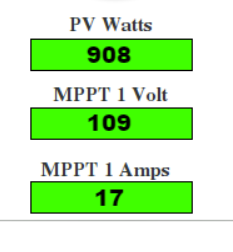
Hi Kobus, I haven"t had that issue for a long time. I initially had my 12 panels split into 6 sets with 2 panels in series per set. I think this caused too much of a voltage drop under certain conditions, so I ended up connecting 3 panels in series, so that I ended up with 4 sets. I don't know what application you use to monitor your system, but the below Voltage on my system dropped too low:
-
I would not go back to having two panels in series. That was my main problem, because when the voltage dropped too low, the MPPT would switch off. I have three panels in series and four strings in parallel and have not had an issue for a long time. I however use Pylontech batteries.
-
Yes your PV Voltage looks good. The minimum and maximum MPPT Voltage will depend on your inverter, but I also have a 5kW unit and I think my range is from 70V to 145V.
-
-
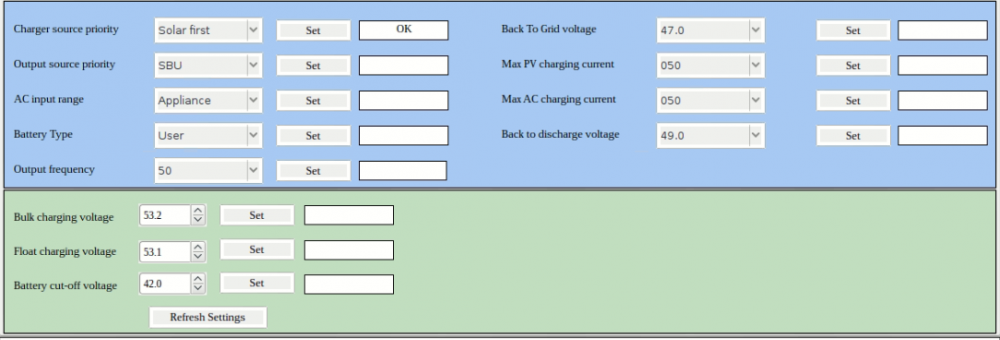
Kobus, most I my issues have disappeared. I think the main reason is because I changed my PV panels wiring so that I now have three 330W panels in series. I have the same 12 panels you have, but previously only had 2 panels in a string. This would cause the MPPT voltage to drop below the minimum Volts required. I also see a big drop in PV Watts, but this is only when the batteries are fully charged. My settings are similar to yours, but your bulk charging voltage seems high. You should check with your battery supplier what the recommended values are. Your back to grid voltage and back to discharge voltage are also different. I think the reason the solar doesn't seem to change your battery, is because the battery is actually already fully charged, even though the inverter doesn't know it (SOC 73%). I have a set of two 3.6kW Pylontech batteries, so with the cable between the Axpert inverter and the batteries, my inverter knows the exact SOC of the batteries.

-
The topic heading will definitely draw attention😂 Do you have any US3000s or is it possible to add a US2000 to two existing US3000s?
-
-
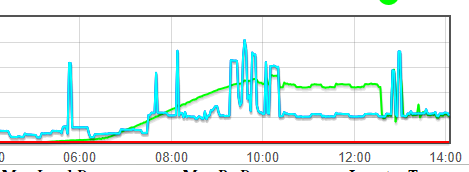
This is the way it always works. Below is another example I captured today: So once the batteries are fully charged, the PV drops like a stone, because the load drops like a stone:) I am never around to actually monitor the charging LED at this time, but according to the Pylontech interface, both batteries are at 100% SOC.
-
Hi, Maybe some extra info I've noticed on this issue. I have two US3000 Pylontech batteries connected to my system. Now what I've noticed, is that the PV drops don't seem to be happening during the mornings. In my case it is most likely because I switch to battery power at 10PM every night, so in the mornings the inverter is quite busy charging the batteries again. Once the batteries are fully charged, the required PV Watts drop significantly to cater for the current load. In the example below this happened just before 1PM: From this point onwards you will notice the drop in PV Watts as the load Watts spike. In most cases currently the system recovers, but I have had some instances where the PV Watts disconnects completely and all power is supplied by the batteries until I intervene.

-
-
-
Thanks for all the advise guys. I started with the option to first replace the ACDC earth leakage with a model from Schneider and have not experienced any trips since last week Thursday. I did however check the Neutral to Earth voltage at the output of the inverter even before making this change and it was around 0.5V, so it looks like my inverter already does the bonding.
-
Thanks @Padwan, but that article seems to have many theories, but no indication what the final fix was you've implemented. I really don't want to end up putting in a change over switch.
-
@Stanley do you perhaps have a model number or some other detail on the Schneider earth leakage breaker that I need to look out for. I need to find one here in Pretoria, so just need to make sure I buy one that will actually work.
-
Jacques, if this was an issue, wouldn't it trip the EL at the input to the inverter?
-
Thanks for the advise. My inverter is fairly new, I think it is a Nov 2018 model, so I trust it has the bonding relay. The hunt is on for a better RCD😀
-
-
-
-
I can try a new one, because the one I have in currently is one of those ACDC products, so I'm not sure how reliable they are.


