


ErwinK
Members
-
Joined
-
Last visited
Everything posted by ErwinK
-
Good morning power forum team Hope there is some way to investigate. I have a pylontech /sunsynk deployment that consists of: US3000 x 4 +- 3 years old UP5000 x 2 +- 9 months old I noticed in the last month that LED's on my batteries and SOC on the sunsynk don't seem to correlate(see photos of 22%SOC, with some not even shown an LED). Also a few evenings, a drastic drop in SOC charge percentage occurs even though a constant load is applied (which is odd, since typically 4 to 5% is lost This seems to have started after a grid-failure/ rainy weather combination where shutdown percentage was reached about a month ago (thank you brakfontein) I want to attempt balancing the batteries first, before going into more advanced troubleshooting with the installer. Will it be possible to balance the system leaving cables as is (especially DC), by powering down all batteries using the physical switch) except one, and moving the comms cable to the respective battery? Will the system (8kw inverter) be able to run on a single battery? I seem to remember that multiple batteries are required I assume it is recommended to disable my solar during the balancing phase (using the big switch on the left of the inverter) I believe balancing should just be charging each battery to 100%, and then powering them all on at the same time? I am also concerned about the alarm status on the "master" UP5000, but I assume this is because some batteries are completely discharged? Fullly aware that I might be facing a faulty battery , but I am more concerned about the difference in discharge as that can probably cause pylontech to come back saying that I discharged the battery beyond specification :( Any other tips are welcome thank you! Erwin


-
thank you for the inputs / guidance. A few points i can use , but will definitely push a few of them once we have the next AGM. problem is, common property unfortunately ( 40 units, installed in blocks of about 5 to 10 units with roofs joined together, single story). they did raise the maintenance issue at the previous AGM, which is quite funny since it is a tiled roof, and did not receive a drop of paint ever since the units was built i believe 20 years ago. Me performing my own maintenance is the easiest i think (even willing to allow a 10 year cycle where i will remove panels ( leaving the brackets), alllowing them to paint the tiles if needed. Increase in property value, especially in the current eskom climate is the big factor i want them to consider. Last ruling was that the trustee need provide rules and regulations regarding installation on common property, and/or provide quotes on installation of seperate carports that will carry the panels (who wanted aesthetics anyhow :/). Should hopefully have another meeting soon to see what options they present.
-
now that sounds like a goal i can strive towards I wish -> really need to get body corporate convinced. really playing the hardball here (had verbal approval from one trustee, but then they back tracked when i asked for it in writing. from 11:00am to 13:43, thus close to 3 hours or 0.045x3 / 0.1kwh. less than 1%?
-
directly from the horses mouth, so to speak. made the measurement as follows : Photo of prepaid meter units, switch off AC supply to sunsynk. Normal house loads powered until batt SOC hits 10% (SOC on the unit showed 9% ->) Switch off AC out of Sunsync (so that it only acts as charger). Switch on AC supply to Sunsync and measure units required to get the batts back up to 100%... starting units 75.61 ending units 60.69 (nice) used 14.92 units to recharge 91% or12.7 units of usage on the batteries. 17,5% losses if calculations is correct. I did push the charging cycle a little, thus losses might be more due to the higher charging current (and subsequent cooling the Sunsynk had to activate) Still feels a bit much -> would love to know if this cannot be optimized? (over a 10 year lifetime, that is a massive amount of power)
-
definitely fun...so to speak lol tried this again today, and in my rush to discharge the batteries faster, so that i can charge them before loadsh*tting hits, i managed to blow the DC fuse installed (was a 125A fuse, and drawing just over 7kw was a bit too much i guess) rough measurements, this round was 7.5 units used and estimated 10.34 to recharge +-35% losses. main reason i am doing this, is to determine if this losses will translate over to the solar install as well (which will leave it a little bit under powered, especially for winter months). Just hoping now that the prepaid meter is not wonky as well 😕 on a side note : i might need advise on what power limits to set on the Sunsynk? Pylontechs will provide 7kw at 0.5C , but then the sunsynk can do up to 8.8 i believe. Is adding an additional battery safer? so many questions to sleep on tonite
-
hmmmmm the maths does seem to add up : / old ages or paranoia must be getting to me lol. planning to test it again tomorrow, if time allows. but yes low usage might be at play here as well.
-
Hi guys Kicking myself for not testing this sooner, but i seem to have massive system losses on my inverter setup. Current setup (very basic description only, as it was done by a sparky thus i don't have the wiring diagram) Eskom power(prepaid) into Sunsynk 8kw ( via bypass trip switch) Sunsynk connected to 4 x Pylontech 3.5kwh batteries (also have trips and fuses in line) Sunsynk output connected to the home load. ( also have an option to bypass this so that home can be powered directly by Eskom if required. NB - I DON'T HAVE ANY SOLAR CONNECTED YET (other legalities with body corporate, hopefully solved soon) Thus the system is currently a relatively expensive inverter/battery solution. Having studied the spec sheet before, i believed losses to be in the region of 15%, however having tested today with basic tools at hand, losses seems to be close to 80% which is really really bad. *SEE EDIT BELOW FOR CORRECT CALCULATION* i setup my test as follows : take a picture of current prepaid units (340.11) switch everything off at home, leaving only one ciruit active. Switch off the eskom input to the Sunsynk (thus forcing it to supply from battery) connect an inline energy meter Activated the load (was a Bosch induction hob drawing about 2800 watts) for 40 minutes (might have been less for about 10minutes) Total usage reported 1.735 KWh Batteries dropped to about 87% SOC if memory serves (which almost matches usage above (14000w bank losing 13% is 1820) after that i switched off the load completely, and restored eskom power batteries was recharged at 100A (think upper limit for a stack of 4 pylontechs is 148A, thus fully in spec). AC draw on sunsynk display was 22A take a picture of prepaid units after batteries was restored to 100% (337.95) Thus according to my rough testing to recharge 1.7 units used from the batteries cost met 3.11 units - >almost double. At current eskom load shedding rates, that is a bit high (think even a genny will be cheaper, minus convenience now) Can anybody confirm if this is within normal specifications , or is there something in my test that can improve before calling in my electrician to check the configuration. (i am also open to have another qualified sunsynk installer look at the install so that any other issues can possibly be solved?) thx team! Regards Erwin *EDIT**************************** -> calculation error as described by P1000 below. thus usage is 340.11 - 337.95 = 2.16 units to recharge 1.735kwh drawn from the batteries. efficiency should be = (output/input) x100 thus1.735/2.16 * 100 = 80%, or 20% losses. I think in this test we can assume losses from battery to load and charger to battery is at play, thus probably closer to 10% .
-
An update on this -> Tested system capacityon friday night, whihc came short by about 8 hours. updated settings as per Achmat's screenshots above on Saturday, but then notice batteries was not receiving charge. (Also gave the battery stack a full power cycle, just to be certain they ar epicking up the master correctly. Enabled Grid Charge option under Batter settings -> Charge, and immediately saw power going to batteries. -> Odd part is i am relatively certain the batteries charged the first time after installation earlier this week after getting a a full charge, tested a pwoer failure again last night, and managed 12 hours from 8pm to 8am , using about 55% of SOC, which matches my planned values roughly. Not sure what the "Grid signal" option is under charge settings, but didn't seem to initiate charging in my current setup. Happy for now however, as i really hope to have solar panels installed in the next month or two, once the Body Corporate gets the neccesary permission for me to perform installation on the unit's roof. with solar installed, charge settings from grid will be disabled as i would prefer this to occur from solar only. thank you for the guidance Achmat!
-
ok will give it a try . power test gave an estimated 3kwh in 3 hours and then switched off. doesn't corelate settings 100% i believe, but will try balancing and updating settings. thx for inputs so far
-
Thank you. that looks more or less what i thought it is supposed to be . about 145a charge for 0.5C, and capacity double that. installed by installer, thus i don't know w.r.t balancing . Does that not occur automatically due to BMS? busy discharging them tonight with a simulated power failure to see if that might correct the situation, but i think updating the settings is a next step. think it is currently on a 20% safe value for DOD. want to first confirm matching firmware before pushing to 10%.
-
Hi Powerforum team I have a yet to be completed install, where i only have my inverter and batteries currently operational, but no panels. Consists of an 8kw Sunsynk inverter, and a stack of 4 Pylontech US3000C batteries. Solarman app reports only a 50% charge after a few days of AC charging, although the LED's on the batteries indicates otherwise. Is there possibly a wrong configuration here, or maybe a firmware incompatibility? If there is any other screens required, please let me know thx guys! regards

-
thank you. yup believe spending the additional money wil be worth the peace of mind : )
-
Thank you! This helps! I was wondering about that -> Can you maybe share what size your Pylontech bank is? I will have Grid available (famous last words), but solar is a bit of a large investment to add. . Assume you have the Inverter connected to the BMS via CAN ( thus allowing the required communication to occur?) regards
-
That might need to be an option -> but trusting the pylontech investment (if i can safely avoid hitting the limits Also at this point the Hubble /BSL prices i have seen is about 20% more per kwh than the pylontech. I assume this varies based on demand, but once i am locked in, future upgrades will force me to stick with Hubble/ BSL thus pushing upgrade costing.
-
Evening PF team after reading another thread where warranties was discussed, there seams to be a consensus that Pylontech might frown upon batteries that exceeded the 0.5C charge/discharge rating. however, on their spec sheet, it states the following : My requirement is to phase in my solution , purely due to budget. Thus i will have an 8kw inverter, but i will add circuits based on the amount of batteries connected. I am going to face scenario's where the planned base load will be 3.0kwh ( 2 x pylontech 3500C at 0.5C), but some spikes may occur due to startup currents (Fridge/freezer etc). The 50A / 100A specifications on the batery will easily meet these spikes. In order to protect the pylontech warranty, i believe i can configure the Sunsynk to "export" only 3500watt -> but then how do i cater for the spikes? any ideas how to otherwise handle this? * note -> The planned base load of 3.0kwh is with scheduled usage of heave devices. Unfortunately "user" (e.g. female ) training can only go so far, thus i am certain they will blow past that number easily. Thx team!

-
Thank you for the inputs. Really informative thread. Guess we are back to comparing VW beetles and other favourite cars Does however remind me to keep battery installation area as cold as possible.( i.e. closer to ambient) Does make me wonder about winter nights (which does go below 25). should i give my pylons a blanky?
-
Ola sir. Can you maybe link the Pylontech warranty you are referring to? The document i have (attached), only refers to ambient temperature as per manual (which is 50deg) Testing is limited to 25 deg +- degree, but not everyday usage. thx! The daily usage thing is a headache -> wanted to phase in my solar install, with inverter plus batteries first, then solar later. Can i request eskom to do phase 1 loadshedding everyday for the next 3 years? daily usage is a strange term however. What happens if you go on holiday and switch everything off , hypothetically, for three weeks? Pylontech_product_warranty_US serie-EU_2020 Oct.pdf
-
This is my biggest fear -> as the disruption is probably worth more than the few thousand saved . is there any direct contact for growatt south africa (their website has been under construction for many months now)
-
you actually made me google this damn sucker for punishment!
-
Thank you sir! i can unfortunately only fit 315w panels due to restricted space on the roof. 400w plus panels is just too large to properly arrange in the space available. are you using batteries ? I am planning a set of pylontech (will need 3 to 4 to provide enough charge to carry me through the evening) can you maybe share your supplier(s) details, as i want to make sure that the Growatt is correctly configured upon order (Parralel + wifi) thank you!
-
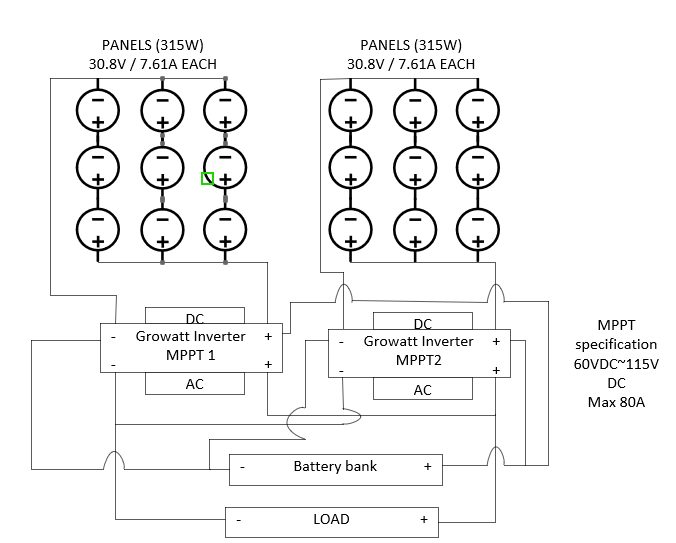
Correction to above planned drawing. (cant find the edit post button :/)
-
HI guys I am looking at a solar system design, and most cost effective seems to be a parallel Growatt system.The manual unfortunately only covers wiring for the parallel side for the battery, Utility and loads, but does not show the MPPT 😕 Does anybody have experience on how PV panels / strings is to be wired in a parallel inverter system?I suspect that each MPPT will be wired separately (eg not parallel), but i am not sure how the balance will then be handled - rough drawing follows : TIA!
-
that matches exactly what i will need -> plain an simple operation. I think i will probably go with SBU mode (if i can afford enough pylons -> balance between panels/batteries seems to be the budget winner here. what happens during an extended overload? (i can't believe the above didn't use more than 5Kw). I am planning to keep geyser , but letting it run on a timer to only heat at the warmest time of the day when there is surplus solar. challenge is to remind the rest of the house not to go rambo with the power during that hour.
-
ahhhhhhhh LIGHTBULB. /runs off to look at hybrid again. thank you sir!
-
very nice setup! also doing my research currently, but need to finish my measurements first and also decide on the inverter/panels. your inverter, going on your tests above, is able to automatically switch to eskom should the load be too much for your panels? i read on another solar advice website that you will rather need a hybrid system, which i don't want to play ball with (not interested in feeding back into the grid) thx sir!


