stevenv
Members
-
Joined
-
Last visited
-
In the end I just went with an AC power supply.
-
Greetings! I'm about to add the first panels to my Sunsynk 5kw (with Hubble AM2) that has been providing load shedding relief since around the middle of 2021. This will be done by a solar installer 🙂 Don't have any pictures/layout of the current setup but everything is currently wired into the LOAD output on the inverter except for the geyser, oven and pool pump which are only on grid supply. Plan is to install the CT clamp and then feed excess solar back to the grid side to supply primarily geyser and pool pump during the day. Since that grid-side feedback isn't possible when the grid is down, will be installing an AC changeover to move the geyser and pool pump (not the oven) over to the AUX output during extended load shedding, or for any worst case scenarios. I'm in Cape Town and my roof options are either NW and NE however by far the most space is on the on NW facing side. The plan is 8x JA 460W (specs below) in series on one MPPT on that NW facing side as the first step. At some point in the future might add some more panels to the other MPPT on the NE side but due to "fancy" roof design I can probably only fit 4 panels on that side. Have been reading a lot on these and other forums and looking to sanity check my plan, assumptions and ask a couple of questions. Any caveats to consider when installing an AC changeover to switch circuits between non-essential (grid side) and AUX load? The label on the inverter states 11A per MPPT but the panels are 11.45A for Isc. My understanding is that this is acceptable and the current will be clipped to the maximum allowed. The latest spec online for the Sunsynk states 13A per MPPT but have seen posts on the forum has been reduced again in newer firmware. What is the limit currently? I've never upgraded my firmware (versions below). I believe there was a 9.9A limit at some point so I might have to upgrade if I've got that problem on my version. Understand that the most important factor to consider in design is the voltage limits on the MPPT. The single string will be just over 400V (8 x 50.01V) so only 25V until the max of the MPPT range. I do however believe this is fine since the 425V is the max operating range and that the max PV Input Voltage is 500V i.e. the buffer is 25% (100V) before there is a problem. The installer will put in a DC box for the PV with a 20A 500V DC breaker, 600V DC SPD and 2x 20A 1000V DC fuses. Does this all sound correct and must there be a DC isolator as well or is the DC breaker sufficient? Have read a LOT (probably too much) on the debate about earth spikes and earth-neutral bonding. Don't understand the technicalities very well but what is the TL;DR version? 🙂 Basically do I need to be concerned about these topics at all or can I sleep again at night without them? Panel spec Pmax = 460W Voc = 50.01V Vmp = 42.13V Isc = 11.45A Imp = 10.92A Firmware versions COMM: e417 MCU: 2159
-
Can you just connect the DC rings to the battery terminal on the inverter?
-
-
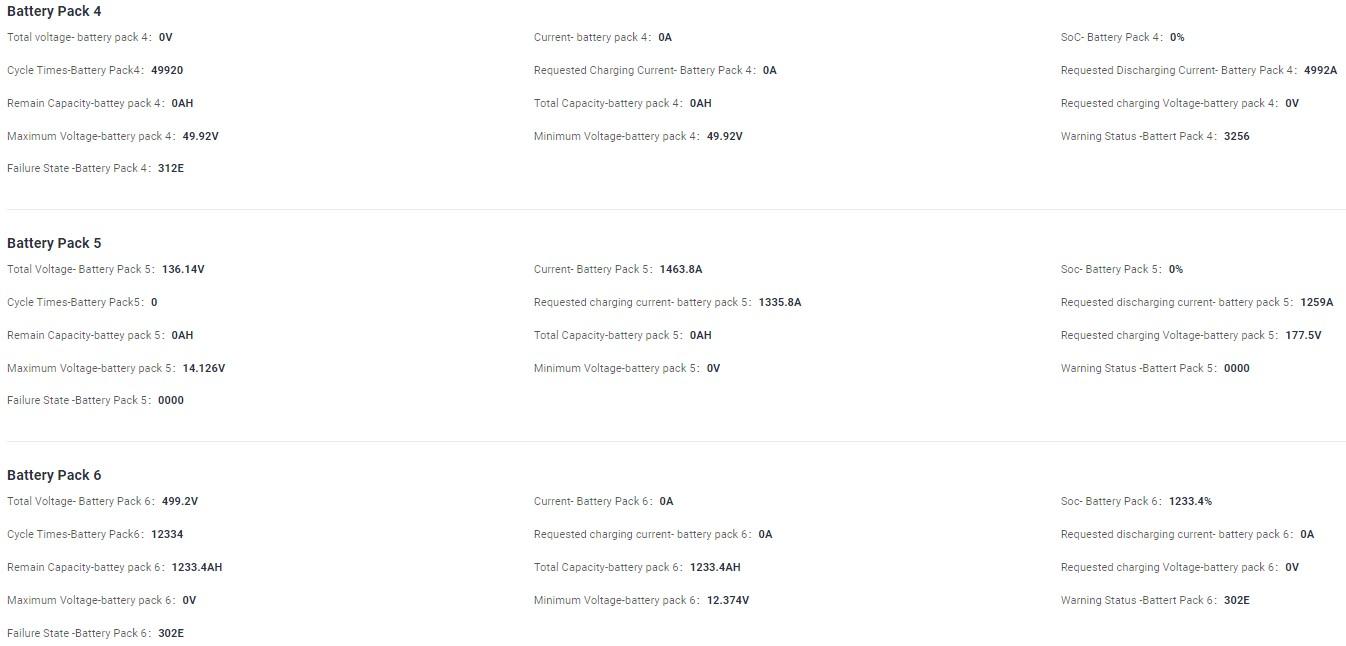
I've got an AM2 recently installed with a 2108x serial number. Solarman Smart is reporting some bizarre statistics for some non-existent battery packs (web UI screenshot below). Could this be caused by the same incompatibility between Sunsynk and Hubble? Or is this issue only related to multiple batteries and Cloudlink? Firmware on the Sunsynk is a bit old and have posted similar question in the inverters forum here.

-
Hi all, I've recently had a Sunsynk 5KW and Hubble AM2 system installed in my garage. Will add solar at a later stage when budget allows but for now this is just providing backup power for essential circuits. Couple of questions: The inverter was bough in the middle of last year so the software probably needs an update. Is upgrading firmware recommended? Currently on the following: Protocol Version: V0.2.0.1 HMI: VE.4.1.7 MAIN_1: V2.1.5.9 It's been warm in CPT the past few days and the garage isn't exactly cool (probably need an extraction fan) but the inverter is pretty warm (around 30 degrees) and the fan is running almost constantly. I put a bike computer on top of the inverter and it got up to 36 degrees. Is this all normal when base essential load is 0.5kw with brief spikes up to 2.5kw? Is there a way to find historical battery temperature data via Solarman? The battery temperature seems high: currently at 28.8 degrees while idle. Hoping there's a way to see this temperature without having to check it manually all the time. Should my system be reporting any values under the "battery pack" sections of Solarman? Some sections are zeros but others have what looks like crazy values e.g. 1233AH and 1233% SOC and 49920 cycle times. Is this a battery problem or is it just garbage data that could be fixed with the latest firmware?


-
My Sunsynk 5kW arrived today. This will be paired with a single Hubble AM2 to give whole house backup for load shedding. Will add solar sometime in the future. I've got a qualified/licensed electrician lined up to install but I'm technical so educating myself to understand how this is wired into the house. From my reading on this forum and elsewhere, a separate DB isn't required if there is enough space in the existing house DB. This means my DB would end up with the following: Meter -> MCB -> EL -> Changeover (mains supply) and non-backup circuits Meter -> MCB -> Isolator/CB -> Inverter -> MCB -> SPD -> EL -> Changeover (backup supply) -> Backup circuits Is my understanding correct? The Sunsynk manual has the following: For AC input on page 10 and page 12: Meter -> RCD -> Isolator -> Inverter Why is there an RCS before the inverter? Everywhere I've ready says EL on the inverter output. Can a circuit breaker be used instead of isolator? I realize there's a technical difference but just wondering. For AC output on page 11: Inverter -> MCB -> SPD + MCB -> Isolator Can the inverter go straight to the SPD since there is an isolator as well? If MCB must be directly after inverter (before SPD), can the isolator then be eliminated since turning off the MCB will cut off the supply? Does there really need to be an MCB after the SPD and going to earth? Or is this actually the house MCB? Stretching my knowledge on the very last point above so explanation would be appreciated.
-
Can you remember where you read this?
-
In the market for a lithium battery and came across this thread: I'm not in either camp. I know a lot of cycle life is marketing but what is the impact to lifespan of the Hubble at 1C continuous draw? Why doesn't Hubble provide any recommendations on discharge rate? Do we think at 1C they expect 6000 cycles at 50% DOD? From the Pylontech US3000C specs, they have a recommended discharge rate (37A/0.5C) which I assume (maybe incorrectly) is to maximize the cycles.
-
Yeah, I see there's a newer model now so would definitely go that route. Our usage is pretty low (<20 kWh/day) with LEDs everywhere and not much more than the usual electronics: easily under 1.8kw. Going to convert to kettle on gas hob so just need to avoid microwave and espresso machine which are both >1.5kw.
-
Thanks! Probably a single Pylontech US3000 in a cabinet with room to add more. For now this would only be for lights and most plugs but excluding any major appliances and the geyser of course. Fortunately the DB is quite well laid out so can feed high consumers before the inverter.
-
Can these Sunsynk inverters run without any solar panels? Might sound crazy but I'm thinking of putting a system into my home starting with single battery grid backup for load shedding and eventually upgrade to solar and add more batteries.