


recre8
Members
-
Joined
-
Last visited
Everything posted by recre8
-
Out of interest, is it necessary to fit such a high current relay? What current is expected to flow through earth when the relay is active and bonding neutral to earth?
-
@Gerrie What do you think of TOMZN Automatic Transfer Switch (ATS). The product blurb claims to switch in under 8ms. Option for manual control as well. Seems very cheap compared to most other ATS's. A bit odd that the all the various current rating options (63A, 100A, 125A) are all the same price. https://www.aliexpress.com/item/4000943742083.html?spm=2114.12010612.8148356.10.405c7e3833u3ti

-
Just realized a mistake in my diagram. Neutral can't be tapped from the neutral bar, since this is after EL. Neutral will be tapped from the top-side of the EL breaker.
-
I need some advice from you guys about the proper way to install my 2.5kW Solis single phase grid-tie inverter into my DB board. As per the manual, the inverter should be connected in parallel with the mains (before the earth leakage) and preferably through a 2 pole isolator/mains breaker and another MCB limited to 15A. Attached is a photo of my current DB, but I've drawn it as a diagram as well (it's a small townhouse so it's a tiny DB and all circuits are protected by EL). Is my understanding correct: - Label existing half of DB "GRID" and label new breakers with "Alternate Supply" - Add a new mains-rated breaker (63A 2P). 10mm2 Neutral from neutral bar. 10mm2 Live tapped from Earth Leakage input. Label "Alternate Supply" - Add new 16A MCB. 10mm2 live tapped from new 63A breaker bottom. Label "Inverter" - Connect inverter using live from bottom of new 16 MCB. Neutral from neutral bar. Earth from earth bar. Surfix with 2.5mm2 conductors. - CT Clamp in seperate conduit to DB clamped around live from prepaid meter before mains breaker. Here is the diagram of what I mean A few questions that I have: - Only my EL is marked with mandatory direction, the others are all omni-directional. In my DB board, the convention is that the load is connected to the bottom of the MCB. In the case of an inverter, which side is really the load? Should the house mains be connected to the top or bottom of the new MCBs? Does it matter - Is it really necessary that the new 2-pole breaker be rated at 63A? Since there will only be a single 16A breaker for the inverter connected to it, may it be a lower current rated breaker? - Is the traditional way to split live to another circuit just to jam another wire into the terminal of a MCB? Seems like it might be difficult to force two 10mm2 wires into that tiny screw terminal. - All cables are plastered into the wall without conduit in my house. I'm installing the inverter directly above the DB board. Is there any issue from a COC-perspective if I chase into wall above the DB and install a conduit. What alternative way is there to get cables into a flush mounted DB? Hopefully I can get most of the work done myself and get a sparky to come do a COC when all is done and turn it on for me.


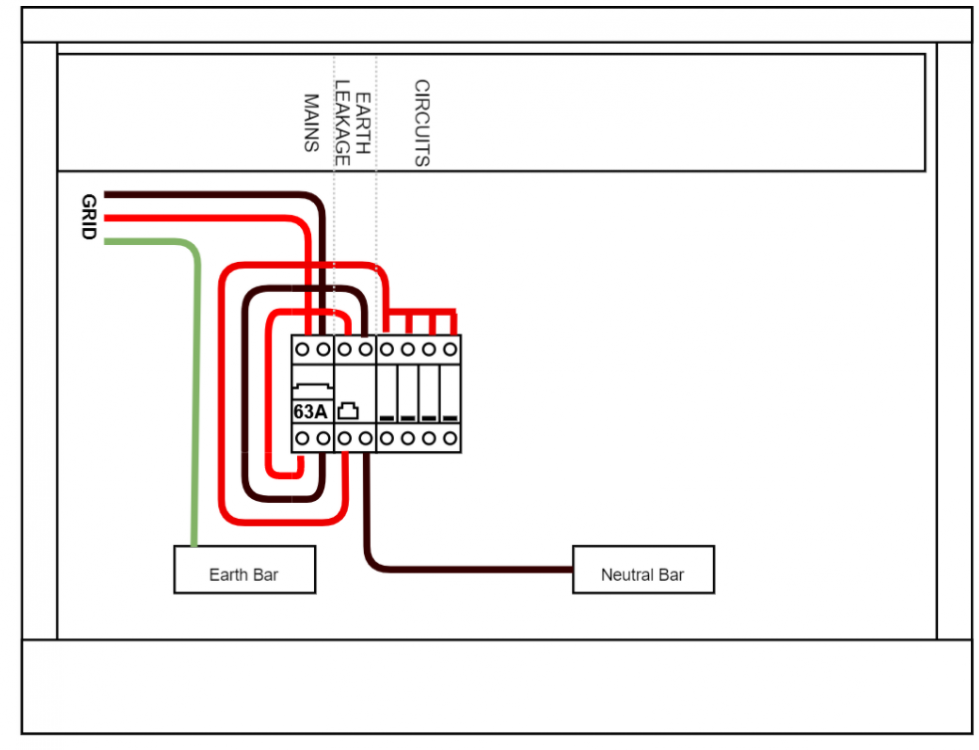

-
Sorry for reviving this thread again, but do you guys have any feedback on these ARaymond PowerSnap S antitheft clips especially in windy areas? I'm mounting 450W panels and considering securing them using 6 of these powersnap clips (3 per long side). But my question is how do they stand up to the wind? Anybody have some long term experience using these?
-
@VassenCurrent price is R435 including VAT for 5.1m length
-
@VassenI just opted for aluminium because all the steel Unistrut I can find is either 1.5mm or 1.0mm thick. The genuine one sold by Cabstrut (P1000T 2.5mm pre-galvanized) is now over R600 a length ex VAT. My dad is quite happy to weld steel, so I can always ask him to make up the A-frames. Do you think the long horinzontal aluminuim struts are OK still to mount the panels on when affixed to a sturdier welded steel frame? Especially with 2m spans (and two panels) between the A-frames? Oh, forgot to mention... I spoke a installer based in Gauteng, who told me to stay away from the galvanized metal strut in the coastal area because "it will corrode away in no time". Not sure if I should trust that opinion? Your frames look really neat. Is the black frame just steel that is coated with a NS4? Or did you have it galvanized as well?
-
I'm in a bit over my head here with regards to my mounting frame structure, having never done this. I'm just starting and with solar and I want to mount my panels (360W 1m x 2m) on my garage roof at a 30 degree tilt. I've designed a structure using Rubicon's 2.5mm thick aluminium solar strut (41x41mm unistrut clone). The structure will be supported by bolting it to the wall on one side and a pine rafter (H3-treated 50x152mm) secured using truss hangers on the other. Three mounting rails will complete the frame. The panels will then be bolted to the two lower rails. I added the third rail (uppermost) for some added strength against the Cape south easter and will use Araymond Snap clips for the top rail. The span between the uprights are about 2.1m (i.e. each pair of angled frames will hold up two portrait panels). I've left a gap of 100mm between panels. What do you guys think. Will it hold up?


-
Long timer lurker finally taking the solar plunge. I live in Cape Town in a smallish townhouse in a complex. Our complex is bulk metered by Eskom (100kVA 3-phase for complex split to 12 units among the three phases). Each unit has a iTron prepaid meter. For some reason, despite being single title units, our complex is submetered. I have relentlessly tried with Eskom to get a conversion done so that each unit is supplied directly be Eskom, and so that we can "enjoy" the lower block tariffs, but the red tape has been prohibitive. Recently, our reseller informed us that they will be changing their tariff model and our flat rate will increase to R3.00 inc. per kWh. For simplicity I'm going to just to use the word "unit" from here on. I've decided to take a little money saved from not travelling during Covid and spend it on "my first little solar install". My constraints are a budget of about R20 000 to R30 000 (max) and a viable unshaded flat-roof space of about 7m x 4m. My daily average usage is about 15kWh. I've been actively tracking my electricity usage (LED pulse metering on prepaid meter using Arduino and SQL database at 1 minute interval) since I moved in, so I have a good grasp of my usage. Considering that cost is an issue and I'm mainly working from home for the foreseeable future, I'm considering going grid-tied for now just to help me lessen my Eskom usage during daytime. I contacted my reseller and asked them about grid-tie. They explained that I should avoid any backflow since I will pay for the energy pushed back, but that the meter has tampering-detection disabled and that it should not trip if there is the occasional few seconds of backflow. If it does trip, they normally swap out the meter. Please note that there are other units connected to the same phase as I am, and the electrical infrastructure inside the complex is owned by us, so it is unlikely that the phase will ever flow back to the Eskom meter. OK, so a little bit about my usage. Here is a chart of my usage during a typical day. My average usage during is about 450W during working hours, with the occasional peak of the geyser and the kettle. Here is also a table showing my current usage between the hours of 09:00 and 16:00 and how much of that a 1.5kW, 2kW and 2.5kW grid-tie system would be able to cover of my usage (given ideal conditions). To explain it a bit better, I've taken my Eskom usage at 1-minute intervals and then capped it at 1500W, 2000W and 2500W to get an idea of how many units each wattage will be able to cover. I can probably get away with using a small system (<1kW), to cover most of my average daytime load currently, but I'm considering the following to get a little bit more bang for the buck. Go with a 2.5kW grid-tie inverter and 7x 365W panels (2555W) Replace 3kW geyser element with 2kW element. Install Geyserwise unit and set to only heat to 65C between 12:00 (noon) and 16:00. Geyser should still be around 50C by 8:00 morning shower time. Shift a few high-usage appliances into daytime (dishwasher, washing machine etc). My hope is to consume about 5 units a day from PV, so that my annual savings will be about R5500 (1825 units @ R3). Also meaning about 5 years to break even. I'm considering the following setup: 7x Canadian 365W panels - Series connection Solis Mini 2.5kW 4G Grid Tie Inverter + Warranty extension + Wifi stick + CT clamp K&N DC Disconnector (Single string 25A 450V) 4mm Solar wires, MC4 connectors and tools, flexible PVC conduit DIY mounting structure with 30deg tilt. DB board add: Mains breaker, 15A breaker + electrician to sign off Lastly, my proficiency with these things I would rate at a 5/10. I'm mainly a firmware and electronic PCB designer so I'm accustomed to <24V. My highest achievement unlocked with higher voltages was to add a breaker in my DB board. What do you guys think? Am I on the right path? I'll post a few drawings of my intended setup later in the week.


