jacquesretief
Members
-
Joined
-
Last visited
Everything posted by jacquesretief
-
The V+ is cheaper but too noisy. The 3.0+ (non V version (v for value)) is quiet and customer is happy and works perfectly with 2x hubble s100. The inverter sits in the dining room. Another customer has a V+ and this one sits in the garage with the cars where it can make all the noisy fan sounds that it desires where it is away from people. That one too I have connected to hubble S100 (2x) and works like a dream (5 hours with a barfridge, 2x standard 200-300w fridges, 1x freezer) with some life still left in the batteries. On both installs I have installed a battery balancer from Geewiz to keep the voltages across both batteries consistently the same.
-
@DenBeech what inverter did you go for?
-
Judging from Sc00bs post, are your earth and neutral bonded at the gen?
-
This causes me anxiety! I am an installer and recently installed this unit. U2 is the same as yours except u1 is 09 56. Fans seem to be on a lot too. I reduce float voltage I think because it is keeping the batteries charged which makes the fans run. But as we speak I had it charging at 27.1 and it is slowly reducing to the news values 26.6. I have 2x Hubble s100 in series 24v. Edit. Months later. The fans on this unit are either on full speed or off. No ramping involved. Techie at Rubicon says the 3.0+ unit has fan ramp feature. This unit also suddenly failed within a month of this post. Because of the loud fan issue (and my lack of willingness to integrate a fan/temp controller (see youtube) I don't know what I will do to recommend a replacement upgraded unit. I will test drive a 3.0+ and see for myself.
-
Hi @JO+e What has come of your grid feeding issue?
-
7.12.7 Additional requirements for photovoltaic (PV) and similar installations that provide a supply as an alternative to the main supply 7.12.7.3 The rated voltage of each circuit shall be clearly indicated at all ends of the circuit.
-
Could you please show me what is underneath...the lid?
-
Cool, no problem. I am an electrician in Durban suffering with this problem with a customer, so trying to learn as much as I can before I try and resolve this repeating problem. The idea of measuring existing natural floating problem will be my first go to. I think it could be an age old watercooler fridge causing the sensitivity (over spike in current leakage). So I will test first for existing current leakage to earth, and then isolate the circuits. I will then either isolate the machine/components and insulation test at 240v and see what low resistance is letting all this surplus current leak to earth.
-
Fascinating, but also advantageous that you have such a tool. This may or may not be the same issue that the original poster has with his tripping earth leakage, for his and many others with the same problem. But I think definitely low voltage surges (spikes?) are the cause of most issues. Is my thinking correct in, say, an old fridge with compressor, a low voltage on startup (caused by return of load shedding) will cause a high spike in current to operate the fridge (to maintain the voltage/amperage balanced relationship, aka rated power or WATTS of the device)? Thus the original "low leakage to earth" let's assume 10mA could spike as high as 20mA because of the increase in current?
-
It doesn't, really: "Sunsynk replaced it, have not opened it"
-
Is there not a better solution than to have idle solar panels? *edit. The above sounds presumptuous. I apologize for the crude method of trying to maximize efficiency. Can't we store this excess energy in localized community, or feed back to the community to offset electricity pricing to specific areas with mention of exactly who is responsible for the benefit of those who live around them?
-
It seems the same to me. It makes sense for a hair dryer or a vacuum cleaner, but not an equipment that can have its neutral and earth readily bonded. It would make sens then to force the neutral/live wire relationship in the plugtop.
-
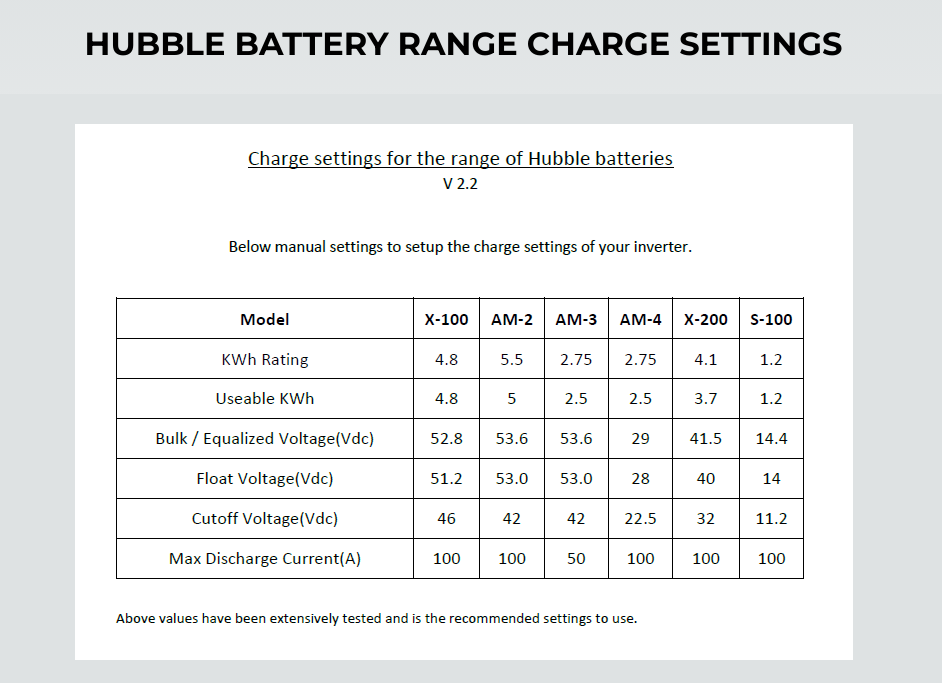
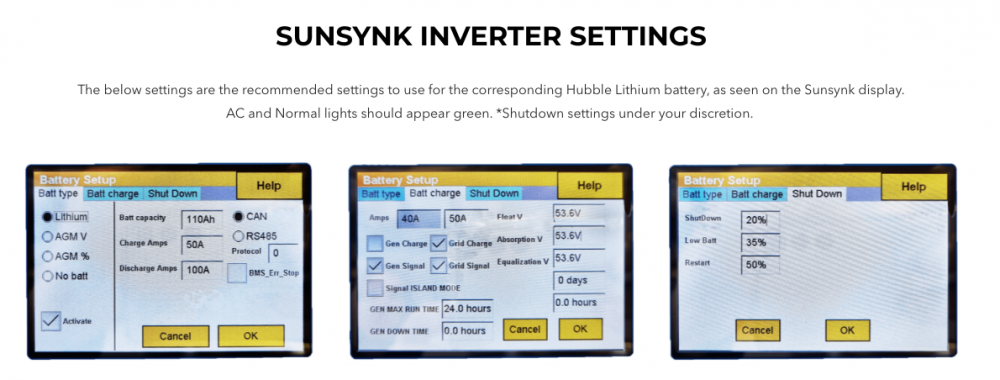
Yeah I'd like the science behind it. V2.2. Is there a Rep from hubble on this forum?
-
Okay you said something important - "shouldnt leave LFP batteries at full charge for extended periods". "Why not add a few panels and start earning a return?" It is for a customer and I am working on it 😇
-
What is the use of timing the recharging (or discharging) of the batteries? Is that for the purpose of balancing solar recharging vs grid recharging the batteries?
-
It actually says to use 53.0v. It says so in the AM2 manual.
-
Thank you gents, What are the implications of not using the timer settings? (A note that my customer does not have solar panels)
-
Hmm your inverter does not even have an earth connection via the schuko plug 🤨 So basically you want to bond the metal housing and interior of the inverter to the neutral of the grid supply? There is a way to test which is live and which is neutral at the socket in the wall but that does not always guarantee that the schuko plug will be inserted the correct orientation every time. I would also not put live to earth on your metal housing mistakenly, but perhaps there is something more to be understood here.
-
Thank you. Could you go into the more technical details as to "untick" timer then retick after fully charged battery? Do I leave it off in the morning and say come back at night? This is for a customer, is there a way that I can automate this?
-
Hi guys, Thread hijack! If I have a 5kw inverter only (solar, later), which "timer settings" should I use, if at all?
-
I recently found out that the sunsynk 3.6kw is fanless, exclusive to SA model, but it is the same price as the 5kw with fan 🤨 The important thing is that you know your loads and the maximum you will need at any given time. I think this is important.
-
jacquesretief replied to jacquesretief's topic in Starting In Solar? Feel free to introduce yourselfInteresting where this conversation is going. And Erastus, why are you showing us pictures of your water filter? It's perfectly clean...
-
jacquesretief replied to jacquesretief's topic in Starting In Solar? Feel free to introduce yourselfThank you for the feedback, I have made the critical corrections. I realized this mistake of '2c' instead of 0.2c whilst talking to my neighbour about the same thing. Why will 6000 cycles at 50% Dod yield exactly the same energy at 3000 @ 100%? Maybe I have my concepts confused and my understandings are incomplete: is one cycle of energy the maximum capacity of the battery fully once depleted? Is 50% DoD of the rated battery capacity depleted half of a cycle? If I used 2.5kW of power in an hour of a brand new battery, I would have used 5999.5 cycles? However, if I continued to use the brand new battery to 0%, I would have used one cycle, leaving it with 5998 cycles remaining? Please note everyone that I do not have panels nor inverters nor batteries and is purely hypothetical and one needs to approach this thread abstractly, not practical. However the calculations and formula proving that lithium ion batteries alone is cheaper than paying for and using grid electricity remains true. As an installer, who, depending on my customer, may wish to expand with solar panels at a later stage while reserving basically a lifelong access to lithium ion battery thus offsetting the negative side affects of load shedding. Panels as glorious as they are, I did not create this thread to promote their use, or not.
-
jacquesretief replied to jacquesretief's topic in Starting In Solar? Feel free to introduce yourselfOn average, every day I use 15kW of power. That's R936 per month. If I were somehow able to keep a 5kW battery fully charged, I would be able to deplete it 3 times a day and cover my full electricity use per day. That means, I would use 3 cycles per day. This is an easy one: This means that I would have a 1000 day battery. Just under 3 years of lifetime use. Instead of paying the municipality I could buy a new battery every 27 months (R936 electricity bill * 27 months). Which means that I save R5000 a year, which I could put that towards more batteries to get to that maximum cycle life of 6000. I'm loving this 😍
-
Jacques and I live and work in Waterfall, KZN. I've done a few Mecer + lead acid load shedding DB installations and now taking a big step towards solar and larger inverters and its scary and exciting and I'm thrilled to introduce myself and HELLO EVERYBODY! 👋 So I was wondering about using batteries as a way to not only have a storage of energy but as a way to offset electricity cost. Currently I am paying R2.0866 per kW of hourly usage or converted R0.002c per watt of electricity used in an hour. An AM-2 Hubble Lithium Ion battery sells for R26 000 @ 3000 cycles used at 100% DoD. Consider the calculations below: 5.5kW = 5500W 5500W * 3000 cycles = 16 500 000 watts per full lifetime of one battery. R26 000 / 16 500 000 = R0.00157 cents per watt. That is 24.5% cheaper than Ethekwini's tarrif. At 6000 cycles (50% DoD,) we have twice the amount of cycles, therefore twice the amount of savings. Almost 50% cheaper!! We know that tarrifs have been on the rise. Unless municipalities pull thumb or already pulling thumb and considering sourcing electricity independent of Eskom we can have hope. Another source of hope is that individual sources of power production have passed legislation to self-generate from 1MW to 100MW and I remember recently reading in an ethekwini newspaper that bi-directional meters are being highlighted to being rolled out where you can sell power back to the grid. We really can save the earth by taking these small steps away from coal/fossil fuel burning to harvesting natural sunlight energy.