Jakes
Members
-
Joined
-
Last visited
Everything posted by Jakes
-
This forum has been a great source of information for me over years. For that reason I greatly appreciate the inputs of members like 87 Dream and Buyeye. I (we all) have little to gain from brand bashing or guys who are sensitive about certain products causing them not to see the shortcomings. As an example: I spoke to 2 suppliers about Axpert (one is not an "anti-Axpert" guy, the other is very much a "pro-Victron" and "pro-Sunsynk" guy). One says that he has been installing Axpert for 8 years. Only one problematic site. It was later found that the electrician wiring an extension to the building made a mistake with the wiring - not the inverter's fault. The other guy says that the longest he has ever seen an Axpert last is 18 months. He guarantees me that if I connect solar panels to that machine, it will pack up within the first 3 days. He regards their average lifetime as a couple of months (as long as you don't connect solar panels to it). Should one consider Axpert, the calculations make for interesting reading (this is based on quotations I received). For the price of Victron equipment that will provide 6.5kW of power, you can buy 4 Axperts providing 8kW. I fully realize that this is not comparing apples with apples, but if we decide to compare rands with rands, we can buy 4 Axperts, install 1, (through it away after a couple of months, according to my supplier above), and have 3 paid for inverters on the shelf to install. Should 3 Axperts outlast 1 Victron, it made some financial sense. Are there more suggestions for an inverter? (I am slightly concerned about the abundance of reading material, also on this site, where Axpert problems need to be addressed with updated software. There's a lot written about Sunsynks needing updates as well, btw. My perception is that a quality product comes sorted from it's mother, gets installed, and works). Thanks again for all the good inputs.
-
Hi B Yes, off-grid, as in no eskom. Will you be happy with an Axpert Max in an off-grid system? Reliability, endurance, back-up/support and so on? I am thinking 8kW inverter, 8kW panels and 10kW storage. Which components will you use for the system? Thanks for the help. J.
-
I'm planning an off-grid system at a facility of us in Gauteng. I have installed a couple of systems over the years, but it is not my job. The plan is to use an 8Kw Sunsynk inverter for the system. I recently started doing some research on the inverter because they are relatively new to our market. I watched a video where the manufacturer communicates how eager he is to help guys from our country. I was impressed. I also watched a video where, what seems like the local importer, communicates that he only supports installers. That excludes me, and a lot of guys on the forum who installed Sunsynk product themselves. Are you guys comfortable being excluded from support by the importer? Please share your experience, as I really like what I read about the brand.
-
That's interesting. I sometimes think about a situation where I can use them as a standby bank. We've had wonderful weather lately, and they work like normal (I did quite a bit of welding tonight and last night). I'd like to get more pv and then another mppt for one of the sets, but I don't know if it's feasible. (You know about the other system I must get up and running soon, asking for some investment).
-
My guess is that these will be 15S, being designated as 48V, not 52V. I'll check them out when they arrive, and read, and ask if I have to.
-
Hi Vince I've decided on 2 Shoto 48V 100Ah batteries. The supplier said they are good replacements for lead batteries and work well without communications. I trust that to be true. He seems to have good experience with the specific situation. They'll hopefully arrive within the next day or 3. I'll set the MC's to talk nicely to them.
-
Hi V & S Thanks a million for your inputs, and thanks for the kind offer. The MicoCare components can be set to the values that are needed. It seems that there are batteries able to do what I need. I'll report on the outcome.
-
Thanks Vince There seems to be lithium batteries that can be operated without the need for communication with the inverter. I'm investigating that route.
-
My off-grid system is made up of 3750W of PV panels, a MicroCare 100A charge controller, a 5kW MicroCare inverter and 12 165Ah Narada lead carbon batteries. After 6 years, the batteries are nearing their end. I'd like to replace them a lithium battery. A FreedomWon 10/8 seems to be a good choice. My research about the road forward has brought some confusing information. MicroCare says the charge controller and inverter need to be sent in for upgrades - they'll be out of service for 2 weeks (MC wants them for 5 days). That is not practical, as running a generator for 2 weeks will be prohibitive in more than one way. MicroCare also said that the charge controller as it is now will charge a FreedonWon battery, and the generator will charge the battery through the inverter, but I should only charge the battery to 80% capacity. (This is without the upgrades). FreedomWon referred me one of their agents - a very knowledgable guy. He also sees the only way forward is to upgrade the MicroCare equipment and add some accessories. Has somebody been down this road? What is the best solution.? Thanks a million. J.
-
I haven't posted on the forum in a long time. Our system consists of 3750W of panels, a 100A MicroCare charge controller, a 5kW Microcare inverter and 12 165 Ah Narada lead carbon batteries. These were from days before the fancy batteries of nowadays. The system has been running for nearly 6 years now. My only expense thus far has been for a replacement fan in the inverter. I think it cost R140 from ACDC, about a year ago.
-
There's basically 2 tipes of e-bike: One is where the motor propels the bike on command of a throttle, not needing the input of the pedals. The commuting- and beach going guys use this system. The sports market uses a pedal-assist system. The motor will not give any input unless the bike is pedalled by the rider. The system measures the torque applied to the pedals and adds an amount of power to that. Most systems have about 4 pedal-assist levels. In the lowest, the electrics will add say 70% of the riders input, the next level something like 100%, then 200% and the highest one might be 300%. These are mostly programmable. In SA we align ourselves with European laws governing the use of e-bikes: the maximum assisted speed of the bike may not exceed 25km/h. The bike can go faster, but then it's the rider pedalling it like a normal bike. The dealer can remove the restriction, for "off-road use", but then the customer signs an indemnity. It's a very meaningful way of riding, especially for members of a family where abilities differ.
-
Thanks guys, much appreciated. The bike manufacturer indicates that the battery could be completely discharged and charged again for 500 cycles before it starts to deteriorate. That could be close to 50 000km - a lot of time to spend on a bicycle saddle.
-
Hi guys I'll appreciate your opinion on this. An e-bike uses a lithium-Ion battery. Let's assume a range of 100km/charge. My questions: If the bike does 30km/day, how will a good charging regime look? Should the battery be charged after every ride, or only after 2 rides? If the bike does a 50km ride on a certain day, and a 30km ride the next day, should the battery be charged after the 50km ride, or only after the 80km? My concern would be to optimize the life of the battery. Thanks for your inputs. Much appreciated.
-
I bought my whole system from GW Store, somewhere in 2014. After much battle, I got the panels. After a lot more hassle, I got the charge controller and inverter. I also paid for 24 Willard RT23's. I have not received them (yet).
-
+Me
-
If the roof is 6mx5m, and the panels are 1mx2m, you would be able to fit 15 panels, not?
-
Hi LivSol I'd like to learn. 1. You're correct - it is a 48V system. The 12 batteries are arranged in 3 strings of 4 each. 4 batteries in series make 1 string and the 3 strings in paralel make the pack. How should I reduce the number of strings? I'm keen to learn. 2. Read about the Narada lead carbons. They don't run the same voltages as other lead acid batteries. I can supply some information, but there are values that I haven't got. 3. The "production" figure of the charge controller seems to be at an average of around 8-10kWh/day. With a mountain to the east and to the west our sun day is shorter, but I doubt that it would be too short. Normal sunny days the system goes into float sometime in the afternoon. If the panels were insufficient, that would not happen? 4. Yesterday I isolated the panels from the system. The battery voltage soon goes down to 51V. I switched on 2 kettles (3550W in total) for 45 minutes, refilling with cold water once they boil. The voltage was at 49.5V, after the "test". (We could now make coffee for a compound). Your views please.
-
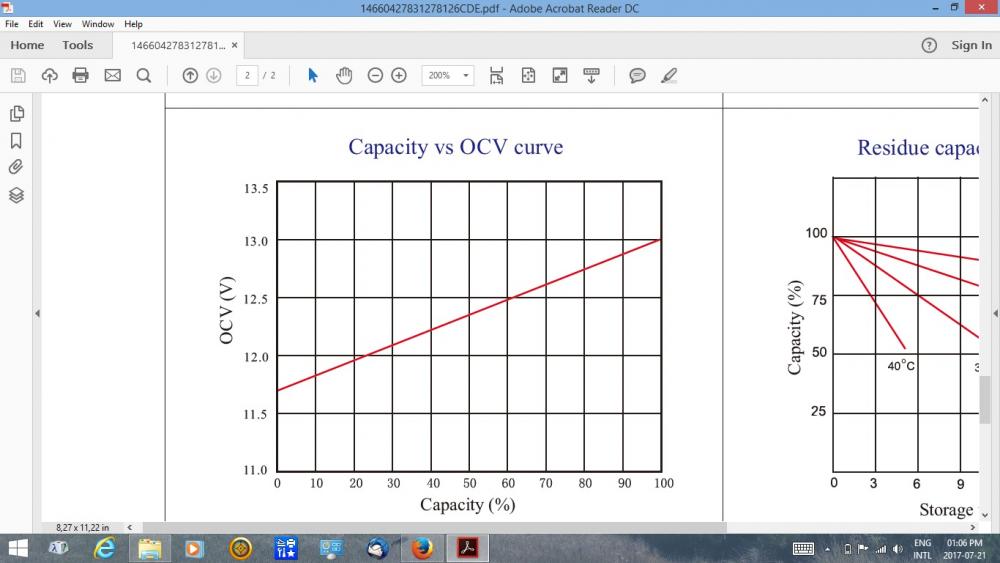
It's not really important, but Narada supplies these figures for REXC's:
-
Attached is the information Narada provides. My effort at drawing a graph. One looses the skils after many years of not working with these things. Batterygrafiek.xls
-
Thanks so far. I'm concerned about the batteries coming down from 52V to 50(or so)V in less than an hour, without any load. I have made notes of different readings, but I'll try and report back with more and better information. What is your feeling about testing a battery with a heavy load? I see the Hawkins tester can apply a 600A load to a 12V battery for 15 seconds. Won't this shorten the life of a battery that is not in a 100% condition? Weasel, I recently saw that my charge controller "overreads" by 1V. I would have probably bought diffent equipment if I knew about inaccuracies like this. One hears good things about a product and you base buying decisions on that. Somehow I expected more from MicroCare.
-
Guys My system consists of the following: 15 x 250W Renesola panels 100A MicroCare charge controller 12 x 12REXC200 Narada lead carbon batteries. (They are 165AH at C10) 3 x HAO2 battery balancers 5kW, 48V bi-directional MicroCare inverter The system has been running for nearly 700 days. We are off the grid. I recently noticed that the battery voltage might not be what it should be. I realize that voltage is not the best way to determine the state of charge or health of the batteries, but surely it must give a good indication. While charging (in "Boost" mode), the system would indicate a battery voltage of 55.4V. It would go to "Float" in the afternoon on a sunny day like it should, indicating 54V. I started suspecting that something might be wrong when I saw the voltage dropping more that expected after the sun has gone down. It seems that the battery voltage would go down to 51V within an hour after the shadow has moved over the panels. It would drop to 50.5V during the evening and be at 49.5V in the morning. In the evening it works lights in the house (all LED's), one 10W LED throughout the night, makes some tea, works an electric blanket and works 3 x A++ fridge/freezers and a bar fridge. I have taken individual strings of batteries out of the bank to see how they behave. Immediately after isolating a string the voltage will be at 52V, reducing to 51V within an hour, stabilizing at 50.5V, where it will stay for 72 hours. The voltages of the different strings test very close to each other. Testing all the batteries individually also indicate the same voltage, even after disconnecting the balancers. According to Narada, 47V would indicate 0% capacity and 52V 100%. This means that the batteries in my system would drop to 80% capacity soon after the charge is removed, then down to 70% where they will remain. I tried getting hold of the Narada importer to get their input, but have not had any success yet. I am concerned about the health of the batteries, but it could also be that I've got some settings wrong. I'll appreciate your opinions.
-
Hi S We've been using a dishwasher for more than 30 years. My wife says if only she knew, she would have bought it before a lounge suit. When we prepared for our move to off-grid living in the Western Cape, I thought that we would greet the dishwasher farewell. I bought a couple of power meters and tested the consumption of the major clients. After seeing the results, I told the dishwasher that it (she) would be the first to climb onto the truck bringing our furniture. The figures are like everybody indicates. We recently replaced that Siemens with a Bosch. The manual reckons that its default program is its most economical one. It takes 3h 30min. We try to only operate it when the sun is shining. The last 50 or so minutes is used for drying. We would sometimes when it is late afternoon and there's less than an hour left, switch the machine off and open the door for the load to dry by itself.
-
Thanks so far. We're heading for a good solution. Personally I was thinking along the same lines as Weasel's suggestion. I'll clear out with the M/C-man before I start grinding and welding on his circuitry. If he doesn't like it, he can come up with a better solution. For the noise-generating-device, something like a not-so-loud car hooter might work well. For that I can borrow 12V from the battery of the generator. Electronically I'm worth as much as an earthworm. I'd have to ask CH or P to build the system, if we go the electronic route. I'll update on the progress.
-
Jip. 48V/5kW Bi-directional.
-
Hi Tripple T I want to make the buzzer louder, you suggest a R60 000 solution. A 10kW MicroCare costs R50 000. Then to replace 160m of underground cable and some of the switchgear? Eish bru. Splitting the load between 2 inverters will not really solve the problem. We sometimes overload the system from the house alone. We don't really have too little power, we just need to not switch on certain equipment while others are doing duty. Then, if we switch on something that overloads the system, we can switch it off imediately, if we get the audible warning.