JayMardern
Members
-
Joined
Everything posted by JayMardern
-
Now I wish the Sunsynk had an option for 210V! For a better balance between being more in-range and lowering resistive-load peaks. Ironically the only appliance I’ve had fail in the decade at my house is the fridge compressor! (Albeit after 8 years). I checked it and it was rated 200-240V~50Hz (and we don’t go much below that), so I’m not sure if it’s related (it’s now on the essentials circuit but still exposed to grid when there’s utility power.) I’ve been told that SANS 10142 allows for a 10% tolerance at supply (so voltage could be as low as 207V) with another 5% drop allowed under load (so around 197V which would put me just in range). If it really is just 5% in total then I should take a photo of my meter and submit a ticket to City Power. I think I’m going to go ahead and do the geyser move; I’ll ask the installer to put it on a change-over switch to allow me to put it back to non-essentials if Aux doesn’t work out. And if we bump up against the inverter max I’ll either instruct the family to flip the switch prior to using the higher-power kitchen equipment (just the snackwich at present); or I’ll take the plunge and try out using 200V…
-
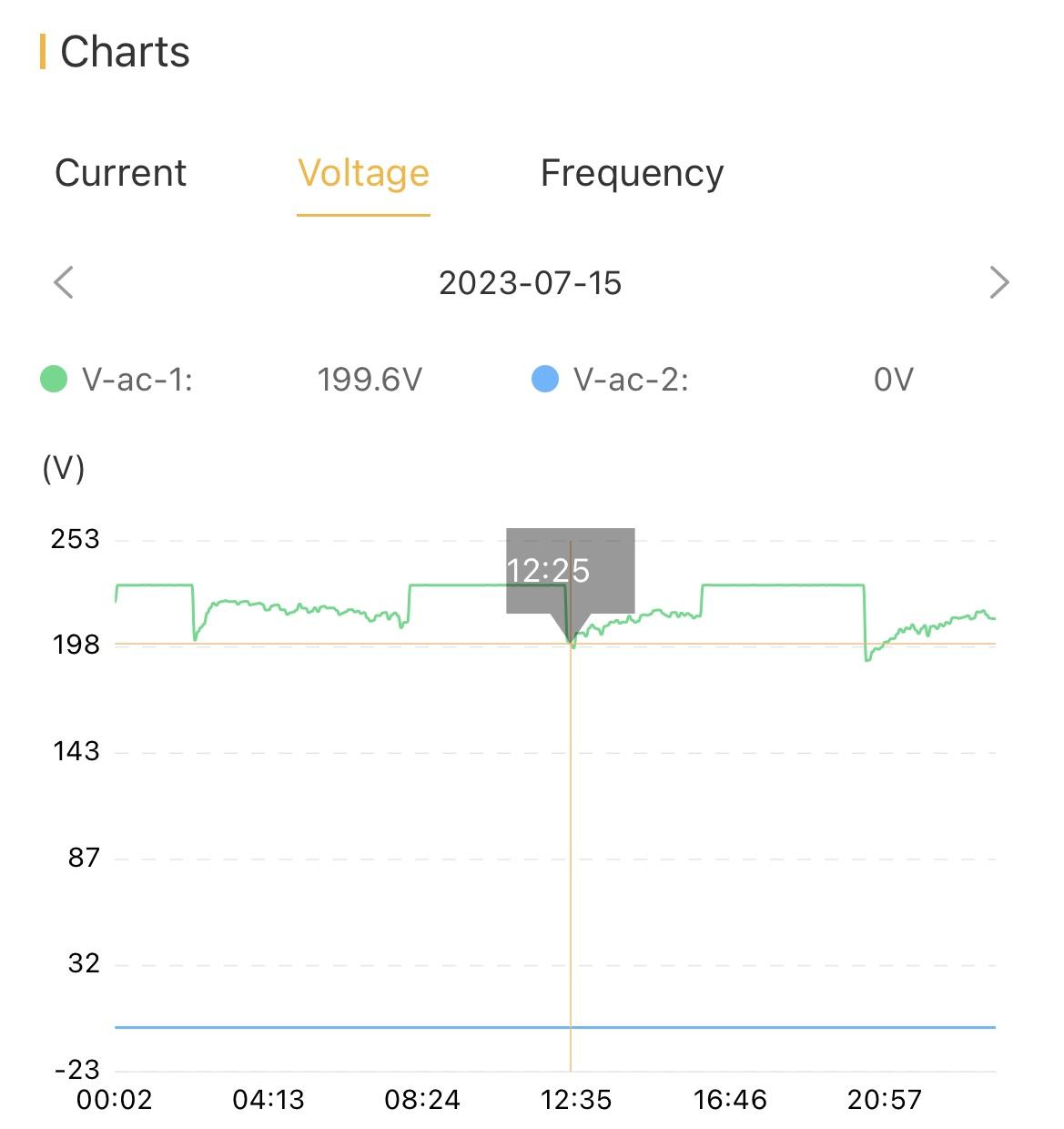
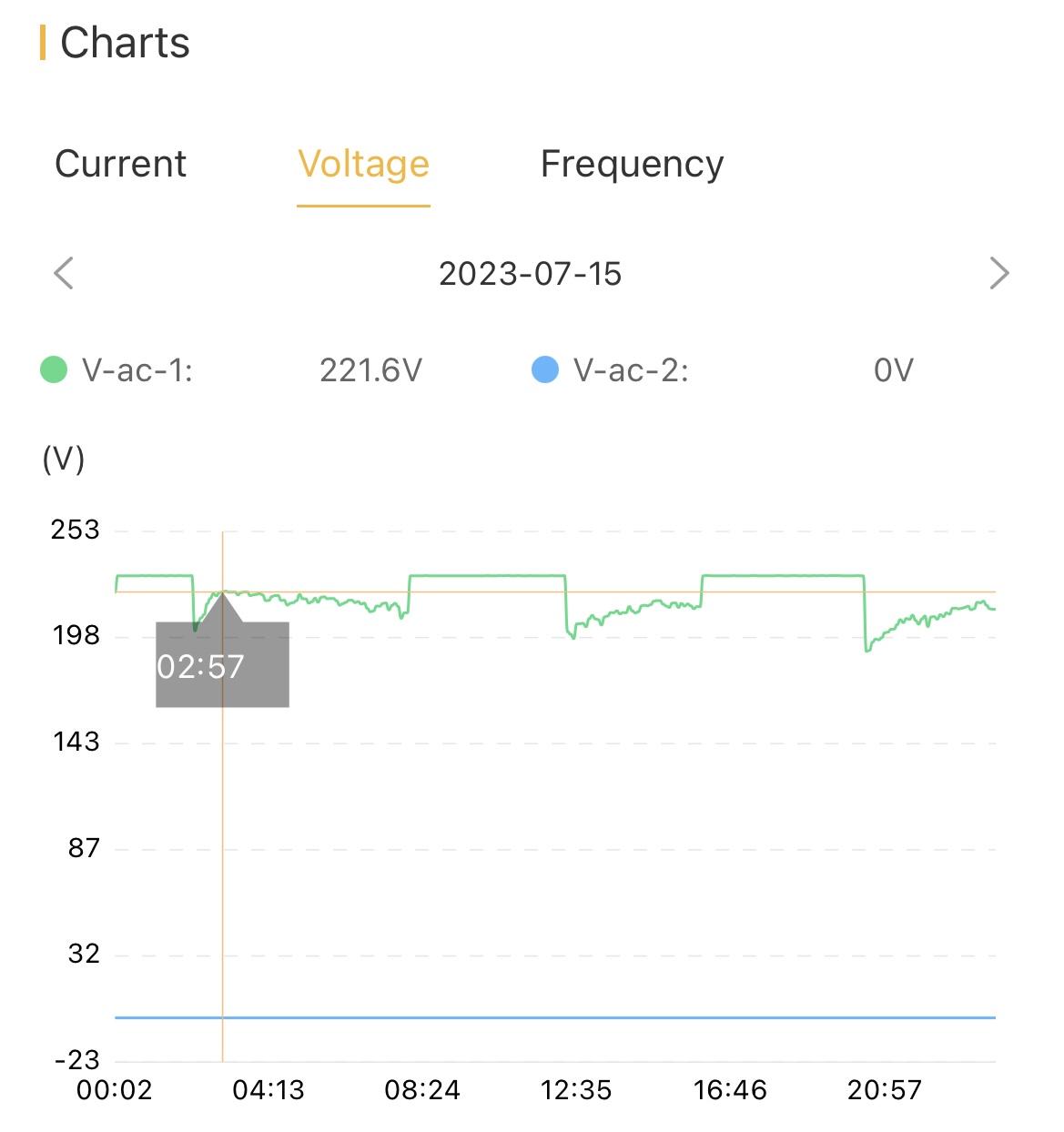
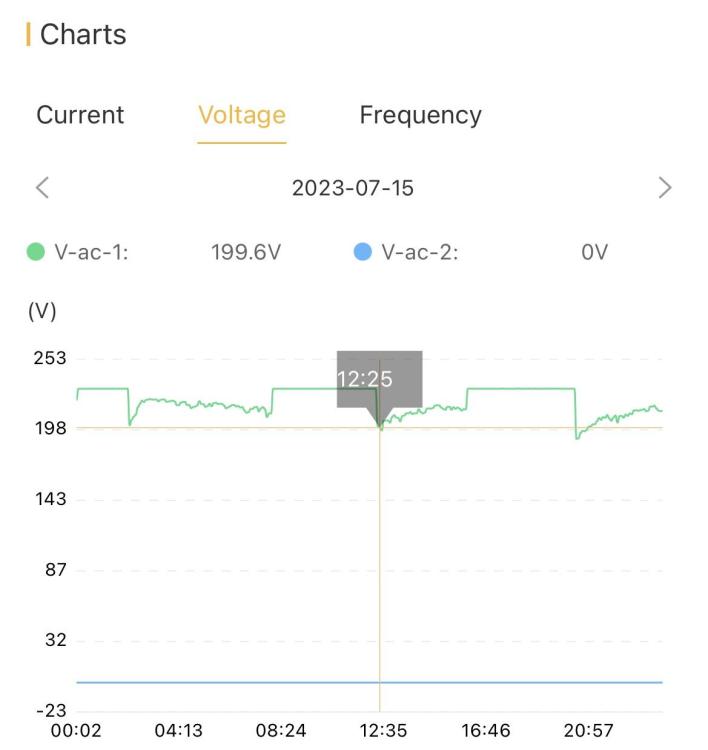
I’m in JHB; City Power - my area’s power infrastructure is rather old so presumably this is part of the reason. Back before the Sunsynk the low voltage was a major issue on my Must inverter for several years since it was low enough to delay charging as the Must would wait for it to hit 210V - which sometimes took over an hour, leaving me with a sub-50% (lead-acid!) battery after the next round of load shedding. Not great for the lifespan of those poor old AGM’s… this is one of the reasons I upgraded to a new inverter and Lithium. (Well, this and having to purchase a new pair of 200ah AGM batteries every 18 months!) My property has two phases (only one is in use at present) so perhaps I should see how the other performs… other residents in my street have reported similar voltages though. Attached are some graphs from the Sunsynk app to illustrate a trough (right after load shedding) and a peak: the plateaus between are the unit outputting 230V during load shedding. I feel like I’m probably safe to drop that 230V output voltage in my case…

-
Aaaah so you’re saying that the time slot had ‘Grid’ unticked in the System Mode-System1 screen - which forbids the inverter from pulling from Eskom at that time (those settings seem to take priority). This actually makes sense I guess. Thanks for letting us know and shedding a bit more light on this otherwise cryptic Aux port!
-
Hi! I’m looking for confirmation before I pull the trigger on moving my geyser to Aux: Aux contributes to regular Load capacity, correct? So if my Load pulls 2.6kW and my geyser-on-Aux pulls 2.5kW on my 5kW Sunsynk, the inverter will instantly trip, correct? (It wouldn’t cut off Aux first to avoid a trip?) If so, I may undervolt my inverter (from 230V to 200V) to reduce my peak resistive load (including geyser) power…
-
Thanks for an enlightening read!! This forum has been a treasure trove of info! I’ll see if I can find that thread; though in my case many days the Utility Voltage doesn’t go above 220V and it’s often just 200V post-loadshedding anyway so perhaps in my case the differential won’t be big enough to make a difference. I think I’m going to pull the trigger in the near future when the installer has capacity. I’ll revert back with my findings when it happens. Thanks again!
-
@ViperGTI Did you ever come right? I wonder if this might be an issue with parallel installs… are you running latest firmware? There’s so much confusion regarding Aux; it’s poorly documented. The Solar Power figure has been found to indicate how much PV must be in use by the inverter to trigger the port. Thus if there’re no loads and the battery is full, a high figure here will stop the port from activating even on a sunny day. For this reason it probably makes sense to set this value low (perhaps just below base-load, as a simple indicator of the presence of PV) and instead use battery cut-offs to determine if there’s sufficient sun to keep the port active (since the battery dropping indicates insufficient PV for the load). This is clarified quite nicely in this thread:
-
If you can find the model number then you can look this up based on the official data sheet. For example if it’s one of these Narada LFP models: https://mpinarada.com/wp-content/uploads/2020/07/Narada-NPFC-FLS-NA-V1R11.pdf Then they’re rated at 6000 cycles to a depth of discharge of 60% at 25 degrees Celsius. You can then use this to convert to days.
-
Yeah that’s the plan; but doing so is going to contribute to the maximum that can be inverted (ie 5kW) So my current off-grid 2.5kW peak; plus the 2.5kW of this geyser; is going to bump me against the limit. Hence my idea to drop the “INV Output” to 200V (from 230V), which should drop that peak to around 4.3kW - comfortably under the limit… I'm just not sure if there’re other potential issues I may not be considering…
-
Hi! I have 4.5kWp During the winter there’s enough spare PV to keep it running from 10AM to 3PM… summer would be even better I imagine.
-
Running a Sunsynk 5kW inverter with a typical load-shedding essentials load of just 0.5kW with peaks to 2.5kW when the kitchen is in use; with a 1C Hubble AM5 5.1kWh battery. When there’s grid, CT-export saturates my PV wonderfully; but during daytime loadshedding many kWh go to waste due to my low essentials load. Thus I’d love to move my smaller 2.5kW geyser to Aux as per the thread linked below. Unfortunately those peak kitchen loads mean that I’m going to be flying close to the inverter limit during load shedding if the kitchen gets used whilst the geyser element is active. I could downgrade the element, but since these are purely resistive loads (Geyser, Snackwich) and the Utility often provides just 200V post-loadshedding anyway without issue, is it a decent idea to simply drop my Inverter Output to from 230V to 200V? This would save around 0.8kW on the geyser+kitchen, putting my peaks at a safer 4.2kW and allowing me to move the geyser. Thoughts?
-
Exactly; the conflicting info out there is the reason I like that thread. Even Keith's videos on the topic aren't very clear. In my case I run CBI Astute timers that keep each of my two non-essential-connected geysers heating separately during the day (to reduce overshooting of PV availability) from the Sunsynk via zero-export to CT; and then the timers switch them off in the evenings. It works really well, but when there's daytime load shedding those non-essentials are of course powered down; so the result is a lot of wasted PV since my essentials average at just 0.7kW (and peak at 2.5kW briefly when we use the kitchen). I've attached a chart of this morning's usage with load shedding starting at 8AM and causing a loss of at least 4 units; (yesterday was twice as long - around 8 units wasted). The large geyser is on from 10:00; the smaller one would have been on until then but didn't get the chance due to LS. Aux would allow me to move this smaller 2.5kW geyser to the inverter and keep it running if the PV/battery levels suffice. The catch is that I only run a 5kW Sunsynk so I might be flying a bit close to the maximum AC power output if the kitchen gets used at the same time (although I could perhaps undervolt the Inverter Output from 230V to 200V to drop the resistive loads' power usage and give me an extra 15% headroom on both the Geyser and the kitchen equipment; 200V is what I often get from the utility.) What are your reservations with regard to running your geyser like this? Any major issues?

-
Yeah OP is presumably using the default System Mode/System1 settings which would work mostly as he describes if I'm not mistaken. The Aux Load ON and OFF percentages seem to confuse people but it is indeed covered in that thread, And as you say, the Solar Power (W) value in that first image is going to be too high for most people - most of the time it makes sense to have it just below daytime base-load to allow the port to trigger when there's sun (and allow the battery dropping to the OFF percentage to tell us if there's enough sun); although this does get covered there. For me, reading that thread was the first time I actually understood how this feature works. Reading it has me now considering moving my smaller geyser from Non-Essentials onto Aux to capitalize on PV during daytime load shedding. If you find other inaccuracies post there so that we have a record for future reference!! I may just use your advice myself 😀
-
Depending on your settings PV can already be prioritised when there’s excess; though leaving the geyser on non-essentials and allowing the CT to handle this might be more suitable in your case. This is what I do; works great. Take a look here regarding Aux/SmartLoad:
-
Linking to this thread which contains the answers (and a lot of other useful detail) for the benefit of others (like myself!) who found this one first using Google:
-
It’s almost definitely related to balancing: if you take a look at my attachment you can see my battery drops from 100% to 99% whilst absorbing power (this is after charging post-load-shedding). It happens every time. I’m certain it just indicates that battery cell-balancing is completed. Happens during PV cycling day-time as well; even when the SOC for the time slot is at 100%. I run an unlimited-cycle-warranty battery - but even then, I’d be extremely surprised if this contributed to the BMS cycle counter… As a side-note, OP would be an excellent candidate for setting his SOC System-Mode settings below 100% to smooth out those peaks and troughs (and hence capitalise further on that glorious PV!); at the expense of a few extra (legitimate) battery cycles!

-
Nope: a single cycle is typically 100% (so on a 5kwh-capacity battery, a single cycle is the full 5kWh). If this is indeed the BMS balancing, it’s not going to contribute!
-
I suspect it denotes battery cell balancing. We can see your PV is dipping very slightly into your battery; balancing then happens thereafter briefly. It happens after running during load shedding as well, right? I see the same behaviour from my Hubble AM5: 99% is the default “full state;” but after the battery SOC drops, the battery hits 100% at the end of each charge (presumably indicating battery cell balancing) for a little while before reverting to 99% and staying there.