Multiwatt
Members
-
Joined
-
Last visited
Everything posted by Multiwatt
-
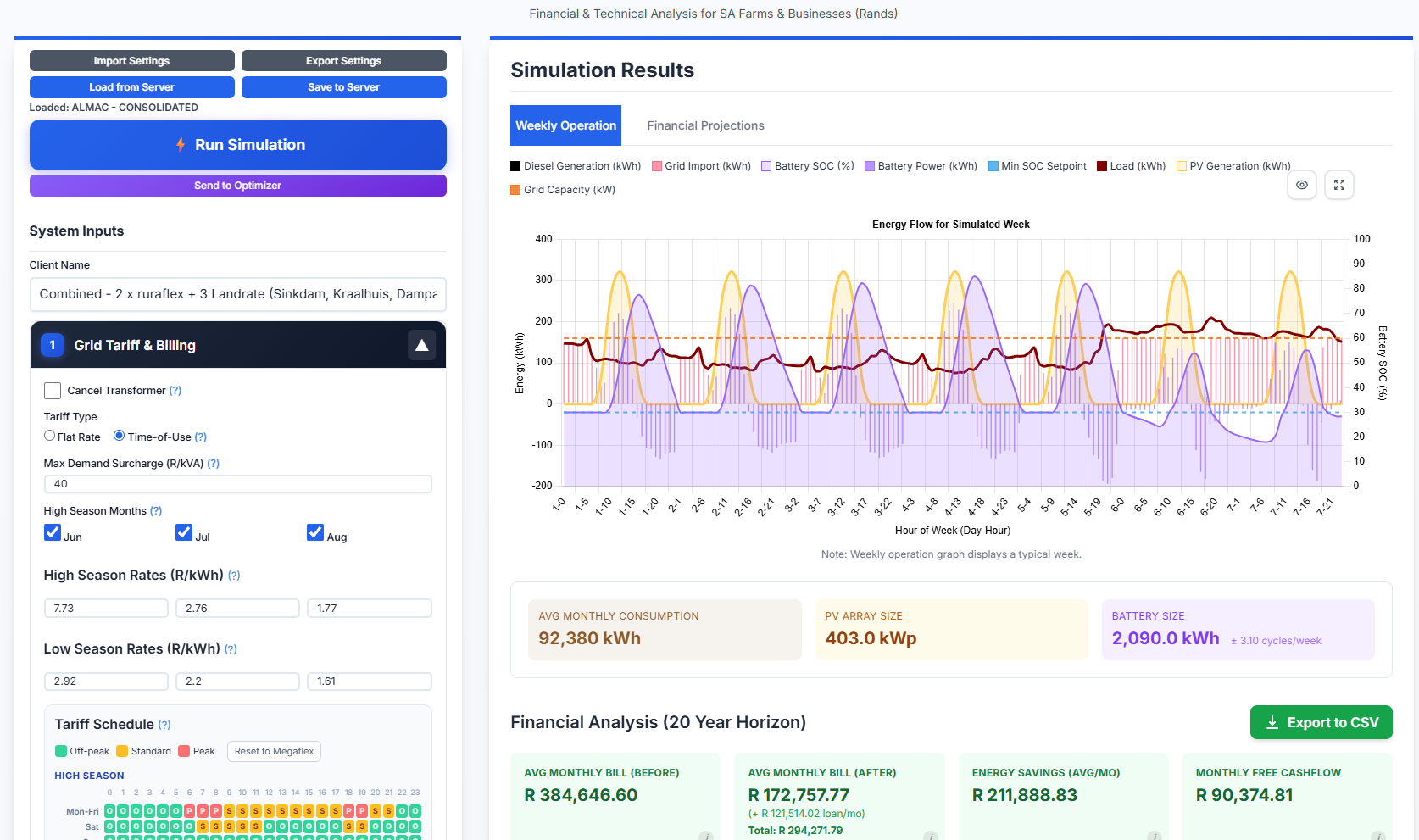
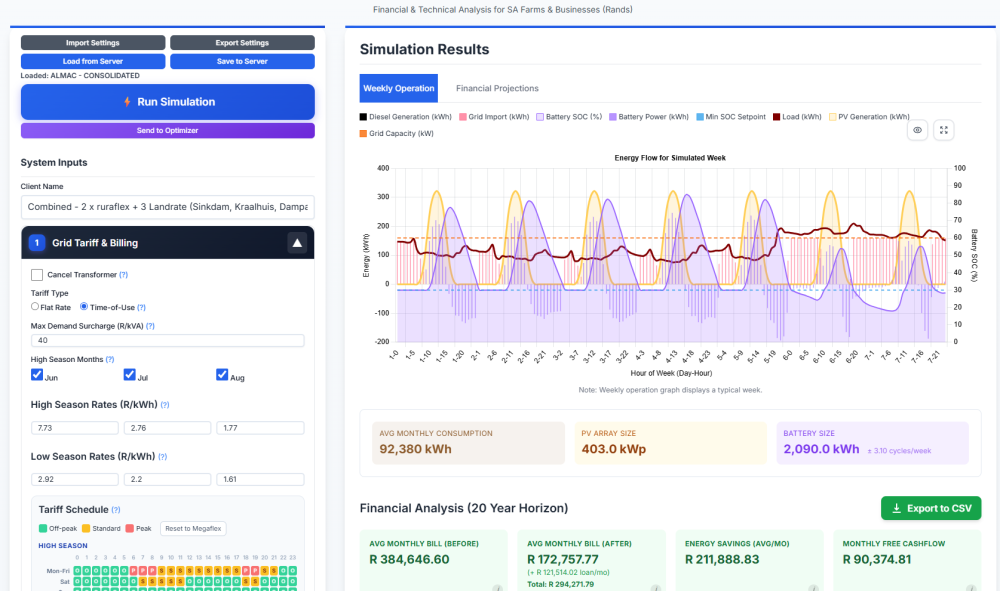
Hi We decided to make the basic version of this battery and PV simulation software free to use (on our website) solarsim.multiwatt.co.za The "pay-to-play" PRO version is obviously more powerful and something that we offer as a service via consulting or which you can buy as a standalone license. Please feel free to post any questions/suggestions you may have on this thread. I will also consider making a "How to use" video if interest is high enough Kind regards Hanno
-
Vtcza you might want to look at our free simulator to assess your situation solarsim.multiwatt.co.za The paid version is actually what you want but you can wangle your way around grid charges by playing with your effective "R/kWh" (referred to as a Blended cost of Energy) Let me know what you think - I may even do a free analysis for you
-
@Steve87 thanks for documenting this. People are impressed by the scale but what impresses me more is the successful coupling of the grid-tie inverter onto the HPS. Does one have to install an energy meter on the output of the grid-tie inverter so thet the HPS 'knows' what is load and what is grid-tie generation? and then performing frequency-shift control (Much like a Victron approach if you have experience with AC-coupling and victron) Or did you do it all in software with a 3rd party EMS that reads the grid-tie, reads the HPS and does the magic in software?
-
The reasoning behind the stricter control of inverters and installations is for the following reasons: 1) Eskom (COCT is just leading the way in terms of enforcement) want to ensure that all inverters connected to their grid meet certain minimum requirements in terms of safety but also in terms of power quality and grid control: Proven anti-islanding topology that makes feeding back into a "blacked-out" or "browned-out" grid impossible. I know of an instance here in Worcester where a lineman (luckily) measured 2kV on a line that was "isolated" and the culprit was a shitty 5 star inverter that back-fed into the grid. Rare but possible. Harmonics: Australia's grid is already seeing very high harmonic levels due to the large adoption of high frequency inverters. They are even deploying synchronous condensers to combat the effects. Shitty inverters have higher switching harmonics. Frequency Power control: In the future when PV plus inverter adoption is high (inevitable) Eskom needs a way of throttling this grid-connected power for a multitude of brands and locations. This can only be done by frequency shifting. By enforcing NRS097-2-1 standards the approved inverters have this safety feature readily installed. Logistical and practical bookkeeping of all systems: The city council needs a system that shows the location (in the garage/kitchen) and size (in kilo-Watt) of all installations. By using weather forecasting Eskom can ramp their turbines up or down depending on load and weather anomalies. In short: It is a matter of ensuring that whatever gets connected to their grid meets certain quality and safety standards. The technicalities of this falls outside the area of competence of an electrician and a junior engineer. There have also been a multitude of house fires caused by systems with a freshly written CoC. I have seen life threatening installations that have a CoC. Engineers registered at the ECSA was thus chosen to ensure this quality control. Sure, it certainly is an inconvenience, but at the rate PV is being deployed in the country it makes 100% sense from a grid operator's point of view. Feel free to contact www.multiwatt.co.za for sign-off and engineering assistance.
-
Hi You are welcome to contact me should you require sign-off for an SSEG application
-
What brand inverters do you have installed? Maybe one can look at some sort of AC coupled approach?
-
Hi I know this is an old topic but I would like to advertise my services as an ECSA registered Pr Eng (Electrical) Feel free to google my company to make an arrangement for sign-off and other engineering services. Regards - Multiwatt www.multiwatt.co.za
-
This settles it. Thank you @TaliaB Bit embarrassing that I did not know this was changed in the latest revision. I have a suspicion that this is what has since happened somewhere in SA, thus proving the law: If a highly unlikely, very improbable, most-certain-damn-near-impossible fault may occur in an electrical design... It will occur. Design accordingly.
-
I hear you, but look at the diagram. The minisub is bonded to earth. The "Eskom" Neutral at House 4 is bonded to earth the moment the inverter syncs to grid. The Homes 3 and 5 have no potential at their main breakers, since the neutral and earth path back to the minisub is non-existent. HOWEVER, the moment your neutral (Which is also their Neutral) gets synced to Mains, their homes "see" (close to) 230V on the main breaker, and your home becomes the path of least resistance back to the minisub Neutral. Their Earth leakages will not trip since the RCD wont sense a differential between L and N, No current is "Flowing to earth" from their RCD's perspective - only in from Live, and back out through Neutral. Background: I am not an advocate for the permanent bond, but I am on my way to sign off a few SunSynk sites next week, and I know the latest NRS097 permits a permanent bond, but I want to dissuade the installer by laying out the facts, and fully understanding all the fault-condition the risks and their likelihood.
-
Yes. Since the N at the transformer is referenced to Earth and your home's Neutral is referenced to earth, you are at risk of acting as a SWER line for your neighborhood for a brief moment before your main breaker trips (Or explodes). To clarify, I don't want to DO the above. I want to understand the risk of a permanent bond well enough to dissuade other installers who might want to argue for it. Don't do this with a regular RCD. Use a Type B RCD. HF Inverters may inject a DC offset on their output, over time saturating your RCD's internal core, rendering it ineffective to interrupt a life-threatening fault.
-
I Really want to understand this statement thoroughly. I have drawn up a little "Scenario sketch" to illustrate my (possibly wrong) understanding: If you have PV installed you most likely have an Earth-rod installed as well. Your installer permanently bonded your Inverter Output Neutral to Earth. Your minisub neutral bar gets stolen during loadshedding. The return path to the transformer-neutral of all the homes on that minisub takes place the moment your inverter synchronizes to mains and connects output Neutral to Eskom Neutral. Effectively connecting the neighborhood Eskom neutral THROUGH YOUR LITTLE EARTH BRIDGE to earth. Earth carries the current of all homes back to the Eskom Neutral. Your main breaker will trip, but there might be a possibly-large explosion inside your inverter. Am I missing something?

-
I really want to get my head around the fault current that can flow if one permanently bonds Inverter output Neutral to Earth. Am I correct in saying this can only happen when YOUR installation is "On grid" (ie the inverter's output neutral is connected to the input neutral AND earth) a bunch of upstream homes lose their neutral AND earth, and all of a sudden YOUR little bond cable is the path of least resistance back to the ESKOM mini-sub transformer via your earth spike? See my diagram attached. Am I missing/misinterpreting something?

-
The challenge in the above lies in that sentence "after the grid connected inverter matches the communications protocol of the HPS" Easier said than done. Atess calls it "running in EMS mode whereby the grid-tie inverter is connected to the Atess via RS485. It just does not work very nicely. Can't wait for Atess to get a working 3rd party Energy meter provider which one can then connect right below the grid tie inverter and program it as a "PV Inverter energy meter" like the Victron+Gavazzi systems. SynSynk also fails with this one. Claiming it is "easier" to connect the grid tie straight to the Gen input of the SunSynk which is often very far away. Typical chinese approach where they churn out what the Europeans have refined, and wait for feedback from the market acting as their guinea pigs.
-
the problem with AC coupling the Atess is that one then requires the Atess bypass cabinet which makes the project more expensive. I will get the Deye should the client opt for that option.
-
Afternoon Gentlemen Thanks for the replies. Let me give you a bit of background: The reason I'm asking about the SunSynk HV batteries is to quote on a 3ph system for a school with a peak load of about 40kW. Since the school is comprised of mainly Capacitive and unity-PF loads (LED's, Computer PSU's, Geysers etc) I figured I would like to suggest a system with their financial constraints in mind. I too am a fan of Low Freq transformer based solutions, but in this instance I took the calculated risk of proposing a 50kW 3ph high voltage SunSynk for their needs. The problem as i'm sure you know is that SS only supply their 10yr warranty if one uses their "approved battery brands" with the inverter. Pointless if you ask me since they all use CATL or BYD cells if they are half decent. Nevertheless. The major advantage of the HV "string" battery approach (ie a rack comprised of 51.2V modules in a series "string) is that the client can expand in smaller increments should the need arise. They don't have to lay down the cash of another Freedom Won 80/64 in parallel. An engineer can design the system to initially be within the lower DC bounds of the battery voltage and they can expand in 5kWh (or 6.3 or 10kWh bla bla bla) "steps" by adding one or two in series up to the upper DC bound of the inverter. Before I give my example I would like to explain my self-made-up terminology: module is a "pack" of 16 (3.2V) cells in series (the image above has 12 "packs" A "bank" is a large server rack frame filled with a bunch of "packs" in series and protected by a BMU HV interrupt device. Example: The SunSynk 50kWh has a Batt DC range of 450V - 850V. A 3.2V (nominal) LiFePo4 cell typically has a "depleted" voltage of 3V and a "Charged" voltage of 3.46 (conservatively speaking) Assuming a "pack" is comprised of 16 cells, that means the SunSynk typically has a limit of 10 modules in series on the lower bound, and 15modules in series on the upper bound. Assuming they are comprised of 100Ah cells that gives an expandability range of 25kWh before one has to split the bank again. ie The client can initially invest in a 50kWh "bank" (10 packs) and upgrade in relatively cheap 5kWh steps all the way to 75kWh. Whereafter one can take the leap, buy 5 more units and build two "banks" with the 20 units, and the cycle continues (only now in 2x5kWh steps) This is dependent on three things: 1) SunSynk allows one to buy the "packs", BMU and frame separately (whilst retaining the 10yr warranty)... >doubt 2) The BMU can interrupt the max DC voltage of 768V safely and reputably 3) The communications in the "bank" can handle this (bonus if you don't have to mess around with DIP switches) These HV systems will become more prevalent in commercial and Agri scale applications since the "installation-friendliness" of the HV "server rack" architecture is just nicer to work with. And whilst the Victron HS19 HV inverter is still in the lab, SunSynk can fill the waiting gap Edit: The 4 x MPPT trackers of the SunSynk 50kW is also a major bonus above the ATESS HPS50's Single tracker. Edit 2: The IP65 rating of the SunSynk is also nice
-
Bump
-
Bump
-
Hi Does anyone have experience with the SunSynk Rack mount HV battery? (12 x 5.1kWh modules in series) My two main questions are: 1) Can it function like other suppliers' HV batteries in the sense that you can "build your own" battery by combining a custom amount of 51.2V modules in series to reach your desired kWh (Obviously staying within your inverter's Battery voltage range) Atess and BlueNova are some examples. 2) Assuming one wishes to make use of SunSynk's 10yr warranty by pairing a SunSynk 50kW with this HV battery: The SunSynk 50kW is IP65 rated. By installing these battery modules in a custom IP65 server rack, would that void the warranty of the battery? ie are you forced to use their "server rack" 3) Assuming "1)" is true and the modules can be expanded, what is the max amount of modules one can add in the "battery string" from a CAN-Bus communications perspective? FYI I see SunSynk has an 80kWh (665V)version available lately, which correlates to them using 120Ah cells in a "13-pack" configuration indicating that the battery is NOT fixed to 12 modules as with the 61kWh version. Herholdts is struggling to find the technical in-house expertise to answer my question, and SunSynk has not replied to my email from 2 days ago...