Elroc
Members
-
Joined
-
Last visited
-
-
As some other replies on this thread, in my case simply replacing my EL resolved the problem. But replace it with something "propper". I got the "cheapest" Schneider EL, and that fixed it. All the other EL's the electrician used was still causing EL trips on Grid resumes.
-
-
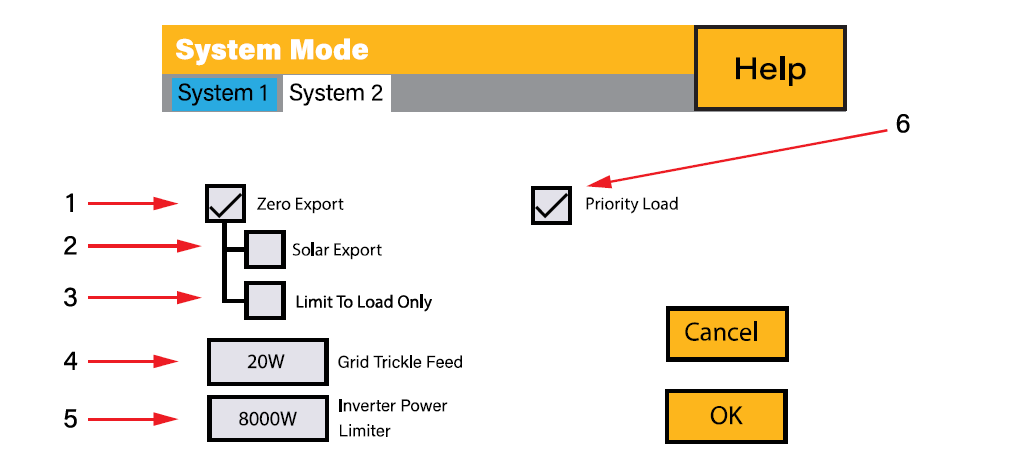
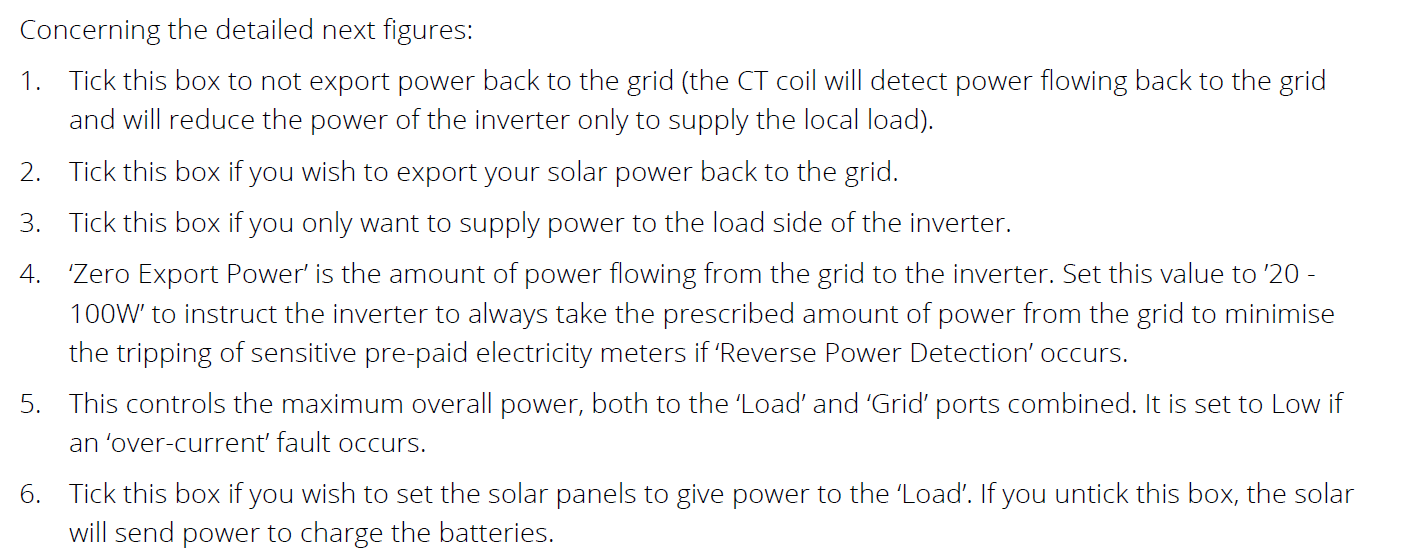
Late reply to this chain, but my 2 cents: These settings are a bit confusing but I've found the following helps to make sense of it: 1. Zero export: "Don't export power into the grid" 2. Solar export: "...EXCEPT surplus solar power" 3. Limit to load: "Don't even power the non-essential loads from the inverter. (solar or battery)" I suspect (but haven't tested), if you untick all these boxes, it will export to grid even from your battery at a rate limited to the Power Limit setting on this screen.
-
-
@Nexuss is correct. The screenshot looks like an older firmware. Newer ones have the wording better laid out, but in short, from the user manual For the original user, in order to have the inverter supply the non-essential items whilst Eskom is on, Zero export needs to be ticked, and Limit to load needs to be unticked. Solar export should only be ticked if surplus solar power should be exported to the grid. Even the manual description for priority load box is confusing. When priority load is ticked the order of priority for distribution of solar power is: First supply essential load (and non-essential if allowed). If additional solar power is available, use it to charge the batteries. Example - Panels are generating 1000W, essential load needs 500W, remaining 500W is pushed to batteries. If you untick priority load, all solar power is first used to charge batteries until they reach the level configured under the timer. During this time, if the grid is on, any required load (essential and non-essential) will still be taken from the grid. Only when batteries have been charged to the level required in your timer settings, will solar power be used to supplement load requirement.


-
-
-
Hard to say without knowing your exact setup and type of inverter, but if I check your post history you mention you have 2x Growatt SPF5000ES inverters, so all the below is just assumptions on my side based on this. From a quick scan on the inverter datasheet, it is an off-grid solar inverter and cannot push power back to the grid, only take power from it. If the grid goes out the inverter then simply powers your house from your batteries and PV panels. And then when the grid goes down, it's down and you don't need to worry about powering your neighborhood This also means that you can't push power back to the grid even when the grid is live. The complexity with the Sunsynk/Deye (and I believe Axpert?) models are that they are "hybrid", and have the option of pushing back excess power to the grid OR, simply supplementing load to devices on the grid (non-essential) side when surplus power is available. In my setup we've left the oven and the geyser on the 'non essential' (grid) side of the inverter. I only have a 5kW inverter, and having either of these draw power from the inverter, on the essential (load) side, would quickly cause the inverter to overload. If however, on a sunny day, if the wife were to be cooking a roast in the oven, and my batteries are full and my house side load is for example just 1kW, I could supplement the power the oven is drawing from my panels or batteries up to 4kW. On condition that the grid is on. If Eskom were to hit load shedding, my oven and geyser are still without power. (Disclaimer: I'm no expert, or electrician. At best I'm a computer engineer with a deep urge to understand anything that doesn't behave to my liking, often causing loss of sleep as I try to get to the bottom of things not in my field of expertise. I can confidently tell you lots of things about accounting, SARS tax laws as they relate to home office claims, retrenchment processes, legal principles around body corporates and common property, ADHD, and most recently electrical wiring, inverters and the like. It's very likely anything I tell you is total BS, so don't believe a word I say - always check your actual subject matter experts first )
-
Quite the contrary. Under no circumstances are you allowed to push power back to the grid when the grid is not active, for a wide range of reasons, e.g. the grid might be off to allow someone to work on the wires, so you would be putting wires that someone assumes is 'dead' to live. Or, in your scenario, for a second or two your inverter/generator/hamster wheel might try to power you neighborhood before spectacularly catching fire/exploding/falling of his wheel from being overloaded. Also (and this is where my understanding gets fuzzy), if you WERE able to power you neighborhood in the absence of the grid because your inverter was built by Chuck Norris; once the grid comes back online I believe your generator and Eskom generated power would be out of sync/phase, and 'bad things will happen'[Citation needed] To accomplish this any power generating device connected to a live grid (such as your inverter) must either have built in islanding functionality, or be islanded using external circuitry to avoid it being able to push back (energize) the grid side when the grid is offline. This is why on you hybrid inverters that can supplement power to your non-essential (grid) side, once the grid is off, you can't power your non-essential devices at all.
-
Good point, and I've been wondering the same, allow me to hazard a guess: Based on this diagram I shameless stole from this informative post: Assuming we use the TNC-S configuration, and being completely reliant on municipal Earth; (ignore L2 and L3 for our basic single phase layout) On the inverter input (Grid connection), when Eskom is down, the inverter internal AC relay disconnects for islanding purposes - you can't push power back to the grid if the grid's not there, you might blow the poor electrician working on the wires to bits. From the wiring diagram for Sunsynk, this disconnects L and N, and by implication the existing E/N Bond on the municipal side. If on the inverter output (Load) side we don't have (add) a E/N Bond, your Earth in your home wiring is not actually earthed or tethered to anything. To use a VERY BAD analogy, there is no string (E/N Bond) to keep your baloon (N voltage) tied to the ground.

-
This might be something else for me to look into. I'm not aware that I have a spike installed, and for sure my earth and neutral in my main DB is NOT bonded. From what I read in another post I'm basing my understanding on the assumption that we use TNS-C type grid connection. A friend of mine has a similar setup in a much older house with an earth spike and earth neutral bond in the main DB making him have a lot less of these types of troubles. Assuming one DOES set up an earth spike, does the spike then connect to both these earths? Or should they each have their own spike? My current install has a single DB, with the splitting done inside. Though I'm contemplating having that redone as well. I based it on this circuit diagram from Sunsynk. It might be that ONLY Neutral is bonded at this point, but it's handled by internal relays in the inverter: Sorry I wasn't clear, I agree, Sunsynk output neutral should not be tied to ground while commercial power is available. But where I'm (currently) dependent on the commercial power earth and not my own earth spike, when commercial power goes down, the inverter output has no reliable earth reference and leads to elevated voltage (across E-N). To rectify this the inverter output earth and neutral should be tied together, ONLY when commercial power goes down. (And in case you (I) don't have an earth spike), and hence the earth neutral bonding relay. It seems Sunsynk doesn't have one internally, and they advise an external relay triggered by a signal they send from their inverter when commercial power goes down. There isn't one (on purpose), but because my earth bar is common all over, and because the installer has a permanent earth/neutral bond on the inverter output side, then yes there is an unwanted neutral/neutral bond, and I concur it should not be there. Thanks, I appreciate the input - I'm updating my original wording here and there for future clarity sake, but leaving the original in my quotes here.

-
Sorry for raising this topic again, I see it's a frequent and well worked through one on this forum across a plethora of threads, but I'd like to try and summarize what I've learned and check if my understanding is correct. Context: I recently had my entire system installed - Sunsynk 5.5 kw inverter, 2x Shoto 5.2kWh batteries, 12x 545w Solar panels. Without the earth neutral relay bond I must add, something my installer seems to not be aware of - more on this later. As an engineer myself I like to understand how/why things work so I can fix it or understand why it doesn't work, and this led me down this rabbit hole. My understanding - please correct if I'm wrong: 1) In the majority of South Africa installations, Neutral is bonded to Earth coming from Eskom at some point prior to entering my house, likely at the meter box, or the transformer. Regardless of this bonding, for the purposes of wiring inside the house, Earth, Neutral and Live are to be treated as distinct lines. I'm not aware of a grid related earth spike on my property, and I only have an earth wire coming from the meter box on the opposite side of the road. 2) SANS regulations require that in a UPS installation, such as my Sunsynk inverter, split neutrals be used. I.e. The neutral on the non essential (LOAD) side of the inverter shall NOT be connected to the neutral on the essential (LOAD) side of the inverter. I'm sure there is more motivation than just SANS, but for the purpose of my current understanding this is sufficient motivation. Also, both GRID and LOAD side needs their own earth leakage breaker. 3) Within my house wiring earth should be common across the board - I.e all earth (PE) lines can join on the same bar in my main DB. This is in relation to the AC circuitry of course. Panels have their own unique earth spike. 4) When Eskom is on, and the inverter is running in 'normal' mode, the LOAD and GRID live and neutral lines are connected internally in the inverter. This allows the inverter to blend power from multiple sources. 5) When Eskom goes down, we effectively lose the earth/neutral bond on their side, and we're left with Live and Neutral with no reference to ground, and what people see elevated voltage output on the inverter load output. 6) Because of 5) we need to create that earth/neutral bond in-house dynamically when Eskom power goes out to prevent the elevated voltage, and other funnies. This is where the bonding relay and the Sunsynk islanding mode signal comes into play. 7) Why can't we bond earth and neutral permanently on the inverter load output and take out the need for the bonding relay? 7.1 ) It's not allowed by SANS to have another earth/neutral bond in the home? [citation needed]. 7.2 ) Because of the earth neutral bond existing on Eskom side, if we do ANOTHER earth/neutral bond on the house side while Eskom is live, it effectively connects the split neutrals from 2) above via ground. This is a problem because it risks negating/messing with the earth leakage breaker functionality? I'm still fuzzy on why though. ------- Theory 101 complete, now to my localized issues: My installation concern: My installer has connected the Neutral port on the LOAD side of the inverter to both Neutral for the essential loads, AND to my common earth. He's not connected the Earth (PE) port on the LOAD side of the inverter to anything. When I queried him on this he said without this setup (bonding earth and neutral on the load side) the inverter LOAD output voltage floats high (110v), and "all the Deyes and Sunsynks do this and the engineers have not been able to explain why". If my understanding is correct 5) above would explain what they are seeing, right? Symptoms in-house: I have the following problems in-house, that I suspect may be linked to this installation approach, some more than others: 1) When everything is 'on', Eskom, etc, my oven clock light has a weird flicker. Some of the LCD display segments blink on and off intermittently. Setting the clock on the oven takes 'longer' (Normally when you adjust the time, pressing and holding on the + button makes the minutes spin by faster and faster, this isn't happening anymore). The oven is on the non-essential (GRID) side of my setup, and if I disconnect my 'AC TO INVERTER' breaker, the oven returns to normal operation, i.e. Eskom is still on, but the AC link into the GRID port of the inverter is severed. I suspect this might be due to the now not-split neutrals as described in 7.2 ) 2) I have 2 aircon units (8000 and 12000 BTU), both on the essential (LOAD) side of the inverter. When either one is on, I hear a buzzing sound on the earth leakage breaker for the essential loads. I've replaced the breaker once already, and the buzzing is reduced but it's still not gone. I'm not convinced this relates to the earth/neutral bond situation, but rather caused by cheap RCD. Going to be replacing them. My essential side RCD doesn't even trip (reliably) when I press the test button on it. 3) Elevated base power draw, and inaccurate load measurements on my house since the installation. My base load at night when only a bare minimum of lights are active is reporting 400 to 600w, and it 'feels' too high. I'm used to around 300w only. Also when something like my geyser element turns on, the inverter reports its load as adding 4kW to the grid draw, and I was under the impression I had at MOST a 3kW element in the geyser. 4) Bad house wiring (not my solar installers fault). It would seem the original house wiring took shortcuts and had a few plugs and light circuits on the same neutral line. This proved a headache when splitting the DB during the solar installation and it's not in an ideal state. Some lights are causing RCD trips, even though they have removed the light circuits from the RCD's. Next steps: Unless I'm completely daft in my understanding, I'm going to get a earth/neutral relay bond installed on the inverter load side, and see if any of the above issues subside. I'm also going to get an electrician to rewire my house side and fix the joined lights/plugs. If anybody has read this far through my ramblings they deserve a medal. If you have anything to add or correct to my understanding of the whole sunsynk/earth/neutral/bond/relay topic, please feel free to do so.
-
Hey @Halcyon Did your repair job on the inverter actually fix this problem? I.e. after repair did you stop measuring this 2 amp draw? I have the same 'problem' (oddity perhaps?). Sunsynk 5kW inverter, 3 days old, the grid side has a constant current measurement of about 2 amps, when inverter is set to 20 W grid trickle, and no other non essential items are drawing power. It's even confirmed by the status screen on the inverter (see attached screenshot) The numbers don't line up, or am I missing something? 244 V * 2.2 amps = 536 Watts, not 21?

-
-
Thanks to @Sonoff Africa! Received the bundle in good condition, just in time for Christmas break. Time for some more DIY-ing!
-
Found this thread due to experiencing the same issue, with a twist. So at present I don't have any backup system/inverter/solar etc. installed. And in the past I've had occurrences where my earth leakage would trip when load shedding ended. By some fluke, a small subset of our neighborhood has been excluded from loadshedding for the past 3 weeks or so - something something sub station something something different bus. Literally like a one or 2 block area. Anyway, I STILL have the occasional earth leakage trip when loadshedding ends, around us. Last night I even predicted it correctly. loadshedding was 8 to 12pm, and we had power throughout, but at 12 when power came on for the surrounding area my earth leakage tripped. Same thing happened around 8 this morning. So the trip was not caused by any change on my side, no device powering up from an off state, or anything, but by the nearby surrounding area powering on after extended loadshedding, late at night (read: lots of cold geysers turning on at once), impacting the power delivery to me to such an extent that my earth leakage tripped. I'm not aware if my direct neighbours have similar earth trips at this point. From reading the thread and some youtubing I suspect splitting my circuits between multiple earth breakers might be a possible/viable solution? As noted some base level earth leakage is expected, and designed for in modern electronics and as a geekier home automation nerd I've got lots of electronic devices and smart switches. I haven't measured but I suspect I have a leakage current higher than the average, and whatever surrounding network oddities get caused by loadshedding is enough to push my lone earth leakage over the edge. Thoughts and comments appreciated.
-
-
-
-
-
-
-
No way! Almost missed the win! Thanks, this will help expand all the sonoff I already have. Ive fallen in love with the dual r3!
-
Now look what you made me do, spent a good while digging through Wikipedia articles education myself on the nuances and details of lithium ion batteries, thanks Quoting technical details from manuals to prove a point it TIGHT! Thanks!
-
-
Hi guys I'm trying to confirm what type of battery tech (Lithium Ion vs Lithium Phosphate) is used in the Shoto SDA10-48100, and info seems conflicting. The spec sheet has 'Lithium-ion' in the title (and no-where else explicitly mentions the type), and certain online stores (e.g. sustainable and even powerforum-store) mention "The SDA10-48100 series uses new LiFePO technology". So which is it, or is there some sub-model number, and SDA10-48100 is like saying 'Volkswagen Golf', and not specific enough for that distinction?
-
-
-
Elroc joined the community
-
Is it possible to run Solarman & SolarAssistant? I'm looking into getting a system, and the installer uses Solarman to view and manage (and support) all their installed sites, which I understand and have no issue with. Though looking around I'd like to get the higher rate info from Solar assistant, and pull that into Home Assistant, for exactly the type of fail-safe automations discussed earlier in this thread. So, is it possible to run both Solarman and SolarAssistant?