


EdDee
Members
-
Joined
-
Last visited
Everything posted by EdDee
-
Hi Tj Would you be so kind as to share the code for the CRC calculations for the inverter with me? Secondly, have you managed to interrogate the Pylons successfully as yet whilst keeping your inverter online? (I am reading my pylons direct, but using Solpiplog for the inverter readings, I want to go direct to the inverter now..) Regds Ed
-
3 strings of 8 panels, as long as VOC total does not exceed the stated max, for safety I would go at least 10% less than max. The sunsync can handle the extra pv amperage per mppt input, it simply will not use the extra amperage that is available on the particular mppt input (according to the SS guys themselves) Possibly, 8S panels E + 8S panels W (in parallel on mppt1), the last 8S panels on a north pointer.... Depending on your geography and mounting availability... That might be the best to stretch the daylight... E
-
Initially I was running my servers and certain other kit via hardware switches, they proved to be a royal PITA eventually.... Run the Pi headless (No monitor) and on it enable/install VNC Server (VNC Overheads are minimal) - From your windoze pc, access the Pi via "VNC Viewer" ... Problem solved... Been doing it for years and it works really well... (Controls Windows/Linux/etc perfectly..)
-
Glad you are sorted!!
-
PM Sent...
-
That's unusual..... Node Red/Mqtt/Raspi are pretty much rock solid.... One thing that nothing likes is a crappy power supply.... Changing modes... Spiking the line maybe... PSU has a bit of a dirty output... Things will go awry... On the other hand... If you have a switch with passthru on the dashboard, watch out its not looping back into itself somehow... Log into a terminal and run htop or top... Check the cpu usage and see if it is perhaps looping and blah blah.... E
-
Have you got the comms manual/spec... ? E
-
Yes, Solpiplog will allow inverter mode switching, as well as charger mode switching too... Definitely.... I am in fact using these features and send the requests via Node Red -> Solpiplog -> Inverter... E
-
Hi Willem, Looking in the comms manual, I don't see anything referring to bypass mode for bits 84 to 90 - They mostly seem to be pertaining to charging status and a few other things... QMOD on the other hand, returns, and I quote "Device Mode inquiry" - Power On Mode - P -Power on mode Standby Mode - S -Standby mode Line Mode - L -Line Mode Battery Mode - B -Battery mode Fault Mode CODE(M) - F -Fault mode Power saving Mode - H -Power saving Mode How are you reading the data? Node Red? I haven't had a chance to write the direct comm flow in Node red yet, I currently use Solpiplog, but am wanting to move away from it and talk to my inverter directly... If you are using Node Red, would you be so kind as to share your comms routines with me? Ed
-
Just another Dashboard Layout...

-
@Calvin Yeh, seen and used pwrsys type command.... was just using the other status command and just stuck to it... Don't need to go less than .25% anyways, in fact .5 or even 1% is actually good enough for 4 packs... When/if I go to 8 packs, I might relook at it, but nothing on plan in the meantime.. Not really... I use the same link that you quote... Thanx 4 da comps... But its not really about the control so much as using as much as you can out the inverter.... Pointless doubling up on output (and losses) until you find that 5kw just cant manage.... Cheerz E
-
Strange you should mention the demise the chap... My stepfather blew himself up quite badly(but survived) many, many years ago in the UK - He was arc welding using a battery bank for power and being the UK, shed doors were closed for the cold, this allowed a bit of hydrogen build up apparently, and a spectacular bang later.... E
-
Hi @Joe Moer, Here is the main info screen I use on the cell phone, a little truncated, but its just status lights that are cut off at the bottom of the page: And a similar content, but different layout when viewed on PC: The setup has got quite involved, with parameters specifically written for each "main" piece of kit on the system: Certain pieces of kit are SOC controlled, others are controlled by availability of sunlight power, others are solar timed and more often than not, a combination the available options is used to get the best/most out of what energy is available at any given moment - There are also a couple of cute little things I have incorporated to keep the loads below the nominal 3kw mark - This isn't out of necessity, but I am not wild about inverter wear and tear mounting up (It can handle 5kw with a 10kw surge, plus I have a 2nd that I can parallel it with if I need to, but why should I, if I can keep loads in tow automatically?).. One of these tricks is that when a heavy load turns on by available power, other loads are turned off... ie when the dishwasher hits the 2kw heating cycle, deep freeze, air compressor etc are barred from starting and if they are running, they are shut down immediately until the high demand is over.... Here below is a fairly complex parameter screen, namely for the DeepFreeze - It has 3 temperature bands based on day/night and excess power availability, with the option of offsetting day and night times depending on your needs, it also takes care of power failures, checking the SOC and economising power usage when there is no mains power to fall back onto by shifting to the "night temperature" bandwidth... (Oh yes, the system is both Lead Acid and LiFe friendly, with control being selectable from either SOC or Battery Voltage governing...): Amongst other features (beyond just turning on fridges, pumps, compressors and washing machines etc) that I have written into the system are: Luminescence detection (used for determining maximum solar power availability on the fly) SOC control based on reported SOC from inverter OR direct SOC from the Pylon batteries(with 4x Pylons in the system, SOC switching can be fine tuned to within .25%) Monitoring of Inverter Output and the ability to warn users of heavy usage Switching of Inverter modes, be it charger source or inverter mode proper remotely Setting of utility charge current remotely Automatic security lighting based on SOC and solar timers Water preheating based on excess power availability, this heated water is then fed into gas geysers for final heating if required - 8 stage multi load purely resistive element, temperature and power availability controlled... System messaging and control via Telegram alerts to control remotely as well as be notified of urgent system items. Telegram control of external Lighting Control of auto start diesel generator - This only starts when there is a mains failure and batteries are nearing depletion - The system then puts the inverter into eco mode, switches to utility and solar charging, sets the charge current, then monitors SOC until it is within bounds... It then shuts the gennie down, switches to battery, sets charge/inverter/everything back to "normal" mode... (All modes, currents, SOC's etc are user configurable) 433mhz(keeloq) remote key fob control for security lighting or whatever grabs my fancy (currently only controlling lighting but can be easily expanded to turn on equipment as I need) - this is specific to remote control fob user, per button or combination of remote buttons pressed.... Timer controlled "smart charger" - if load shedding is scheduled, and SOC is a bit low to carry through due to inclement weather, there is a "smart charger mode" that can be timer enabled to charge the batteries prior to the shed happening - Modes etc are similar to the auto start gennie enviro, but take advantage of the lower cost of mains charging rather than diesel charging if possible (automatically going back to preset running inverter defaults once the event is past)... Along with probably a hell of a lot more that doesn't spring to mind at the moment! @lupasha - All of this is ostensibly wifi based, running on either Tasmotized Sonoffs or custom written 8266 wifi units... As to Home Assistant, I am clueless - this is all running running on a pi4-4gb with a 16gb mem card that is hooked to my inverter, running Node Red as a controller enviro with all the dangly bits reporting in via MQTT(Mosquitto) - CPU usage on the Pi4 hovers around 20 to 30%, so it is far from stressed... Data collection and trending is done with EmonCMS, only because I started with it a few years back and haven't had a chance to redo the front end under an Influx/Grafana environment... Cheers Ed


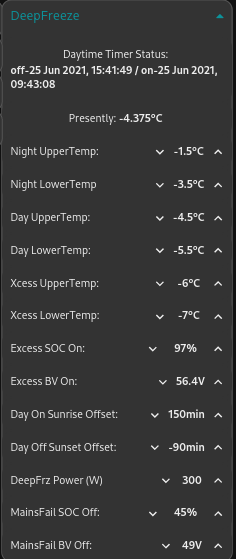
-
Hi Rob Apologies... 60yr old eyes playing tricks on me.... On closer inspection I see that its a big croc clip to your charger or inverter... Sorry for the false alarm! (But then again, those damn things have caused me more trouble than they are worth in burnt contacts and terminals...) I also steer clear of them because on the crappy chinesium ones, there is seldom a copper strap between the two sections... A bit of bad contact bad luck and the tensioner spring becomes a nice heater, often throwing a good few balls of red hot molten steel onto things as it turns into an involuntary fuse... Regarding trip switches, I know I am harping on about you having a trip per battery, but trust me, it makes a mess when a battery casing decides to pop.... I had one pop here a couple years back, I had the charger hooked to a jump start battery and left the jumper cables hooked to my tractor battery..... All was well for a couple of hours, no big sparks when I hooked up the jumper cables/charger to the tractor.... Left it to charge and then the tractor battery kinda went orbital and tossed pieces of its casing in about a 10m radius, 5m radius of which got a nice atomised coat of sulphuric...... A right PITA to clean up.... Cheers E

-
A thought on your inter-battery connections.... Flatten 2 or 3 pieces of 1/2" copper pipe, drill them to suit your terminal bolt sizes, and use 2 or 3 flattened pieces sandwiched between each battery as interconnects... Unless I am mistaken, it looks like a piece of galv plated mild steel pipe that you are using there in the mix(if it is, replace it with copper)... I also agree that the interconnect wires are a bit thin... I, personally, steer clear of crimped ends as well, anywhere near any possible corrosive vapours where it comes to batteries particularly... They are quick to put together, but should any corrosion take place, they fail under high current and are a pain to replace later (read that as during a blackout when 3 of 4 batteries are still charged but the one that is solidly connected to your inverter is flat)... Don't forget to add a protection breaker at each battery positive to allow it to be isolated from the bank ..... There are many myths surrounding battery interconnections, best practice is ultimately to star connect them with equal length/thickness cables, the goal is to have terminal voltages as close as is possible under charge and load... As long as chemistry matches, you should be ok... Cheers E
-
Hi @phalaborwa The system you have put together there is fine for lighter loads and a few very short term surge loads - At 12v, the losses add up quickly! But all is not lost - Try and get away from pumping water until it is an emergency - The inverter would be better spent running lighting and small loads, such as tv/sound system etc - the creature comforts that make "no power" bearable. Instead of pumping water on demand, could you possibly install a header tank (unaware of your roof height and space) - A small 200 or 500L tank, with a float valve to top it up when water pressure is available, which then gravity feeds your cisterns and showers - If you can get it to about 10m, that equates to around 1 bar of pressure, which will run the lower pressure gas geysers and be more than adequate to fill the toilet cisterns.... 10m sounds a challenge to get a tank to, but there are some easy tricks to doing it, even higher, even alone that barely break a sweat to get it done.... (Takes more effort to dig the holes for the base posts.) Also, if the cisterns are taking a very long time to fill, possibly ream the openings of the float valve a little larger(Or is your piping caked with lime perhaps) - I did this when I installed my grey water flushing system - The orifii were opened from about 2mm to around 5mm dia, as the grey header tank sits at barely 4m altitude - Cistern filling takes little over a minute.... As to running different Ah rated batteries in parallel, I do NOT agree with the previous posters, on the proviso that the chemistry/style of batteries are similar - ie do not mix flooded batteries with AGM etc - if your deep cycles are all flooded cell lead acid, of similar chemistry, they are compatible, the charge/discharge curves are close enough to be similar, and they should cohabit quite cheerfully - One thing that I would recommend, would be the addition of a good old 15A(even an AC one) circuit breaker on the positive pole of each battery before it goes into the main positive buss line - Should a battery short a cell by dropping a plate or for some other reason, the reverse current supplied by the other batteries could amount to enough to cause quite a bit of damage, to say the least. In a perfect world, each battery should have leads the same total length to the buss cable, so allowing each battery to be at as similar a voltage as possible during its charge/discharge process. With dissimilar rated batteries, small over/underages will occur but if you maintain the similar lengths as short as is conveniently possible and the buss cable/bar as large a sectional area as is possible, these over/unders should be relatively negligible.... I no longer have a header tank that I use for potable water, but what I have done, to minimize pump on/off cycling, is to add some really basic air accumulators on the pump output line(referred to above as pressure tanks) - they are simple, work well, and are virtually indestructible. Simply put, take any airtight, corrosion resistant cylinder(Old Stainless Beer keg, Old Ali CO2 extinguisher), invert it, screw in an adequately sized T piece, and plumb it into your pressure line on the outlet of the pressure pump. The idea is to trap an air cushion in there that the water pump pressurizes when it is running - Set your pressures on your pump(if you can) to come on as low as possible and to stop pumping at as high a pressure as is possible - The accumulated pressure in the cylinder will amount to around 50% of pressurized volume, sometimes a bit more, of pressurized feed to the house, before the pump has to kick in again... Not only does this save quite a bit of inverter load (getting the pump moving takes a fair whack), but also lengthens the lifespan of the pump quite considerably in my experience. One could even place these homebrew accumulators at various locations that are convenient along the pipe - I have one 20L unit close to my kitchen and one close to the bathroom on the external walls.... The downside of them is that about every 3 months or so, you will need to turn off the water pressure/pumps and open a tap or valve that is at a lower physical height than the accumulator, to drain any excess water and allow atmospheric air to take it's place (you will notice it is required quite easily, the pump starts more often than it should) - The air does tend to dissolve into the water over time and the trapped air volume tends to decrease... but that is a small inconvenience overall... As to running your 2kw water element on the inverter - I wouldn't, certainly not on a 12v Inverter and definitely not on the one you have in the picture! (without seeing the exact specs for your unit, if made of chinesium, they are usually rated and labelled at their maximum surge power, not their running average maximum - 4kw surge rated inverters are normally around 2.2 to 2.5kw highest nominal constant load. Even if the inverter is capable of supplying the power, your batteries wont take it for long - to put it in perspective, today, we had some good sun and I shunted about 1.6kw into my "dump load" geyser (gives mildly preheated water to my gas geysers) for around an hour, maybe a bit less.... Water temp in the tank went from 17 to 21.4C .... Its around 250L or so... A better solution for water heating is by using a waste oil fired heat exchanger system, but, like anything, the worse the fuel, the more the maintenance... (I won't get into that here).... Hope this is of some help... Cya E
-
Using Solpiplog 3.0.0 Trick or Treat: Try the following... solpiplog/pip/status/set - Payload:sbu/uti/sol/eco/onl/aut (For King, but on mks sbu/uti/sol work) solpiplog/pip/charge/set - Payload:0=SBL/UCB , 1=SBL/UDC, 2=SLB/UCB, 3=SLB/UDC (this is for King, but 0/1/2/3 worked on my old mks too) solpiplog/pip/maxcharge/set - Payload:2/10/20/30/40/50 - For Utility max charge A I used that and then switched to cron-plus to allow for dynamic offsets of sunrise/set etc to be set programmatically and via dashboard input.... E
-
Here's a page of my Emon that shows what's happening in detail (Things I am monitoring as I see fit, I add/remove/play here)... It is all pi based, being fed from custom software I have written in Node Red... If anybody is interested, I will post a few more pics of the node red dashboards when I get a chance... The pi is controlling somewhere around 30 to 40 wifi switches, doing everything from irrigation to lighting to grey water recycling to fridge, washing machine, dishwasher, deepfreeze, to multi element geyser control(to name but a few)......(Oh yes... Also integrated 433mhz remote fobs to control selected lighting at will)...

-
Pleasure.... Just went from Pb to Li Batteries this weekend.... This solar "forecasting" method is still doing its thing, very well in fact, not switching things in as much with the Li as with the Pb... But still useful nevertheless!! The graphs I was using on the Pb now look a little "disconcerting" with the Li... The Li can soak up the "excess" power for charging way better... I was very gentle on the Pb, limiting charge and DOD on them to keep them healthy as possible for as long as possible... They are topping 2 to 3years now, still about an average of 80% health when checking them with a battery analyzer (28x638SMF in 7 strings of 4 giving about 490Ah total).... They have already found a good home and have gone a fair way into recovering the ZAR for the crossgrade... (Up yours, Eskom and ZAR!!) .... Cheers E
-
@Coulomb You hit the nail right on the head... Was wondering when someone would notice that! Being a sourcing type regulation system, if I understand it correctly, the actual panel voltage has little to do with the panel current as reported when it comes to actual panel power calculation... The charge regulator only passes sufficient voltage to maintain the charge current(and of course, the panel voltage is normally measured before the charge regulator)... This is limited by a few things, amongst which are: the preset limit as factory set by the manufacturer as to maximum panel current(only changeable via firmware hack I believe) and then user settings as to charge limits on the battery etc... This does of course bring in interesting things that can be done with "over panelling" your charge controller... If it is designed correctly and has the charge limits firmly implanted, it doesn't really matter how many extra panels you install on the input... so long as working voltages are not exceeded (too many panels in series) ... The actual current passing is limited by the control... Just because you have 300A available, if designed correctly, the controller will limit its use of this current to stay within its mandated power limits... But this is another long drawn out thing that probably many theses have been composed over! Cheers E
-
Okaaaaaaayyyy.... So let me see if I understand this correctly.... During today's run here... My panels were at one point: 50A and 66V - That equates to 3.3kw..... But PV charge power at that exact time as registered by the inverter was only 2729W (Which coincides pretty closely with the battery power calc of 55V x 50A giving a total incoming at that point of 2750W) ..... Based on that, I am pretty sure your understanding of the calculation of the rated MPPT input power is flawed, unless I am wrong, of course... Ed
-
As far as I can read it... MPPT charging power is battery voltage x MPPT output current.... Go Check and correct me if I am wrong....
-
Incidentally, the manual for the King specs it as 80A 145Voc with a working of 60-115V.... My panels were about 100V and 45A when the mppts died according to the logging system.. Had I known about it at the time, I probably wouldn't have gone this route... But, looking back, the King does seem to be saving me a bit more bux in the long run... As to if it will last... Well, time will tell.... E
-
Here's some food for thought: I had an Axpert MKs wired 3S 4P - 125VOc running for years.... No problem... Took a bad, really bad, lightning hit, besides the rest of the place that was in ruins, the Axpert was stuffed too... Bought a couple of 5Kw Kings put in... The first lasted a week, then the mppt packed up(First bit of decent sunshine since installed)... called suppliers, they told me to install the second one I had on hand still... That lasted 48hrs, same problem... By this stage the first one had been replaced under warranty and I invited their techs over to come and inspect the site... No problems were found whatsoever, everything was within spec, except the batteries which are a bit long in the tooth... Damage to the Kings was not spectacular... The MPPT's drivers' simply shorted out (straight through) and when they went into charge mode, the batteries pulled the panel voltage down below spec, causing the mppt ?relay? to disengage... After about 30sec, the relay would pull in and the cycle would start again.... The following morning, I rewired the panels to 2S 6P, installed the 3rd inverter now and held thumbs.... A few months down the line, things still running fine... The King is a reasonably nice inverter (Once you get the firmware up to date) .... Downside of this - I had to get a separate mppt charger to use the E-W Panels as they are impossible to wire any other way than 3S, being 9 panels in total...(and no more parapet space to install another one)... Upside to this - The King can handle up to a 5+5Kw surge for a few secs, where the MKs used to shit itself and bypass for the slightest reason.... I haven't needed to install the second King yet as my power requirements are still within a single unit's spec... Cheers E
-
Hot Water and DeepFreeze Graph... Today... Yellow-Deep freeze on/Red Geyser Temp/Blue Deep freeze temp/Orange Geyser elements in use, ie just after 9am is step 1, just before 09h30 is step 2...etc... Deep freeze temp is measured within 100mm of the top of the freezer, at -10C the bottom of the freezer is around -40 to -50 or thereabouts... Green dot-Deep freeze compressor running/Blue border means under Auto System Control, the thermostat in the deep freeze is for safety/manual only... E:3 denotes 3rd element step in geyser operation running at 933W Output... Totalizer on top right is over the last 3 weeks, maybe a bit less, just for geyser itself.... I have set this up so that any kit that is turned on either manually or automatically beyond this available power then backs the geyser off a bit as required... The Deep freeze also runs a bit harder under surplus conditions, bringing the temp further down... If I store hot, why not cold as well? Cheers E


