Gerrie
Members
-
Joined
-
Last visited
Everything posted by Gerrie
-
If you have them in parallel one will be the master and one the slave inverter, you only set settings on the master inverter and they will automatically work as one inverter. No need to worry about the slave backfeed as the master will control the setpoint. You also don't need a CT coil for the slave inverter.
-
Something to consider is that a evacuated geyser in S.A. in summer can reach temperatures of 89 degrees celcius before its overtemperature valve opens and dumps the hot water. Feeding this heated water with such high temperature through a heatpump and into the secondary geyser might be problematic as the secondary geyser might not be able to handle 88 degree water and the heatpump might even try to cool the water down to the setpoint of say 55 degrees. I might be completely of mark but my own 200ltr evacuated geyser often in summer dumps about 50ltr of overheated water. Is it not possible that your evacuated geyser also use its element to heat water as per the timer setting? unless the element has been completely disconnected it might explain extra usage.
-
Did you manage to fix the problem, do you have a lithium battery and what is the BMS voltage reading on the display at BMS section? Then also what is the battery voltage reading on the display at the diagram/chart section are they the same or is there a big difference?
-
You can also check your DC battery cable connections right up to the inverter terminals, if they don't make good contact, you could have fluctuations.
-
I have done tests similar when commissioning to ensure all batteries are working with Sunsynk and BSL. It should be more or less the same with Deye. Start by switching off the last slave battery circuit breaker for (slave 9) and disconnect its comms cable while monitoring the inverters bms screen it should drop down from say 1050AH to 945AH. Repeat procedure by switching off (slave 😎 and carry on till you get all the way to the master battery the reading should than be for master battery only and about 105AH. That should give you indication where the problem cable is. To switch back on, do same in reverse. Plug in comms and switch on breaker (slave 1) while monitoring the bms screen. AH should increase with 105AH. Wait at least 20 seconds in-between the switching for inverter to respond to the changes made, it should than display the new AH reading. Just ensure you don't have large loads on when starting to switch off batteries because it can overload your batteries and trip your system. Hope this helps.
-
Any recommendation for suppliers of solar geysers. Not sure yet if it will be a split system kit or complete high pressure solar geyser, still deciding on options in johannesburg area. It will be a diy install so I just need to purchase from a reliable supplier.
-
Thanks, Yes it did take longer than a single 48KW unit, fortunately roof repairs and painting was also done and gave me some extra time inbetween string installations. The amount of cables and other materials were also more than for a single unit, I absolutely loved doing this install and switching on one by one string makes it all worth it.
-
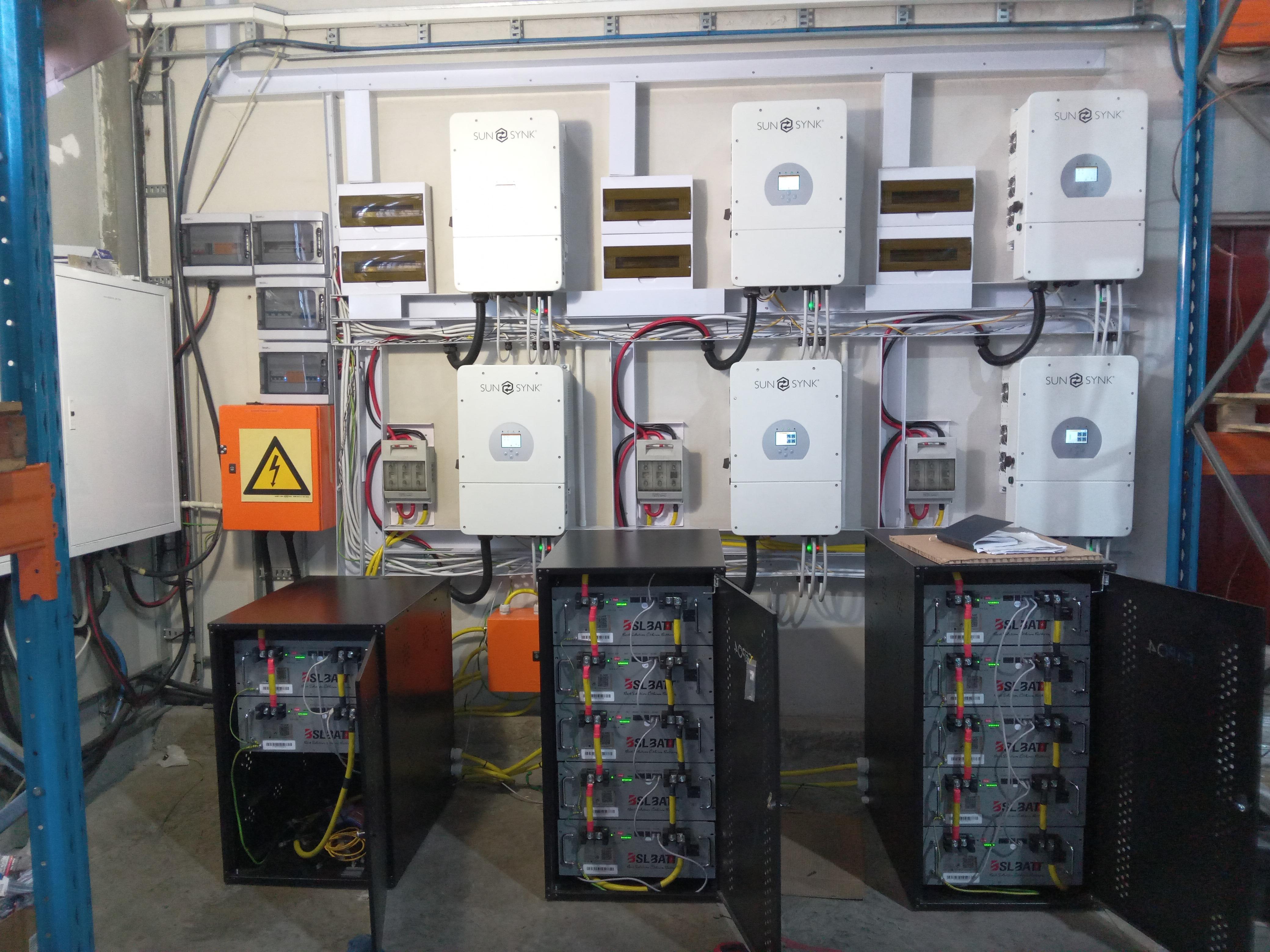
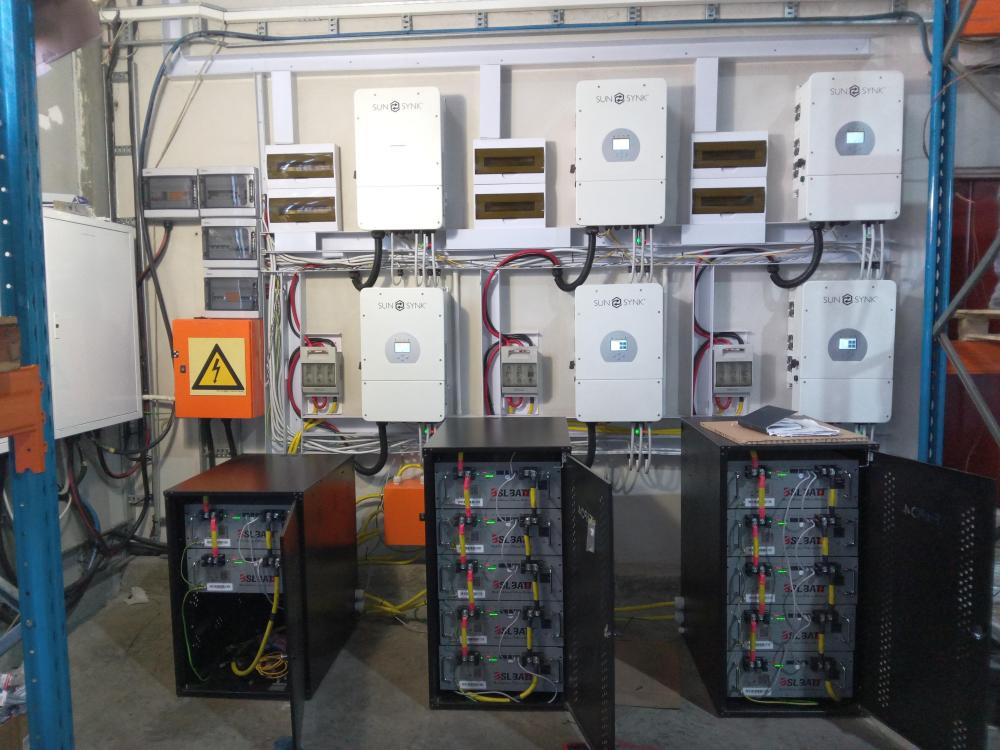
Eventually finished with the installation of 6 x 8KW Sunsynk inverters and 96 x 555W Longi panels. It has 3 x master and 3 x slave inverters with 12 x 7.4KW BSL lithium batteries. There's also a 100KW generator that can charge the batteries should it be needed. I installed 2 x auto changeover switches, one for Eskom/Generator and the other for Eskom/Inverters. Should the inverters trip for whatever reason the inverter loads will switch over to Eskom, when inverters recover it will auto switch back to battery backup. Should Eskom fail the generator starts and supply all the nonbaked-up loads and the generator will be back-up for the batteries if there's no solar and battery level drops below setpoint.


 Thanks WannabeSolarSparky and Talia for the advice I will change back to 8xpanels and try to avoid the smoke.Just for info I connected a 9th Longi 555W panel to a the one MPPT (blue) The max voltage sofar was 428.7V as per screenshot, I will monitoring it to see where it might go over the next few weeks. Hopefully it does not get too close to 500VDC otherwise I will disconnect it again.
 The system has been running just as battery back-up for a few weeks now and we had a few actual Eskom outages for couple of days where the generator setup was put to the test and had to charge batteries when SOC level dropped. I did have a inverter trip of the system in the begining when the charging current was set at full capacity of about 48KW charging for all 6 x inverters plus the rest of the non-essential plant was also pulling another 50KW from generator maxing out at 100KW capacity. The gen frequency was dropping to about 48.5Hz causing the trip, so I played around with charge settings and set inverter charging down to about 24KW where the plant and generator has been happy since. We started installing solar panels and about 60 x panels connected so far and pushing power to inverters so the generator should only kick-in, in real bad solar conditions. I am impressed with the simplicity and the functionality of the Sunsynk inverters and it has been working like a dream sofar.
 I have used quite a bit back in the day on big houses that only had a 60A supply. Normally with a stove, dishwasher, geyser and jacuzzi all on at the same time the main would trip, but these units solved the problem by switching off the geyser or jacuzzi when stove is used, depending on your priority. They can actually be handy these days with limited solar power to also throw off non-essential when switching on essentials. Only problem with them they take a bit of space in the DB.Is the generator ports paralleled on all three inverters. It sounds like generator has been wired to master only. If all generator ports have been paralleled it might be that you need a software upgrade. I have done generator charging on Sunsynk 8KW units, but for 3phase configuration, 3xmasters and 3xslaves and it is pretty much balanced when charging from generator.Would 9 x 555W Longi's be too much per Mppt? Currently I have 8 x 555W panels per sting and the voltage highest was 388V today. Adding a extra panel will add about 43V and should max at about 431V. What is the thought on this?
 It can also be that the wire between the inverter and loads is too thin causing a volt drop when fridge starts up.In my opinion the little stand alone trolley does not require a COC, because it just plugs into a wall socket and feed directly to the appliances with plugs. The moment you permanently connect cables to the Installation, you need a COC to comply WIT SANS. The same with solar panels, are they just free standing outside and plugged into the trolley or are they fixed to the building. The moment they are fixed you need to consider a COC because it now becomes a permanent installation and require all the proper DC - DB safety requirements like earthing, fuses, isolators and surge protection, labeling etc. I have done trolley installs and I do them exactly as a normal solar inverter installation connected to the DB feeding the critical loads. The solar panels are mounted as normsl on the roof with DC DB protection, earth rod and the whole lot for COC. Compliance.Essential loads roughly 2.0KW per phase and non-essentials is averaging about 14KW per phase. Non essentials is wired to generator backup.Thanks the batteries are 12 x 130AH totalling to 74.8KW. At this point I don't think more batteries is necessarly because the plant essentials draw a total of about 6500W on all phases and also has a 100KW generator that can take over when batteries drop. The solar is over specked with about 12KW per inverter but we might go up to 16KW to make up for bad weather. (550W longi panels)Just had an upgrade about 3am last night from from version E426 MCU2022-1724 to M6.0.2.6./S1.7.2.4./CE.4.3.8. Reason is for 6x 8KW in parallel its recommended to get latest version for improved generator port functionality.The inverters have been powered up and a few load tests done. The three phase seem to work well. The setting up of master, slave, dip switches, CT coils and phase rotation can play games with you but once right it seem to work pretty well. I have no solar pv connected yet, will start conecting the strings soon, just waiting for some roof work to be completed. I'm excited to see the pv side when connected.
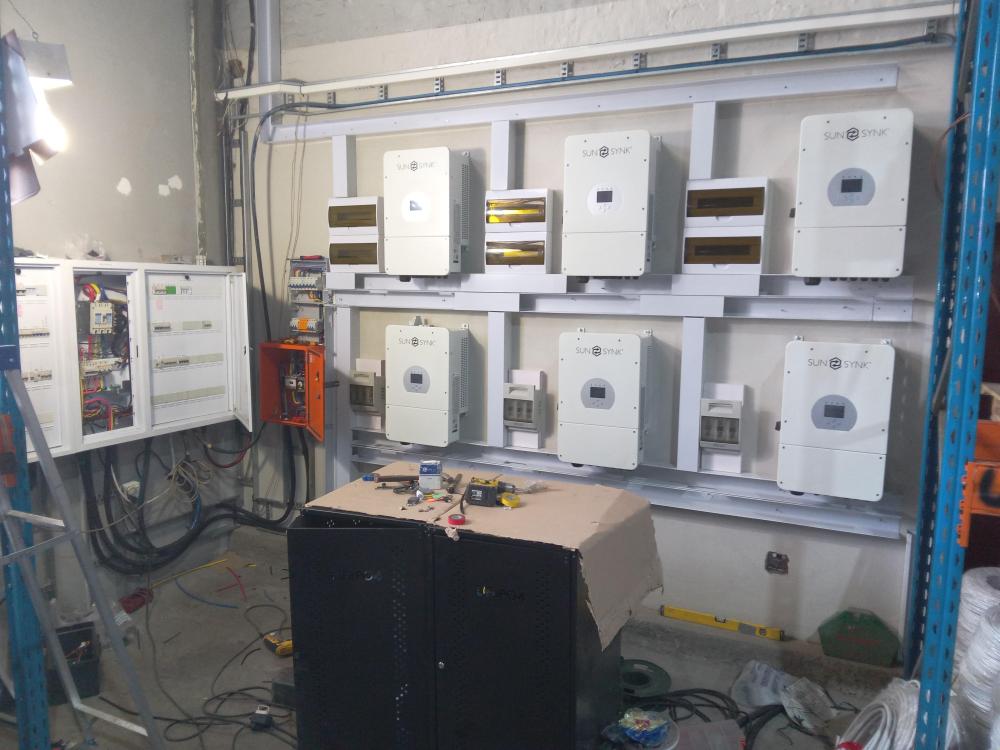
 Mounted tunking and small DB's. Started with wiring. The 6 x inverters and other accessories do take lots of space. Still busbar DB and generator DB to be mounted.
 I'm in Jhb and not so familiar with Cape Town, but you could ask the new installer for proof of registration with the Department of Labour as a electrical contractor and proof of his wiremans or masters license That way you know he is licensed to do electrical work and sign the Certificate of Compliance. It sounds that the new installer picked up on lots of non-compliance issues and will not sign off if it's not fixed or even replaced. You could also get a second inspection/opinion to make sure you are dealing with a installer that won't let you down again.Fortunately they have spare units for back-up, so that should not be a problem while one is out for repairs.Yes to install a 50KW would be easier but my customer already had 8KW units in stock and they did not want to purchase the 50KW unit. I must admit I also like the challenge of the 6 x units.