superdiy
Members
-
Joined
-
Last visited
Everything posted by superdiy
-
Difficult to say right now, I don't want to speculate on a price, but I'd rather design and build the microprocessor controlled version first - then I will calculate the cost. Currently I'm busy with my PV installation and that keeps me occupied all me time. Just keep in mind that a single unit works for a single string in a 48V system - either 4 x 12V batteries or 8 x 6V batteries or 12 x 4V batteries or 24 x 2V cells. You'll have to have 1 unit per 48V battery string - if you have 4 parallel strings, you'll need 4 battery disconnectors. The relay I'm currently using to disconnect the string is rated at 30A for 250V AC - it should handle about 30A at 60V DC - that is the current for the single string only. I can also make a unit for 24V and a unit for 12V, but I'll have to use relays with higher contact current ratings for the lower voltage versions.
-
Last price I got for the T-105 was R1 653.00 incl. each - that was on 12 Feb 2015
-
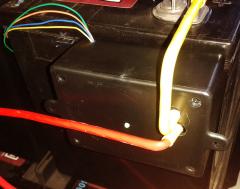
From the album: Battery disconnector
-
Used to monitor individual battery voltages in a string and when one battery's voltage becomes too low or too high the string will be disconnected.
-
Your 3 strings, each connected to the busbars, are still in parallel and therefor if any cell in any of the batteries fail, the other batteries in the string, containing the faulty cell, will be overcharged by the healthy strings and/or charger.
-
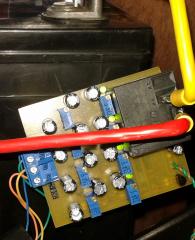
From the album: Battery disconnector
-
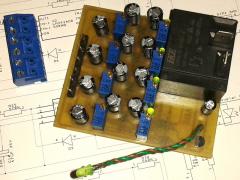
From the album: Battery disconnector
-
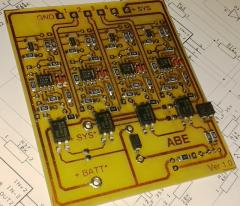
From the album: Battery disconnector
-
I had 5 strings of batteries and towards the end of last year one of the cells in one of the batteries went shorted - that caused the faulty battery as well as the other 3 batteries in that string to become very hot because the faulty battery and the other 3 in the string were basically being overcharged by the other strings and the charger. I then designed the battery disconnector. It disconnects a string if the voltage of any of the batteries in the string become too low or too high. It is still version 1 where you have to set the upper and lower limits by means of presets, but I'm still improving on the design and the next version I might be using microprocessors to achieve more accurate cut-off limits and hysteresis.
-
2V x 24. If one cell dies or get damaged for whatever reason, you only replace the single cell. Only my opinion though. If you look at pictures of all the big installations you will mostly see 2V cells and sometimes 4V or 6V batteries. Capacity wise a 12V battery would also get quite bulky and heavy. The other option is to connect multiple serial strings of 12V batteries in parallel to get the same AH rating. Since you are going to use 2 x 5KVA inverters you are probably looking at at least a 2000AH battery bank - in that case I'll try to get very high AH 2V cells in order to have a single serial string instead of lower AH batteries in multiple serial strings connected in parallel.
-
Hi Steggo I currently have a 3KVA UPS and all the essentials are already running from the UPS. It sometimes reaches close to 100% load when the vacuum cleaner or the microwave oven or the hairdryer and a lot of the other smaller appliances are running at the same time. All the heavy users, e.g. kettle, stove, air-cons etc. are not connected via the UPS, so I've never measured peak load. You're looking for 5KW, why not go for a single Axpert 5KVA then - just keep in mind that they are only rated 4.2KW - not 5KW. They do support overloads for short periods.
-
No, I have no idea about the test certificate for the Infini. If they have an issue with the Infini, I'll either go off-grid or split my setup. I'm also not going to register for net metering - R400 to have the option 0c / KWh fed in to the grid.
-
Willem Currently our average usage is between 12 & 15 KWh per day, but I've not decided exactly how I'm going to configure the Infini - might be grid-tied. I've got a 300AH battery bank on my current 3KVA UPS system which I will transfer to the Infini-setup. If I'm not going the grid-tie route I might configure the Infini to use battery power instead of the grid during the night (or part thereof). So many possibilities with the Infini.
-
Just an update... I got myself an Infini 3KW Plus and 12 x 250W Trina Solar panels. I'm currently busy preparing and securing the mounting hardware for the panels since I have a non-standard installation which requires quite a bit of additional work, but I'll post some pictures when I'm done.
-
The image you've posted is for DC systems - where you distribute DC throughout the premises e.g. your home and all equipment / appliances run off DC. That is why the DC negative is grounded as well. On AC installations the Negative is also grounded before going into the E/L unit - when there is a ground fault (current leaking from Negative OR Positive to ground), the E/L unit disconnects the power if the leaking current is more than the leakage rating of the E/L unit. You should however not connect the DC Negative of the PV panels or the batteries to the system ground unless your inverter / charge controller installation manual clearly states that you may do so, otherwise you risk damaging the inverter / charge controller.
-
Both the Axpert and Infini will do what you require, both can be configured in various ways to e.g.first use pv or first use the grid to charge batteries etc. etc. By default these inverters will supply the load with pv power first and draw power from the grid if the load requires more than what the pv panels can produce. Although the Infini inverters can be grid tied, they can also be configured not to feed back into the grid. You can start off with a few panels and add more at a later stage.
-
BUT, the Infini (and one other I found) has separate mains in and mains out connections. The grid is connected to the "IN" terminals and the load to the "OUT" terminals, like a standard UPS system, BUT the Infini can be configured to supply to the grid (grid tie) when enough pv power is available - the feed in to the grid goes via the "IN" terminals. The added bonus here is that if the grid fails, the inverter works like a UPS drawing from pv and/or battery and still supplies the load - other standard GTIs cannot do this - they switch off when the grid fails.
-
Hi blackhole The "hybrid" terminology sometimes confuses me as well, but I think you are correct when you call it a hybrid. As I explained above and as you mentioned in your reply, you can connect it to the grid, pv panels and batteries to supply the load, but it cannot feed back into the grid. The Infini is thus a hybrid on steroids, since it can do all of the above, but grid-tie as well.
-
Hi blackhole Axpert KS models - PWM Axpert MKS models - MPPT The Axpert inverters cannot be grid-tied (won't supply power to the grid) - they can be run in UPS mode and pv panels can be connected as well. If you want to grid-tie but also want to have power when the grid fails (e.g. load-shedding), you have to use a hybrid inverter, e.g. Infini, but those you cannot run in parallel. If you use a normal grid-tied inverter (not hybrid) and the grid fails (load-shedding), the inverter will also switch off and you will not have any power to operate your load from. Some grid-tied inverters can supply minimal load when the grid is off, e.g. certain of the SMA sunny Boy GTIs. Normally you would connect panels to the inverter with roughly the same rating as the inverter, e.g. connect 3KW pv panels to a 3KVA inverter, but that is totally inverter dependent - the Infini 3KVA "Plus" model accepts panels up to 4500W for instance. Regards
-
http://www.solarsolved.co.za/datasheets/solarpanels/250wjinko.pdf 1650 x 992 x 45 mm
-
Thanks Mike, please let me know as soon as you have confirmation on the estimated arrival dates and pricing information. May I PM you regarding the price for the 3KVA Infini Plus and other hardware? Regards
-
Hi Mike Can you get the Inifini 5KVA as well or is the 3KVA Infini Plus the only model available in SA? Am I correct if I say that the Axpert inverters can draw from the grid, but not supply to the grid? Infini inverters: Looking at the separate grid and AC load connections and reading through the manual I am confident that the answer is yes, but can you confirm if they will still supply the load with AC power (generated from solar or batteries) when configured as grid-tied and in case the grid fails? Can you supply a SNMP card for the Inifini inverter as well? Thanks
-
Willem, these pictures are awesome and the comments very informative. Thanks for sharing!
-
Hi Willem, don't forget www.solarsolved.co.za - they also sell the SMA inverters. (http://www.solarsolved.co.za/index.php/products/inverters/grid-tied-inverters)
-
Hi Mike Can you give more info about the "Inteli Plus". Who sells them? Are there any minimum quantities on the panels - I also got a price for the Jinko panels, but you have to buy a pallet of 23 panels.