


Cassie
Members
-
Joined
-
Last visited
-
An interesting Ai calculation and input regarding a power plant design. However I still need support to verify if Ai's suggestion is correct or an overkill. I asked Ai the following question: Question to Ai: If I use 3x 5.5kW heating elements to; 1.) boil 240L of water from 30 degrees C to boiling point, and 2.) then ad another 440L room temperature water and continue heating now all 680L water again up to boiling point. 3.) when all 680L is at boiling point I need to keep on boiling it for another 1 hour; 4.) If I apply a water turbine which can generates 16.8 kW/day 24/7 what size kW three phase inverter, batteries and solar panels should I add to do the above Ai's Quick answer (numbers you can use) • Total energy required (best-effort assumptions): ≈ 74.4 kWh to complete the full sequence you described. • Peak AC power required (heater draw): 16.5 kW (3 × 5.5 kW). • Suggested three-phase inverter rating: ≥ 20 kW continuous (25 kW recommended for safety/headroom). • Battery usable capacity needed (to run the process without any PV during the run): ≈ 94 kWh usable → recommend installing ~110–120 kWh nominal battery bank (to give margin and allow e.g. 80% usable depth of discharge). • Solar array (PV) size (if you want to offset most of the energy with PV + use the water turbine): ~12 kWp (I recommend 12–15 kWp to give margin for weather/seasonalvariation). Below Ai shows the assumptions and the step-by-step calculations What Ai assumed 1. Room temperature for the added 440 L = 25 °C. Boiling point = 100 °C. Specific heat of water = 4.186 kJ/kg·°C. (1 L ≈ 1 kg) Heaters run at 16.5 kW (3 × 5.5 kW) continuously while heating and for the 1-hour “keep boiling” period. “Keep boiling for 1 hour” interpreted as running the heaters for 1 hour once the 680 L is at 100 °C (i.e., we did not try to calculate mass evaporated — we assumed you keep the elements on for that hour). Water turbine generates 16.8 kWh/day total (your wording “16.8 kW/day 24/7” interpreted as 16.8 kWh/day, i.e. ~0.7 kW average output). Inverter efficiency ~95%, battery usable DOD ~80%. PV yield assumed 5.0 kWh per kWp per day (reasonable mid/high yield for sunny locations; change this if you have a different local estimate). Ai's detailed math / calculations (so you can verify or change inputs) 1. Heat 240 L from 30 → 100 °C: E₁ = m·c·ΔT = 240 kg × 4.186 kJ/kg·°C × 70 °C = 70,324.8 kJ = 19.535 kWh Add 440 L at 25 °C and reheat whole 680 L to 100 °C: o Mixed temperature after addition = (240·100 + 440·25) / 680 = ≈ 51.47 °C. o ΔT to bring whole 680 L to 100 °C = 100 − 51.47 = 48.53 °C. o E₂ = 680 × 4.186 × 48.53 kJ = 38.372 kWh Keep boiling (1 hour of heaters on at full power): E₃ = 16.5 kW × 1 h = 16.5 kWh Total energy = E₁ + E₂ + E₃ = 19.535 + 38.372 + 16.5 ≈ 74.4 kWh Time to perform whole job at 16.5 kW continuous ≈ 74.4 kWh / 16.5 kW = ~4.51 hours. Turbine contribution during the process: o Turbine average power = 16.8 kWh / 24 h = 0.7 kW. o Over 4.51 h it would supply ~0.7 × 4.51 ≈ 3.16 kWh (small compared with total need). Battery sizing (if you must supply the whole run from batteries with turbine contribution during run): o Energy to be supplied from batteries during the run ≈ 74.4 − 3.16 ≈ 71.25 kWh. o With 95% round-trip/inverter efficiency and 80% usable battery DOD: battery nominal = 71.25 / (0.95 × 0.8) ≈ 93.8 kWh usable → round up: ~110–120 kWh nominal pack recommended for margin. PV sizing (if turbine gives 16.8 kWh/day and you want PV to cover the remaining daily energy for one such event per day): o Net daily energy PV must provide ≈ 74.4 − 16.8 = 57.6 kWh/day. o At 5.0 kWh/kWp/day that needs ≈ 57.6 / 5 = 11.5 kWp → round to 12 kWp (12–15 kWp recommended for seasonal margin). Inverter: must continuously supply 16.5 kW AC. Because of losses, transient events, efficiency and safety margin, choose a three-phase inverter ≥ 20 kW continuous, preferably 25 kW with appropriate three-phase output and good thermal capacity. Recommendations & practical notes • If you intend to run the heaters only during sunny hours, you can reduce battery size a lot (use PV direct + small battery buffer). If you need to run at night you’ll needthe full battery capacity above. • The turbine is useful as continuous background supply (~0.7 kW average): it will shave some battery/PV requirement but is small relative to the 16.5 kW heater load. If you can run the heaters when turbine + PV combined exceed heater draw, you’ll rely less on batteries. • Sizing margin: I recommended rounding up inverter and PV slightly to handle cloudy days, wiring losses, inverter derating, and future expansion.
-
Actually "neutral bonding” is the bonding of the Inverter neutral with the "earth".(as I understood) The neutral of AC in and AC out is not "neutral bonding". The AC "neutral in" of the inverter, should never cross (makes contact) with the AC "neutral out" of the inverter. This can burn your inverter (destroy it). So there are actually 2 issues you asking about.
-
I need some advice. I kept a brand new 200-ah Gel battery in my room (not to forget about it - never been used - now 1 year old). The voltage dropped below 13.4 volts once every second month, and then I gave it a little charge to restore it to 13.4 Suddenly it dropped to 10.3 volts, and it's not holding its charge after a recharge. Is there perhaps a magic which I can apply to revive it? I have a need now for it and now it's not functional anymore !! Thanks in advance.
-
I know how to connect the LED pilot lights to show the status of Mains (Eskom) and Solar (Inverter). I already have them installed, but I want to add pilot lights to show which source is supplying power to the load via the transfer switch. I thought of doing it according to the drawing below because the neutrals are not crossing (two separate neutrals - inverter requirement). But I'm afraid that; 1.) this way might cause the neutrals (now) to cross, and 2.) both LEDS are going to "shine" at the same time anyway because each one is going to have a neutral and a Live fed (even when not switched). Please advise if this will be possible and how? Thanks so much
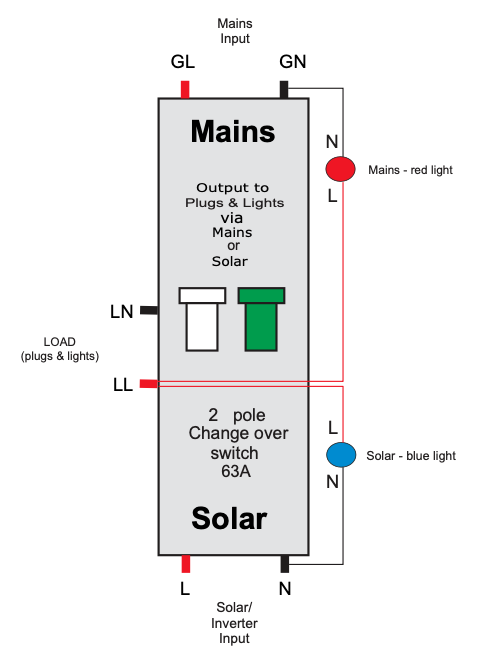
-
 Basil Katakuzinos reacted to a post in a topic:
Can I connect a hydro-electric generator to a Axpert inverter?
Basil Katakuzinos reacted to a post in a topic:
Can I connect a hydro-electric generator to a Axpert inverter?
-
Its very easy (I assume your client is using an AC circulation pump) : 1. Use a transfer switch to render AC power to the Geyser either from the Mains (Eskom) or the inverter backup system 2. Have a Geyserwise Max installed. 3. During load shedding I transfer the power supply with the transfer switch to the Inverter backup and ensure that on the Geyserwise Max the element is not selected at all. For this reason, I do not use the program timer to switch the element on. 4, The alternative is to install a DC circulation pump with a 10w solar (PV) panel and 12v battery - this will eliminate 1. and 3. above. This is what I'm going to do next,
-
My son has a strong stream of water coming down the mountains (head; over 150m) 24/7. To start as an experiment he is considering installing a small hydroelectric 1000w 220v generator and store energy in 4x 10⁵ah gel batteries. Can he connect this generator to a simple 5kva Axpert and use it's MPPT to charge 4 batteries? (he has a surplus Axpert) In view of the fact that this generator will run 24/7, will it take the batteries to SOC of 100% via the Axpert (assuming that due to the amount of water and the head a max output of 800 - 1000w will be possible)? As far as I can remember the Axpert doesn't have a generator input, can he just use the AC input?
-
With reference to the above discussion: My son has a strong stream of water coming down the mountains (head; over 150m) 24/7. To start as an experiment he is considering installing a small hydroelectric 1000w 220v generator and store energy in 4x 10⁵ah gel batteries. Can he connect this generator to a simple 5kva Axpert and use it's MPPT to charge 4 batteries? (he has a surplus Axpert) In view of the fact that this generator will run 24/7, will it take the batteries to SOC of 100% via the Axpert (assuming that due to the amount of water and the head a max output of 800 - 1000w will be possible)? As far as I can remember the Axpert doesn't have a generator input, can he just use the AC input?
-
Marc, is this generator still for sale. If so what do you want for it?
-
I have a Sunsynk 8Kw. I did the installation myself and made some changes on my switchboard adding 2 change over switches. One on the essentials so that I can switch over from the PV/battery/inverter to the grid (if something went wrong on the solar side) And the second change over switch on the non-essentials (like the geyser, bore hole- and irrigation pumps and garage DB) This enables me to use my (non-essentials) geyser, pumps and electricity in the garage when the Grid is on load shedding. As @GreenFields is saying "the non-essential loads don't run through the inverter, they are connected onto the grid feed." This allowed me to do the installation as I did.. What is interesting of the Sunsynk (and I suppose of all newer generation inverters) is that they can be described as smart inverters. If there is enough PV the inverter supplies the non-essentials with power even thought they are not running through the inverter. If you send me an email I can send you the drawing of my wiring just to give you an idea. Which inverter are you using?
-
Thanks I'll check it out.
-
Is there an official app with which I can setup and control a Deye 5kw on my laptop, similar to the Sunsynk app?
-
Can I trust LEDtronix. Did anybody do business with them in the past. They sell Gel batteries at a special price. Just want to use them to power LED lights. Thanks in advance
-
Due to the fact that Gel batteries are different from AGM batteries, I need to know which setting I should select on a Axpert 3KVA 24v inverter for Gel batteries. Flooded, AGM or User-defined? Thanks in advance.
-
Hi GregDB, The best choice I ever made - to buy a Sunsynk 8kw. Youhave to start somewhere when you upgrade to the "real" world of solar - and Sunsynk is the way to go. And if I can advice go for the 8kw from the beginning. Ok your batteries at the moment might not be an adequate match. But you're planning to upgrade that as well later. At least the Sunsynk charger will fill them (the Royals) up quickly, if they are not already damaged - but hopefully it will give them a good push I think. Just make sure to add Lithium Ion (actually Iron) batteries latter. All the best with your adventure!
-
I'm interested to see if/how it will perform, with these specs, as an EV battery?