Beat
Members
-
Joined
-
Last visited
Everything posted by Beat
-
I personally don't like the idea of one big battery and prefer several smaller ones. If one fails it can be taken care of while I'm still in business with the other ones.
-
Because they don't want you to buy from competitors.
-
It is save to mix battery packs with the same chemistry and the same number of cells. The size (Ah or kWh) may be different, no problem. The compatibility of the BMS is another story. However it looks like most BMS support RS485 protocol for pure monitoring.
-
Good for you! Not everybody is such a Hercules that can lift 70kg, neither am I.
-
On my 3 older LEOCH 48100TB the BMS calculates SOC by counting metered Ah in and out but neglect the internal losses. The result is their SOC readings are always to optimistic. When approaching full charge their BMS display 100% SOC while the batteries have not yet reached full charge voltage and continue charging. Therefor I prefer charge managing by the Inverter on the base of battery voltage without interference from the BMS via coms.
-
I have: Its a LEOCH 48100-S. I have no coms and use inverter settings for bulk and float charge voltages according to specs of the battery manufacturer. According their recommendations the bulk charge remains for 1 hour to allow for balancing. However it looks like it has no effect. Averge refuses a guaranty claim by arguing that the pack still has full capacity according to specs.

-
I think you don't need an additional MPPT. Connect the west roof panels in parallel with the east roof panels. This will not overload the MPPT since the east and the west panels will never deliver full power at the same time. I have such a situation and write from experience. Condition is however that east and west panels are of the same type (same number of cells).
-
This statement being classified "bad advise" any further discussion becomes obsolete. I stop it right here.
-
Think about handling, i.e in case of requirement to move them. A 4.8kWh battery weights about 45kg. 2 persons can handle this but everything larger would require lifting devices. Better make up your storage needs with several handy units. Also in case of failure of one it would impact the system less.
-
That's what I thought too. But on my bank of 6 packs I observe the following: During charge and discharge all packs show quit coherent voltages with the inverter, taking measuring inaccuracy and voltage drop in the cables in account. However at full charge with no current some of the packs voltage deviate from others and from the inverter up to 1V. I have no explanation for this other than weird BMS. What I don't know and wonder is whether the terminal voltage readings are measured at the terminals or just the mathematically adding up of the cell voltages.
-
Tinbum, you are a genius for imagination of extreme scenarios, that 99.99% of users never experience. This forum as well as the inverter forum are full of threads complaining about BMS to inverter comms issues. The actual thread is a typical example. The author neglected proper inverter settings assuming the BMS would take care of it. But that didn't happen. I cannot remember any thread with an issue caused by the lack of such comms. I conclude that comms cause more issues than they resolve. One cannot over emphasize the importance of proper inverter settings according to battery specs, with or without comms. Just figure out if there is or is not a risk.
-
Quit a horror scenario you fantasy. My solar panels can never deliver so much power that could overheat the batteries with charging. The total nominal 6kW never deliver at the same time thanks to different orientation. The grid charging current is limited to 0.1 C of the batteries. Besides, if one had so many panels to present a risk, he could limit the charging current in the inverter settings.
-
What you mention are protective parameters, not charge managing. If any those exceeds critical value by internal cause the BMS has the ability to disconnect itself from the terminals. If you have a bank of several battery packs there is no need to intervene with the inverter leaving the rest of the system functional. What you need however is periodically monitoring of the packs. I do it with a RS485 bus connected to each pack and wired to a laptop in my office. You might also do it with WiFi.
-
I strongly disagree with you. From my experience with BMS weird behavior I get goose bums thinking those could control the inverter. Inverters are designed to manage charging on the base of battery voltage. That information never lies.
-
Reading trough this tread resurfaces my old question: What can BMS comms do better than proper inverter settings? My inverter settings with no comms according to battery specs for 15 cells are: Bulk charge 53V held for 1 hour, float charge 51.5V. These values have never been exceeded. With these settings healthy battery cells never go into OV state.
-
Thank you for your advises. Yes I purchased all 6 packs directly from Averge. This last one purchased about a year ago is still fully under guarantee.. As mentioned this happens every time the pack reaches full charge. I cannot reset the BMS remotely but wait until it releases OVP by the cell voltage falling below OVP release at 3.38V. As the pack is disconnected there is no discharge current other than the little balancing current, it takes hours to release.
-
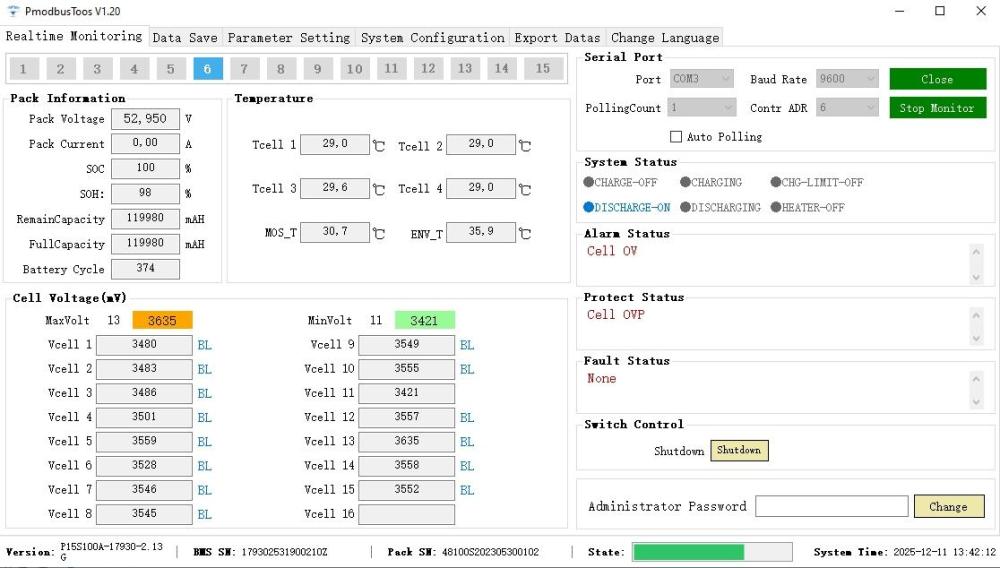
I had some email exchange with Averge. I wrote: Yes, the BMS is functioning correctly, set aside the weird SOH readings. However the cells 11 and 13 are not functioning correctly. When approaching full charge cell 11 dives to significant lower voltage while even with very low charging current of a few A cell 13 raises its voltage over the cell OVP threshold. That should not happen as long as the packs terminal voltage remains within specified bulk charge voltage. These two cells are sick. A small system with only this one pack could not operate correctly. And further: The issue of this pack is the abnormal cell over voltage of cell 13 at full charge that triggers cell OVP and disconnects the pack from the 48V bus. This is a dysfunction and indicates a health problem inside the cell. It is beyond being unbalanced. It happens every time the pack reaches full charge. Averges response: We want to assure you that this is a normal protective function, not an indication of a problem. The OVP briefly pauses charging to allow for safe cell balancing, a routine process in lithium batteries. This prevents any cell from exceeding strict safety limits. The definitive test of battery health is its performance, which in your case remains uncompromised: It provides its full rated capacity. All communication features (display, inverter integration) work perfectly. It recharges fully after an OVP event. If functional capacity were affected, we would share your concern. However, since the system continues to perform exactly as specified, the OVP is simply doing its job to ensure long-term safety and reliability. This behaviour is expected and within normal operational parameters for lithium technology. I am helpless.
-
Below the response from Averge: Good morning, The cells are balancing and within 400mV at full or empty which is normal. The battery will only be replaced under warranty if the capacity is less than the spec: being Less than 80% SOH (or usable capacity) before 5 years or less than 70% before 10 years.
-
Tank you both for your thoughts. For your information I read from the BMS parameter settings: Cell OV protect is set to 3.65V, the OVP release at 3.38V. @DeonBez In your case perhaps a reset would also have done the trick. But your bulk and float charge settings are correct for 16 cells as recommended by the battery manufacturer. In my case with 15 cells bulk 53V, float 51.5V.
-
I started my system 5 1/2 years ago with 3 Battery packs of LEOCH 48100-TB. So far satisfying performance with no problems, set aside the little flaw of SOC calculation neglecting internal losses. They accumulated meanwhile 1831, 1649 and 1560 cycles, still displaying 100% SOH. I monitor them trough a RS485 bus connected to the laptop in my office. Some days ago pack 2 disconnected itself from the 48V bus after being completely charged to 53V bulk charge voltage. It just sat there with no current in or out, 100% SOC, no alarm, no fault, no protect status. I checked the built in breaker but no trip. So it got to be the switching transistor failing. I started to figure out how to eventually short circuit it in order to make the pack operational again. But then I thought to try the BMS reset, it couldn't do any harm. I never had to use it before. I waited the other packs to get fully charged in order to minimize equalization current. The reset has to be hold for a few seconds until all LEDs have gone trough cycling. Then WOW, a quit high current occurred but gradually came down to normal. Bingo the pack worked again. However I noticed in this very same cycle pack 3 disconnected. I did the reset on it the following day and it also got back to normal operation. I wouldn't be surprised to experience the same with pack 1. Is there any one of you BMS experts that can explain what really happened?
-
The troubling fact is that this cell 11 behaves normally in all other conditions, voltage in line with the others.
-
That comes close to what I am experiencing with my latest acquired LEOCH 48100-S. They are different from the earlier 48100-TB and have different BMS. Look at the screenshot below. This brand new pack does it every time it reaches full charge. It goes on cell over voltage protect. While cell 11 has unexplained low voltage the difference to the other cells triggers balancing of them. This situation prevails then for quit some time until the balancing currents have lowered the cell voltages. I think this is not sustainable and noticed Averge for a guarantee claim. Up to now I have no answer. No other pack behaves like this. Note also the 98% SOH display that Averge could not explain. What do you think of that?
-
There is also another factor to be taken in account: the internal losses. As I observed on my LEOCH 48100TB packs the BMS counts and discounts Ah as metered to calculate SOC but neglects internal losses. The result is that when approaching full charge the BMS displays 100% SOC while the pack has not yet reached full charge voltage and is still charging. The difference between the displayed SOC and the true charge is the internal loss. If the battery is not fully charged as may happen on cloudy days the error of internal losses accumulate. Note that my system manages charging only on the base of pack voltage.
-
Your thoughts are basically correct. However the resistances of 25mm² cabling is so low compared to the packs Ri that it is neglectable. Remember that the cells Ri in a pack add up to the packs Ri. The more cells you have the higher the Ri. Therefor your consideration is more relevant on 12V and 24V batteries but becomes less important on 48V and 51V batteries.
-
This myth seems to be persistent. We discussed this several times. The fact is that differences in internal resistance (Ri) between the packs are likely to be higher than 20cm of 25mm² connection cables. As a matter of fact it happens so that the pack at the end of the row (and it's the oldest one) draws the highest currents due to its lower Ri. These differences in Ri are due to manufacturing tolerances.