


Beat
Members
-
Joined
-
Last visited
Everything posted by Beat
-
The importer and seller, Averge, confirmed to me that this way of installation presents no problems. By the way - as I think of it, it's the other way around. As the picture of an opened pack shows the cells lie flat if the pack is installed horizontally. In my vertical installation half of the cells are upright, the other half upside down. On the flat positioned opened pack the cells terminals are visible with the metal plate bridges between the cells.

-
Looks nice and need. How high can you go considering the wight of the packs? There is one problem: In case you have to move one of the lover packs i.e. for inspection or maintenance, you would have to first take the packs above off. I prefer it this way:

-
Think about handling, i.e in case of requirement to move them. A 4.8kWh battery weights about 45kg. 2 persons can handle this but everything larger would require lifting devices. Better make up your storage needs with several handy units. Also in case of failure of one it would impact the system less.
-
-
-
-
-
-
I started my system 5 years ago with 2 Battery packs of LEOCH 48100-TB. I gradually added another pack, a second 5kW inverter in parallel and PV panels. So far it worked to satisfaction. Last year I added 3 more battery packs. LEOCH had in the mean time come out with a new model that is the 48100-S. Now there is an issue with the new ones. While the 3 older ones with over 1500 cycles still show 100% SOH, the new ones after a few days of service showed 99% SOH. I complained about at the seller Averge. But Averge argues that if they can prove 100Ah capacity according to specs they do not consider this a guarantee issue. In the mean time a year later two of them have turned to 98% SOH. Assuming the packs are still in good health and the algorithm in the BMS to calculate the SOH is correct, I conclude there must be a wrong parameter setting. But what is that parameter? Is there any BMS expert out there that could help?
-
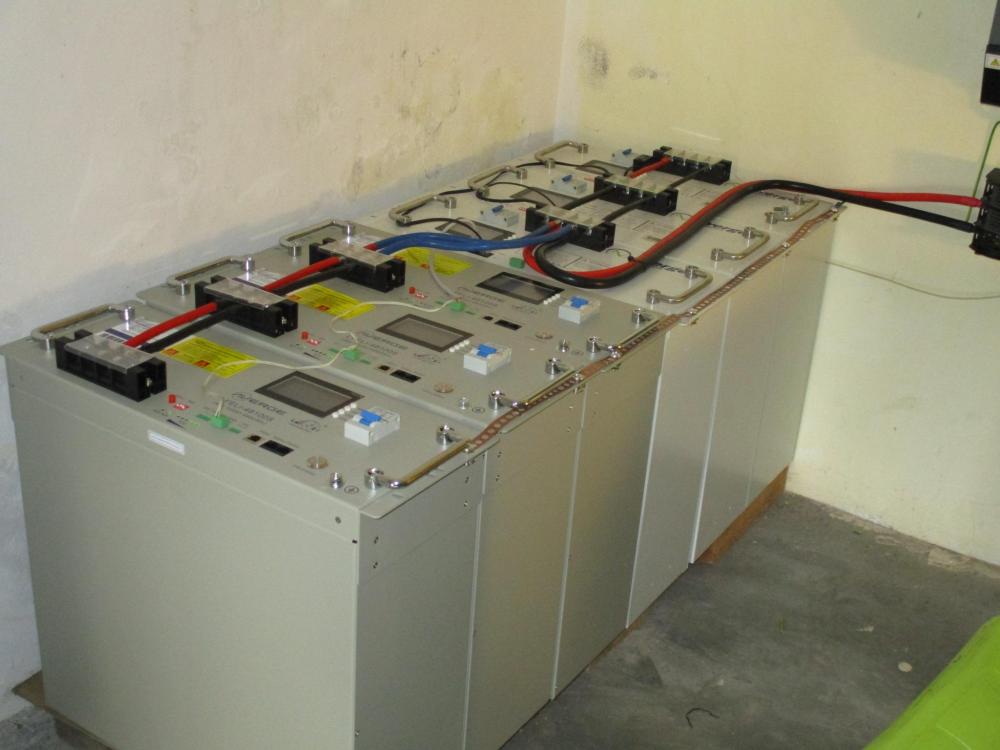
I think to stack the packs one on top of the others is a bad idea for two reasons: I'm afraid the lowest pack would mechanically suffer from the wight of the others. If you need to take one out for inspection or repair it would require to remove all on top of it. Not that easy at 45kg each. Do it rather like in my picture: There are wood planks underneath the packs.
-
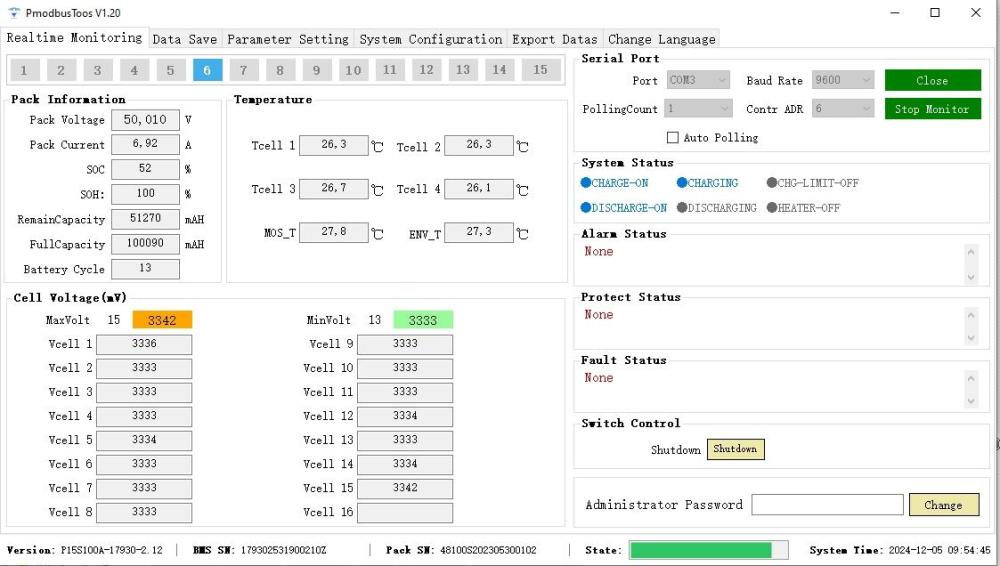
I had same problem with my LEOCH 48100-TB packs. The setup with RS232 according to the manual didn't work. Finally the supplier came up with the solution: Create a communication bus with all RS485 ports on the packs in parallel and connect with an RS485 adapter to the laptop. Also needed to change the software to PmodbusToos V1.20. Each pack must have a different address set by the dip switches. This way I can remote monitor every pack individually but not simultaneously. There is no master, all packs have same priority.
-
The real capacity of batteries I started my system 5 years ago with 2 Battery packs of LEOCH 48100-TB. I gradually added another pack, a second 5kW inverter in parallel and PV panels. So far it worked to satisfaction. Last year I added 3 more battery packs. LEOCH had in the mean time come out with a new model that is the 48100-S. I connected all of them in parallel to one bank now theoretically 600Ah. Pretty soon I noticed that the new 48100-S packs behaved different from the older TB48100-TB. First they draw higher currents than the older ones. I attributed this to a lower internal resistance due to improved manufacturing. However It was followed by a faster decrease of SOC when discharging. I noted differences of about 30% when the others were at 40%. It culminated in a low SOC shut off by the BMS while the other packs still run at 30%. I checked the currents with my clamp on ammeter, they confirmed within reasonable tolerances. By analyzing this I came to the conclusion that these packs have in reality a significantly higher capacity than the older ones. The lower Ri, the higher currents, the contradiction between terminal voltage and SOC, everything pointed to that. I guessed to about 130Ah. However the BMS was set to only 100Ah full capacity. So at discharge the BMS discounts the metered Ah from 100Ah rather than from 130Ah and at a higher rate due to the higher currents. So I decided to change that setting in the BMS. But I had to wait for a moment when they are fully charged. Lately it happened. With PBmsTools I set each of them to a different value: 125, 130 and 135Ah in order to find out the best settings. After observing a couple of days it turned out that this was somewhat too much and I lowered Nr 4 and 5 to 120Ah and Nr 6 to 125Ah. That proved to be the real capacity and the SOC countdown is now within a few % the same as with the older packs. Note that this does not change the basic performance of the cells and packs. However it will prevent premature shut off by the BMS due to false low SOC readings. The wrong settings in the BMS falsify the SOC calculation. While at 100Ah capacity every Ah equals one % SOC whereas at 120Ah it takes 1.2Ah to make one % SOC. Now hold on for a minute. I bought and paid 100Ah packs but got 120Ah and 125Ah - that's a bonus isn't it? It appears that when LEOCH redesigned the cells they achieved an increase in capacity within the same dimensions and wight. The difference between 120 and 125Ah is due to manufacturing tolerances.
-
It sounds to me like BMS malfunction. BMS could have wrongly discounted Ah to reach low SOC limit and shut off the batteries. By recharging the batteries the BMS jumps to 100% SOC when the cell voltages reach bulk charge level. To find out record the batteries terminal voltage.
-
I run 2 Axpert MKS 5K (also Voltronics) in parallel without BMS coms for almost 5 years with no issue. With the correct settings they manage the battery charge perfectly on the base of battery voltage. Yes the inverters battery SOC reports are worthless since they don't have the right curves in their firmware. I monitor the batteries with RS485 connection to my laptop. Read also my thread "Are BMS reliable?" in the battery forum.
-
The user manual should tell you.
-
Basically you can access all parameter settings directly on the inverter with the built in control panel.
-
Did you try to disconnect the batteries com cables and run the battery management with setting 05 to USE?
-
That seems to me too high. The manufacturer of my LiFePo Batteries specifies 53V. I never get cell overvoltage alarm.
-
Yes there is. It's the difference of internal resistance due to manufacturing tolerances. That difference is likely to be way higher than the difference of resistance in unequal lead lengths. I.E. my oldest pack that connects with the longest leads shows consistently highest charge and discharge currents. The only thing you could do about it is to open the pack and check the cell connections. I found one pack with poorly tightened bolts on the cell terminals.
-
I had a similar issue with my newest purchased Leoch 48100-S pack. From the beginning cell 15 showed significantly higher voltage at charge and lower at discharge. This being a brand-new pack I contacted the official importer and seller, Averge, with a guarantee claim. But they didn't want to do anything about it. I asked to allow me to open the pack without voiding the guarantee to check the cells connections. They wrote me the permission and so I did. I tightened all M4 hexagon bolts of the cell bridges with a socket wrench. Some allowed up to a half turn. After reassembly and re-connection the issue with cell 15 no longer persists. It looks like all cells run the same voltage within a few mV. This proves to me that all cells are in good health.
-
Despite your hesitation I would recommend paralleling another 5kW unit. The big advantage would be to have redundancy. If one unit fails, and they will one day, you still have the other one running in case of black out, even with reduced power capacity. I did it myself - it's not such a big deal. Remember - you also would need to add some battery capacity.
-
I think your calculation is wrong. Even if your inverters were as bad as only 80% efficient, 20% of 4.8kW would be 960W. Did you measure the 6kW from the panels or do you take the panels spec? If they really deliver 6kW the sold goes into the batteries. But I reserve measuring errors. There is no way an inverter of your size produces 1.2kW heat loss. It would very rapidly go up in flames. It's the power of our infrared room heaters. From your writing I conclude that your inverters are Voltronic rebrand or Voltronic clones. Their efficiency is better than 90% as claimed by the specs of my Axperts.
-
My thoughts about it is: Get off grid and forget about exporting. Install an extra air conditioner in the inverter room. That would comfort the inverters and potentially extend their life. It would consume part of the produced energy but according to your writing anyhow overflows.
-
I don't quite understand your logic. Voltage is the same in every language and the only information that does not lie. That's the reason why all inverters are programmed to manage charging on the base of battery voltage. No, that's not the way it works. The BMS cannot regulate anything, it can only cut off the battery in case certain limits are exceeded. If the parameters are set correctly in the inverter there will never be over-voltage as long as there is no failure.
-
That's the way it is. The inverters are programmed to manage the battery charging on the base of battery voltage, provided the determining parameters are set to battery specifications. I have seen weird BMS SoC readings that give me goose bums when thinking that the inverters should depend on them. I prefer not to have BMS to inverter comms. Read my thread "Are BMS reliable?".


