


LoodPyp
Members
-
Joined
-
Last visited
Everything posted by LoodPyp
-
Thanks for the feedback @JamesF, glad to find it a new home.
-
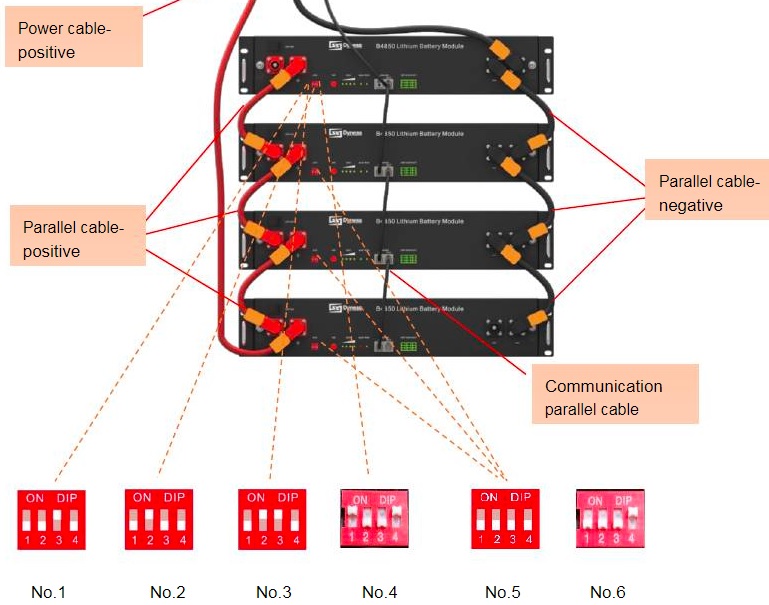
Hi @GerhardvN Looking at the Dyness B4850 Battery Manual, p17 ( https://www.manualslib.com/manual/1987164/Dyness-B4850.html?page=19#manual), it shows the required settings for the various batteries (master and slaves). Hope this helps.
-
9 panels in series will reach the minimum voltage (to start delivering power to the inverter) earlier in the day than 5 panels in series, and stay active later too. If you have identical watts in one series or in two parallel strings and all other factors are equal, the series connected string should outperform the parallel strings due to longer operation (total time of use per day above minimum voltage). However, if an east/west configuration provides you with longer (duration) but lower (level) all-day power delivery, your specific needs or preferences may swing the decision.
-
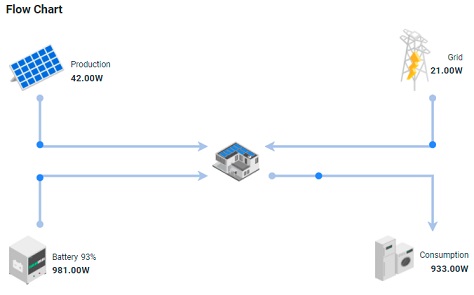
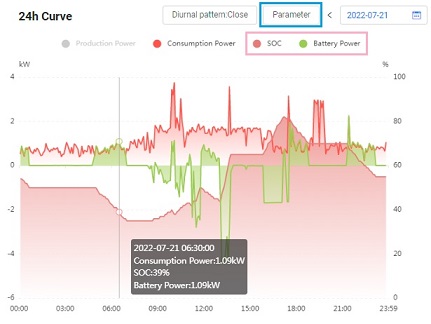
Hi @Oxman Check and add to deduction: You are using a Sunsynk Inverter. (Which capacity?) Please explain "does not show my batteries." We may as well start at the beginning. "Graphic" meaning your plant's Flow Chart: Or "graphic" meaning the trend: My default parameters when opening Solarman Smart are Production Power and Consumption Power. From my interface the battery(ies) condition is viewed by selecting the following Parameters (in pink, selected using the bright blue block): State of Charge (SOC - dull red) and Battery Power (charge/discharge - green) Are these parameters not available for you to select?
-
@Zapnologics The installation angle is likely your limiting factor to receiving more solar power in winter. I have 6*270W panels which were mounted at 15-20 degrees above horizontal, facing north. A month or more ago I decided to elevate them, and 45 degrees turned out to be an achievable position with hardware which I had within reach. Power input increased by more than 30%. (This figure aligns with @BGb's chart's winter reduction, despite having clear skies.) Unless you are able and willing to make seasonal adjustments, increasing the number of panels will be the easiest option. Given the cost of purchasing panels and mounting systems, I am guessing that it may also prove to be cheaper/ more effective in the long term.
-
Hi @karina My local supplier is confident in his Shoto products, and the price was decent and stock was available (Nov 2021, when most suppliers were waiting for delivery). No complaints so far, and communicating well with my Sunsynk inverter. A recent search showed some Shoto 5.12kWh stock available at R23 500; Sunsynk's equivalent is about R25 600. I saw somewhere on the forum that using the Sunsynk combo has a positive impact on your warranty, but I have no idea how many users have ever needed to test the effect of this and how much difference it makes in the long term.
-
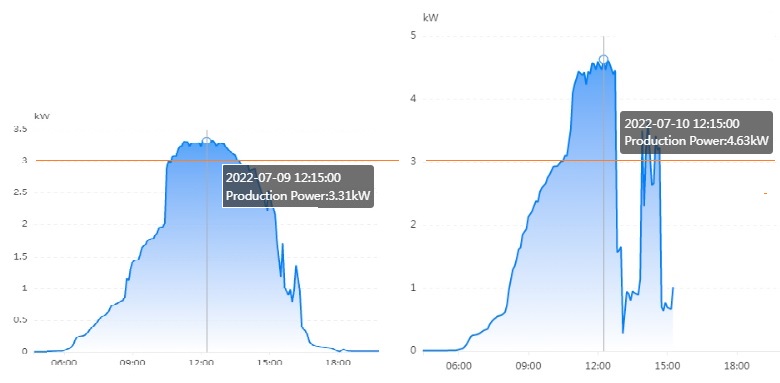
@Marcodp Thank you for sharing. First, the mounting position on panels. This picture is for JASolar 365 - 390W Panels (just to illustrate the principle): The vertical mounting hole sets are spaced 1150 and 1400mm apart. I understand that the ideal clamping position is between these sets of holes (along green lines). On to the shadow. Learn from my mistake, as I mounted my panels too close to my solar geyser. During the winter months, it casts a shadow on the closest two or three panels (depending on time of day), affecting performance of the entire string. Yesterday I moved those three panels out of the shade. Here are the results between yesterday and today (both days: clear blue skies): Excuse the readability, but I resized one graph to show equal vertical scales. Orange line shows 3kW. The winter's reduced power generation from having a roof inclined at 15-20 degrees is nowhere near the reduction in performance due to shading. Today the batteries were full just after 1pm, whereas yesterday charging was still underway at 4pm when I disconnected for the relocation (mains charging required). Peak power of a string of 9*455W on one MPPT has increased by ((4.63-3.31)/3.31 😃 40% just due to removing the partial shadow (similar in extent to your chimney's) from 3 panels. Before moving the panels, I may have been better off just disconnecting 2 or 3 panels. (If you want to try that yourself during the day, just remember to disconnect the breaker feeding DC to the inverter before disconnecting the cables at the panels.)

-
Hi @SkilliePower Since no other comments are offered, I'll mention the basics - at the risk of stating the obvious, since you asked no specific questions. I'm not going to address the technical issues about specific products, but mention general principles: By "you" I am addressing the household, since everyone needs to work together at making the implemented plan succeed. Assuming 20% minimum State of Charge (SOC), one 2.5kWh battery at 2kW discharge rate will last max 1h, regardless of whether it is drawn from the kitchen, bedroom, lights, etc. Obviously, the less you draw, the longer the battery will take to discharge. Assuming 2.5h of loadshedding per event, you will need to limit power drawn to below (2000Wh/2.5h=) 800W (on average) to last from 100% to 20% SOC on the 2.5kWh battery. The lower the start SOC, the lighter the average load needs to be to last, or the shorter the duration until the inverter switches off. If past stage 4, loadshedding may extend to 4.5h per event. Back to your post: have you quantified the load for early morning/evening loadhsedding? (What is included in your requirement - lights (how many?) TV, radio, alarm system, bedside appliances, etc?) If a permanent installation, consider wiring the DB to supply just those essential sockets to prevent 'accidentally' using battery power on a hairdrier. How does the math add up - both power supply/demand and finances? And rather be a tad too generous than too accurate, since there always seems to be some form of scope creep *after* budgeting for the requirements. I hope you find what you need and that it works for you.
-
Hi Eldred. I believe that your current budget allows for addressing your needs. (Where are you located, if I may ask? Another member may be able to advise regarding local options.) Prices have changed since last year, but I'll mention figures to illustrate. Sunsynk 5kW (R21k) vs 8kW (R31k). Deye is similar to Synsynk, but slightly cheaper to purchase (about R3k for 5kW model). If pressed for price and you only want to buy once, learn once, set up once, consider buying the 8kW Deye. (Having suffered with an Axpert before, I'd avoid it myself.) If you have sufficient solar collection now, you could add panels later, budget permitting. Remember to plan for that capacity and mounting now and only pay once for hardware, and you could possibly install additional panels yourself and simply connect. In the meantime you have a reasonable "free" solar supplemental input and back-up during loadshedding. My present consumption is about 30kWh per day. I chose the 5kW inverter based on current need, but am aware that long term needs may differ, although children are now leaving home. However, I installed a higher power cable to connect inverter to DB for future-proofing. I bought 4kW of panels to add to my previous panels (conveniently now on 2 strings). Even if mounted flat on roof, remember to budget for mountings, which add up fast. My roof pitch is 15 degrees, so summer yield is high (>5kW). Last week I changed the pitch of the old panels to about 40-45 degrees and am now receiving 400W more at peak (on 1.6kW nameplate rating, that is significant). My newer panels may see a similar adjustment soon, but I am prepared to adjust seasonally. I opted to have the electric stove connection bypass the inverter completely. (The top runs on gas.) The geyser has a 2kW element, although I have solar prefeed (saving 50%). This allows electric heating by day using solar at no/little cost. (These options add up, allowing you maximum draw from solar when available, otherwise it has to be stored in battery or lost. In winter, with shorter days, it could become a significant portion if managed correctly.) You are able to manage battery levels to reserve a predetermined charge for the event that loadshedding strikes from 6-8am, provided your battery capacity is sufficient to supply your household's morning peak. Which brings us to batteries. I opted for 2*5kW Li-ion batteries, which last well through warm, shorter summer nights. However, using timed charge limits overnight to ensure 2kWh available power through peak demand results in municipal power usage during winter. (Monthly usage is now about 200 kWh in winter, almost none is summer.) One 5kWh battery is sufficient for 2.5h of loadshedding, day or night (i.e. 4kWh use from fully charged, but just don't keep it there if you want it to last). I installed the rooftop panels, inverter and local isolation/fuses myself, saving on installation fees. Don't hesitate to renegotiate cost with the installer if they only connect components. Although prices have increased, if you can accept 4kWh back-up with 5kW inverter, then you should still make it with R100k (installation, rewiring DB, switches, fuses, mountings and large components). Flexibility depends on priorities, and remember to shop around for prices once you have decided which option/model suits you. I stay in a 'dorpie' with a reputable and willing electrical store, and knowing that I can count on their support for planning, sizing and purchasing hardware such as inverter, panels, batteries, fuses, etc. provides ease of mind. I hope you can settle your needs and wants into a reasonable specification (or two) soon and get your project going.
-
I recently contacted the battery supplier regarding a questionable BMS (different lights blinking at different times). His response was that if the BMS is problematic, the battery does not work - with no doubt after looking at the capacity.
-
@Japie Basson, use "Li-ion" option on Sunsynk battery setup. The Shoto battery manual shows the connections. In short, use CANBUS for inverter to master battery, and RS485 between batteries, with master/slave switches as per last page in battery manual, depending on number of batteries connected. (See attached pic supplied by @TheoVogel showing Shoto CANBUS (yellow) and RS485 (grey) connection and switches.) @system32, thanks for info. Please advise where to locate the inverter's software version (required for requesting upgrade from Sunsynk).
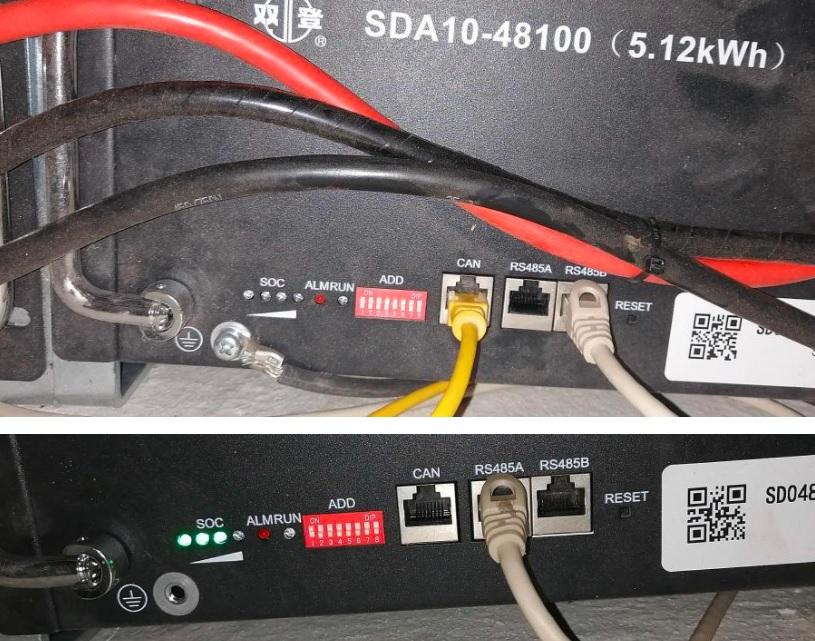
-
@Be4dawn I had a similar concern. My previous inverter had a strong fan and switches which started operating at sunrise. In GP that is before 5am in the summer. Bear in mind that my DB is in the passage between the kitchen and bedrooms, so it caused much unhappiness. The new inverter (also a 5kW Sunsynk) was therefore placed in the dining room, further from the bedrooms, and out of the echoing passage. It cost an extra length of 4-core 10mm wire (not cheap, but capacity allows for future upgrade to 8kW) from DB to inverter and back, so as to prevent disturbance at night - like when I fiddle with the buttons. My experience has shown that if isolated by a closed door, the fan is not easily heard. Leshen's estimation of volume is about right. Just ensure that the inverter is not mounted on a wall which may act as a soundboard toward the bedrooms, because at night every noise seems so much louder. Perhaps when things quieten down at night you could leave an oscillating fan running where you would consider mounting the inverter to hear what it sounds like when everyone turns in and all is dark.
-
Different strokes for different folks. However, I share @isetech's view. The reason for monitoring (the Check step in the Plan-Do-Check-Act cycle) is to determine what has resulted from the installation's operation. A part of this is identifying system improvement opportunities (e.g. optimising settings), but the other part is noting what adjustment *you* may require (habits, schedules, etc.) in order to improve your power system's performance. If you'll invest some time to understand your system and its peculiar details, you'll be better equipped to confidently extract maximum benefit. Many owners soon realise that their installer is not an expert regarding their specific system configuration.
-
Canadian Solar 410W Bifacial Poly Solar Panel - CS3W-410PB-AG Vmp 39.1V Imp 10.49A Voc 47.6V Isc 11.06A 10* Vmp is near the ideal operating voltage of 370V, although 10* Voc is over MPPT's 425V operating limit. Imp is within 11A limit, but certainly not 2 strings in parallel, unless connected to separate MPPTs. (Then 5* Voc is at 238V, which is well over min MPPT range of 125V)
-
@Adriaanvt Please also indicate your selected System Mode settings (desired State of Charge) at the start and end of the solar acceptance, i.e. between about 12:00 and 15:00. (45% or lower after 12:00, increased to >85% after 15:00?) Under the Advanced settings, what is your Max Solar Power value set to? (2500W ?)
-
@Bahaa As Chris Louw's first post on 19 July 2020 shows in the picture, the contacts are simply switched contacts (normal condition: connects N and NC, switched condition: connects N and NO) which are operated when certain criteria are met. Since this only provides the switch, you need to provide the rest of your circuit (from power supply, wiring, appliance, protection measures, etc.), and connect across N - NO and/or N- NC, depending upon which connection you need to operate your appliance. As with any switch, you'll measure 0 Ohms resistance across the Normally Closed switch in its default (Normal) state, and infinite Ohms across the N - NO side. Once the switch criteria are satisfied, the switch will operate and you'll measure 0 Ohms (direct contact between) on N - NO, and infinite resistance (open circuit) across the N - NC side of the switch. Just be sure to size the power supply and load to keep within the specified limits of your inverter.
-
@Vijen If you remain within the maximum settings on both MPPTS, you are able to maximise solar generation by typically mounting one string of panels (near max capacity) facing East and another facing West, suitably angled to reach (about or slightly over) optimum capacity between the two at noon. This will allow earlier solar generation, a high level compromise during the day as you transition primary feed from East to West string, and longer generation toward sunset, when others with flatter, North-facing panels have almost reduced input current to a mere trickle. The physical (roof location, angle and weather) and economic constraints (cost vs benefit) often dictate where to find the balance.
-
Yes, true, but don't you enjoy the *daily* free panel rinses?
-
Supplied by Solar Panel Energy, Vanderbijlpark. (I had to travel some distance to actually get stock, but it was also well-priced.)
-
@Don Sorry to spill the beans, but I don't recall basic numeracy being a requirement for political appointments. Despite socialism being a short-term game which eventually implodes, the short-term winners don't care about the rest. @RhysMcW I don't like the sound of this plan either. (I read it elsewhere too, so let's not discount it entirely: https://www.citizen.co.za/business/business-news/2993192/grid-tied-solar-consumers-could-be-hit-hard-by-nersa-tariff-review/ ) Politics aside, the technical situation: If larger (e.g. >20kWh/day) users leave the municipal network on sunny days, power planning really goes south on rainy days when previously solar-powered customers join the regular customers in drawing from the network. (As you mentioned, the fluctuations are usually there, but now potentially have higher peaks.) These ad-hoc customers are not such reliable sponsors of those who do not pay their bills, and are further seen as a convenient source of more taxes. What the suppliers don't consider is that this double taxation just alienates their ad-hoc users even faster, leaving them with a smaller customer base to support the non-paying users. (The implosion commences...)
-
2x Shoto batteries dated 31 August 2021. Master showed as dead last week. Upon recommendation by supplier I disconnected both batteries and reset the master (by 2 minute reset press), and it seems to be behaving well now, as before. The next option was to return it to the supplier for BMS replacement. (Thanks to this discussion I was able to avoid that as a first option.)
-
Yes, but lead acid soon became dead acid batteries. I did not confirm whether the older inverter's co-operation with a lithium battery may have been acceptable, as I upgraded to an inverter with greater capacity, grid supplementing and more user friendly controls.
-
@Silkman Essential information you need to formalise your requirements: 1) Have you optimised your electrical consumption yet? First reduce power consumption before oversizing your system at great expense. Alternative options include gas for the hob, geyser, etc., more efficient or lower capacity appliances (e.g. for when next you must replace a freezer), thermal insulation of the house for both winter heat retention and summer cooling. Even simple alternatives such as opening windows for fresh air, rather than using an airconditioner can deliver significant results. 2) Understand your present power consumption, and preferably times of use too. If you use much power during daylight hours, you may lean toward more solar panels. If heavy consumption is at other times, you'll need to store this in batteries to be able to supply it later, unless you live in a region where wind power or a water turbine provides an alternative source. Presently the PV (photovoltaic = solar panels) is often the cheaper option, and having additional capacity helps for rainy days and shorter winter days. You may consider replacing a geyser element to allow fit it into your capacity plan (i.e. inverter sizing). 3) Priorities. If your usage patterns are flexible, how flexible are they? Are your solutions acceptable to the household (who could make it work or break it). Daylight electrical use to pump borehole water and heat geysers to maximum is general practice, but do you need to reheat overnight? This point is a very touchy subject, and several people regard it as non-negotiable. After all, who enjoys a lukewarm bath on a winter morning? Are you prepared to accept only powering essential items when battery power is low, or will you need to add storage, typically to compensate for the second or third rainy day. (On that note, where do you stay? Your weather is a significant factor and learning from others in similar climatic regions will shorten and lighten your learning.) Also factor future developments in, such as children, work from home, etc. And the most important question to answer for yourself is what your budget allows. Are you prepared to pay for: a) overcoming load shedding, b) a reduction of dependency on municipal supply, c) self-sufficiency while still maintaining the municipal connection for unforeseen situations while proving that your capacity planning was sufficient, or d) total grid separation (which may require supplementing with a generator for emergencies)? It never hurts to have additional funds for all the additional expenses which pop up during and after the main event. Finally, find out which local suppliers are effective in delivering good service. Building a solid foundation to keep your system running afterward may have significant cost implications later on. The forum members' advice in this regard may also assist in avoiding unreliable suppliers.
-
I experienced similar grid priority problems with my system of similar configuration. An electrician friend assessed the matter and came to the conclusion that the inverter is not a true hybrid (not able to supplement solar with grid power), and was cycling the batteries regularly to draw the difference, which led to premature battery failure. The inverter then eventually switched to grid more frequently, as the batteries had effectively been worn out. That inverter is best used for off-grid application. The solution which was recommended for true hybrid operation was to replace the inverter first, since it was the cause of short battery life. Not an easy message to swallow, but rather than throwing money at the problem, I had to choose to invest in an effective solution.
-
Hi @Jacques Ester. When I was shopping around, the Sunsynk batteries were much more costly to purchase for the same rated capacity, so I settled for a different brand which has proved to work well with my inverter.

