


Trev
Members
-
Joined
-
Last visited
Everything posted by Trev
-
@system32 thanks for this post it is very useful for where I am now heading after installing my SunSynk 8kW with 2x Hubble AM2s back in April 2021 I’m now looking to finally include my solar array. Where I stay we’ve been immune to load shedding but reliability of the local network is now a big issue and so it’s time for the upgrade and to also save a buck or two! With the bought of prolonged power failures that we experienced in Ballito during Dec24 - Feb25 I established that my 11kWh battery bank was only delivering 50% of its capacity. I engaged Hubble support who dialed in via Anydesk and confirmed that a cell per battery needed to be addressed. I took them in and they honored their warrantee with great service! They obviously upgraded firmware at the same time. Upon reinstallation this afternoon I noted that although I have setup the SunSynk to reflect a Battery capacity of 210Ah, the capacity reflected via SOLARMAN Smart only shows 100Ah??? If I’m not mistaken you also had this issue if I read correctly in your post on 10 Jan 2022? How do I know if my CAN BUS connection to my master battery is reading correctly? More importantly, how do I know if my link from my master to my slave battery is also correct? Reading Hubbles website, I note they have some detail about the RJ45 cables potentially cause a short circuit to ground if you use a full straight CAT5 cable and they you should only use one with the necessary pins. Could this be my issue? It’s a tad ambiguous when you need only use the needed pins as it’s under the Cloudlink section? See here for detail: https://www.hubbleenergy.com/_files/ugd/ece034_a86bd55c3a7a457d94bfe5f221d46397.pdf Confirmation of my batteries communication with my SunSynk would be useful if you can advise? Thank you, Trev
-
If you are installing the Cloudlink RIOT you will be able to tell via that. While I don’t have one, I recall reading up on it a few years ago and that’s like dialing straight into your battery BMS. So it will tell you! I last used WatchTower a few years ago when I had an Axpert. I connected it to my WIFI via the RS232 port with what they called a ‘WiFi box’. Have a look at the PowerForum post here for more detail: Look online for them, here is one but can’t vouch for the legitimacy of the website: https://oricolimports.co.za/products/inverter-wifi-box-compatible-with-msk-ii-axpert-king-5kva?srsltid=AfmBOopC3OihfoFScBAlC9gGpfB7nZMK8yMZCVfZB8QgoAVs1LJlYpkJ
-
Thanks @Kill_switch this is useful confirmation. Your insight is much appreciated! It would also be great to hear from @HubbleLithium if this constant small current is acceptable for the battery? Is this how Lithium Ion batteries remain on standby and keep their charge compared to Lead acid where the charge is OFF until it reaches the Float voltage?
-
Hi @Kill_switch - I am running via the CANBUS but there is still the ability to input the three parameters above so I'm not sure if it even looks at this when CANBUS is selected? Does your SoC ever get to 100%? Or should I ask, do you ever have the situation where your BMS no longer charges your batteries after reaching 100% and then back on when you hit float voltage? @Brani mentions above that the three parameters are for lead acid batteries which I'm familiar with having had that before upgrading to Lithium. Perhaps maintaining state of charge is different for Lithium compared to Lead Acid... At the end of the day, my main concern is 'overcharging' by way of not giving the batteries any 'rest' as opposed to overvoltage. Is this a valid concern? Thanks, Trevor
-
Hi there @Achmat, I have been wondering the same... Just wish we received a notification via the SolarMan App to advise when we are on Grid versus Battery. I clicked on your link to the SunSynk website and noticed that your post has been taken down... Has this been resolved?
-
Hi All, I have 2x 5.5kWh Hubble AM2's connected to a 8kW SunSynk inverter. Upon installation and after referring to the with @HubbleLithium quick reference manual, the recommended settings are as follows: Float Voltage: 52.0v Absorption Voltage: not specified? Equalization Voltage: 54.0v I have set my batteries via the SunSynk menu as follows: Float Voltage: 52.0v Absorption Voltage: 53.6v (after emailing HubbleLithium support and being advised that "ideally charge voltage is 53.6v where 54.0v is high enough") Equalization Voltage: 54.0v I have noticed that my battery SoC is always at 99% at a voltage of 53.49v (or less) and therefore there is a small yet constant current continually flowing into the batteries that maintains the 99% SoC... Should my bank not be reaching SoC = 100% and then cutting off all charge current until reaching the float voltage when it should recharge again? I am concerned about constantly sending current to the batteries no matter how small the current. Thank you Trev
-
Hi Leshen, as a matter of interest, please could you clarify this? Are you saying that you basically connected your batteries in series and then to your inverter? Surely not as this would give you 153v where the inverter input voltage from the batteries is rated at 48v. So I am sure I have misunderstood you...! I assume you connected the three batteries in parallel to maintain 48v then connected the +ve and -ve terminals to the inverter...? Could you please provide a brief sketch to clarify? Apologies if this sounds trivial. Thanks!
-
Thank you @TonyH, there is no mixing of AC & DC cables in the trunking. The battery cables run upwards and jump over in flex conduit. The AC cables run alone in the horizontal trunking. When I install my solar strings they will run in their own trunking.
-
Thanks @ianm I tried finding some reference from Keith but clearly missed it. This would have helped. @Brani yes confirmed, CT connections to be in installed on 5-6. I hear you kn the level of nervousness 😆 Last night after a final check and ensuring that my earth-bond relay was engaging I switched ON. All good and running nicely as an expensive UPS for now. Looking forward to the solar installation next... Thanks to everyone for your assistance!


-
Meant to say that 'N underneath the terminal block lines up with L2 on the PCB...' Note: I now know that the markings on the PCB's are supposed to be blocked out, but this is exactly the point of my comment that has not been done sufficiently. Looking at my photo one can see that they have tried to blank it out, but its not so evident when you are actually looking at it...
-
Hi @Speedster I have the 18A...
-
SunSynk 8kW AC Wiring Morning all, This morning I was going to post a question pertaining to the AC wiring of the 8kW Sunsynk but decided to rather contact one of the Master Installers listed on the SunSynk website to clear up my concern. It does not sound serious, but after having chatted to Shane (Solar Electric Wise), he confirmed the confusion is real... Attached is a photo of my AC wiring for GRID & LOAD on the terminal blocks. Take note of the markings on the PCB as N, L1 , L2 (suggesting two phases?) whereas underneath the terminal block it is marked as N, L. Now this would not have been an issue if the Neutral markings corresponded, but they don't... The N underneath the terminal block lines up with the L1 on the PCB??? While this may sound trivial, for me I was not comfortable to power on until I had clarity. Shane (who i don't know i just found his contact details on SunSynk's website) confirmed that you need to wire according to the N & L markings beneath the terminal blocks. Shane thinks that the inverter is also intended for other countries where there are two phases supplying a house which doesn't happen in South Africa as we have single- or three- phase only... SunSynk have not done a great job in masking the labels on the PCB which should really be addressed! Has anyone else also been in this uncertain situation? Thanks Trevor
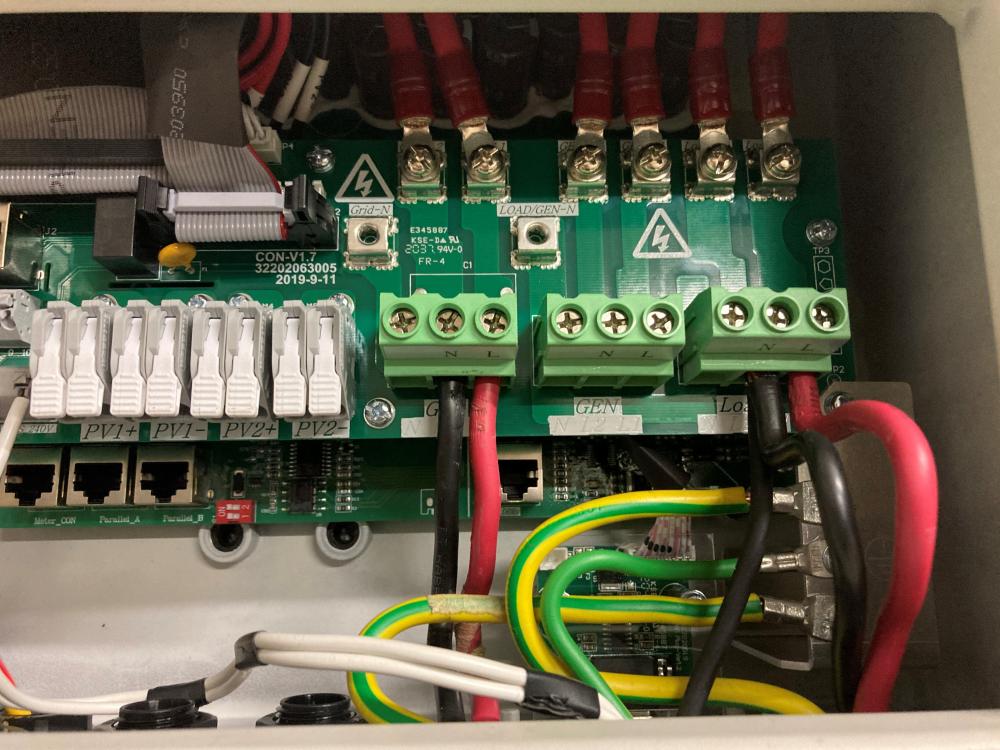
-
-
@Vassen how would you know if you’ve bought the newer model? Where can I check? Week before last I bought an 8kW SunSynk at a great price and it came with the WIFI dongle.
-
Managed to get one from ACDC Dynamics in Pinetown. Good price too!
-
Hi @Vassen Thanks for your assistance. 1. Noted. 2. I'm going to install the SPD directly to E while i research further for interest. 3. Sorry I did not explain myself to well, i should rather have said when you merely want to by-pass the inverter. I'll have a look for the electrical diagram that you refer to. If this is merely the function then i have taken care of this with my 4-pole ON/OFF/ON 63A rotary isolator which does the same trick i.e. Isolates the inverter and bypasses Grid to Essentials DB. 4. Thanks for confirming. The chaps at ACDC Express were a bit stunned by the high amperage. I found one on the ACDC Dynamics website. The only difference i can see between the one that you obtained from Communica is the 'Form'. Your one is a Form 1C whereas the ACDC Dynamics one is a Form 1Z... Do you know what the difference is here? I believe that all we're really needing is a Normally Open relay with decent load carrying capability? https://www.acdc.co.za/pages/product-individual?JQX-50F 40VDC I'll also try Voltex... 5. New Question: I note that the wiring diagrams in the SunSynk installation manuals specifies to 2-pole MCB's. However, it is interesting to see that in the Deye installation manual (see page 18), there is a seperate diagram provided for Australian, New Zealand and South African installation requirements which is only done using a 1-pole MCB on the L. There is also a confusing text in the box that states: 'Do not connect this terminal when the neutral wire and PE wire are connected together.' But we are deliberately connecting the N to PE when we loose Grid through the Earth bond relay??? https://www.deyeinverter.com/download/product-manual/hybrid-inverter-2/ Thank you, Trevor
-
Hello All, With reference to the SunSynk Protection Circuit show below, i have the following queries and would appreciate your assistance please: Question 1: I would like to confirm the size of the Supply & Load MCB's for the 8kW SunSynk. I have seen numerous discussions about the 5kW which is 35A. Depending on which Installation Manual you consult, i typically get the following: 5kW Max. AC Output Current: 25A Max. Continuous Passthrough: 35A 8kW Max. AC Output Current: 40A Max. Continuous Passthrough: 90A Calculating using maximum available power of 8,800W one would get: 40A... Question 2: What is the purpose of the single pole MCB that ties the surge protection to Earth? What size is this MCB for the 8kW SunSynk? Question 3: Can you please confirm that the double pole Isolator is there when you want to bypass the inverter and supply municipal power to your essential circuits? This ensures that no power can get from the inverter in this status... Question 4: With respect to the required Earth bond relay that closes during loss of power from the utility for anti-islanding prevention, is this only possible with a 40A, 220V relay or has anyone managed to do this with a contactor? Is that allowed? Does anyone know where to get one in Durban / North Coast? Thank you in advance. Trevor

-
Nice install @Kill_switch I am about to do the same thing with the same equipment. Just some questions on the battery connection: 1. Is it not better to connect the two batteries using 25mm2 cables of the same length at a common junction / busbar and then take it to the inverter using 50mm2 from there via the circuit protection? 2. The manual recommends a 350A DC isolator in series with 250A fuses. I know you are current limiting and agree with the discussed rational for your 200A fuses. But is it good practice to rely on pulling fuses every time you need to isolate power to the inverter? The price of a 350A DC isolator is pretty hefty, but if the regulations call for it then it needs to be there I guess. Is this the case or is the fuse isolator sufficient? I currently have 100A fuses in line with a 125A 2-pole DC Isolator / CB for my 5kW Axpert and 5kWh battery bank. I have seldom needed to switch the bank off apart from when I changed from AGM to Lithium. Scaling up obviously calls for more copper and higher level of protection at a cost. Can anyone provide some guidance here please? Thanks, Trev
-
Okay, so I did some more reading and I came across another discussion regarding Fusion vs Deye where my precise question was addressed. https://powerforum.co.za/topic/7465-fusion-hybrid-inverters-5kw8kw/ Advice offered by @Vassen is that SunSynk support is far better. @Craigm did you go for the Deye from SolarAdvice and are your receiving expected support? I haven't seen any comments about direct Deye or alternative brand support quality? Thanks Trevor
-
Hello All, I have read most of this forum thread, so excuse me if i missed it somewhere. I know that the Deye / SunSynk / Fusion inverters are one and the same merely rebranded but all emanating from the Deye factory. What i would like to know however is if the support channels are all different? @Johann1982 I noted the efforts that you went to in order to get support from SunSynk. Did this come via SunSynk or Deye the OEM? Perhaps someone can shed some light on the various brands and the support channels that exist? For example, I note on the SunSynk website that Ellies & Herholdts(?) are listed as distributors but none are listed on the Deye website. Fusion however appears to be a full on SA branded version much like the Mecer or RCT version of the Voltronics's Axpert... Reason for asking is i note a small difference in relative pricing on various websites and just wonder if there is a premium being asked for the better supported brand of essentially the same inverter? Thank you, Trevor
-
Looking at the data sheet it’s saying that Recommended is 37A but Max is 74A. So surely for the instance I’m explaining about 3x 74A = 222A which is even better! We’re talking about an event that happens 2-3 times per day for 3-4min.
-
Hi @plonkster Thanks for this, but my main concern is the ability for Lithium-Ion batteries to handle Surge Currents in excess of their rated Maximum Discharge Currents. So with 2x US2500's connected in parallel this would provide 5.1kWh delivering a maximum 112A (continuous) or 224A (15-sec). So what happens during short term over current situations drawing say 7kVA of power which should be pulling 145A from the batteries for 3-4 minutes? How do the Pylontech's and similar Lithium-Ion batteries handle this? Do they trip or just keep push current like my flogged AGM's? Thanks, Trev
-
Hello All, I am in the process of upgrading my battery bank from AGM to Lithium-Ion and when consulting the datasheets for each product I am mindful of the Maximum Discharge Current detailed by most of the Lithium-Ion batteries. For example, the Pylontech 2.4kWh battery (US2000) has a maximum discharge current of 50A (or 100A for 15-sec). This is in contrast to the Axpert MKII 5kVA Inverter which maximum discharge output at rated capacity of 5kVA is 104A. I was about to now state that according to the Axpert datasheet, the unit has the ability of withstanding 2 x rated capacity (i.e. 10kVA) for 10-min. I was quite certain of this feature as i recall it being one of the reasons for buying the unit in 2015 when I was comparing to other brands. But I have just downloaded an Axpert user manual to check myself and I see that it states 'Surge Capacity: 2x rated capacity for 5-sec' (a significant difference). Practically however, what I do know for certain which is a common daily occurrence is that the ladies in the household run the inverter up to 7-8kVA with some appliances (typically the kettle, microwave and too many lights etc) where the Axpert starts warning with beeps and a red flashing light. The observation is that it holds this out for the duration of the kettle being boiled which is typically 3-4 min. The inverter does not trip on overload protection so I'm thinking that my original specification of 2 x rated capacity for 10-min may have been valid unless i have bypassed this with my settings 🙈. Anyway, the question i wanted to ask about this common occurrence in my household with respect to the Lithium-Ion battery is: Q1: At 7-8kVA the Axpert would be drawing up to 167A for this period of time. How does this now work with the maximum discharge current specifications outlined by the Pylontech or any other battery for that matter? This has been my biggest procrastination point that has stalled me from moving ahead with this and i would like to get your expert input to this matter please? Please note that I have tried to browse and search for previous discussion on this topic. I do recollect a conversation on this in one post where someone (I recall either @Chris Hobson or @plonkster) was alerting everyone to the limited discharge current capacity of the Pylontech battery. Please excuse me if this is covered elsewhere. If it is, kindly point me to the informative post? Getting back to my current set-up and now pondering over the details of the Axpert datasheet, the reason for upgrading my batteries is because my bank (9.6kWh: 2 x 4x100Ah Renesola 6GFMJ-100 - see attached for ease of reference) no longer has the capacity to hold-out for the design duration of 4-hrs at 50% DOD. It was doing so in its early life and held out for an entire 11-hrs to 100% DOD on 2-3 occasions. Now, when entering load shedding, my charge capacity drops drastically and any heavy loads such as a microwave or kettle causes it to shutdown. Reading previous posts I thought it may be due to imbalance and a damaged cell so I tested my batteries which all checked okay according to the guidance provided in those posts, but for good measure i purchased and installed two HA02 Battery Balancers from @ChrisB along with a Victron BMS-712 which shows me trends on the App of the drastic roll off in charge capacity (Note: i'm behind on installing the midpoint cable for whatever reason at the time of installation so cannot confirm the BMS warnings... I know, this defeats the reason for getting it in the first place... Rand out of time...) Q2: Could the frequent (daily) demand surge at for extended durations of 3-4 min at a time have prematurely damaged or aged my Renesola AGM batteries? Consulting the Renesola data sheet, I note that the 'Constant Current' table has a 10h rating of ~10.3A per cell which should give ~120A for the 2x (4x100Ah) set-up. However, I also note that this table shows capacity ratings down to 15-min where it holds out at higher currents of 128-166A per cell implying a massive capability of delivering very high currents far exceeding the cable capacity and hence the need for inline fuses or fast tripping DC breakers at 125A etc... Q3: Given the fact that Lead Acid / AGM / Gel batteries are supplied without overload protection when compared with the Lithium-Ion packs that are supplied with all and sundry, can I deduce that unless you do not implement the necessary protection mechanisms, the hammering of my AGM batteries on a daily basis would have resulted in a general degeneration of the batteries faster than the specified 1000 cycles at 50% DOD? Hence the system is typically undersized for the connected loads to start with and it's probably advisable to parallel a second Axpert (which i have available) should i wish to maintain the current load profile? This talks to my first question about the need for 'matching' the maximum discharge current of the battery bank and the inverter. Could the AGM's have quietly taken he abuse at the cost of a shortened life span given their ability to deliver on high currents? When switching to Lithium-Ion, can I anticipate that the batteries will trip if i breach the maximum discharge specifications given the built in circuit breaker? Thank you, Trev Renesola 6GFMJ-100 TDS v3.pdf
-
Hello @Cassie Lithium Ion is a the category name given to a number of Lithium based batteries with difference active materials. Namely: Lithium Iron Phosphate(LiFePO4) — LFP being most popular for its advantages but there are many more... While not an expert, I have done a lot of reading as i look to switch my system from AGM to a Lithium-Ion alternative. This is the best resource that i have found with a great comparative explanation between different types: https://batteryuniversity.com/learn/article/types_of_lithium_ion. I'm not sure how 'apmedoutdoors' got to their sales pitch on their website when i have seen a few of these Lithium-Ion derivatives on the market.
-
Hello Buffy Welldone on this! I have been waiting for someone with your skills to take initiative on this. I installed a Wifibox last year and have enjoyed knowing when my inverter kicks in from a remote location which is only done via Email. A significant improvement to your App would be to send all warnings and errors via Notification on the iPhone. This way it brings it to your attention as opposed to being missed in an email inbox. Secondly, one warning that the system lacks is when power is restored! No email is sent to say MAINS_RESTORED... So the only way I am able to assess how long a power outage was for is by logging into power-datacenter.com and analyzing my data points which I set to sample every 30s. This would be a big up!!! I can suggest a few more but this would be great as you would be fixing something that the Wifibox does not do! Thanks again, Trevor


