


wolfandy
Members
-
Joined
-
Last visited
Everything posted by wolfandy
-
No - this should not be contributing to your temp situation. But as @YellowTapemeasure wrote, get your installer to fix it. Otherwise your inverter is running 'blind'
-
Really nice 👍 What do you use for the 'Minutes to next Loadshedding' ?
-
I went with 2x 5.5kW rather than 1x 8kW to get the additional 2 MPPT. I am running strings into 3 different directions now
-
I have a couple of 12,000 BTU inverter units around my house. When they have to work hard to cool down a room, they draw around 1.5kW each. During that time they use similar power to a non-inverter unit. Once the room has reached the desired temperature, the inverter benefit kicks in. My older units draw just over 100W during that time (the inside unit's fan runs permanently). On my new unit even the fan on the inside unit switches off, so it draws next to nothing. When the units need to add cooling to maintain the room temp, the power consumption goes up to something like 200-300W. These are some of the ups and downs in my chart during the night. I am actually running 2x 5.5kW Sunsynks and have everything on the essential side by now. I did at the beginning have heat-pump, geyser, and washing machine / tumble dryer on the non-essential side, but during heavy loadshedding I got annoyed with not being able to laundry whenever I needed. So I eventually moved everything across. But yes, it also works with the heavy loads on the non-essential side. The smart load management will just help you reduce your Eskom consumption as your Sunsynk will feed your non-essentials from PV Yes, last night 2 aircons were running throughout the night 🙃
-
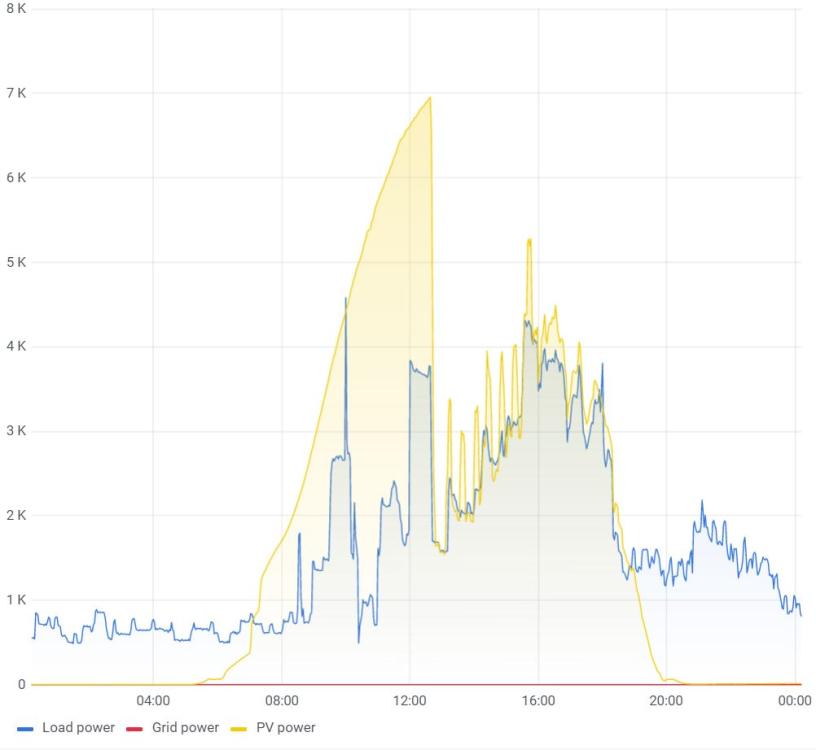
Agreed. Easy and relatively cheap thing to do. Have done the same with my 2nd geyser (main one is running on heat pump) If you've changed the element, then you can put something like a Sonoff POW Origin 16A on the geyser and easily manage it via schedules. Cost is just over R300 and works well (I have them both on my heat pump as well as on my 2nd geyser) That will definitely help. But I have to warn you - it is a dangerous journey 😉 Your bank account will suffer. I also started with 1 Pylon US3000 - and have 5 by now 🙃 One other thought for that (especially for this time of year): I don't know if you have aircons in your house. Use the spare PV to run aircons and cool down the house while it is for free. And especially inverter aircons require very little power to maintain a room temperature once it has been cooled down. My aircons switch on around 15h00 and by the time the sun goes down all rooms are at nice temperature. Here is my graph from today. You can clearly see when after 09h00 my heat pump went on, then at 12h00 the 2nd geyser. In the afternoon, the aircons switched on
-
Happy to help where we can 🙂 A side-note on your graph: Is there a way to manage your high consumption during the morning and maybe shift some of it out to later in the day? Your battery is down to 40% at that time - and hence you are drawing from the grid to make up the difference between your load and your PV production. If you'd be able to shift that load out to a bit later in the day when your battery has recovered to a higher SOC (e.g. with smart relays or other timers), you can draw the difference from your battery - and probably still have sufficient time left in the day to get it back to full again. It would allow you achieve even more savings. At the moment, you are using grid in the morning while in the afternoon you have plenty spare PV capacity
-
+1 on Pylontech (though no experience with Hubble)
-
Please keep us posted on how your system performs when you have both strings connected
-
This is very interesting. Because in theory you can connect connect a whole lot more than 6.5kW and still be within the V and A limits of each MPPT. If true, this would allow you to put more than 9kW on the unit across both MPPTs. On the other hand, I could argue that your 7.3kW of panels is just over 10% excess on the 6.5kW limit as per specs - and hence similar to what I remember @Coulombadvising for the older Axperts. Does anyone have any more knowledge or experience with how much we can overload a Sunsynk?
-
Sorry - but I have no idea where this 'good practice' is coming from. I am running 4.5kW on MPPT 1 and nothing on MPPT 2 - and have not had any problems in the past 1.5 years. In fact, the Sunsynk is running cooler than my 2nd unit that has 2.3kW on each MPPT. In my view, design the strings for optimal voltage I don't think you will get much joy out of only 3 panels. Probably not even 4. I would think you should be able to fit 12 panels to stay within the total 6.5kW limit. Maybe @Leshen has better insights on how much you can exceed the total limit without getting into troubles? On the old Axperts, to my understanding 10% more was ok. Maybe you can get away with 8 as your main string and 5 on second string?
-
Definitely put all your 6 panels into a single string and onto 1 MPPT. That will beef up your string voltage - which I suspect will solve your problems. My guess is that your current string voltage is so low that the inverter is unable to ramp up the MPPT when your load increases during the afternoon. Get someone to re-wire your panels and see if your system then runs as expected. I have the same behavior on my Sunsynk with Pylons. Once the Pylons get around the 'famous' 89% SOC, the BMS throttles the charge current. I'll let the experts here explain the details, but it is normal behavior. But this is not the reason for what you are experiencing. I would not do that either. The Sunsynk can directly communicate with your Dyness BMS, so why would you take away that ability?
-
I think there are several revisions of the 5kW. If I am not mistaken, the first one did have fans on the outside by the heatsink. The version that I have only has a passive external heatsink. I have to admit that I have no idea about internal fans
-
Yes. If you take the RS485 cable I'd suggest the RS485 cable. Then you can leave the Sunsynk Wifi Dongle connected to the RS232 port Yes and no. You do not need a separate cable to connect SA to the Dyness as it will read basic battery information from your inverter (assuming that the Dyness is connected to the Sunsynk). If you do connect a separate cable, then you can read more detailed info on your battery (how-to see here)
-
Cool. Then the 2 different directions will work Correct But the west-facing string would not be my first priority. I am also in CPT and at one point I also added a west-facing string with the same idea as you have. Here is my production data from yesterday. Orange is my total production across all strings, Yellow is my North string (4.5kW), and Blue is my West string (2.2kW). Each Grey horizontal line represents 1kW of production. At 18h20 both strings were still producing around 1.4kW. At 18h45 the North string produced 0.9kW while the West was at 1.1kW. At 19h30 it was 160W vs 435W. So a bit more, but not that significantly. And in winter it is even worse because the sun is not that strong anymore that time of day... I get much more from my East string (also 2.2kW) than from my West. East in Blue and North in Yellow (each Grey line is 0.5kW production): You can see how the sun comes up over the mountain to hit my panels on the East string So if you want to add a 2nd string, I would rather recommend East than West


-
Very likely yes. I am not sure if the inverter will already go up in smoke above 115V - but I would not take the risk I would put 3 panels in series, but not 4
-
Yes, I have seen on both my Sunsynk as well as my previous Victron MPPT that the MPPT often starts producing before it gets to the 'official' start-up voltage. How many MPPTs does your inverter have? If you 2 MPPT in your inverter, then you can put panels into a different direction that your current string (if I understand correctly that is what you want to do). If you only have 1 MPPT, then I would advise against putting panels in different directions into 1 string. You might get a bit of production out of the string, but not nearly as much as the rated capacity. I would advise against this. If you have 2 MPPT, then the start-up voltage is for each MPPT individually What do you mean by 'across both strings'? Do you mean paralleling 2 strings on 1 MPPT? I would only do that if you have the same voltage across both strings. Otherwise you will end up with a complete mess On a side note here: I would advise against this. I have 3 separate strings (each in a different direction and on it's own MPPT) and the panels towards the evening sun are giving me the lowest production out of all. If you want to add panels, I would add them in your current (I assume main) direction and beef up your string voltage. You will also get a bit more production out of it in the evenings as your MPPT will not shut down as early as it currently does (due to higher panel voltage). Not an extra hour or so, but a bit. And it will start up earlier in the mornings due to the higher voltage.
-
No. Unfortunately not yet. They occur in random intervals, so it is extremely difficult to do fault-finding... At the moment have parts of the problem circuit physically disconnected and have been running stable for 2 days - but unfortunately that does not necessarily have to mean anything Yes, am running 2x 5.5kW Sunsynks
-
Thnx
-
Yes, my whole house is packed with Sonoff But on the circuit in question is only 1 Sonoff device - a Sonoff LED strip Am not having any problems with any of my Sonoff devices on any other circuits
-
Brief udpate: I ran for the rest of the day and throughout the night without problems - so I thought I had identified my aircons as culprits Until around 08h30 this morning my E/L tripped again So it's not the aircons... Pulled everything in the living room (TV, DSTV, etc) from the plugs, flipped the E/L - and it tripped again before my finger was off the circuit breaker Pulled everything from the rest of the plugs on that circuit and flipped the E/L. Stayed on. Started plugging in stuff again one by one. About 30 mins after I had plugged in an Echo Dot and a Sonos speaker, the E/L tripped again. The Echo Dot is relatively new while the Sonos speaker is 5+ years old. But both are on 2-pin plugs, so without an earth - correct? Have left the Sonos disconnected for now - and have now been running stable for the last 7h. Could this be my culprit? Will see what happens next...
-
Correct. In full sun conditions, your inverter would clip each panel at 11A - meaning your panels would only produce max 462W (11 x 41.96) Yes and no. It is called over-panneling. In summer-time during peak times, you will not be able to utilize the full potential of your panel and will 'lose' 90W of your peak production capability. However, the benefit of doing this is that both during summer-time non-peak times (morning, afternoon) as well as during winter (so basically whenever your panel never even gets to producing 11A / 462W), your panel will produce more power than a smaller panel (that would only produce 11A during peak times). If the price difference between the 550W panel and a smaller panel is not too much, I would definitely go for the 550W panel. I have to admit that I do not fully understand those 2 statements together. On the one hand you are saying that you want to put 2 strings in parallel on 1 MPPT, on the other hand you are saying that you are limited by roof space / orientation. Putting 2 strings in parallel only really makes sense if they are the same direction (unless you want to go really wild and put them in directly opposite directions). So if you can put 2 strings of 5 panels into the same direction, I would probably rather put 9 panels on 1 string. Or what do others think?
-
I would suggest you put more panels in series on 1 string. You want to get closer to your 425V max range (without overshooting) to maximize your production day. I would put 7, probably even 8 panels in series on 1 string
-
Thanks - you can see that I am not an electrical engineer 🤣
-
I have to admit that I have to open up all boxes again to confirm. But from I can judge from the trunking I assume the following: [Inside socket] - wire - [Manual switch inverter 1] - wire - [Manual switch inverter 2] I assume that the wire from switch 1 to switch 2 is connected to the In on switch 1
-
Thnx. Will do when he is here next


