


wolfandy
Members
-
Joined
-
Last visited
Everything posted by wolfandy
-
Correct. The Sunynk's voltage limit is 425V per string, so you are still far away from that Not any closer than you are at the moment. Putting panels in series adds the voltage of the panels, but the amps stay the same Correct That is fine. Depending on the specs of your panels (if higher than 13A), the inverter will simply clip at 13A. Other than you loosing a bit of production potential at that point, no other risk or downside No. Only upside. Your production will start earlier in the morning and last longer in the eve due to the higher voltage of your string
-
Well spotted - I did not notice Then the right answer should be: Leave the dip switches as they are. No need to change anything
-
You can leave all dip switches up - no need to change anything This looks weird to me. If you have selected Lithium on the Batt Type page, it should show percentage settings here - not voltage Agreed - thanks Can you please post a picture of how the positive and negative connections are wired on your batteries? It should be one of them to the top Pylon and one of them to the bottom Pylon, with the short bridges between the Pylons for the other connections. That will ensure balanced charging/discharging. Like this Please post a picture of your System Settings page, so that we can help with that

-
Ok. A few things: On the BMS screen you can see that it gets the correct charge and discharge values (74A) from your batteries On the Batt Type screen, please change both charge and discharge values to 74A and as @mzezman wrote capacity to 150Ah. The info from the BMS should override the charge/discharge values that you have set, but better to be on the safe side Error F56 appears to be caused by a low DC bus voltage, which can be caused if the load is higher than what the batteries can provide. See here and here. So if your load is more than 3.5kW while running on batteries (or when the power goes off), the inverter will shutdown and take a couple of minutes to restart. It sounds like this might have happened in your case. Otherwise changeover from grid to batteries should be completely seamless (other than a brief flicker in my LED lights I don't notice it) Could you maybe please post a picture of the Battery Shut Down page? Just to make sure that there are no funny settings there Judging by the photo of his BMS screen, the inverter seems to have comms with the Pylon BMS
-
Don't know - but you can find more details here
-
Don't have these in my house (I use POW Origin 316) - but one thing that I found with the latest set of Sonoff products is that they are a step backwards in terms of Wifi technology. I bought a L3 led strip and could not get it connect at all to my wifi. The recommendation from Sonoff support was "please try to set the wireless standard from IEEE802.11 b/g/n mixed(for example) to IEEE802.11 b and see if the problem persists". In the Ubiquiti environment, this means enabling "Legacy Support". Only after changing that setting was I able to connect the L3. All my other 20+ older Sonoff products had worked without that setting. I made that setting change before adding the POW Origin 316 to my system, so I do not know if they are also affected by it - but maybe something to give a try
-
Am using the same - bought mine here
-
I have replaced the element in my 2nd geyser with a 2kW one and control it through a Sonoff Origin 316 (16A), which is significantly cheaper than the POWR3. There is also a 20A version of the Origin
-
Had the same pre-paid and the same problems. Logged a fault with CoCT. The first time they came out they just looked around and said that if the problem continues, they will install a new meter. A couple of days later I logged another fault. They came and replaced the pre-paid meter with a wireless unit that now sits in a central box in the street. Since then I have not had any problems
-
We probably will need more details on your 3-gang smart switch. What brand? Exact model? I have a bunch of Sonoff T0 smart wall switches with a few of them also in 3-gang. I can completely independently switch each gang. I have to admit though that I cannot remember how many neutrals I have...
-
Interesting - never had that happen on any of the firmware version that I have been on (granted that I do not do every firmware update available)
-
Thanks - this looks good. As you can see, the inverter has taken the charge and discharge current settings directly from the BMS (which overrides the settings you make on the Battery Setup page). So then setting 'Batt Capacity' to 100Ah is the only thing that you need to do If you want want us to also have a look at your System Mode settings, please post a picture of that page here
-
If you only have 1 battery, please change 'Batt capacity' to 100Ah You can also change 'Charge Amps' to 50A Except for the Batt Capacity, your inverter should read all other values also directly from the battery BMS. I assume that a comms cable is installed between the inverter and the battery - correct? Can you maybe please post a picture of your BMS screen - just to make sure? This video shows how to get there
-
Thanks From the specs you can see that Capacity is 100Ah and Nominal Charge/Discharge Current is 50A On this page of your inverter, you should make the following settings: Type - Lithium Batt capacity - 100Ah Charge amps - 50A Discharge amps - 50A Also, untick 'BMS_Err_Stop' On this page, set Amps to 50A Except for the Batt Capacity, your inverter should read all other values also directly from the battery BMS. I assume that a comms cable is installed between the inverter and the battery - correct? Can you maybe please post a picture of your BMS screen (like the one below) - just to make sure?
-
The discharge amps depends on the type and number of batteries that you have. E.g., for 1 Pylon US3000 it is 37A We need more details on your setup to be able to help properly
-
Am not fully sure I understand what is happening Can you please post pictures of your menu settings for Battery and BMS? And I assume that the BMS of your Pylons are linked and that the Master is connected to the inverter?
-
If you have the Pylons connected to the Sunsynk, then the only setting you need to do is the Ah on the Battery page (74Ah in your case). The inverter will get all other data directly from the BMS. You can check everything by going the the BMS page in the Sunsynk menu
-
Don't want to hijack this thread - but I do not really agree with that statement. I have my grid draw set to 10W and draw somewhere around 1-2kWh per day from the grid as a result. So not anywhere near the 200W or so described in the other threat. I have by now put a 63A smart relay inbetween my incoming mains and my inverter feed, so that I can completely disconnect myself when I don't need to be connected to the grid. That way I can be completely off-grid most of the time and only be connected to the grid (and have the power draw to enable the inverter to sync with the grid) when needed. I would definitely by Sunsynk/Deye again
-
🤣
-
Not sure at which firmware version this happened (already a while back), but through one firmware upgrade Sunsynk increased the MPPTs from 11A to 13A The other added feature I am aware of is being able to manually set the voltage when running off-grid Without any changelog from Sunsynk I am not sure if there is anyone that really understands what all the firmware updates have brought... Maybe @Leshen has more insight?
-
What my installer explained that this is according to some regulation (don't know exactly which one). It is to indicate to the fire department that this DB board (and hence part of the house) is still under power even after they have cut the Eskom main power feed (assuming that the inverters are still running) Mine looks like this:
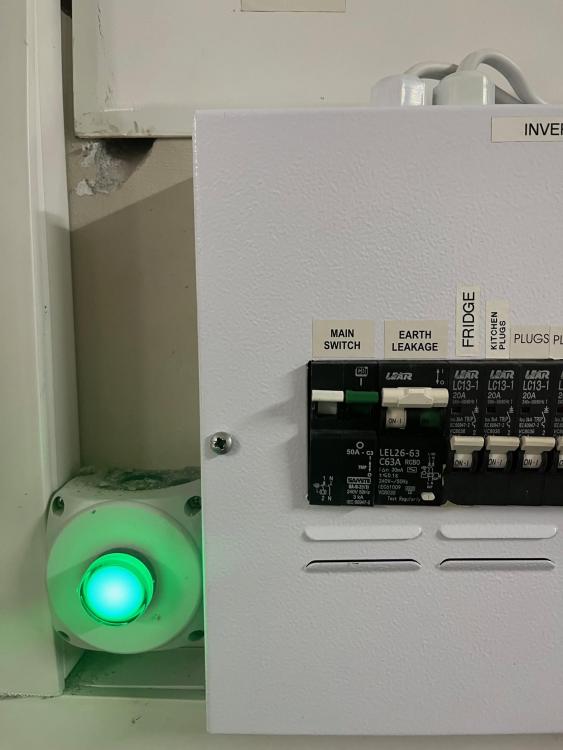
-
I only briefly played around with HA and SolarAssistant integration - but it showed the combined values for both of my inverters (if I remember correctly you can also read the individual values if you are interested)
-
A few things where I have seen installer cut corners: Metal trunking for DC cable from where the cables enter the roof space all the way to circuit breaker box next to inverter (no plastic trunking, no free cables in the roof space, etc.) Surge protectors (and obviously fuses/disconnectors) for the PV strings Appropriately sized fuses/disconnectors between inverter and batteries (for each + and - if you want to be proper) If more than 1 battery and/or inverter: Busbar for central connection, properly sized wires, correct wiring if more than 1 battery Light on DB board for Essential Loads to separately indicate power even if Eskom main is switched off As mentioned above, make sure you oversize your separate DB board for Essential Loads and still have space for future additions (I first still had some stuff on the non-essential side and by now have moved everything across and control the non-essential things with Sonoff devices)
-
That is why I went with 2x 5kW instead of 1x 8kW - to get more flexibility on the strings. The price increment for that was not that significant (when looking at the costs for the whole system)
-
I've got metal conduit (pipe) from where the cables come through the tiles into the roof space all the down into the circuit breaker / lightning protector box in my garage. Plastic trunking from from that box to the inverter.


