superdiy
Members
-
Joined
-
Last visited
Everything posted by superdiy
-
100nF Datasheet suggests within 20mm - I think I'm within limits.
-
Usually these things contain microprocessors and that skill of mine is rather limited. What I've heard is that it is not that easy to get the code out of a microprocessor - maybe Plonkster can elaborate on that matter.
-
That is not a problem. First thing I'll do is to make a proper pc board for it. This was too simple and a once-off and a spur of the moment thing - not enough motivation to make a board for it, but just preparing the little piece of veroboard probably took more than it will take to design a pc board for it. I can make the boards and add the components and then everyone can just solder their own cables to it, will that work? Or should I add terminals as connectors for the people lacking soldering skills / equipment? Terminals like these? http://www.mantech.co.za/ProductInfo.aspx?Item=72M2062 And then you can put it in a box like this: http://www.mantech.co.za/ProductInfo.aspx?Item=72M0642 Looks like the ISO7221s are quite expensive lately > R40 each at RS, maybe this is a cheaper option at R28: http://www.mantech.co.za/ProductInfo.aspx?Item=13M0869 How many people will be interested? I estimate the cost at about R100 for the assembled pc board, including terminal connectors and including the enclosure mentioned above. Maybe Jay can add it to the product list in the shop.
-
Back to the topic. My attempt of a galvanic isolator using an ISO7221. PL2303HX USB to Serial cable connected to the one side of the ISO7221 - other side of the ISO7221 is connected to the BMV.


-
To import stuff and not using a reliable courier company is a gamble. I'm still waiting for stuff I've ordered in Nov 2015 and some items I've ordered in 2012. And about 8 more orders all in 2016. I try to never spend too much per order. Some items do arrive, some never arrive - probably gets lost at customs.
-
I totally agree with you - I think the same thing every time I read an article about it. If there was never a fire hazard before - this is it. 5A maybe, but 16A continuous - I doubt it will last very long.
-
The lamps containing about 20 of the 5mm LEDs usually make use of "capacitive droppers" but mostly polypropylene caps are used in those droppers because non-polarized electrolytics are more expensive and less popular. The 3W and up lamps usually contain SMPSs / buck converters and they have an electrolytic on the HV side after the bridge rectifier and another on the LV side. Those are usually hi-temp (105°C) caps, but also have a limited life span and usually it is the cap on the LV side that gradually "cook out" and eventually the remaining capacitance is to low for the circuit to work as intended. Same thing happens with the caps in the PSUs of the DSTV decoders - the decoders run too hot and the caps on the LV side gradually "cook out" until one day when the decoder stops working.
-
I was actually referring to 220V downlights, in existing installations, where some of the lights start to blink after a few years of operation.
-
Maybe I've used the incorrect word (flikker in Afrikaans is seker eerder "blink" in Engels). The flickering I referred to is rather blinking - the lamp gives a flash either at random times or at a constant rate - it is not a bad-connection type flicker. Sometimes you will see similar blinking / flashing on failing fluorescent tubes and even CFLs.
-
I'm using various different brands of LED downlights at home and (touch wood) never had a failure. They include Uniontech, no-name lamps from Rabtron (with really nice lens diffusers fitted), no-name lamps bought via BidorBuy and a few from electroniclights.co.za (some of the first ones bought at ridiculously high prices ) I've seen many partly failed LED downlights in shopping centres - they are not dead, they flicker and that is not the LED chips that has failed but rather the SMPS in the lamp. I think in most cases the actual LEDs chips are not the weak links in the chain, but rather the power supply built into the lamp.
-
But, and there is always a but, if you do the above, and your load is less than what the panels can produce at that point in time, the remainder of the PV generated power will be fed back into the grid, either spinning the disc in the rotary meter in reverse or in case of a pre-paid meter you will either be billed for usage since the standard pre-paid meters cannot detect current flow direction or the pre-paid meter will detect reverse flow and trip.
-
Yes, that is the beauty about the product. Being a hybrid, it combines power sources to supply the load, depending on the configuration, it can combine PV and/or battery and/or the grid to supply the load. Let's take the 3K infini as example - when the grid is not available the inverter will combine PV and/or battery to supply a load of up to 3KW, but if the grid is available, that 3KW limitation is not applicable anymore, because the inverter will use PV and/or battery and invert up to 3KW and then combine the grid with that 3KW to supply a load of much more than 3KW.
-
Just keep in mind - the efergy meter measures apparent power, not real power. Your utility energy meter measures real power and you only pay for real power consumption. The efergy does not take the power factor into account, so for a pure resistive load like a kettle, geyser or incandescent bulb it is fine, but if you measure any inductive or capacitive load like fridges, microwave ovens, computers, TV's, DSTV etc. etc. the reading will be the apparent power and depending on the power factor of the item being measured, it might differ quite a lot. As an example, I've measured the standby power of an old LCD TV, apparent power was 18W and actual power was 3W. But to confuse you even more, when you convert DC to AC (inverter running on battery or PV) it will consume the same amount of power on the DC side as the measured AC apparent power, so in the example above, keeping that TV on standby via an inverter will draw 18W from the battery or PV panels (losses and efficiency excluded).
-
You do get the overload warning, because if the grid fails at that time the inverter will also shut down - it is still a warning - not a "fault" or "issue". you can switch off the buzzer if it bothers you. I also don't recommend it for extended periods at a time, as I've mentioned before, but for a few minutes at a time, it should be fine. The infinis can do this "overloading" thing while the grid is available, so can the Imeon 3.6 (and maybe other Imeon inverters), but most other inverters cannot do this. As you know, the very popular Axpert inverters cannot handle overloads for more than a few seconds - it simply switches off.
-
Most of these emergency lights and camping lights etc. etc. have chargers similar to the one mentioned here. I have not come across any one of them having a decent / half decent charging circuit. They are designed to be as cheap as possible and to only last for the warranty period. The worst I've seen was a Eurolux emergency light (twin 2 feet florescent) - transformer, bridge rectifier and a 5W series resistor directly connected to the battery.
-
Not entirely true. We've done tests on the 3KW infini and when the mains is available you can draw much more than 3KW. I had a load of just below 6KW for about 15 minutes and MaurioZA (I think) frequently have loads of 266% (8KW) for a few minutes at a time. You should be able to easily draw 10KW + from the output of your infini 5KW (not like you are currently using it without anything connected to the output) for minutes at a time - not for spikes only, as you've mentioned. Saying that, I don't know if it would be a good idea to draw 5.5KW + from the 3KW infini for extensive periods (more than an hour at a time) as per the OP's posts above.
-
Decompile the solarpower java app to find all the commands you need.
-
Hi Kloon Although the 3KW infini can handle peaks of more than 6KW for a few minutes at a time, I would not suggest loading it with > 5.5KW for hours at a time. I would then rather suggest the infini 5KW model or two Axpert 5KVA's in parallel.
-
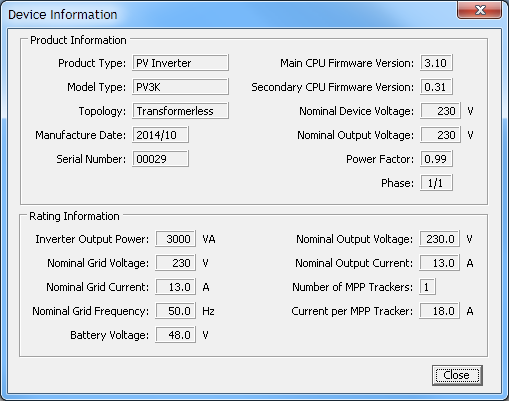
Some teaser screenshots - still a long way to go though...


-
Neat and clean installation! Well done. It just needs the 14th panel to get everything on the roof symmetrical. (My OCD again)
-
No harm done for asking. Yes, you can use thin wire, similar to what they've supplied with the BMV. If a current of more than 5A flows in either cable the fuse should go.
-
Depending on the type of balancer used... The idea behind battery balancing is to ensure that all the cells/batteries in a bank are at equal SOC - in other words balanced. There are many different types of balancers available, from simple zener diode types to sophisticated types where you have a balancer on each cell which communicates with all the balancers on the other cells and transfers some of the charge from more charged cells to less charged cells etc. etc. So depending on your budget and the cost of your battery bank, you have many different balancing options to keep that investment in tip-top condition and to actively extend its life.
-
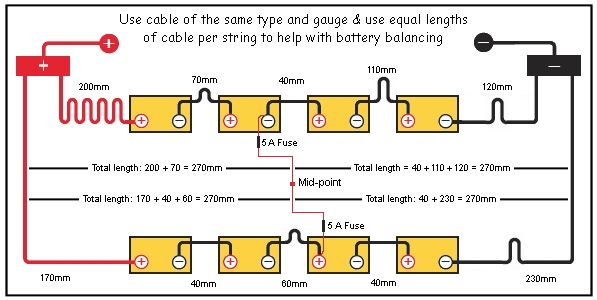
It is not about the positive or negative pole, but rather the true mid point of the string of batteries. Parallel battery strings on its own is something to avoid and by tying the midpoints of different strings together is even worse. If you have multiple strings and want to tie the mid points do it via no more than 5A fuses - that way, if something goes wrong in one string, one or more of the fuses will go open and protect the remainder of the strings.
-
I think you have maybe mis-read my explanation. The total length of cable between the batteries on either side of the mid-point must be equal, not only the length of cable connecting the mid two batteries - see below. Using thick copper bars between the batteries instead of cables should work very well.
-
Just to clarify something. All the battery interconnect cables do not have to be the same length. However, if you are connecting something like the BMV to measure the mid-point voltage, then the total length of cable on each side of the mid point must be equal. If you have parallel strings of batteries the total length of cable per string must also be equal. The reasoning behind equal lengths of cable is because the cable has resistance and at higher loads higher currents are flowing through the cables and therefor you will have higher voltage drops over the cable and these voltage drops needs to be equal on each side of the mid-point of the battery string if you are measuring the mid point and also needs to be equal in each parallel battery string to ensure the same current flows through each parallel string of batteries. The reasoning behind the bussbars are the for the same reason - to have equal lengths of cable per parallel battery string to ensure that you have equal resistance and equal voltage drops over the cable and equal current flow through each string.