Wiggly Electron
Members
-
Joined
-
Last visited
-
-
-
-
-
That's great news! A lot easier than to make a filter!
-
This sounds like a low frequency hum. It isn't directly related to the 15kHz noise discussed earlier in this thread. I'm afraid there isn't much you can do about it unless the unit is in fact faulty and you can get it replaced. But based on what I have heard it's quite common for these inverters to make that noise.
-
Hi @starmage What kind of buzz is coming from your inverter? A 50Hz hum or a 15kHz high pitched wine?
-
-
-
Repost from another thread: https://powerforum.co.za/topic/12943-sunsynk-8kw-high-pitched-noise-beware/page/3/ Hi all Here is the update on how to make your own inductor to filter out the noise coming from the inverter. First off, you will need a core to wind your wire around. A toroidal core will be the easiest to work with and will also radiate the least amount of EMI. The bigger the core, generally speaking, the better as you will be able to get more windings on it with a thicker wire. Here is the biggest one I could find with a good permeability: https://www.mantech.co.za/ProductInfo.aspx?Item=82M1485 The enamel wire diameter will determine the amount of amps it will be able to handle. I would recommend using 1-1.6mm diameter wire. You can find a good variety from Communica. https://www.communica.co.za/products/eccw-1-25 Just note that thicker wires will be more difficult to work with, but will obviously be able to handle more current. Here is a website to give you an idea of the current carrying capability of different wire thicknesses: https://www.powerstream.com/Wire_Size.htm How many turns do you need? Well you would want to wind the inductor to get you an inductance of at least 1mH, but more than 5mH would probably be overkill. You can calculate the exact number of windings you'll need with a nifty program called Coil64: https://coil32.net/download-coil64-for-windows.html For the above-mentioned core and wire, you will need about 50turns to get 1mH and 75turns for 2mH. (The inductance goes up with the square of the number of windings and the resistance of the wire goes up linearly with number of windings). As mentioned before, you would place this filter "In-Line" by breaking either live or neutral and join the break through the inductor. Also, be sure to use a surge protector on the load side of the filter as inductors might cause voltage spikes when the current draw through it changes. I still need to test my toroidal filter to see how many amps it can handle, but for now I can definitely say that it works in filtering out the noise to a level that is completely inaudible. The previous filter I made with the E-core handles 8 amps without getting too hot. I would guess that the smaller toroidal core will do about 3 amps, as I had to use a thinner 1.25mm wire instead of the 2mm wire. Hope it helps!
-
Hi all Here is the update on how to make your own inductor to filter out the noise coming from the inverter. First off, you will need a core to wind your wire around. A toroidal core will be the easiest to work with and will also radiate the least amount of EMI. The bigger the core, generally speaking, the better as you will be able to get more windings on it with a thicker wire. Here is the biggest one I could find with a good permeability: https://www.mantech.co.za/ProductInfo.aspx?Item=82M1485 The enamel wire diameter will determine the amount of amps it will be able to handle. I would recommend using 1-1.6mm diameter wire. You can find a good variety from Communica. https://www.communica.co.za/products/eccw-1-25 Just note that thicker wires will be more difficult to work with, but will obviously be able to handle more current. Here is a website to give you an idea of the current carrying capability of different wire thicknesses: https://www.powerstream.com/Wire_Size.htm How many turns do you need? Well you would want to wind the inductor to get you an inductance of at least 1mH, but more than 5mH would probably be overkill. You can calculate the exact number of windings you'll need with a nifty program called Coil64: https://coil32.net/download-coil64-for-windows.html For the above-mentioned core and wire, you will need about 50turns to get 1mH and 75turns for 2mH. (The inductance goes up with the square of the number of windings and the resistance of the wire goes up linearly with number of windings). As mentioned before, you would place this filter "In-Line" by breaking either live or neutral and join the break through the inductor. Also, be sure to use a surge protector on the load side of the filter as inductors might cause voltage spikes when the current draw through it changes. I still need to test my toroidal filter to see how many amps it can handle, but for now I can definitely say that it works in filtering out the noise to a level that is completely inaudible. The previous filter I made with the E-core handles 8 amps without getting too hot. I would guess that the smaller toroidal core will do about 3 amps, as I had to use a thinner 1.25mm wire instead of the 2mm wire. Hope it helps!
-
-
-
Hi all I finally received some toroidal cores. As soon as I get the enamel wireI that I ordered, I'll wind a new filter and test it. Should be a few days to a week before another update.
-
-
-
Hi all There are two other posts on the same topic that is worth reading if you are still looking for a solution. These post are for Sunsynk inverters, however I believe the internals are the same. Kind Regards Wiggly
-
Hi @DiSiNTiGR8 Most of these off-the-shelf filters are not very likely to work unfortunately. I have wasted a couple of bucks to try these out too. Almost all of them are designed to filter out frequencies in the CRISPR defined conducted emissions band, which starts from about 150kHz and ends at 30MHz. Some do seem to have good filtering properties at 15kHz on their datasheets, but one should be careful for the "50Ω/50Ω symmetrical" condition the tests were run at. This condition refers to the characteristic impedance (transmission line theory) of the test system and is usually only applicable to RF circuits and not mains power. The test condition for an inverter would be closer to something like 0.1Ω/100Ω. Under this test condition most of these filters perform very poorly or can even cause resonances making the problem worse as in you case. If you are looking for an off-the-shelf solution, you should get a filter with an inductance in the 1-5mH region (the higher the better but past 5mH it would be overkill). Just be careful, some datasheets also list the Common-Mode inductance, which wont be helpful in our case. A differential inductance (aka a normal series inductor as everyone knows it) is needed. I am yet to find an off-the-shelf solution that has a large enough inductance and current rating. Usually you get to pick either or, but not both. Regarding a DIY solution, I am looking for a supplier of a large toroidal core, which will make the whole winding process very easy. This will make it a viable solution for the general hobbyist. Will make a post as soon as I find something. Cheers for now Wiggly
-
Hi @scot These filters won't work for filtering out the Sunsynk's noise. The 10-15dB attenuation you see on the datasheet is for a 50/50Ω impedance system (traces A and B on the log graphs). A 50/50Ω impedance system is typically what you would see in radio and other RF circuits. The trace you should be looking for is trace C, which is a 0.1/50Ω system which is approximately what you would have with a 5kW inverter setup. In this case the filter would cause a negative attenuation (also known as a gain) of about 6dB. This filter would therefore make the noise even worse due to constructive resonances in the filter! 6dB would translate into a doubling in noise amplitude at 15kHz😵 There is another post here on powerforum where a better performing solution is discussed. DiSiNTiGR8 has linked it in the post above. Cheers Wiggly
-
This is usually not something that can be changed with a software or firmware update. Even if it could, it wouldn't be advised as the components that the engineers chose were specifically chosen to work at 15kHz. Changing the switching frequency might damage the components or cause efficiency problems.
-
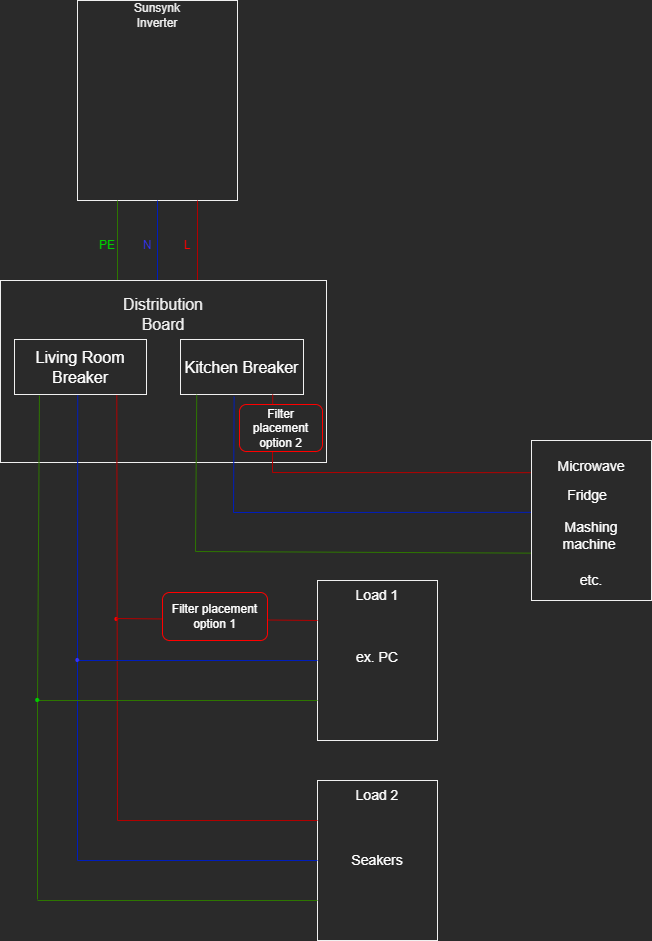
See the attached diagram I made below. You can have the filter in multiple locations but I would recommend the placements I marked as options 1 and 2. Option 1 will be the easiest to implement as it will require the smallest inductor (as it will have a smaller current requirement). The downside is that it will only silence that specific appliance that is connected right after it. Option 2 will be more expensive and also more difficult to build as it will need thicker wire due to a larger current requirement. The upside is that it will cover an entire room's (or multiple rooms') appliances. The surge protector should be placed between the filter and the load in both options. An inductor has two wires, so you would cut the live wire and join it again with the two inductor terminals. For option 1 I would recommend a simple Ellies surge protect plug: https://www.takealot.com/16a-high-surge-protection-3-pin-plug-top-for-electrical-devices-/PLID73912362 https://www.takealot.com/high-surge-protection-8-way-multi-plug-with-r30-000-warranty/PLID27971525 For option 2 I would recommend a DIN rail mount surge surge protector to be installed in the distribution board. I couldn't find one online from a reputable retailer now but they usually sell them at general electrical suppliers such as ACDC Electrical. They look something like this: https://www.chamberlains.co.za/lear-din-10-20ka-2-pole-surge-protector-385v-blsd-10-2-1086674 I will make a post that details the technical and practical inductor design later on this week. For now I'm a bit swamped with work. Hope it helps!

-
My situation is a bit different; My flat is being fed from my landlord's house with two 5kW Sunsynks in parallel. I have also used an app called "Sound Analyzer" by nobapp (the free version is Sound Analyzer Basic I think). It works quite well in picking up the more subtle noise emissions or emissions in noisy environments. Sometimes something like fan noise will drown out the 15kHz noise from the ear, but with the app you can clearly see it. In my experience I always hear the 15kHz noise, even during night time when the solar DC/DC isn't doing anything. The noise would seem to come from any appliance with a transformer in it (which is the same as @mneeth suggestion as the appliances having some form of inductance in it). I believe the magnetic field created by the noise induces Eddy currents in these components which then vibrates the enamel wires or the core at said frequency. The appliances where I noticed it the most was my UPS, inverter microwave, laptop charger, inverter fridge and inverter washing machine. Some sound worse than others.
-
Hi there When looking for a filter in this application it's all about inductance. The bigger the better. If you look at the specs of this ferrite sleeve it is specced to be 225Ω @ 100MHz. So if we use the formula Z=2πfL we can solve the inductance to be 358nH. That is very, very small when trying to filter 15kHz. At this frequency it will only offer about one thousandth of a decibel of attenuation (0.001dB). Or in simpler terms it will only filter 0.02% of the noise we are struggling with. These sleeve ferrites are designed to filter out much higher frequencies in the AM and FM radio bands. The design issue with these inverters are very unfortunate. I believe most inverters have similar noise emissions, although at slightly higher frequencies that are out of the hearing range for humans. I have measured an Axpert 5kW VMIII and it had similar noise levels but only at 19.5kHz which is basically inaudible. The problem with the Dye/Sunsynk inverters are that their switching frequency is just a bit too low at 15kHz where we can hear it. I am still on the lookout for more off-the-shelf solutions, if I stumble across anything I will be sure to post it here. Regards
-
Both will work. However it will probably be best to use multiple filters on different plug lines to distribute the load across multiple filters. If you are only going to use one filter on the main live inverter output, it's going to be huge! Alternatively (probably the best option) is to use one filter just before the appliance that causes the most frustration. That way you can keep the size and cost of the filter down. Oh an an important note, the inductor can cause big voltage spikes when a load switches off. It is best to add a surge protector on the appliance side (or both sides if possible). So the setup would be Inverter/Filter/Surge Protector/Appliance.
-
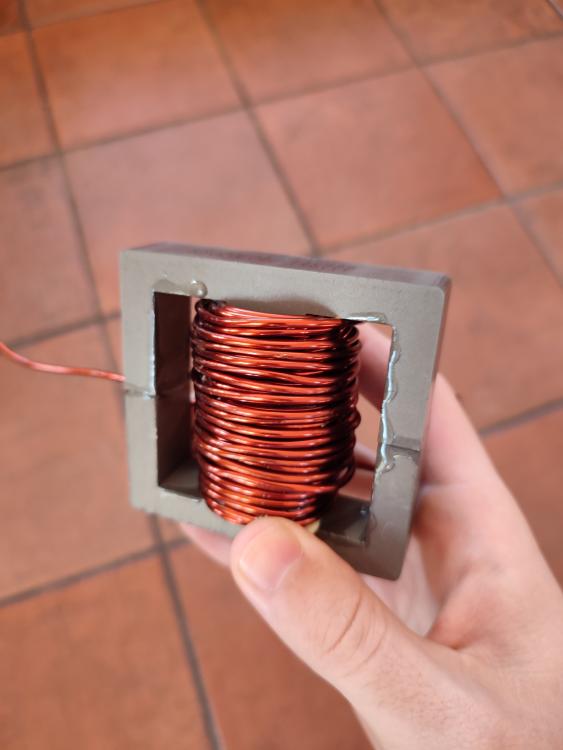
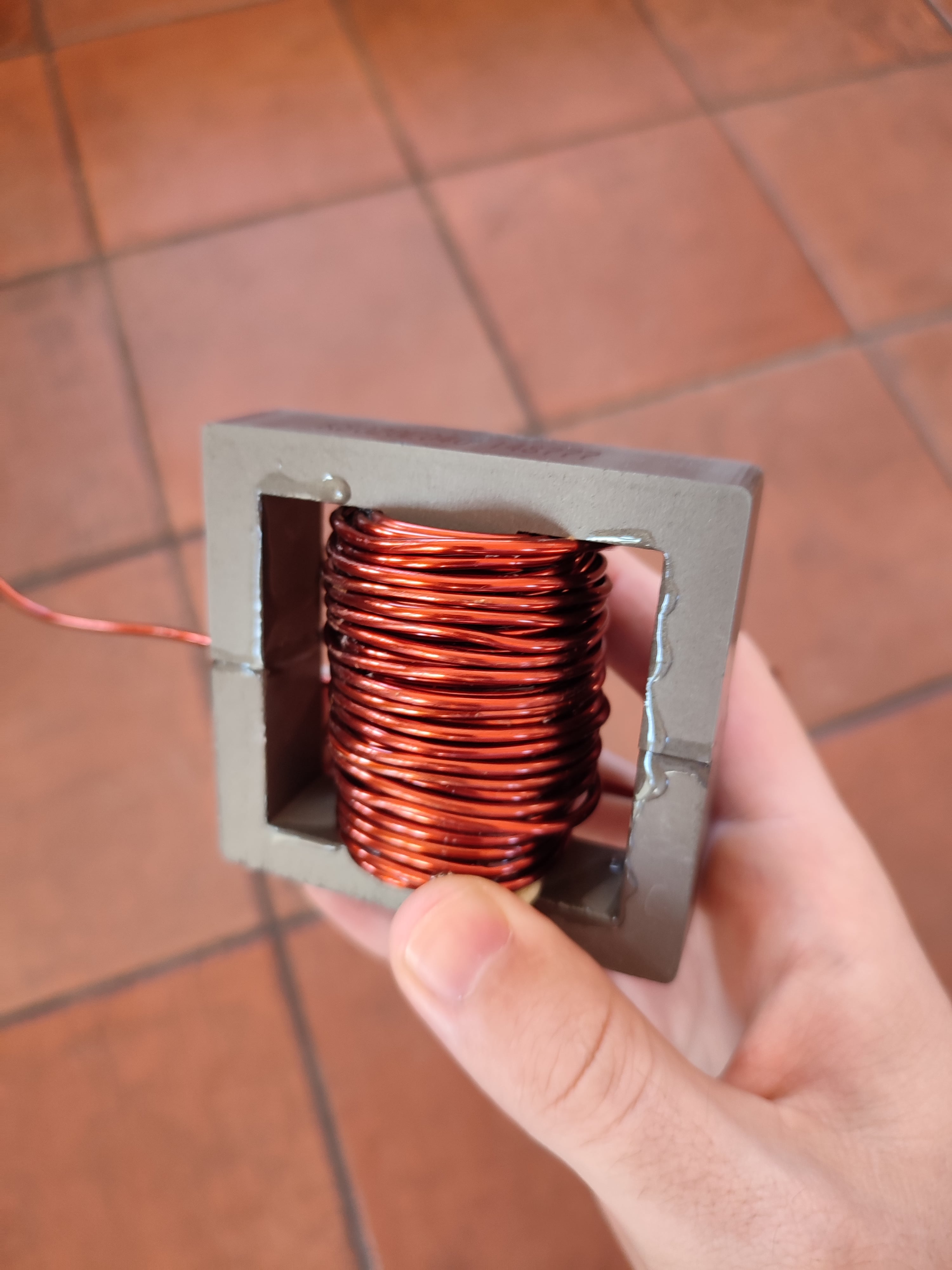
Hi everyone I have found a solution to the problem. Before you get too excited, I need to say that it isn't an easy nor cheap fix. It also only gets rid of the 15kHz whine on your appliances (output side of the inverter), while the noise from the inverter itself remains unchanged. That being said, it was still worth it for me. Our microwave was driving me insane! Anyway without further ado, to fix the issue you need to place a big filter inductor on the live line between your inverter and your appliances. The inductor must have a ferrite core (preferably the MnZn type as they have a higher core saturation point). Iron cores wont work as they will filter out the 50Hz power as well and probably cook itself within minutes. I got my E-cores from Mantech Electronics (about R350 for two half cores), although they seldom have stock of these large cores. With these cores you will need between 50-100 turns (resulting in 1-5mH) and the wire size is determined by the amount of current your load is going to draw. I used 10m of 3.14mm^2 enamel wire (sourced from Communica @ R210) which got me about 50 turns and 1.25mH. At 1.25mH it should attenuate about 14dB of the 15kHz noise. After I installed it, I couldn't hear the whine at all. So it definitely works. Also, another note to those who haven't wound an inductor/transformer yet, it took me a whole day to wind that thing. A solid core wire with a 2mm diameter is quite difficult to work with... Hope this might help someone. Regards