Derek Ramos
Members
-
Joined
-
Last visited
Everything posted by Derek Ramos
-
It charged from 50% to 100% in a reasonable amount of time.. but like I said I’m looking at longevity here, so if I can charge at a lower amperage to get the batteries to last longer I’ll definitely explore all options. Obviously I don’t want it to take the whole day to charge but I see my project as an investment I want to protect not a project I want to use to extract every ounce of energy it has to offer.
-
So I watched an interesting video from Andy off grid garage, he stated that you could charge lithium iron phosphate to 80% at 3.4v. when looking at the specs of my batteries it says the I have 1p16s in each battery. Does this mean that I can multiply 3.4v by 16 and get a total of 54.4v and that would be a safe charging voltage per battery pack? just trying to understand what he is saying
-
Hi, could some please check my settings on my inverter for my batteries. I’m looking for longevity settings not really peak performance settings. I’m more worried about the absorption, float and equalization settings as I don’t want to push the batteries to hard.. I set my charging amps to 100 because I thought it might prolong the battery life if I charge it at a lower amperage? Thoughts? many thanks 3 x 100ah sunsynk batteries (sslb1) 8kw sunsynk inverter. running as a ups for now as I don’t have my panels installed but will probably run my essentials loads constantly from the batteries from tonight. Also is it a good idea to get your batteries to charge to 100% every day?


-
So I got all the communication sorted out. Turns out I had the wrong cables, anyway the correct cables I had were to short so I made a new longer Can cable and also made new communication cables between the the batteries. I don’t really know why sunsynk sell wall mount brackets for the batteries but don’t supply long enough cables to connect everything. I had to custom make all the battery cables and communication cables.
-
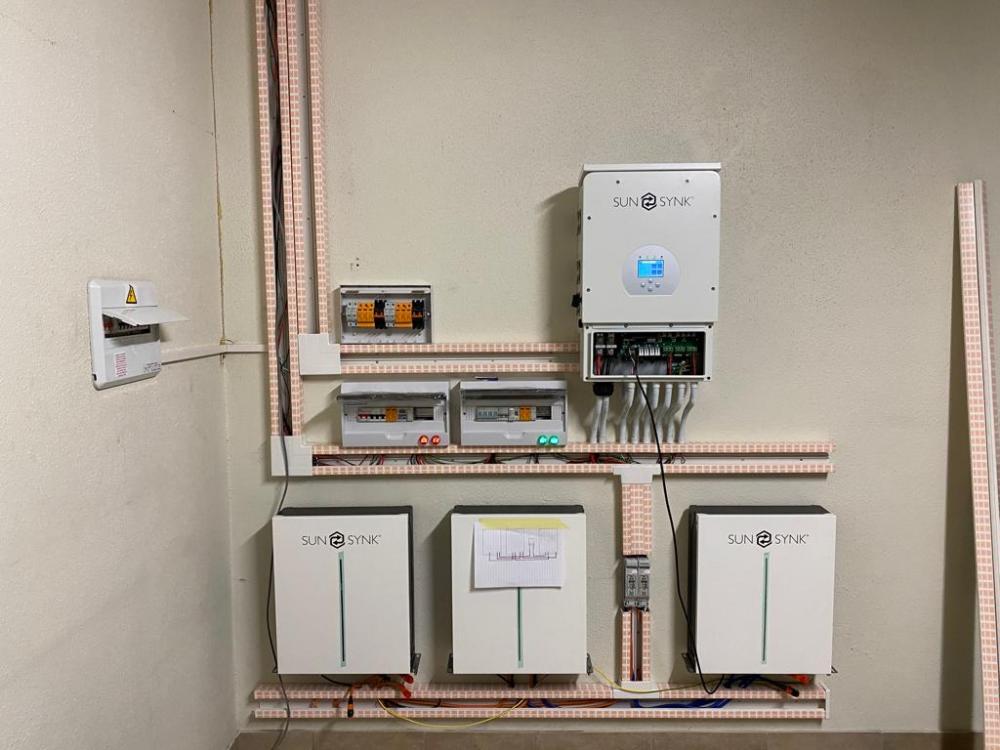
And I’m up and running… we’ll sort of😀 having problems with my batteries syncing with the inverter. So I disconnect all of them and only connect one so I can work out wiring and communications problems. Anyway after stressing my nuts off for awhile I did get the one battery communicating correctly, simulated a power cut and everything seems to be working good. Got my earth/neutral bonding sorted, battery charges from grid correctly. Only running it as a ups for now because I don’t have my panels installed (Next weekends job). CT coil reading correctly I think, it displays positive values. one thing that was causing a problem was my prepaid meter, it’s the one you plug in the wall. For some reason it would not communicate with the outside meter. Was showing error 30.. anyway I ran to the front of my property where there is a plug point, connected the meter, it read correctly, ran back to my house and plugged it in, seems to be fine now but I’ll have to monitor that. Excuse the battery cable laying around at the bottom. Still have to work out the communication. And get a longer CAN cable.


-
Thank you, I’ll be posting another updated picture today.
-
@Powerforum StoreThank you Steve, much appreciated
-
I’m still waiting for a quote to purchase a sunsynk data logger. To be fair it’s only been two day but I Haven’t received any feedback.
-
I bought a pss inverter last year with a 200ah lead acid battery pack.. to be fair the pss inverter works great although it’s limited, You can’t change any settings on it and you can’t see the state of charge of the batteries when there is load shedding. it’s connected onto my main DB board and when there is no load shedding then inverter just acts a pass through. I have separated the loads on my DB for essentials and non essentials so the inverter only runs lights tv and WiFi, when I bought the inverter the batteries lasted about 6-8hrs no problem. A year later my batteries only last 2 hrs at most with me restricting lights and WiFi, or running WiFi but no tv. besides all of that the inverter has worked flawlessly, when there is load shedding it automatically switches over without switching off my tv or lights. if I wasn’t doing a massive upgrade to my own system I would just buy 2 x 12v 100ah drop in lithium batteries. It would be just fine for load shedding. Pss is also introducing a lithium battery pack for these inverters but obviously there is no stock. here’s a link, check them out https://pss.co.za/product/3000va-sh-series-inverter/ this is the one I have.
-
Thanks for the reply, because I’m not up and running the historic data lose won’t effect me. I’ll see if I can sell my solar man stick and get a sunsynk one. Haven’t used my solar man stick yet so it’s still brand new.
-
Thank you for the reply, Do you have the sunsynk data logger, is it worth it rather than having the solar man logger.. I have the solar man Stick logger already but I’ll probably try sell it if the sunsynk is better.
-
Hi, is the sunsynk data logger worth the buy? I am almost done with my installation and I have the solar man stick logger. Haven’t used it or any of them but I would assume the sunsynk is the way to go. although I’m abit confused with the sunsynk data logger, I went to look on the powerforum store at the logger description and it said there were 4 levels of uses? Seeing as though I am a new user (one of the levels) would I not be able to change parameters or settings on the app? Any help would be greatly appreciated thanks
-
Thanks for this, unfortunately I was planning on going for the tiger panels from solar and inverter warehouse, they 15min from my house and easy for me to collect. They cost R3150 for 470watt which is pretty similar in price to most of the panels in that range. what I’m thinking with the 545watt is that if I do 16 on one mppt ( 8x8 in parallel) in the future the amps on 16 panels would be about 26 and the watts if I done it on both mppts would be like 17400watts. I know the inverter throttles the amps and watts but would that not be damaging to the inverter if it’s constantly trying to throttle down such a big difference ? Also the inverter can only take 10400 DC watts. Would it be and overkill to have a 17400watt or 15000 watt array if you inverter can only take 10400 watts not exactly sure which way to go here.
-
Thanks @Scorp007i ment to say 8 panels and not 9.. thank you for the reply. Much appreciated
-
@Kalahari MeerkatSorry man, my brain and hands were not collaborating with each other… I wrote down 18 but I ment 16. but thank you so much for the idea, when eventually I want to expand I can use the 16 I’m about to buy on one mppt because that will work if I have 2 strings of 8 each, connected in parallel. Then just get whatever is available for the 2nd mppt, or try and match the 1st mppts panels. thank you for the reply. Much appreciated.
-
The idea is to have 36 panels (not now but maybe future) mppt1- 2 strings of 8 panels each connected in parallel. (16 total panels) a little over 400v and 22amps mppt2- 2 strings of 8 panels each connected in parallel. ( 16 total panels) a little over 400v and 22amps. for now I just want to get 16 panels, 8 panels in series on one string on one mppt and the same for the 2nd mppt. the question I’m asking is that in future could 36 panels work the way I’ve said above and would it be beneficial to get 470watt panels instead of 545watt for future expansion.
-
So just before I buy the last pieces of the puzzle I was hoping for some feedback. my system: 8kw sunsynk 3 x 5.12kw sunsynk lithium (sslb1) panels?? my original idea was 18 x 545watt, then it changed to 16 x 545watt Because of safety and voc and so on. Now the 545watt is out of stock so I’m going for the next best thing which is 16x 470 watt i think this will suit me best in terms of adding panels in the future because the amps from each panel are 10.8amps.. so if I add panels later I could do a couple in parallel and have about 22amps going to the inverter which the inverter will cap at 18amps? so in theory in the long run you could add 18 panels , 8per string and 2 string parallel on one mppt so it would be 22amps of about 400voc. then 18 panels on the 2nd mppt with 8 per string and both strings parallel giving me the same, 22amps and 400voc Would this work? Does it make sense? Tiger 470W Mono-Facial Electrical Data | STC* Nominal Max. Power (Pmax): 470W Opt. Operating Voltage (Vmp): 43.28V Opt. Operating Current (Imp): 10.86A Open Circuit Voltage (Voc): 52.14V Short Circuit Current (Isc): 11.68A Module Efficiency up to: 20.93%
-
Since my last message I googled things related to this and I found the pylontech training pdf. It has a diagram with two cables on a bank of 10kw. So I feel better now 😀 thanks for your help.
-
@NexussSo I’ve been trying to find out if this is the correct way of doing it but I don’t see anyone connecting it like this. By connecting it like this will I not take away the principle of connecting the batteries in parallel? might be a stupid question but I just don’t want to make a mistake.
-
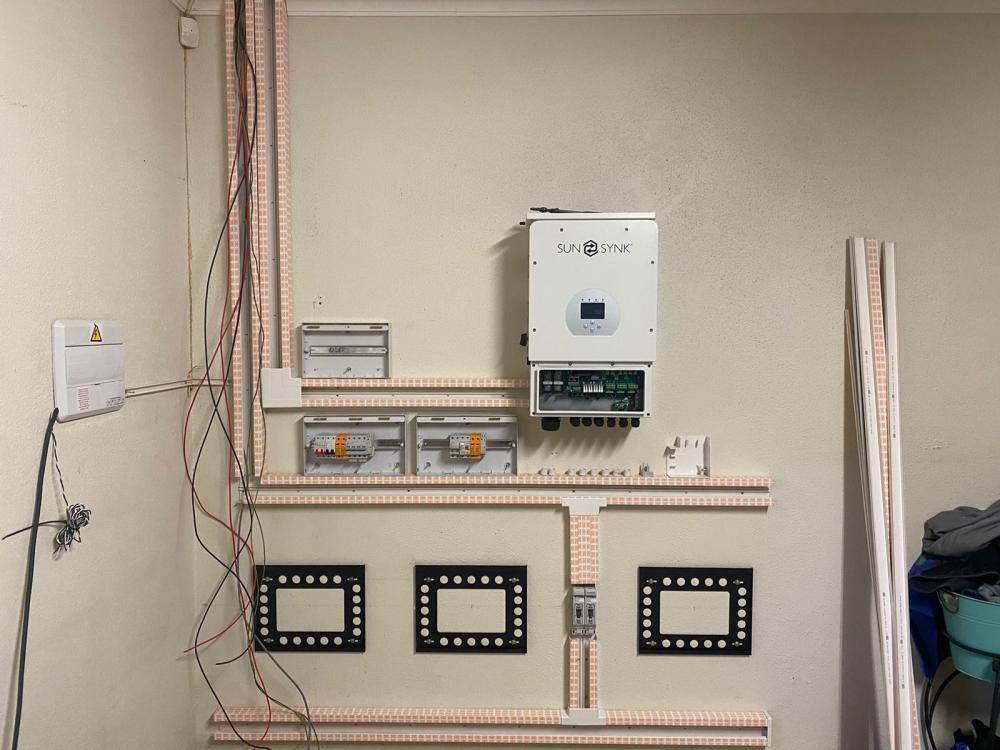
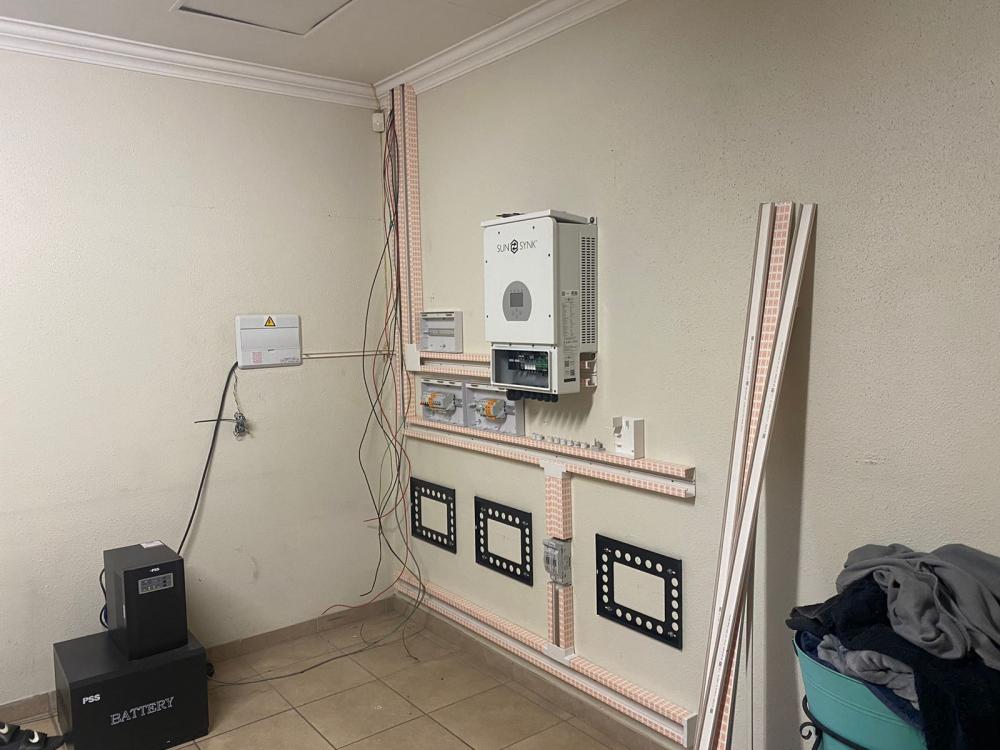
Slowly coming together, it’s tough to work at night when my load shedding is at the exact times I can work.
-
My opinion, if I didn’t get my 5.12kw sunsynk batteries at a really good price I would have gone for 4 x us3000c (300ah) instead of 3 us5000 . yes it’s more expensive per amp hour but it has a longer warranty, from 7 years to 10 years if you register the batteries, were as the us5000 only has 5 years. Also if you have a problem with a battery you only need to remove one and still be operational. if you only going to buy one battery and not planning to expand, then I’d go with the us5000 just because you have more capacity but if you planning to expand then I would go with the 3000 and expand gradually as they are more affordable as finances allow
-
I’m trying to do the same, I got a quote from solar and inverter warehouse for 18 x 545watt Jinko panels and the guy there told me 9x per string was to many. He said 8 is 400v and then you have to add 8-10% for safety which puts it to 450v. The manual of the 8kw sunsynk says max of 425v per mppt so you would be over 500v with the safety measure in place if you had 9 panels. I don’t know how true this is but I was going to buy 16 rather so I don’t stuff something up
-
@BluefrontedNice install. could you please provide info on your panels. How many strings, how many in parallel. I’ve got more or less the same setup but I’m just looking for alternative panel arrangements as panels are going out of stock pretty quick.
-
@WannabeSolarSparkyso what I think I’ve learnt after watching some videos on ka rating is that if you have a 60ka surge protector it means that it will control a surge of power that’s 60ka once but will control a surge of 10ka 6 times before you would have to replace the surge protector. So the positive about having a smaller ka rating is that if you have small surges you would know there is a problem quicker than if you had a bigger ka rating. So a smaller ka rating would potentially bomb out before a bigger problem is caused possibly damaging equipment. I don’t know, does this sound correct or am I just talking kak 😂
-
So the supplier has 2 pole 600v dc surge protectors, but they come in 20, 40, and 60ka ratings. I’m just worried about which is rating to get because the 40ka is out of stock, even my local AC/DC is out, so basically I just need to know if the 600v 60ka is okay or is the last rating to high