


Wetkit
Members
-
Joined
-
Last visited
Everything posted by Wetkit
-
You talking about the M Solar series? I would love to be able to afford some of these baby's. At 2000 cycles at 50% discharge, you will struggle to find a better battery for solar, but at 80kg, 500mm long and 500mm high for the smallest 6V cell, they can fill up a space and empty your pocket quick quick. MSolarBrochure-13.pdf
-
Personally I think the solar manufacturers is coining it since the Eskom rebate program was established. Before the Eskom rebate program solar systems was much cheaper, local manufactures, not imported equipment. Local geysers is either flat panel of vacuum tube. I would say vacuum tube is the most efficient of the two. Problem is that glycol vacuum tube systems is all but gone locally. With these systems the glycol would be heated in the vacuum tubes and this heated glycol would then heat the water in the geyser. Advantage of such a system is that if you use hot water during the night, there is still enough heat energy in the glycol to re-heat some water again.
-
Ok, I had a look at induction cooking some time back, but just the fact that I had to buy all new pots and pans did not do it for me Seems like the smallest SnappyChef uses around 800W to 900W. That is 75Amp @ 12V - That will pretty much kill any battery very quickly. At 48V the amps drop to nearly 19Amp, which is way more acceptable. I still prefere to cook with gas, but that is just me.
-
Hi Guys, Here is a pick of my solar water heater. The first 2 years it was installed incorrectly. You can see the space between the pool heaters where the solar collector was mounted. It worked well in summer but in winter it was useless. I built the new frame myself and changed all the pluming over. I have now also insulated the pipework and it works well to date. I would love to perhaps add a 2nd flat collector, but not yet sure of how and where. My latest project I am working on is not so much energy saving, but rather money saving. My garden is irrigated with clean water, but the monthly bills is krippling. So now I have invested in a 5000L tank, some pumps and a rather lot of PVC piping. The wellpoint should keep the tank full. Takes about 8 hours of running to fill the tank from 1/2. The 2nd pump is activated by the irrigation system. So far all seems to be running well. Just need to tidy up the cabling a bit. Problem is the pumps is now using up all the electricity I have managed to save the last year or so. As soon as NET metering is available, I will be running the pumps, pool pump included, from solar.


-
I have been thinking of changing my downlighters to LED now for some time, but have left it due to the cost and quality. Lately the LED cost have come down a bit and you do get Cool white, Warm white and Daylight colours now as well. Currently I have 12V 35W Osram IR coated downlights. The light colour and output is amazing. They have been running without fail for the past 5 years! Yes, in 5 years I did not have to replace a single globe. Compared to some of my CCFL lights that I have to replace about once a year So much for CCFL life. LED installers/suppliers now tell my I have to convert my downlighters now to 220V to take advantage of the LED's. So my question is why is 220V LED's better than 12V LED's?
-
Hi Clint, To me, that does sound a bit low, especially with evacuated tubes, which is supposed to be much more efficient than flat panels. Do you perhaps have a controller or timer on the pump that stops it so that the water ds not get too hot? Either that, or the pump flow is too high or too low. But, if if it works for you, who am I to judge I really like the idea that the pump is powerd from a solar panel. Takes away the need for a controller or timer on the pump.
-
@ Pieter, Could you elaborate on that a bit? What makes a panel T1? How would I know a panel is T1? Is T1 only performace based, colour based, ect...
-
@Pieter, What is a T1 rating??
-
This is what I use at work. Cable ratings is unfortunately for 4 core SWA cabling, except where stated Single Core. So a 25mm 4 core cable is rated safely at 110Amps. Single core PVC cable is then rated 140Amps. 25mm = 4 AWG (American Wire Gauge)
-
Hi Clint, Looks like you have a lot of shading there. Was this the best location or the easiest for the installer?
-
Power. Normally the power rating of a panel will be given as Pmax or Wp. This means the maximum of power the panel will deliver when tested in the factory. This is normally done at 1000W/m2 at 25C cell temp. Also note that most manufacturers allow a +-5% variance on power delivery. Some manufactures can also supply Nominal power figures. This is normally done at 800W/m2 and at 45C cell temp. Should give you a much better idea of what to expect in real world conditions. Voltage and Amps at max power. This is basically the voltage and amps your MPPT solar controller will try and control your system to, if possible. Open circuit voltage. This is extremely important to know this value, especially if you going to connect more than one panel in series to a solar controller. If your solar controller input is rated 50V max, and you connect 2 x 24V PV panels, it might sound ok on paper, but the open circuit voltage might be 29V, and that could either blow the solar controller, or cause it to stop working. Short Circuit Current. This is the maximum current that will flow through the wires of a PV panel if they are shorted out. I would use this as a good benchmark for sizing cabling to and from the PV panel. Maximum System Voltage. This is a good indication of how many panels could be connected in series. Say max system voltage is 1000V. Open circuit volts is 29V. Max panels in series is then 1000/29 = 34.48 Panels, so 34 panels in reality. Here is some examples.... . DS_Sovello_Project_Pro_P_V1 5.pdf TE190-220-54M.pdf
-
See, I thought MT equipment runs better on 24V, and from there the two battries in series perhaps?
-
Hi Guys, This is always a heavily debated subject. I always thought to buy the cheapest panel I could afford at the most reliable supplier which might still be in buisness in 10 years, but that is just me. Here is a link which I though explains it a bit better... http://energyinformative.org/best-solar-panel-monocrystalline-polycrystalline-thin-film/
-
Both Solaire and Tenesol is good.
-
Eish, that is dismal returns on a 3000W unit. Looks like you can get 250W to 300W with 3-4m/s windspeed. Would a smaller unit then not give you better returns?
-
Looks good to me. Why such small battries, or is space a problem?
-
1. Make sure your roof face North and also slope that way. Makes it easy to mount solar PV cells and Solar heating. 2. Floor insulation. I see the latest is to put polystyrene sheets, about 50mm thick, under the floor and then cast the concrete floor ontop of that. This should insulate your floors much better. 3. Although I would love underfloor heating, it is way too expencive. Doing it with liquid is another option, but who in SA does have the know how? 4. Windows and glass. I would love to go double glazing, but boy is that expencive. But it does work!!! 5. Grey water. See if all the drains from the shower, bath, wash basin and washing machine can go into an underground tank. This water can be used for irrigation. 6. Electrical. Make all the preperations and planning so that you can add Solar and generator power at a later stage. 7. Solar water heating. I would love to have at least a 2000L tank with hot water heated by solar. Yes, it will take long to heat up, but once heated you can use 200L without having a major effect on the overall temp in the tank! 8. Skylights - if your house is very dark, sky lights can save loads by not having to run lights 24/7. 9. Get an AGGA for a stove!!! That would sort out all your heating problems, but you sure as hell going to need a big ass AC for the summer time
-
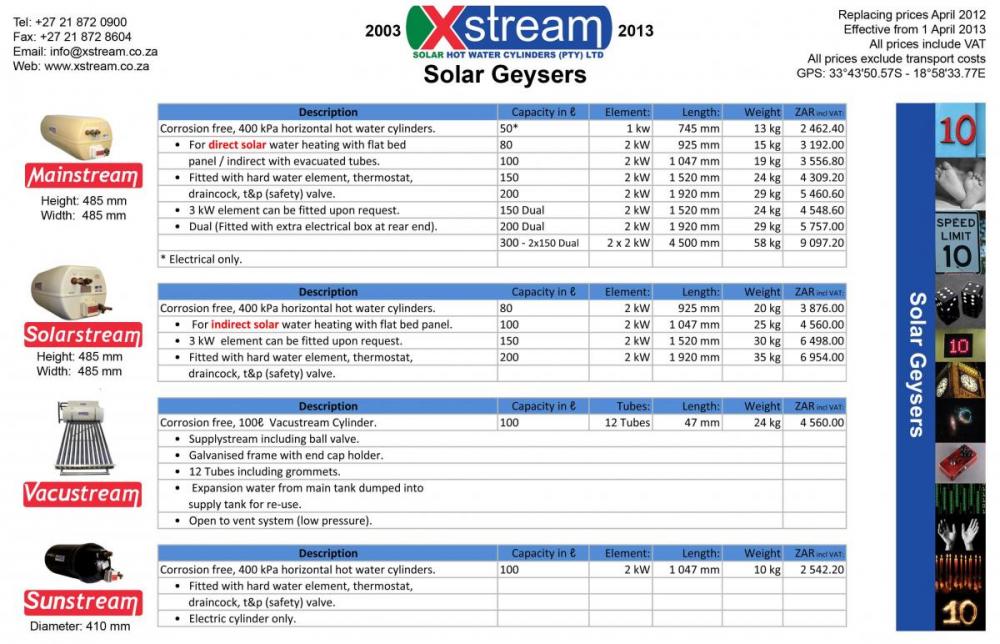
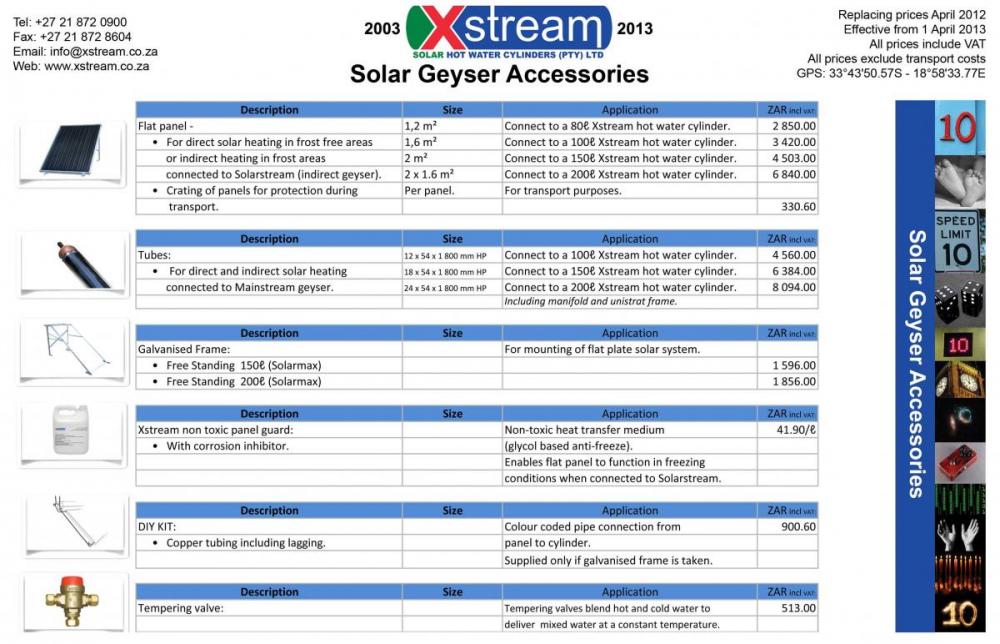
Hi Guys, Here is the latest pricing from Xstream for those of you that might be interested. I must say when I did this 5 years back, the prices were much cheaper. Seems like as soon as Eskom started the rebate program, the pricing has gone through the roof At the time I did the install, I did not know a lot about this, so there were loads of mistakes made. At the time, there was an additional amount, about R3k, on the quote, for a frame. The guy that did the quote, could not tell me what it was for. Only years later I found out that this frame was to position the collector to face North and at the correct angle. My system is a 200L geyser with only one flat panel collector. I see these days they reccomend 2 flat panels for 200L. Initially it worked brilliant in summer, as I switched the power off from August till April every year. In winter it was a bit of a struggle, due to the incorrect angle and facing East. Two years back my electrical consumption started to skyrocket and I could not find the cause. I installed a timer on the geyser, which helped a little, but not much. I then got myself an eneryg monitor. Eventually found the problem to be the thermostat on the geyser was faulty and never switched the element off This year I build my own frame for the geyser and the flat panel to turn it facing North and at the correct angle. Also put insulation on the exposed piping on the roof. This also seemed to help a lot. Only other thing I would reccomend with a solar installation is a Geyserwise. With this device you can see what is happening and configure how you want the system to work. For long overcast days and Eskom blackouts, I have also installed a gas heater in my 2nd bathroom shower. Works great!

-
Mmmm, Personally I would use the 12V socket in my car.
-
Eish, you lucky to start with a new build. There is SOOOOO much you can do in a new house to save energy!!! Perhaps start a new thread with your plans for the house. Perhaps we can add some ideas
-
Yes, I did have a look at solar pumps, but the cost was just too high compared to normal pumps. For a remote site where NO electricity is available, they make sence, but not for me.
-
For me, battries have been the single biggest stumbling block when looking at a solar system. The simple reason is cost!!! For a small system that does not need to run 24/7, or use much power, batteries is not that big an issue. Problem comes if you looking at constructing say anything larger than 1kW. Now you have to start looking at battery configurations, like 12V, 24V, 36V or 48V. For 12V the currents would be much higher and you would need loads of batteries in parralell. 48V requires lower current, but more battries in series again, 4 x more than with 12V. Then you have to look at backup time, charge time and how low the battries would drain every night. Everytime a battery is drained and charged again, is called a cycle. All battery manufacturers state battery drain versus cycles. The deeper the battery is drained, the less cycles it can perform. Backup time is basically your total Ah rating of your battery bank divided by the hours you going to run from it and the total load. Charging time would be how many hours of sunlight you have during the day to charge your battery bank again. Say your load is 500W and constant 24/7. Normally we get around 8 hours of sunlight during the day, so your battery bank needs to support 500W x (24-8) = 8 000wh. With a 12V battery bank you will then need 8000wh/12V = 667Ah. Now, here comes the problem, that is 667Ah with the battries drained 100%. To get longer life, you do not want to drain the battries lower than 50%, so this gives you 1334Ah. With standard 100Ah battries, this would be 13 to 14 battries in parallel !!! The next shocker is that you need to put all of this back in 8 hours or less. 500W x 24h = 12 000Wh 12 000Wh / 8h = 1 500W This means you would need at least 1500W of Solar panels to power your system. Your solar controller also needs to be extremely beefy. 1500W/12V = 125Amp!!! Please let me know if I have made any wrong conclusions or calculations in the above.
-
Been using the Micro Care 10amp and 20amp units for a while now. 3 x 10amp units at work to power remote alarm installations. Personally I use a 20amp unit in my camping trailer. The 10amp units is extremely cheaply made, but it is made in SA at least. To date have not had any problems with them. For my camping I started with a 10amp unit, but this blew due to moisture. Granted the unit was not inside a box. It still charged the battries, but could not use the switched output. GW Store swapped it out for me with a new unit. Later on I added some more load, so upgraded to the 20amp unit. No problems to date. Micro Care - Retail March 2013.pdf
-
NET Metering is where you meter can allow you to export power back onto the Eskom grid. Currently there is some guys doing it with the very old rotary meters, but it is illigal. Only once the new prepaid meters is available, can it be done legally. So last year I contacted Bloemhoff electrical department and they said they still busy testing the new meters and getting them SABS certified. Currently there is a couple of pilot projects running in CPT area. Here is the reply I got from Bloemhoff: 17887lvr electrical requirements for EG (16-07-12).pdf.pdf AntiIslandingTest2.pdf.pdf Application Form - Embedded Generation - GEN-EMB 201203021.pdf.pdf Declaration of compliance _ MLT Drives Powerstar 6kVA _ G831_1 and NRS09....pdf PowerQualityTest.pdf.pdf SMA_SB3,4,5000TL-21-Serie_NRS 097-2-1_SUM_0.pdf.pdf SMA_SBxx00-TL-ST-21_UNBED_NRS 097-2-1_RSA_U12-441.pdf.pdf SSEG ENA G83-1-1 appendices 2011 11 18.doc.doc
-
Currently going solar is just proving too expencive. So my next biggest bill every month was water. I have a huge lawn and garden and with our poor sandy soil in Kuilsrivier, I have to water often. In summer I have to run the irrigation every 2nd day. Each irrigation cycle consumes around 6 000L, or 6kL. Together with a well used pool, the summer water bill can go up to R3k every month I do have a wellpoint, but the delivery is not enough to power my irrigation system. It is enough fo a small sprayer, but there is just not enough time in the afternoon to do the complete garden. So now I have bought a 5000L water tank. I know it is not enough to do the complete irrigation cycle, but I just could not fit a 10 000L tank on my property. I did however cast my sement slab thik and big enough to install a 2nd 5000L tank if required. Currently busy with the electrical and pipe work to make it all work automatically. So the well point pump will fill the tank when required. Another pump will draw water from the tank and power the irrigation system when needed. This pump will be started from the irrigation computer. Unfortunately this will now increase my electrical consumption again With the water savings I should be able to break even in a year. The extra money saved after that will hopefully to towards running all my pumps, including the pool pump from solar power again


