
esmail-kassir
Members
-
Joined
-
Last visited
Everything posted by esmail-kassir
-
interested
-
could you consider a Solis inverter as silent inverter or you would not install it in your Livingroom or bedroom
-
sorry I've missed your comment earlier
-
interested for curiosity , what is the ambient temperature in your house ?
-
@Coulomb Have you encountered with any newr firmware version that doesn’t do that
-
I hope he is recovering well. How is he doing now
-
Which do you find is the fastest regarding responding to grid outages Full wave mode or half wave
-
Sorry for replying on old post But what about ( no detection ) option Will it be much faster to response to grid outages and act as ups ?
-
inverters from Deye. For example, the 4th generation with the old screen is silent up to 5 kW, and the one with the new black-edged screen is silent up to 6 kW. Currently, the new 6th generation is fanless and silent up to 6 kW. However, I was hesitant, so I chose the Felicity IVGM inverter, also known as the T-Rex. It is completely silent and has powerful software close to the complexity and features of Solis. But I missed out : 1- on the Deye and Sunsynk software, which are more powerful ( the newer version of my inverter has the same software and touch screen of DEYE but myne is cloude and phone managed only ) mind : https://www.felicitysolar.com/product/t-rex-3-3-6-4-6-5-6k/ newer version DEYE like : https://www.felicitysolar.com/product/ivgm3-6kw-p1g2/ 2- Additionally, the inverter is heavy, weighing 32 kg just to achieve that complete silence. anyway Regarding the silent cooling performance, I haven’t faced any issues. However, when I am away from home—meaning the AC and cooling are off in the morning while the inverter works hard to generate power from the panels, supply electricity, and charge the battery—its temperature reaches 53°C or 55°C during the two peak hours." What temperature does your inverter reach during the hottest times (for example, when the room temperature is above 28°C ؟
-
Does sunsynk have completely silent inverter ? (less than 35 dB )
-
so is it solved ?
-
@TaliaB I have been busy lately and haven't been following the forum. I wish you a full recovery.
-
Interesting What about your home battery BMS
-
I see your point In general, smartphones , EVs .., etc tend to decrease the charging rate in based in the SOC or the voltage, And I have found that my BMS do the same , so I am wondering if this feature useful in home LFP case or it only applies to NMC , lithium polymer in phones or LFP but with 2C car super fast chargers
-
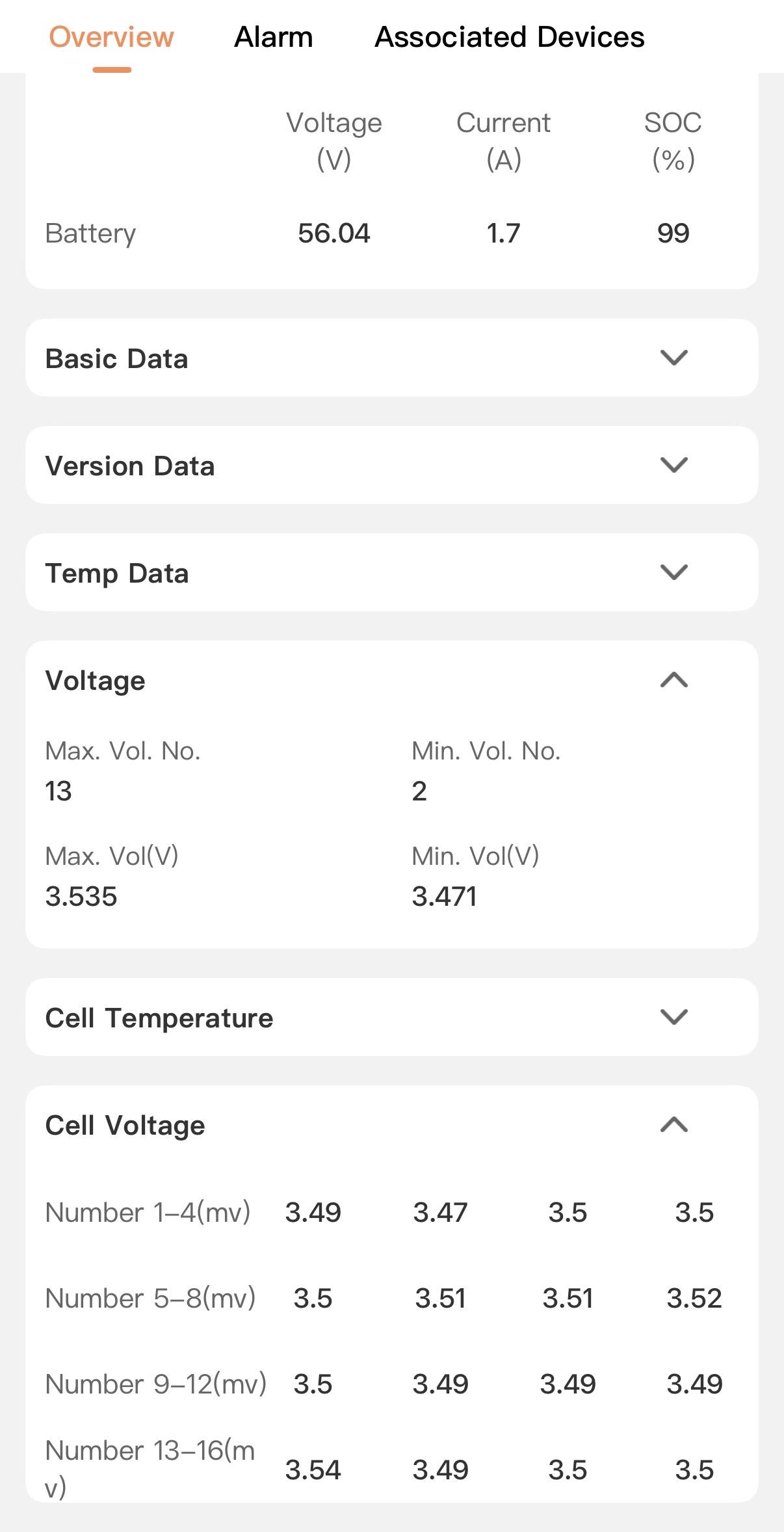
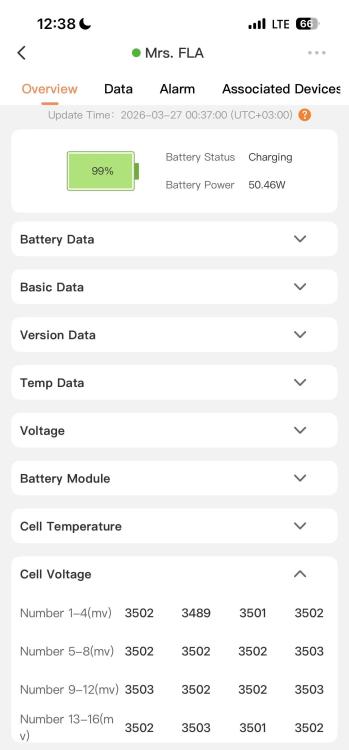
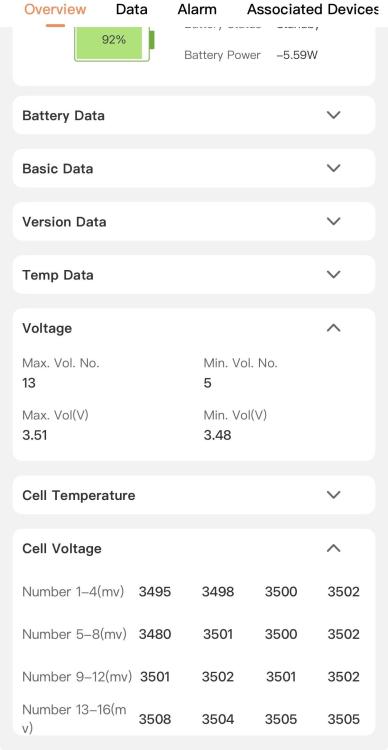
@TaliaB @Stefan Cornelissen @Steve87 @Beat I’ve changed the requested charging voltage from the battery side to 56 volts. Since then, I’ve noticed an improvement. It appears that the BMS only balances the battery when there’s charging current, and the battery SOC isn’t 100% (maybe). Now the delta dropped significantly
-
I’m curious about BMS designs that gradually reduce the charge current based on State of Charge (SOC), rather than the normal tapering that naturally occurs as the battery voltage approaches its final value. ( like what iPhone battery controller do after 80%) For example, some BMS limit the current to 20A during the last 15% of charge regardless of the voltage. Has anyone used such a BMS? What are the pros and cons? Does it affect cell balancing or battery performance?
-
Here are the steps and settings worth checking: Step 1: Disable Battery Saving Mode Go to: Battery Settings → Battery Saving → OFF When this is ON, the inverter intentionally draws a small amount of power from the grid to power inverter circuits This is often the main hidden source of continuous import. Step 2: Adjust Export Settings (If Import Persists) If Battery Saving is already OFF and you still see ~75W import: go to: Storage Mode → Allow Export: Enable Max Export Power: 100 Export Calibration: -100 These settings help “push” the system slightly toward export, effectively eliminating small residual imports caused by measurement offsets or inverter control tolerance.
-
But I have to mention But gotta say, I've seen Felicity batteries with better balancing, like my neighbor's one for example
-
@TaliaB @Steve87 Thanks for help Love the vibe here! Info's on point and the convos are lit 🔥. Appreciate the help!
-
@TaliaB I have charged it up to 100% and then slightly discharged it by exporting to the grid several times today. This led to a noticeable, though slight, improvement. At least this shows that the balancer is working. However, during the winter period, I didn’t allow it to charge to 100% very often.

-
So, do you think most LFP packs will perform similarly, but the absence of an active balancer here emphasizes the issue?
-
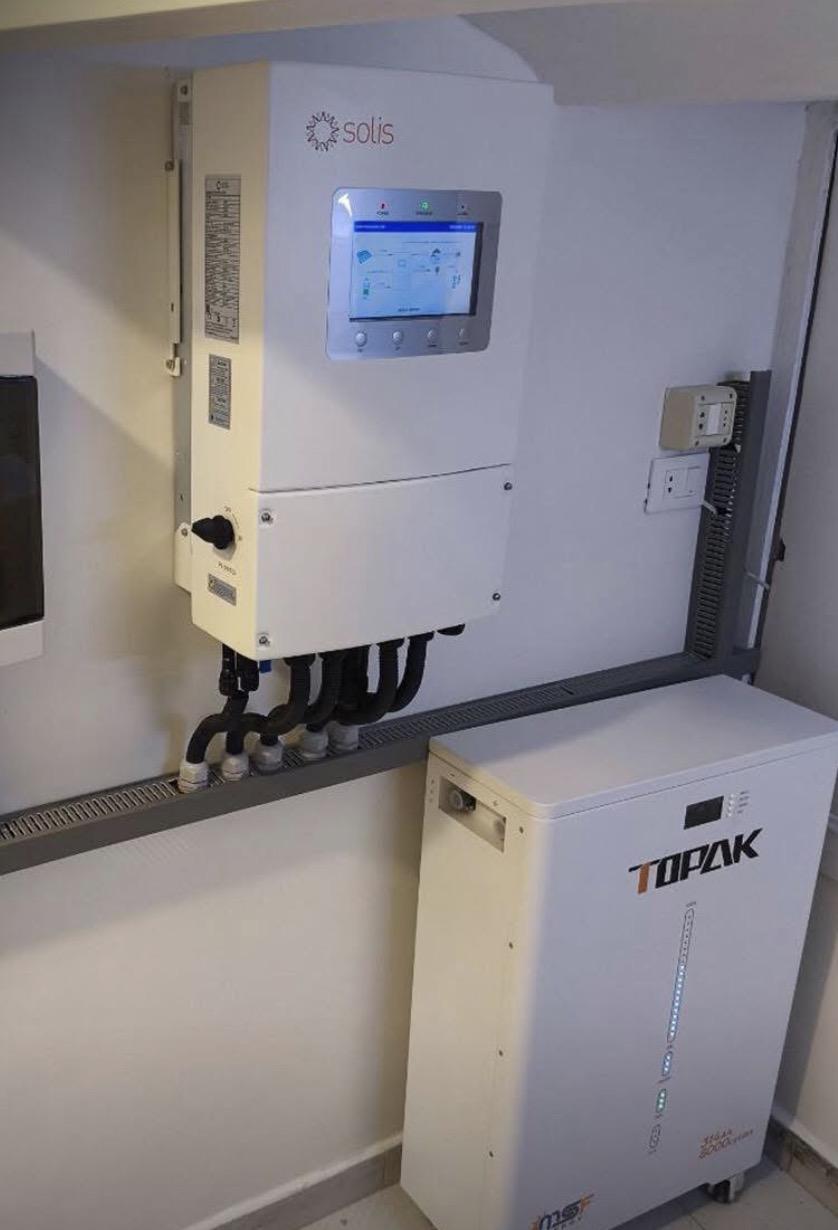
Hi, I’ve noticed a clear difference between generations. previous S5 unit was practically silent, even under load. However, with the S6, the noise is quite noticeable—I can hear it from about 10 meters away، I install it in my parents home and it starts to be annoying for them I did check the datasheet noise specifications, but I assumed that level would represent a worst-case scenario, not something I’d experience during normal operation. Now, with spring approaching and longer solar charging periods, the inverter runs under load for extended hours, and the noise becomes persistent and quite disturbing—especially during PV charging. Is this considered normal behavior for the S6 series? And are there any practical solutions or settings (e.g., fan control, firmware, installation adjustments) to reduce the noise?
-
@TaliaB The cells are well balanced and behave identically under high load, even near the lower end of their capacity. I’ve also verified this down to around 44.8V. The voltage delta only appears when the battery is at full charge, and it drops back within seconds once charging stops.
-
the same situation I have
-
55.9