Scubadude
Members
-
Joined
Everything posted by Scubadude
-
Your installer doesn't understand how hybrind inverters work. If the stove gets any battery power it is wired as essential or (more likely) Aux. My installer did the same and wired the stove to Aux and even neatly installed a "Non Essential Switchover Panel". They dont understand that a hybrid inverter can power non essential loads after the CT and before the inverter, sort if like exporting to your own little mini-grid. As for your gesyer, use Geyserwise temeprature and timer settings to bump up the temperature as high as you can (65'C) between 11:00 and 14:00 when you should have excess solar production on most days. This may eliminate or lessen the need for the early morning bump.
-
The oven should never get battery power - if it does you may wan to rethink your essential /non-essential split. If you dont want to use the battery at all untick "Time Of Use" box. But that would be a terrible waste of good batteries (and robs you of 4-5kWh of solar production per day). I have Time of Use on (and Grid Charge off), with Batt% that ramps up to 80% during the day and ramps down to 20% during the night. This is the minimum level to which the system will charge the batteries to in that time slot, and at night the minimum it will allow the batteries to drop to (while Eskom is on). If there is a threat of load shedding I bump the night time % to around 40%. Keeping it there permanently is being paranoid. The above partially answers your question about priority. The 1st priority power of the system is always the PV power, then 2nd and 3rd priority power will be the battery or grid according to the settngs. The last power backup will be the Generator if it is available. That 2nd and 3rd priority is set here:


-
The inverter consumes some power itself, including for that nice display ... that is why you have those maximum efficiency measurements on the spec sheets. In the real world it doens't get to the published 96 or 97% efficiency though. Your instantaneous inverter efficiency in the pic is 674 / (753 + 6) = 88.8%
-
Large price premium and long wait time ... I'm not that much of a brand snob. Would rather get a Shoto for R10k less.

-
As I understand it the inverter's neutral is permanently bonded to earth. If both on grid and off grid has 0V on neutral, why would it be necessary change anything between modes of operation? Or am I missing something?
-
OK, so the sparky put me out of my misery ... in South Africa neutral is bonded to earth in the box on the sidewalk. One of the standard COC tests is for "Elevated Voltage on Neutral", i.e. voltage between incoming neutral and external earth (ground) ... or an incomplete bond. So no relay required.
-
👍 You did share your wi-fi login details with your dongle and link the dongle to your user account, right? Updates every 15 minutes - may take a while to upload accumulated data. There are web-accesed desktop versions of all three Solarman products as well - useful for keeping an eye without the boss thinking youre on whatsapp ...
-
As I understand there are three versions of Solarman: Solarman PV Solarman Smart Solarman Pro The first two are reporting tools, with Smart having more functionality than PV. Pro is intended for installers, but you can set yourself us as your own installer (will require 2 email addresses), allowing remote control of system parameters. Look here ...
-
All settings on the inverter is available on the control panel. No risk of being locked in. Also, if you do not want to use the included Solarman system, you can use the same dongle with Solar Assistant. Solar Assistant keeps the data on an SD card on the Raspberry Pi that runs it.
-
OK, so a lot of things happened since my last post. The installaer has been great, but the experience has tested my patience as well as his. Firstly, the loads were not connected correctly, with half the house not on the inverter, and the oven and geysers on essential. This was corrected (decided to keep the geysers on essential to maximise self-concumption through Geyserwise timers), but the CT coil was installed incorrectly after the non-essential loads. My carefully typed out and illustrated changes did not help, as I got home to find the geysers and oven now wired to Aux. "But you wanted to used excess solar for the oven?!?!" "Excess solar, yes. Battery power, no. And I must be able to use it even if I dont have enough solar production." So it was rewired again, and this time I checked everything myself and made sure the CT coil was moved where it should have been in the first place. I got about a week of reasonable production (around 20kWh per day) dispite lots of clouds and rain. Then we had loadshedding two weekends ago, and when the power came back on we had an earth leakage trip. The same thing happened after the second loadshedding stint. I contacted my installer and emailed Deye customer care. That Monday night my board was rewired twice one EL split into 3, but the problem remained. Just before midnight I booted them out, switched to Eskom and went to bed. The next morning I simulated loadshedding and the EL tripped as the power came back on. That evening the electrician convinced me it was my alarm system PSU that caused the trips and I replaced it, and also disconnected LED flood lights and surge-protected multiplugs, both of which are reprotedly troublemakers when it comes to earth leaks. The next morning I simulated power failures again, this time with all circuit breakers off. And again, just as the power came back, the earth leakage dropped again. So the next day the installer and electrician picthed up late afternoon and did all sorts of tests. Turned out I had a faulty switchover (which made contact mometarily in the "neutral" position) and one surge protector had blown. More importantly, there was a fairly constant +/- 130V on the inverter output. The inverter was removed and said to have a faulty board. It is expected to be replaced tomorrow. What bothers me is I dont see an earth neutral bond relay in the installation. Anyone cares to share a picture or two so I know what to look for? P.S. .... save for two emails that told me to switch on the inverter so they could check the inverter data, Deye customer service was completely MIA.
-
Dead right. We installed 500kWp grid tied PV at work ealrier this year and used the following to effectively get 28% back from the taxman. You would get the same through depreciation over time, but the provisions of Section 12B brings the cash benefit forward. "Section 12B of the Income Tax Act No. 58 of 1962, as amended (the ‘Act’), provides for a capital allowance for movable assets used in the production of renewable energy. More specifically, it allows for a deduction equal to 100% basis in respect of any plant or machinery brought into use in a year of assessment for the first time and used in a process of manufacture or any other process which is of a similar nature. It is important to note that the allowance is only available if the asset is brought into use for the first time by the taxpayer. In other words, the allowance is not limited to new or unused assets. The wording merely prevents the taxpayer from claiming the section 12B allowance twice on the same asset."
-
If you had a clearer writing style maybe some would. I for one really struggle to understand the points you are trying to make. Build a nice Excel model with clearly listed assumptions to test alternatives with and without batteries ... That would be very easy to agree or disagree with.
-
Tshwane pays 11.4c I pay them on average R2.80. So I would have to sell about 25 units to cover me for one night-time unit. If I use half my 30kWh at night, I need to sell 30/2x 25 = 375 units per day to break even. With a yield factor of 6 that is 62.5kWp or 150-180 panels ... simply infeasible. Simple maths tell me no-one has enough roof to break even with backfeed in Tshwane. So it is a non-argument.
-
I think my 8kW Deye has a similar issue ... but it reads 130V between neutral and earth ( think - I did not measure it). It is suspected to cause my earth leakage trips when Eskom power is retsored. Is this something that can be set on the inverter? Same question as yours I suppose, @schalkvstaden I read elsewhere that the Deye neutral needs to be bonded to earth to prevent a floating neutral, when the inverter is off grid. I'm no electrician so have no clue what that means.
-
Maybe you are right ... this chart may suggest the biggest pricedrops are over, with an 88% reduction in the last decade. Of course our ever-weakening Rand dilutes how we perceive costs. I still think it will be like hard drives ... larger and larger units for the same or less money. Would love to buy 10kWh of capacity for R 20 000.
-
This changed over the last two years or so. When we moved into our house tail end of 2018 I did the sums and at that time batteries would cost more than municipal supply. With battery prices coming down sharply (for shits and giggles have a look at US$/kWp prices for PV panels from around 2005 to 2012 ... I believe we will see a similar crash in battery prices in the next few years) and electricity rates going the other way it is now most definitely cheaper to run solar-charged batteries.
-
Seem to recall Option 1 is for >100A and Option 2 is for <100A. Mine is connected like Option 2, but considering those Shotos are 1C, peak current can reach 200A (if the inverter is set up like that) and Option 1 would be better.
-
Epic! Thanks @mocodo. Mine was close to the truth then.
-
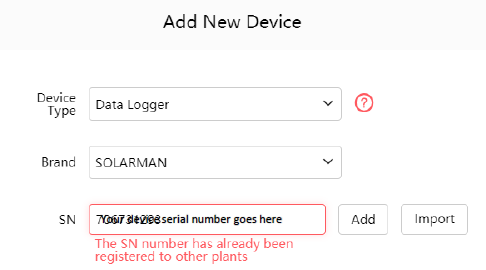
OK, looks like I will need Solarman Pro to get full functionality. I managed to find my Solarman ID in the PV app, and successfully linked the profile. But it doesnt see my data or logger, and when I try to add it I get this result: Am I missing osmething?
-
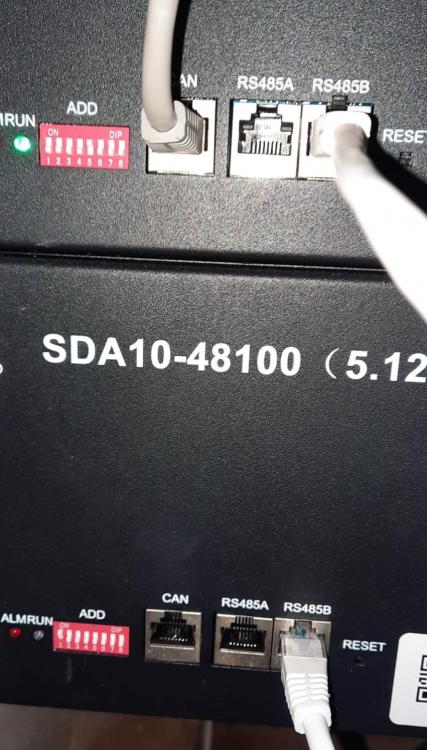
Is the above still considered the correct way? Mine was set up as No. 1 and No. 5(!) with 5 connected to the inverter by CAN bus. 1 and 6 linked RS485B to RS485B. Doubt this is best practice but seems to work OK.
-
First loadshedding event on a fresh install and everything worked like a charm ... Until the power came back and the earth leakage tripped. Good thing the COC has not yet been done ...
-
OK so this may be really basic ... but with loadshedding just announced I'm a little uncertain what to do with my new system ... We will be hit between 4 and 6am tomorrow morning, so pleanty of time to prepare. Luckily I heat up both geysers to 65° earlier so no worries about warm showers. After everybody have been full-body santised, I'll switch the geysers off to avoid the early morning pre-heating I do on the solar geyser (the other one is normally hot enough in the mornings). More importantly, I need to adjust my battery profile ... I normally discharge to 20% over night, and by 4am I'd be lucky to have much more than that left. So I'm thinking to enable grid charge from midnight, and charge up to 100%. But then again I may as well enable grid charging now and keep it full until required? Or maybeI'm being completely paranoid ... I will wake up with an almost full battery, losing out on some of tomorrow's production. I have 10kWh at 77% right now. So I will adjust the minimum SOC for the night to 50%, leaving me with at least 30% (3kWh) when Eskom goes down ... should be plenty. Makes sense, right?
-
I have an 8kW Deye and decided to put everything but the stove on essential. The stove is on non-essential but after the CT coil, so still benefits from excess solar production without frying the inverter. When loadshedding strikes it is easy enough to flick the switch on the geysers to preserve battery power. With a 5kW I would put geysers and pool pump on non-essential as well. But make very, very certain your CT coil is placed right after the main switch.
-
Where do you find reports? You using Pro? From what I can see Smart can export raw data but wont calculate savings.
-
The professional guys use fancy software to model typical yields. Below are the modelling results for my house in Pretoria East - my final installation was somewhat different but it does give a good indication of seasonal yields. This is a free tool which doe sthe same without the monthly split. It is pretty good, but assumes, like the pro software, there is no clipping ... https://pvwatts.nrel.gov/