jumper
Members
-
Joined
-
Last visited
Everything posted by jumper
-
No problem, here is the manual I have for the older battery which has info on the RS232 port in case you don't have it. The manual does say that the RS485 ports can be used to communicate with a PC, so it should work if the seplos software is the correct software. It also says the RS232 port can be used with a PC, I'm just not sure if the seplos software supports RS232 or if it is only for RS485... that's why I suggested PBMSTools as I know it works on RS232 and seems to work with most BMS, it might be worth a try if you have exhausted all your other options. shoto_sda10_48100_manual_v1.0.pdf
-
I have a new battery, so I can only confirm 100% that it works on that battery, I have not seen anyone with the old battery yet to know if it works. This one should work for your battery if it is going to. The only thing is that I use RS485-A port on the battery, but I don't think that makes a difference, just thought I'd mention it. If you have a multimeter with continuity function it is easy to check which cables are going to which pins and know that the cable is working. As for the adapter, I fought with getting this working for 2 months and eventually found out it was a windows driver problem all along. There are other possibilities you could try: You can try the older version of the seplos software (v2.1.8), maybe that will work. V2.1.9 is relatively new, it might not support the old battery, worth a try. You could try accessing the RS232 port and use PBMSTools to see if that works, maybe the older battery isn't a seplos bms, I'm not sure.
-
This is not correct, you have joined the wrong pins, you need to use pin1 or pin2, not combined. If you scroll down to the second last post on the first page I have posted how to get it working. I will quote the important part here: "The pinout is as follows: Pin 1 on the RJ45 plug goes to B (D-) on the adapter and pin 2 goes to A (D+)" You only need to use those 2 pins for it to work. There are 2 different versions of this 100Ah battery and they have slightly different RS485 pinouts. The older batteries only use pin 1&2 and the newer batteries use pin 1&2 OR pin7&8 (I have the newer version). The best way is to just use pin 1&2 which should work on the old and new batteries. Old battery: New battery: Do you know if you have an old or new battery? The old battery has a RS232 port on the far left, but the new battery has a CAN port.
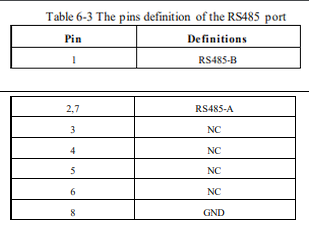
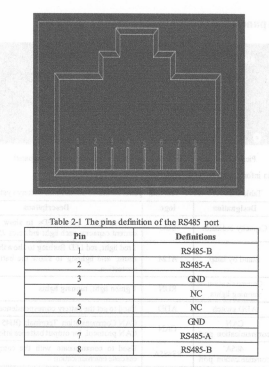
-
@PsyCLown, obviously you don't need to add any lift to the calc if you are lifting all the panels, what was I thinking 🤦♂️ I would go with 1.7x as posted by @Scabanshi as 22deg is a bit further North than JHB. (sorry I misread here, you're at 26deg which is the same as Jhb) Do the calcs with 1.7x and you'll probably end up with extra space an the end and then you can space them a little more. You can also use 1.7x(height of north wall-panel lift) to get the placement of the first row out of its shadow. Thanks @Steve87and @Scabanshi for these easy rules, I was taking the long way round 😀
-
Yes, I'm not sure about this adapter, I've not used on and I'm not sure if it is RS485. The problem would be the cable from that adapter to the battery and knowing which pins it is using for what (unless that is configurable). It looks to me like that adapter will give you LAN over USB. The second adapter should work just fine, it is what I am using. If the new adapter doesn't work, then it might be a driver issue, make sure you have the correct driver installed(windows might do it for you). You can find details on hooking up this adapter here:
-
What pins are you connecting to on the battery? Do you have a manual with the pinout? Usually you need to use pins 1&2 or pins 7&8 for RS485. If you are using those pins, you could try swapping them around.
-
Thanks for the double check 👍 Yes, ideally we need the exact latitude to get the lowest sun angle and then calculate the length of the shadow. The picture faces kinda SW, sun rising over the left shoulder behind him. Basically the panels will face the camera.
-
Yes, I access using the USB port on PC with USBtoRS485 converter wired to a RJ45 plug into the RS485A port on the seplos BMS. I'm not sure if it works on the Pace BMS.
-
sin(25)x2465 = 1042mm : Height at the back of the panel in portrait sin(25)x1134 = 480mm : Height at the back of the panel in landscape. (Someone please double check my math, it's been a very long time since I was in school 😉 ) The gap between the panels will be smaller in landscape, but you will be able to fit fewer next to each other. You would now need to use the calculated height of the panel along with your latitude to get the distance between the panels in portrait and landscape and plan further from there. It might be a good idea to either lift the panels a bit to reduce the shading created by the wall around the roof or you'll need to leave a space. It might be best to lift them and put them in landscape so they don't stick up too high. Any lift would need to be added to the original height in the formula as the spacing will increase. You also need to add the height of any footings for the frame. You might also need to plug the height of the northern parapet wall (the one your're standing on in the pic) into the calculator to see the space you need to leave for the first panel so that shadow doesn't get it in Winter. It might be best to get those boundaries first and then see what space you have left to work with.
-
Yes, this tilt is what gives us the 4 seasons, it's just 6 months difference between N and S, but the lowest angle of the sun is the same for everyone on the same latitude N & S, just 6 months apart. In June the Northern hemisphere is tilted towards the sun and they have the highest sun angle and we have the lowest in our winter. In December the Northern hemisphere is tilted away from the sun so they have their lowest sun angle (Winter solstice) and we have our highest in the middle of our summer (Summer solstice). Angles are the same at the same latitude, just 6 months shift due to the tilt.
-
I would expect that the distance would be the same whether in the northern or southern hemisphere, the max sun angle would be the same for the same latitude N or S.
-
Roughly speaking this should give you around 3330W peak at 12pm regardless of how they are wired. Series keeps the amps down, but increases voltage, while parallel keeps the voltage down, but increases the amps, they produce the same watts. If your installer mentioned they need to be wired like that because you have a low voltage inverter then it sounds like he knows what he's talking about. The inverter is not the bottleneck, your usage is. I doubt 3.3kW of panels is too much for the inverter, but you need to have loads to use that power or the inverter won't produce it. Try switching on the kettle and toaster at the same time and see how much power you can get out of the panels at peak, you should be able to get more than 2kW, close to 3kW. You may have been able to do with fewer panels with such low consumption, but you might need them on very cloudy days to get the batteries charged. I think, to make the best of your system you should consider moving some of the laundry items on to the inverter (at least the dishwasher), just be sure not to use them all at the same time or you will overload the inverter, that way you should start to save on electricity costs. Edit: P.S. don't mix up kW and kWh... kW is at a point in time, but kWh is over a duration. So, if you have 1kW for 1 hour, you have 1kWh, but 1kW for 2 hrs gives you 2kWh etc.
-
This is way over my head @Sc00bs, sorry. I have only set up basic RS485-USB comms using supplied software on my PC, nothing more than that.
-
Yep, these are the finer details that are rarely talked about and it's not always clear what is being referred to. Just take the below as an example, I'm not picking on LBSA, there are others that are affected, like Shoto, Navitas and others, probably all that use the seplos even though the hubble seems to exhibit similar behavior. Here they guarantee 70% capacity after 7000 cycles @ 100% DoD etc. etc. this is where accurate cycle count will be important. Their general warranty page then gets a little more confusing as they talk about cycles vs cycles on bms display, already showing a discrepancy. They've halved the cycles on the display which seems ok at first, but this should be 1/5 for 100%DoD battery because at 9000 cycles on the display you are actually at 1800 'real' cycles at 100% DoD if it is counting every 20% as a cycle... that is a massive difference. They also don't address the capacity guarantee. N.B.: Take note of the last point on the list above... DO NOT CHANGE YOUR BMS PARAMETERS or it will void your warranty. Good that you have all of your data to back yourself in the unlikely event of a warranty claim, it's always best to have as much info as possible.


-
Looks like the BSL might be a Pace BMS, it's not listed with the seplos batteries: https://solar-assistant.io/shop/products/pace_rs232
-
My issue is with the vagueness of this statement as well as the fact that it is not quite correct. Did they tell you it would count 2 cycles when it drops below 60% and 3 cycles when it drops below 40%? They should have told you it will count a cycle for every 20% discharged, that would be correct and honest. I guess I'm just a stickler for specifics. My main issue is that this all stems from one parameter not being set correctly and it doesn't give me much faith in battery "maufacturers" when they just tell people whatever they fell like instead of understanding and fixing the problem. At least they have made their guarantee based on age and not cycles, I'll give them that. Does that guarantee that the battery still works after 10 years or that it still has 80% capacity after 10 years regardless of cycles?
-
Yeah, cycle count will probably only be an issue in case of warranty claims. I can see down the line, people being told things like "That's normal for a battery with so many cycles to be broken/ not performing / have damaged cells/ less capacity etc. etc.... you'll have to buy a new one." I think it's important for people to know that the cycle count is 4 times higher than it should be... forewarned is forearmed. Another thing I have read is that the pylontech for example uses the cycle count to calculate and automatically decrease the SOH value and you can see the implications there if it was counting 4x faster. I don't know if the seplos also uses the cycle count for SOH, I've not looked that deeply into it yet.
-
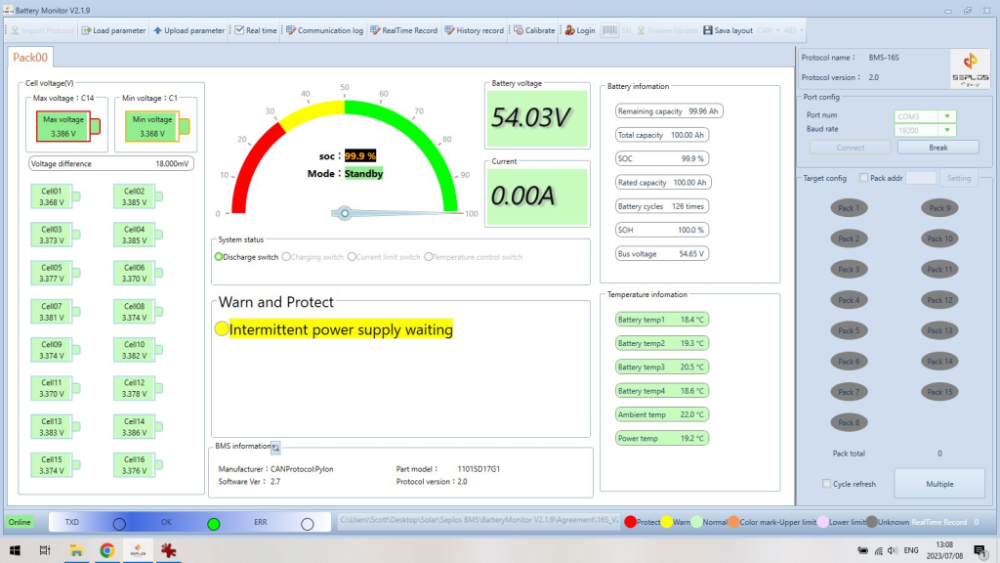
The easiest way is to just divide by 4 to get the 'real' cycles at 80% DOD as it counts every 20% instead of 80%. I also use about 30% daily (from 1 battery) and changed my parameter to 90%, so I get 2-3 cycles per week. This is after almost 1 year of service:
-
Your assumption is correct, this is how it should work, but if it counted only when you reach the 20% (or 10%) mark then you could cheat by never going below 30% so it would never count a cycle, so it has to be done cumulatively on discharge for programming purposes. If that parameter is set to the correct value, the cycles are counted correctly. This is why DOD is usually part of the spec like 6000 cycles @ 90% DOD because if you are not going down to 10% SOC all the time then you should theoretically get more cycles out of the battery, so cumulative is better in that case.
-
Not in Gauteng, but I am wearing all of my clothes today and had to put a seedling heating mat under my battery 🥶

-
It might be as easy as changing setting 1 from USb to SUb, so that it uses solar for the loads as much as possible. Are you able to see what setting 1 is currently?
-
You can use the seplos battery monitor software to change the parameter, but it might void your warranty, I did it anyway. Details can be found here: Yes and yes, but it is a bit more detailed as it is cumulative so: 100% down to 80% and back to 100% is counted as 1 cycle. 100% down to 60% and back to 100% is counted as 2 cycles. 100% down to 90% and back to 100% done twice will count as 1 cycle. Every discharge event in the bms is added up until it reaches 20% (or the value set in cycle cumulative capacity) and then it adds a cycle and starts counting again, it doesn't count the charging at all, only discharge. Hope that makes it clearer.
-
Welcome to the forum. Just stick an @ before his username like this @BritishRacingGreen and he should get a notification.
-
This is due to an incorrect setting in the BMS parameters that counts a cycle every 20% instead of 80%, it's called 'cycle cumulative capacity'.
-
You need to change the windows numbering format in the Date, Time and Regional settings. It is in the old setup manual, but not the new one. You need a . (full stop) for decimal symbol and , (comma) for digit grouping.