


sgs
Members
-
Joined
-
Last visited
Everything posted by sgs
-
I know this is not what you're asking re Aux, but it is another option to consider since you already have HA running and integrated. What I've done is run my geyser, oven and pool as non-essential. That way they can all run off solar during the day. Then at night (around 5pm) I switch the inverter settings (via Home Assistant) to not export any power to non-essentials - so if the geyser runs at night, it runs from grid, not draining my battery reserve. This has worked well for us. The only downside is that, during load shedding, I will never have a geyser. (I'm assuming that with the Aux method you will still have hot water if you have enough excess solar, but I haven't looked into that myself. From what I've heard the Aux functionality is very limited though.)
-
No warranty? Or not worth the effort?
-
I run two 3kw oil heaters on our system often in mid winter - albeit at the 1kW setting. This is off a 5kW Deye. They cycle on/off during the day when working from home to keep the two rooms occupied liveable. They do chow power - but they are probably the simplest form of load for an inverter - a constant resistive load. There is nothing that makes them "incompatible" with a solar system. The reason installers say you cannot run them is because they assume people are going to flatten their batteries too quickly and run them into the groud (underspecced system) and then complain - especially during load shedding when there is no grid available. If you understand how much power your heaters consume, and manage your battery levels accordingly, there should be no issue running them within reason - as already said by others. I just wanted to add that, assuming you're not off-grid, and there is no loadshedding, you can draw +-15kW from two Deye's in Parallel - as long as the grid is available. It will "pass through" the excess that is over the 10kW inverter capacity from grid instead and won't trip. So your chances of tripping anything is very minor! (In addition, if items such as your geyser is connected as non-essential equipment, their usage won't 'count' towards the inverter's trip limit either - they will just draw any excess that the inverter cannot provide from the grid directly.)
-
When mine did something similar, it was the USB power supply that went out of spec. Swopped it out, problems went away.
-
I've also had weird issues with comms using various bargain basement USB power supplies for my ESP32 board. Mileage varied when using bundled cellphone chargers of various makes - some allowed intermittent comms, others just a bunch of errors, and some killed the wifi reception. I settled on quite an oversized (2A) after-market charger which appears to introduce very little noise and is also large enough to drive my fans. I guess power filtering isn't exactly high on the design criteria for these supplies, or the ESP boards are just particularly sensitive...
-
I understand that they specifically roll out the Sienna Enlight meters to cater for solar installs. You'll likely find that when your approval is complete, they will require you to replace the existing meter with one. I don't know if there is a cost, but I would push for that. The Enlight doesn't care about reverse flow - it simply charges you for everything you feed back. They claim it doesn't allow feed back, but if you go look at the meter settings, it has no llimits configured to block feedback - you can theoretically push back 63A permanently. You'll just need to be ready to pay for it .
-
This is 100% normal for Pylontech afaik. The cell balancers kick in at around 88-90% and then charging current drops, and the SOC gets stuck for up to an hour or more where it will suddenly jump and be "full". How long it does this for depends on the charging current and how out of balance the pack is. Have you not noticed this before? This is mine. Has done it from day 1.
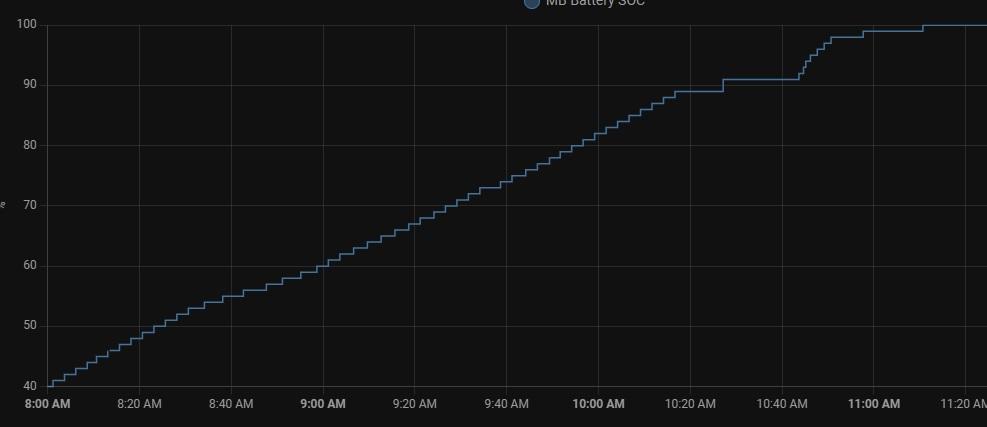
-
I've done something similar with my pool pump timer. Basically, if the pump is supposed to run 14:00 to 16:00 and I've set my usual automation for that. BUT if Load Shedding rocks up 13:00 to 14:00, it will likely never switch on. So I've setup an alternative automation from 14:00 to 15:00 that triggers when the grid voltage exceeds 80V which will also switch on the pump. That way, if power is off when the switch needs to trigger, the 2nd automation monitoring grid voltage will trigger it when the grid is restored.
-
I want to further this question. To my knowledge a COC only covers the AC side of an installation. At least, mine does. The only mention of a solar system is a little "1" next to the "Alternative Power Supply Connection" section. There is nothing else on there about batteries, panels, DC connections and the rest. (The report submitted to council for approval is an entirely different matter though!) Therefore, one would have a COC if you installed a new system, but if you added an additional battery to an existing system, there wouldn't necesarily be a COC as nothing changed on the AC side of the installation. Therefore Hubble cannot even use a COC to confirm that the batery was installed by a licenced electrician, which is what I suspect they'd be after. So then what is the point? Can anyone confirm: would an installer issue a new COC when they add another battery to a system?
-
For the Sonoff, what I've done with my Kwikot is to poke a hole into the foam insulation around the geyser, and snuggy the probe in there, right against the outside of the inner drum. Seems to work very well. (You can get into the foam insulation behind the Anode plug usually - at least on the Kwikot.) I kept the original thermostat (maxed out) as a backup failsafe in-case the Sonoff doesn't switch off. The Sonoff has a profile where you can set it to maintain a specific temperature between certain times, which is quite useful.
-
Before you go and do crazy things with wiring, try adding this to your ESP32 YAML config file: esp32: board: esp32dev framework: type: arduino version: 2.0.6 Later versions of the library broke something in the RS485 support, and forcing using version 2.0.6 resolved this for me. (Before mine did exactly the same as yours.)
-
I purchased this a few years back: https://www.takealot.com/hansgrohe-crometta-85-overhead-shower-1-spray/PLID53022123 It mixes in air with the water to make the streams much more substantial. It is super comfy on the skin, no needle-like jets, and really uses much less water than my old shower head while feeling much more natural. If I didn't know it was a water saving head, I would never have geussed. I can highly recommend it.
-
1. Correct - there is no other component required as you are reading the modbus registers directly into HA. 2. Correct. 3. The inverters have a 12V output labelled "RDS" (rapid shutdown) which isn't in use in South Africa. It is powered as long as the inverter is on. I was contemplating running that through a 5V buck converter for the module. (At least my Deye has that - not sure about the Sunsynk - might be model specific.) However, I had more to run off 5V including a couple of fans, so would have exceeded the output limit of this port. I rather opted for an external USB supply plugged into a socket next to my inverter's DB board. Less neat, but requires no hacking.
-
If your neighbourhood PC shop can't help or you don't have a buddy with the tools, chat to LinkQage. I know they will make up custom cables. (You'll likely just pay a bit for the privilege.) If it was me, I'd make separate RS485 and CAN cables with both only having the relevant pins crimped. And then plug them into the splitter at the inverter.
-
My Deye has done the same. Drove me nuts before I figured out what was happening. I suspect it is related to the timezone setting in Solarman. Mine is set to GMT+2 Cairo, and Cairo does have DST, which kicked in last Friday. There is no way to change this though as my installer controls the plant in Solarman. Does anyone know if Solarman has a timezone for South Africa, though? If so I need to shout at my installer to fix it or to give me control over the plant in Solarman so that I can manage it myself.
-
Also look at ZeroTier One. It integrates straight into HA (there is an add-on) and with the app on your phone, allows access into your HA from anywhere by just throwing a switch in the app. Super easy to setup.
-
Grid tied = can feed back and blend power from grid with PV and battery. These inverters need to be on the COCT's list, and requires a long approval process, engineer's sign-off, possibly 'reverse flow blocking' etc. Inverters like e.g. Sunsynk fall in this category. Off-grid = cannot feed back, only consume grid power to charge batteries or drive the load. e.g. a glorified UPS - it will use either battery and solar to feed the load or grid - but will never "bridge" the loads with the grid input directly, therefore canot feed back. This inverter does not need to be on COCT's list, and does not need an engineer's sign-off - only a COC from an electrician. If it is linked to solar panels, it needs to be registered, but not "approved" as such, by submitting a line drawing and COC to the city. (They claim this is purely so that they don't hassle you if they see you have panels on your roof.) Typically Axpert type off-grid inverters fall into this category. I've been through both approval processes with two properties and the off-grid registration was really just a rubber-stamp exercise - as long as your COC is valid and you haven't done something stupid, they will send you an approval letter.
-
I can only hear this 15kHz when I take the front panel off my 5kW Deye. It drives me bonkers to the point where I cannot work on there unless the machine is switched off. If the panel is closed though, it is just a lowly hum - not at all intrusive. It shows up on a spectrum analyser just like in the above pictures, but nowhere else in the house can I detect this 15kHz harmonic - or if I can, it is tiny compared to at the inverter, and definitely not at an audible level. Could this effect have something to do with the existing wiring in the house? Maybe if the wiring length is a certain factor of the wavelength it might amplify or mute the noise?
-
All installations have to be registered, but the process differs slightly. Grid tied / hybrid is a more involved process needing approval, whereas off-grid is easiest to do and only requires a simple registration. Only if you have a grid-tied or hybrid inverter (e.g. one capable of feeding back to the grid) does it need to be on their list.
-
AFAIK the feed in incentive subsidy is only there until June 2025. Thereafter the rate drops as the extra 25c/kWh will fall away. Furthermore, if you install solar now, you won't be approved before June 2023 - maybe even later (given how long my current approval is taking). So you'll have less than 2 years to profit off this incentive. So, awesome for people already feeding in. But keep this in mind in your calcs if you're installing a new system and calculating your ROI.
-
Do you actually see power being used on your municipal/eskom meter, or are you just measuring with a clamp like the Efergy? This is not the first time this has been mentioned on this forum in relation to the 5kw Sunsynk / Deye inverter, though. Here's an example, but there are more if you search: There was someone who reported that changing firmware versions changed the amount consumed - but I cannot find it now. Myself just had a 5kw installed, but it is still being comissioned. I noticed the same during initial testing with my Efergy meter. Am now waiting patiently for a prepaid meter to be installed so that I can verify if this is "real" use or "reactive" power - e.g. whether I'm billed for this or not.
-
Thanks for the feedback. I have finally managed to reach someone who is assisting me on the city's side, and things are looking up now. Turns out my installer messed up the paperwork, plus actually lied to me about when/what they submitted. Needed some intervention to get that resolved. For anyone else wondering, the city IS backlogged at the moment. So things are taking longer than their expected turnaround. Would have been nice if someone set this expectation beforehand, but my beef here is therefore with my installer and not with the city.
-
Hi all - hoping someone here has a suggestion which may help! I'm struggling to get my permission to install letter out of the city (Cape Town) and pulling my hair out with the lack of communication from both my installer and the city. Maybe I'm just too impatient - I don't know. The application has now been sitting with the elect dept for almost 4 months. Aparrently they 'lost' the application at some point, and then it was resubmitted 2 months ago. Subsequently, my installer who was handling this on my behalf, appears to have gone awol and have stopped communicating with me on this matter. (I assume they're either on break or too busy installing other systems to care about existing customers.) So I've tried taking matters in my own hands by contacting the city directly to find out about progress, and I have been told it is with "a technician" - a technician I cannot reach. Phone lines are never answered, or are "unavailable". From all their communication, this part of the application should have taken no longer than 30 days, and people I've spoken to confirmed that theirs took much quicker than that in general. Is that just boilerplate red-tape-speak for "when we get to it"? Does thie city generally take this long with issuing permission to install letters? If I was applying to feed back, I would have understood - but this is a simple application for a hybrid installation with no feedback. It should be a tickbox on a long list of tickboxes - not a 4 month-long process - or even a 2-month process, if resubmission was disregarded. Am I missing something or just completely over-guestimating the rate at which the city can roll red tape off their dispensers?
-
I initially had intermittent zero readings and while troubleshooting I found that "Zero Export" doesn't actually read the CT coil but uses the internal inverter measurement instead. You only see the CT measurement when it is set to "Zero Export to CT" - so the problem went away when I selected "Zero Export". (Or at least that is what it looked like to me.) In my case, the CT coil was installed fine, but the wire's insulation blocked it from being inserted deep enough into the connection block on the inverter, so the contact was intermittent. You may have a broken connection to your CT coil or it is connected to the wrong points on your inverter?
-
Thanks all! This is great! I should therefore be able to confidently go with the 5kW model if I leave ovens, pools and geysers off the essential side, and adjust our usage accoring to time-of-day. Going to the 5kW vs the 8kW is an extra R10k+ that can go into solar panels or battery storage - awesome!

