



Don
Members
-
Joined
-
Last visited
Everything posted by Don
-
I agree, it seems more than adequate to do the job.
-
Hi viceroy. I assume the power requirements for a serial port on an Arduino, is the same as for a PI. Just make sure you make that the serial port has a MAX3232 chip, as the older MAX232 won’t handle the 3.3v levels of the Pi or Ardduino, whereas the Max3232 will. I got myself a serial port for the PI, just need to install it some or other time.
-
I have 2 x 5kVa inverters running in parallel. I noticed that you can change settings on any of the two and it would program the other inverter accordingly. You don't have to change the settings on the master unit only. That goes for all the settings, except for Charger source priority settings, setting 16 on the Axperts. I have 12 solar panels. 4 Strings of 3 panels connected in series and then two stings connected in parallel. I therefore have 2 strings coming from the solar panels to the inverters. One sting to each inverter. After installed amp and volt meters on the 2 stings coming down to the inverters, I noticed that they do not run in parallel or share the load load equally between the 2 inverters. The slave unit would take say about 70% of the load before the master unit would start to produce any power. Then the slave unit would go to 100% and the master unit will sit at say 20%. The master unit will then handle the fluctuations. I also noticed something else interesting. You can have different charger source priority on both inverters and set them differently. What you set on one inverter does not automatically get sent through to the other inverter as with all the other settings. It seems that everything else runs in "true parallel", where they share everything equally, except when it comes to pv panels. It might have something to do with each inverter having its own set of panels and not share the same string as with say the battery bank, where they both see the same batteries. I just thought it is something interesting to share. Don't assume that because you set the charge priority on the one inverter, it will be the same on the other inverter. You have to set the settings individually on both inverters.
-
Hi Gerald. I can just share with you my experience I had with Aramex Couriers. I used to import a lot of stuff from China with their normal postal service. It takes anything from 6 weeks to 3 months, depending who is on strike, till the day you receive the goods. I ordered some more items and I was not prepared to wait that long. I paid a bit more and requested they send it with Aramex Couriers. From the day I placed the order in Hong Kong in China via Dubai to Johannesburg, through customs and delivered to my doorstep, was 3 (three) days. Just unbelievable. I think if I send a letter to my next door neighbour, it would take longer than that. In SA they do business as Berco Express, which is an Aramex company. I would definitely recommend them. Don
-
Thanks Manie. I assume there is only one application for all three inverters. If there are some differences between the 3kVa, 5kVa and Infini, maybe a one fits all solution may have to be broken up into 3 different solutions to make them more inverter specific, with different input and output parameters. You fix something on the one and break something on the other. Future updates will then have to be be inverter specific, i.e. 5kVa only, if you only make a change to the 5kVa inverters.
-
This morning I struggled to charge my batteries from solar panels due to a lot of clouds around. The wife kept pestering when she could get going cleaning the house. She wants to start washing machine, tumble dryer, dishwasher and vacuum cleaner. I knew once the all start running, I will never get my batteries charged. I gave in and said ok, I will switch to grid. With Axpert setting 16 set to 050, at least I can charge my batteries from solar panels while the wife cleans the house on grid power. I nearly fell off my chair when I had a look at the dashboard. It showed I had 3613 W produced from my solar panels which was charging my batteries 3632 W. That was close enough and made sense. Then I had a look at what was coming in from the Grid = 4756 W, with my load only sitting at 1088 W. That does not make sense. Coming in is Grid and Solar = 8369 W. What get used is Battery charging and House load = 4720 W. The difference between what is coming in to what is being used = 3649. That is close to what the panels were producing. I then realised that in Utility (Grid) mode, all the power that gets produced by the solar panels, gets added to the Grid power. Every time the Solar panels sees some sun and climbs by 2000W, so does the Grid Power, without a change in load. The Grid Power produced during the day in Utility mode, will therefore overstate the Grid usage by what was produced by the Solar panels. My grid usage for the day stands at about 6.4 kWh for the day. About half of that power was produced by my Solar panels. No wonder my figures looks bad on PVOutput, lol. There are some double accounting in those figures. Edit: Looking at the picture again, the Solar Watts line should not drop to 0, just because I switched to Grid mode. If any power gets produced from Solar panels, it is because there is a Solar Load requirement and in this case, only Solar panels can charge batteries. It therefore should be the same as the Battery charging requirement, unless I don't understand Solar Watts correctly. And the Grid Watts line should be the same or close to the Load requirement.

-
So I imagine in 2-3 years time, we will all be replacing our panels with the all "New and Improved" super duper water cooled panels.
-
Damn, with water restrictions I cannot even water my garden. Now it seems I have to water my solar panels as well, lol.
-
For the latest WatchPower and SolerPower Software, go to this Aussie Website called Giant Power (Axpert Rebranded Inverters) - They just painted them red, lol. They have the latest software, V1.09: http://www.giantpower.com.au/downloads/ What I found with V1.09 is that there is no setup file. I closed the application. Then I extracted the zip file, copied all the files, went to my previous installed version folder and pasted the new files overwriting the previous installed version files. Started up the application and now running the latest version.
-
Here is an online Battery Room Calculator I just found on the internet. https://pocketengineer2.sharepoint.com/Pages/battMV.aspx
-
The general air changes required for any factory or workplace is 6 air changes per hour. For a battery room or "Box", the required air changes per hour is 12 air changes per hour. I used to be the Group Ventilation and Refrigeration Engineer for Anglo Platinum with 35 years service. I can design a ventilation and refrigeration system for a mine till end off life in 50 years time. The problem with these small boxes is you cannot accurately measure the flow rate of these pumps delivering small volumes and therefore go on what is written on the specification sheet. If you connect a little pump to a box that seals perfectly and you have a very small air outlet. You will probably pressurise the box and as a result of the pressure, drop the volume in half. Without doing any calculations, my gut feel says, you need one of these. That is what I initially proposed. Install one of those computer fans (the one blowing air onto the evaporator) on the opposite side of the box, to drag the air across the batteries. Ideally the intake should be on the bottom of the box on the opposite side. The problem is not ventilating the box during normal charge and discharge cycles. Very little Hydrogen is given off. The problem comes in when something goes wrong in one of the battery cells and stuff starts to boil. Then the cooler box changes into into a bomb within minutes. I think 90% of us have the same problem. Box or no box.
-
Yes, Hydrogen is generated when the batteries are being charged and Hydrogen Sulfide when the batteries are over charged. I just think that the airflow produced by the mattress pump is insufficient to properly ventilate the box, maybe I am wrong. I do the same, fit the safety devices last when I have nothing else to do, while we should actually fit them first.
-
superdiy, very impressive battery cooler box. This is something you can be proud of. With the internal fan running, the Hydrogen and Hydrogen Sulfide will mix and be all over the show, irrespective of their specific gravity, while the fan is running. I assume the white pipe on the side with the black rubber connectors are the air pump pipes to ventilate the box. I cannot see the outlet, but assume it it is probably the same size. In my opinion, this is totally inadequate to properly ventilate the box. If you have a concentration of 4-46% Hydrogen Sulfide in the box, all you need is a spark and it will set off the bomb. I would make two holes the size of that internal fan behind the evaporator and put spacers (6-10mm) in between the evaporator and the side of the box. Any air flowing into the box will then flow over the evaporator and be cooled if the compressor is running. Then fit that fan you have blowing onto the evaporator on the opposite side of the box where you have your air inlets and let it extract the air out of the box. Air will thus enter the box, flow in over the evaporator, then flow over the batteries and out on the other side.
-
Assuming, they are aware of the problem.
-
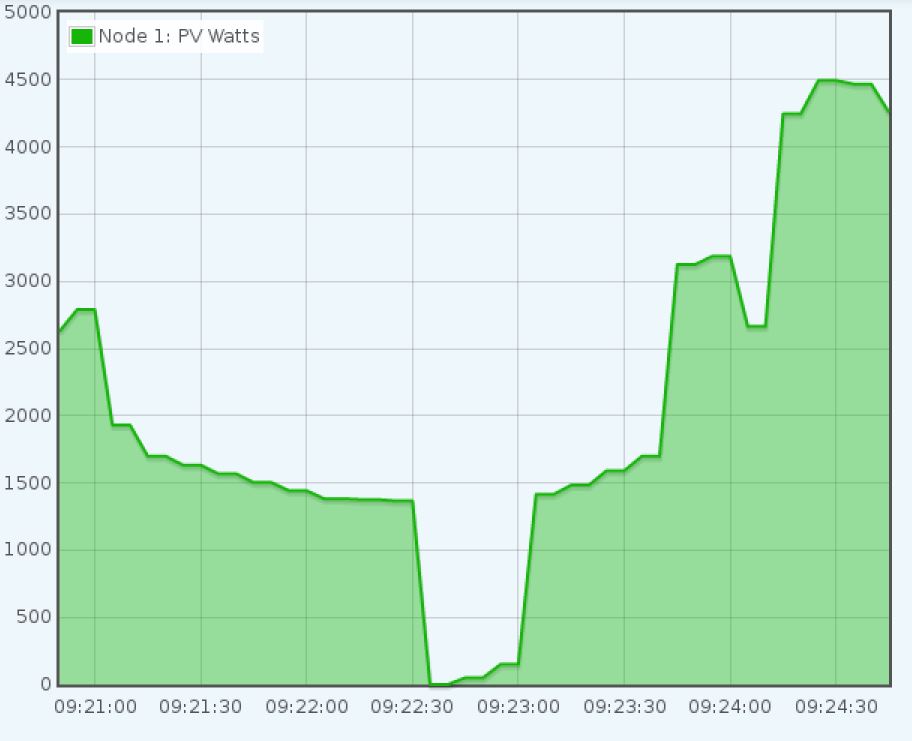
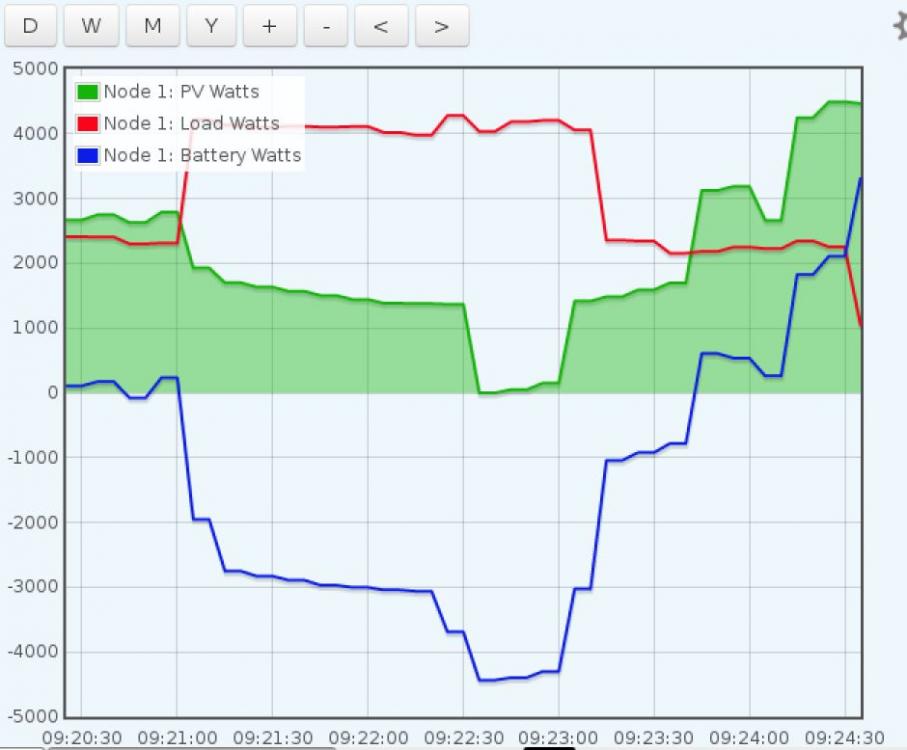
This happened to me twice the day before yesterday. Initially some clouds move across the sun and therefore a drop in PV Output. Then the PV watts dropped to 0 like a dead bird out of the sky and 5 seconds later start picking up again and go back to where it should be. I have added 2 graphs. The one showing the PV Watts only and with the second I included the Load and Battery Watts as well.
-
DownTime, yes, I realise that most of the plugs will be on the same line as you said, including the fridges. I will have to pull in some extra wires to cater for that. What is the correct name for this external contactor on how big is it? When I go to the electrical shop, I want to buy the correct item first time round. I don't want to come home with a 10kg coil and everyone laughs at me for buying the wrong thing, haha.
-
Thanks Plonkster, I will keep the washing machine on the inverter.
-
I agree Jay. I am thinking of doing the following now: 1. Split DB and put stove and oven on Eskom only. 2. Add pugs feeding 2 x heat pumps and pool pump, tumble dryer, washing machine and microwave to the external contactor as DownTime suggested. (Will only be available when Eskom power is available, but cannot run if Eskom is down and inverters are running off batteries) 3. The rest gets connected directly to inverters and will be available at all times, even in the event of a power failure. Does that make sense?
-
Chrono, if you select Utl, the inverter will use solar and battery when Eskom is unavailable. Solar will be the priority. You cannot select battery only. The only way you can use battery only, is if you disconnect the solar via the disconnect switch, i.e.the inverter does not see solar connected and will thus only use battery as backup when Eskom is unavailable. I suggested you make use of any software to give you a better understanding of what your load is during the day. You will quickly realise that 1 x Axpert 5kVa inverter in your case, is not sufficient to cater for your loads, as you exceed the maximum capacity of the inverter at regular intervals. I would suggest you will need to install a second unit. The two inverters will then run in parallel, doubling your inverter capacity. Even adding an additional inverter will at times not be sufficient when you switch on the oven, stove frying pan and microwave at the same time, with the tumble dryer running in the background. Therefore it would be a good idea to split your db board and remove the stove and oven from your load and run it directly from Eskom. If Eskom is unavailable, you don't have a stove or oven, but at least you will not overload your inverters.
-
Good thing you were not home. The gasses given off would probably have killed you.
-
The cheapest option would be to get rid of the wife! You cut out the following from your load. No stove, no oven, no frying pan, no toaster, no microwave, no slow cooker, no dishwasher, no washing machine, no tumble dryer, no iron, no hair drier, no refilling 300lt geyser after a shower, lololol.
-
Hi Chrono, Unfortunately there is no setting on your inverter to fix your problem. Your base load far exceeds your inverter capacity. You definitely require an additional inverter to run in parallel with your existing inverter. Even that will at times not be sufficient,looking at your base load. Secondly, you are on the right path splitting your DB. Just taking your oven and oven off the load and running them from Eskom, will make a huge difference. Looking at your base load I would guess take a rough guess that you have battery capacity for about 1 and a half hours, running them down to about 75%. Your batteries should only be used for Eskom outages, i.e. load shedding. If you run the every night for 4-5 hours until they shut down due to low voltage, they will not last 18 months. You need some energy monitoring software to manage your load and give you a better grip of what is happening. For a start, try and run WatchPower software that came with the inverter or download it from the internet.
-
I would suggest to go for a 5kVa Axpert. It is an all in one unit, runs of batteries and off solar and will cater for their needs. What will eat into their budget is the batteries, Wire the stove, oven and geyser separately to run off grid only, not through the inverter.
-
Paul, the only value I am not so sure about is the Average Depth of Discharge. I have been watching this value for the last 5 charge cycles. Mine seem to be stuck on -189.4 Ah. I had 4 charge cycles at around 100 Ah and last night one of 240 Ah. On the last 5 charge cycles it has not even changed a decimal point on the Average Depth of Discharge.
-
Hi Peter, I think your charged voltage of 52.8 is way too low. You will never get them to 100%. The charge voltage should be 57,6 V and float voltage at 54.4 Volts. And as Gerald said, increase the charging amps to 150 Amps.


