



Power Punk
Members
-
Joined
-
Last visited
-
-
-
Ah, none of you spotted the “deliberate” mistake. It should read 2023, of course 🤭
-
-
-
-
-
-
Yes, but the key is the BMS. Right now only 48V BMSs available, so a battery comprises 2 x 8 cell blocks and a BMS. I believe 24v BMSs will be coming in soon. PS. I assume we're all happy to talk 24v /48v as nominal, knowing that different lithium battery configurations are out there. For example, Pylon uses a 15-cell configuration for a true 48v nominal, whilst BYD uses an 8-cell / 16-cell configuration for a 25.6v / 51.2v nominal battery. Hear a bird whistle, you can buy them from overseas. Another birdie told me some 2nd Leafs (note the intentional pun) had found there way through to our shores last year. The issue appears to be availability: the Nissan, BMW, Renault etc fleets are just too small and young to be yielding any significant volumes. I think BYD has the jump here, because of their substantial bus and taxi fleets, which have been whispering around for the better part of a decade. Projections are that the 2nd Life market will remain tight until around 2013, wherafter 2nd life batteries should become reasonably freely avalable.
-
-
Oh no, phil old chap - your sweeping statement "The Chinese are publicly disassociating themselves from the used product" is a leap of logic away from the exchanges above. Please, keep to the facts.
-
Oops, sorry, I didn't realise you were referring to the distributor and not the importer. My bad. You make a valid point that ALL parties (importers, distributors & resellers) have a responsibility to be fully and absolutely transparent in their dealings.
-
The Pylontech really seems to be great stuff - we've installed a bunch and haven't had a single issue. The warranty is excellent as well. Just be careful to compare apples with apples. It makes sense to compare WARRANTED cost per kWh, or EXPECTED life: Pylons are warranted for 10 years (7 plus an additional 3 on registration) for a single daily cycle, i.e. 3650 cycles, to a minimum remaining capacity of 70%. I can't recall the warranty and cost details of BYD B-Box batteries, but Pylons appear to have the stronger value proposition in terms of cost per warranted kWh of storage. Revov 2nd Life is warranted for 10 years or 3500 cycles, I believe this is also to 70% remaining capacity but need to confirm. As far as design life is concerned, Pylon claims: >10 year design life, >4500 cycles
-
As this is a "new kid on the block", there is very little history to speak of. What I can say is that I had issues with 2 batteries, both of which were immediately replaced without question. I have had feedback that the one was tested and the problem traced to a bad BMS, the second is yet to be analysed. They don't have a reputation - they're a startup. The word "@nd Life" appears in their logo and on the home page menu bar. The phrase "2nd Life energy storage products" is emblazoned across the middle of the home screen page?? The word "refurbished" has no place here. Please familiarise yourself with the plentiful information available on second life lithium batteries - you will find this is not some fledgling flea-market industry, but rather the beginnings of a market which is set to revolutionise stationary energy storage. https://thinkprogress.org/how-used-electric-car-batteries-will-turbocharge-the-renewables-revolution-4baf33d4b15f/?fbclid=IwAR1qep145TMcyxmPZUsJUB7g8I7X_-VghJGI5_iWNSllIecanJMjkWPksds https://thinkprogress.org/how-used-electric-car-batteries-will-turbocharge-the-renewables-revolution-4baf33d4b15f/?fbclid=IwAR1qep145TMcyxmPZUsJUB7g8I7X_-VghJGI5_iWNSllIecanJMjkWPksds https://www.japantimes.co.jp/news/2018/07/04/business/retired-electric-vehicle-batteries-find-second-life-chilling-beer-grilling-sausages/?fbclid=IwAR3atFLQxSjvP26ohj7iLwro0JcLuQDhoDP1FBtlkk7KMjhKWBleFRkam3A#.W-_uGGmxWyU Absolutely agree. Caveat emptor - do your homework 😎 Can you provide examples of this?
-
Recommended retail price for a 10.24kWh battery is R49600 inc VAT. This is for the battery (2 x 25.6v/200Ah blocks), an external BMS and a cable package. The batteries are rated for 100% DoD, so they work out to R4 844 per kWh. This compares with Pylon's 2.4kWh battery, which sells online for R16 000 inc VAT. The pylon is warranted at 80% DoD, so this battery has 1.92kWh usable, translating into a cost of R8 333/kWh. The 2nd Life really are an exciting value proposition.

-
Not only this, but the EV market in China is already quite mature, with early buses and taxis approaching 10 years now - and hence the emergence of the 2nd Life battery market. Taking the plunge on lithium (be it "virgin" or 2nd Life) is not nearly as risky as some would have us believe. There is currently no evidence to suggest that Lithium batteries are doomed to catastrophic failure at some point in their life cycle (EV track record shows us this), and so in the case of 2nd Life you are simply getting in at a different point of the energy-density curve. As confidence grows, warranties are being extended (BYD now warrants their EV batteries for 12 years). The technology itself also mitigates risk - the BMS of a lithium battery will intervene to contain a problem cell, as opposed to an unmonitored LA bank which can be entirely destroyed in a short time by a dead cell or other undetected malady.
-
Hi Khan You are correct, I have confirmed that the batteries are fully warranted by the local supplier Revov and not by BYD.
-
-
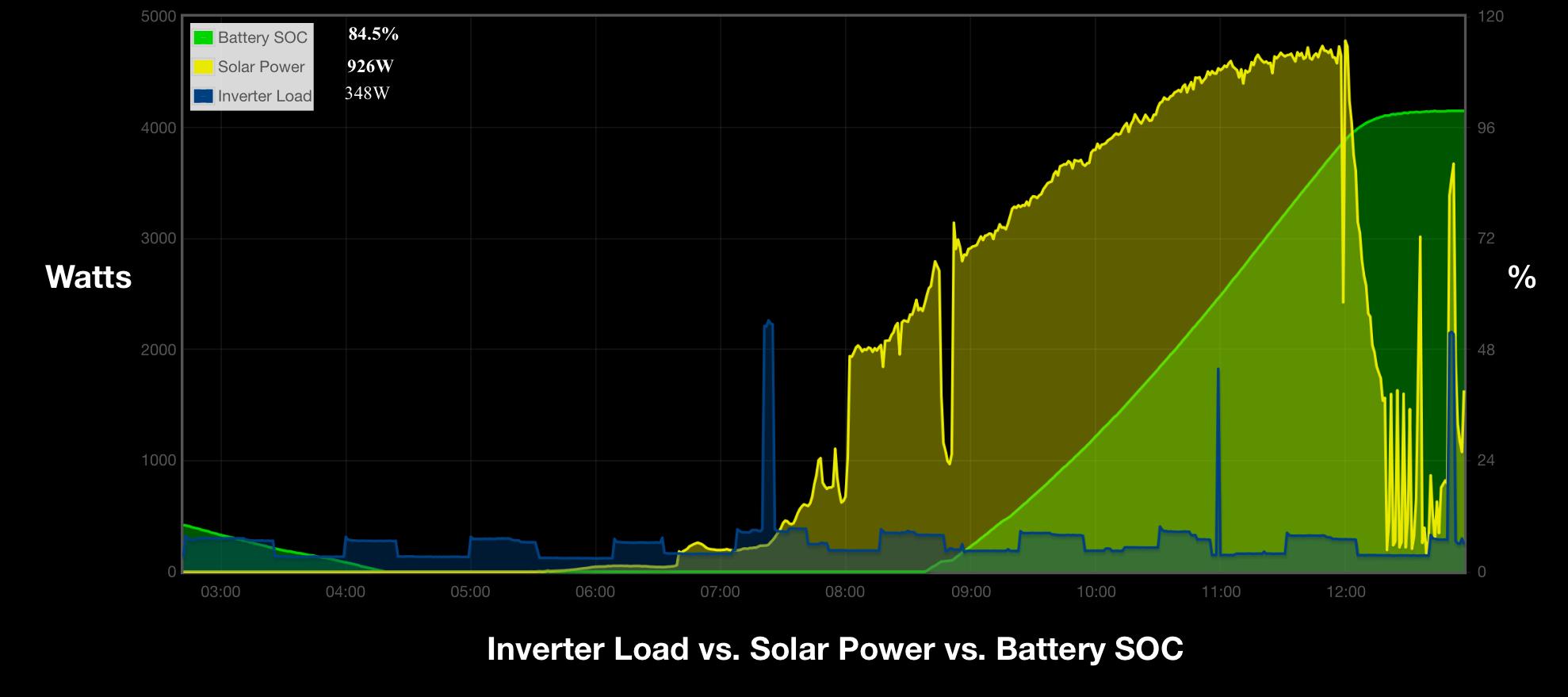
I was so buys penning my tome above, that I missed the half-dozen posts in between 🤣. 2nd Life LiFePo4 batteries are already available in limited quantities locally. I did some tests last year on a 7.5kWh bank last year, and am now running a 10kWh bank on a permanent basis. I cycle the battery fully on a daily basis (100%-0%-100%) for self consumption (I charge exclusively from solar, with small discharge / charge cycles throughout the day, followed by complete discharge through the night, at a typical discharge power of 1kW and up to 4kw at peak. I have almost become "grid neutral" as a result (I now use between 1.2 and 3 kWh per day 😀
-
-
I think there are a few points deserving comment here: 1. It is not good practice to add new lead acid batteries to an existing used bank. Batteries age both with time as well as with discharge cycles, and as they do, they take, hold and deliver energy at a decreasing rate. Adding a bank of fresh batteries in parallel with your existing ones will result in disparate charging between the two. This can be managed to a degree, but is not ideal. Top quality flooded batteries like Trojans are apparently less susceptible to this than your typical SLA or AGM block. This, incidentally, is one of lithium's great advantages - you can pretty-much add capacity whenever you like, as the BMSs manage the batteries at cell-level. 2. For a backup application, you need to pay attention to the "C" rating of your battery - this tells you how much energy you will get out of the battery at a particular rate of discharge. Most lead acid batteries are rated at C10, some at C20 - in other words, a 100Ah (C10) battery will be able to give you 100Ah of energy when discharges over 10 hours WHEN NEW. For a power backup application, and in particular load shedding, we are typically looking at a 2-3 hour backup requirement. A typical 100Ah AGM battery would have a C3 rating of 80Ah. Most lithium batteries are rated at C1, but warranty requirements may limit use to C2, which is still fine. 3. Whilst the economics of total energy of Lithium is a clear winner, you need to be aware of your maximum power requirements. The greater discharge depth of lithium allow a smaller battery to be utilised, but there is a limit to the continuous maximum power that can be drawn. For example, the Pylon 3.5kWh battery coupled to an Axpert inverter (no communication) must be limited to a 37A (1.75kW) continuous discharge rate, to comply with warranty conditions. If you have a larger capacity inverter you can control this by installing a suitably rated circuit breaker on the inverter output (effectively de-rating the inverter), which can be increased at a later stage if you decide to add more battery. 3.As @DaveSA indicated, you need to decide whether you intend to cycle your batteries. In brief, if you want to make use of your solar panels, you need to cycle the batteries. If you intend to cycle, you need to go lithium. It's as simple as that, if you have grid power. There is no lead acid battery which offers a warranted cost/kWh which is cheaper than grid power. In summary, I would recommend lithium over lead acid in all but the most basic backup setups, assuming budget allows, the inverter is compatible, and you are sure of your energy and power requirements. Its also useful to remember that you will be comparing capacities of the various batteries when new, but due to the significantly longer cycle life of lithium, the difference in usable energy after a year or two can become increasing disparate in lithium's favour. Enjoy!
-
Revov continued ... Batteries come in 25.6V blocks (per original EV bus format). Once removed from service they are evaluated and re-rated according to their remaining storage capacity. They are then sorted into capacity batches ranging from 150Ah to 200Ah+. Revov brings in the 200Ah version. The primary application is ~48V nom, so a battery is typically bundled as 2 blocks with a 51.2V BMS, for a total of 10.24kWh of storage. 100% DoD is usable. Multiple batteries can be paralleled. Revov will be bringing in some 25.6V BMSs as there appears to be some appetite in the ~24V nom market.


-
-
I may be able to shed some light on this... These are BYD 2nd Life batteries, not counterfeits. Herholds are not the importers, they are a distributor. The batteries are imported by Revov, who are official agents of these batteries in South Africa (I think they may hold distribution rights for the continent). They are currently only on their 3rd or 4th container and have been supplying to order, so supply & demand is delicate right now. They expect to be in a stock-holding position by the end of Q1-2019. BYD do not want these batteries marketed up der the BYD brand. I assume this is through fear of canabalising their B-Box product line. Herholds have subsequently revised their online description to replace the name BYD with REVOV. Oddly, BYD are still shipping the batteries in BYD-branded boxes. I have done some testing on an early “pre-commercial” 7.6kWh bank, with impressive results. Whilst Pylon was previously our LiFePO4 of choice, we now offer the Revov pretty much as standard, except where smaller (<10kWh) batteries are required. Our Revov sales have now overtaken my Pylon sales. Revov had an issue with a shipment of batteries, where the BYD BMSs were unavailable. They supplied SolarMD BMSs with these batteries, which was very problematic, due to lack of documentation, and some design / specification issues. Revov stepped up and are resolving this. I run a 10.2kWh Revov battery in my own system, with a self-consumption optimized setup. I cycle my battery fully (100%-0%-100%) on a daily basis, weather and load permitting. I am currently using the SolarMD BMS, but I will probably end up replacing it with the BYD unit. BYD warrants the batteries for 5 years. Revov are self-warranting the batteries for a further 5 years, for a total 10-year / 3000 cycle warranty. Tests performed by a (IIRC) Shenzhen university yield a little over 80% remaining capacity after 3000 cycles, with C0.33 charge and C0.50 discharge rates. This improves dramatically at lower charge and discharge rates which are typical in a self-consumption application. GreenHouse Energy Consulting assists Revov with local testing and some technical support. They are currently expanding the inverter application list to cater for inverters without Canbus comms, in a similar fashion to that adopted by Pylon. In summary, the Revov battery is our first taste of the deployment of 2nd Life lithium batteries into the South African stationary storage market. The value proposition is exceptional, and I for one am well impressed and excited at the prospects.

-
... because an Axpert cannot “grid-tie”. Grid tie means to operate in parallel with the grid, i.e. the inverter can import and export power. An Axpert cannot export power. I think what you mean to say is “grid-connected”. If you use that terminology, all flack will cease 🤓.
-
-
I know the frustration of being caught short when everything is closed (this is the only time we get to work on our home systems 😏). If you want to pop out to Centurion I can help you out with some PV cable...


