


HennieL
Members
-
Joined
-
Last visited
Everything posted by HennieL
-
Yes, I am - care to join...
-
I cannot really make recommendations, but can give you some feedback on the Eenovance batteries. When I set up my system nearly 2 years ago I bought what was sold then as Sunsynk Sun-Batt 10kWh batteries. It later turned out that this was actually re-branded Eenovance batteries, and although I was really pi$$ed off about this blatant fraud by a "reputable" manufacturer, the batteries have been performing pretty well... I did experience some errors and one of the units tripping at random for some time, but after an upgrade of the BMS firmware and the inverter's firmware (twice), this problem was solved, so I cannot really point a finger at the batteries. The battery firmware update had to be done manually with the installer hooking up his laptop with each battery in turn and the actual updating process done remotely by Herholdts Electrical (the Wholesalers / agents for Eenovance). I really must praise Herholdts for not only being profession and quick to respond, but also for being accessible - the guy that did the remote updates actually phoned me twice, and spoke to me in Afrikaans... Local is Lekker 😁 One other battery brand that I have heard mainly good things about is Freedom Won - but they are quite expensive - R68 000 for their Home 15/12 unit... (and I'm not sure of their South African support footprint), but I'm sure that the Powerforum Store will be able to advise...
-
I'm sure you will get more, and better, responses if you are not so cryptic No idea what/where Normanton, QLD is - never heard of it... What make & model of inverter? No idea what "Back to Grid" is suppose to mean - are you giving up on solar and moving back to your local Grid, or what? Battery backup for what - load shedding, completely off-grid, or only to run some light loads at night? Without more, relevant information you might as well be asking: "How long is a piece of string..."
-
@Energy-Jason This looks like a very nice prize. Can you please give us some more info: When will the draw take place Will this draw be done public / live? What are the conditions regarding privacy of details - will any third party organizations ever be given access to our email addresses and/or other data? Thanks HennieL
-
Thanks for responding to this thread - You do have a steep hill to climb if you honestly do want to honor your goals stated above... and at the risk of stepping on your toes (apologies for this...), you are not starting off very well (in my humble opinion). There is a long-running thread on this forum, titled "Pylontech Swollen Batteries", that was started way back in September 2024, where a number of people have complained about their Pylontech batteries that were swelling for no good reason, and even worse, about the zero assistance and/or interest of the Pylontech agents and retailers. These complaints carried on until on June 16th 2026 (a month ago...), when someone from "Lumo Energy" posted his or her only post to date, stating that "Solar Deity has taken over the service for SA" and added an image of a "Certificate of Authorization" for Solar Deity, that on closer examination turned out to have expired on the 1st of June this year. Now, this person did not identify him/her self as being an employee (or the MD...) of your company, and this could just as easily have been a fraudulent certificate and a phishing attempt. Anyway, after some further complaints, you posted on that thread on the 18th June, presenting a "new" unsigned certificate that is stated to be valid until June 2027, and that contains a spelling mistake - not something that is usual on any official documentation, and especially not on a formal certificate... Anyway, I then responded to your post, again asking for clarity on your company's position in South Africa, and how many other officially authorized agents were operating in South Africa - reason being that one of the complaints previously mentioned was that one "agent" refused to honor the warranty on a battery because it was sold by another "agent". One further poster complained about your company that visited his house for a warranty complaint (that he had to pay for before you would even visit his home), but that your technician merely downloaded data from two of his batteries, and then weeks later only sent a standard template response. To (that) date his complaint was still not resolved - nearly two months later... My last post on that thread was made on the 19th June, and to this date (13 July) neither you, nor "Lumo Energy", have responded to my very valid questions and comments, or to ANY of the complaints logged on that thread - that does not show any interest to assist the end users that have problems, and also does not build trust from uninvolved people like myself... Lastly, I think that many members of the Forum will appreciate an honest response to the following: Have you actually read your "conditions" (or small print, as I previously called it...) referenced by @Energy-Jason above? Do you honestly think those conditions and vague terms are Fair and Just to the many end users who have been complaining about Pylontech products for some years now? Thanks again for your time.
-
Thanks Jason I actually read their "small print" before I asked my questions - and in my opinion it does not address matters such as the cost of examining a battery for a "trade-in" when buying a new one. Now, to be clear, I do not have a Pylontech battery, and am thus not interested in this "deal", but I do strongly believe in old-school fairness and honesty in business. In this respect, I believe that owners of these batteries who are considering to trade them in for a bigger/better one should in fairness at least know what this evaluation would cost them - and should up-front also be given a range of fair trade-in values based on stated parameters to be evaluated. If, as an example, someone sends in a bloated Pylontech battery for evaluation thinking it is still worth R15 000.00, and this evaluation determines that the battery is worth only R5 000.00 but the evaluation process itself costs R10 000.00, then surely the owner would be better off to just keep that battery and buy a new battery, as he/she will be R5 000.00 worse off than if he did not trade in the old battery - don't you agree?
-
Yes, thanks for the heads up. I'm sure one could build a "bleed valve" of some kind, perhaps using the venturi principle, to suck cold air from the room (or the outside) into this hot air flow to "dilute" the hot air down to a safe temperature. Will obviously have to play around with just about everything to "fine tune" this, learning on the way - this is actually what might make up my mind to try this half-baked DIY idea 😁
-
Airflow design is not my field of expertise, but I thought that a practical starting point would be a 100mm or 150mm silent type of bathroom extraction fan - something that will fit a similar sized galvanized metal pipe going through the wall, with the "extraction" side housing the fan at floor level (or a bit above), and the hot air return pipe entering the room at mid height of the wall. The most challenging part would likely be the sourcing (or more likely manufacturing) of a reduction section to take this diameter down to (say) a 25-30mm metal pipe that would run zig-zag through the hot (~300C) sand... I will try to source stainless steel pipe to ensure a long service life if the cost is not exorbitant, else normal galvanized plumbing pipe?
-
Or just use solar... @frivan , I think you will like this (being technically minded): I did some calcs, and a simple 1.0m x 0.6m x 0.8m double brick "box" filled with sand and covered with good insulation (~80mm glass wool sheets), and heated by ~20kWh of solar during the day could easily keep 2 rooms warm between (say) 18:00 and 08:00 the next nothing with nothing more than a small air blower moving cold air from the house, through this "sand battery" via a zig-zag network of pipes, and back into the house with heated air. I am in a good mind to try something like this myself, building the "box" against my study's outer wall - low tech weekend project with high value (if it works... 🤔)
-
Does it trip at the earth leakage? If so, is the neutral/earth bonding (termination) done correctly for the inverter, and for the generator?
-
Do I understand this correctly: A current owner of a Pylontech battery must ship the battery to Solar Deity at his own cost, then they will test the battery (Is there a cost to this???), and then while they have custody of the battery they will make an offer of a discount for the purchase of a new battery? So, if the owner does not agree to this "discount", then he/she must again pay for shipping it back (plus packaging, plus other service charges???). May I suggest that Solar Deity be totally transparent on this "deal" of theirs, and disclose ALL costs, and "small print" right here in this Forum so that there can not be any "misunderstandings" of terms and conditions later on...
-
@TheMac , I fully agree with your sentiments - In my book there are talkers, and there are doers, and unfortunately the businesses that actually DO (care, and respond) are few and far between. I have advised a number of potential buyers to stay away from certain suppliers (brands...), and in doing so have saved a few million Rands from being spent on the wrong brands and suppliers. If companies that advertise on public forums would only perform as well as they advertise, things would be much better for everyone, including financially for those businesses...
-
My pleasure - now let's see how long it takes for Solis to respond - currently 2 full days and counting...
-
My pleasure 🙂 Just a correction on these figures - I did not take into account that you also had cables that paralleled the four batteries, and if these 200mm lengths of cables are the same 8mm diameter then the total cable length should obviously take that into account... At a total length of 3.2m (2 x (1.0m + 0.2m + 0.2m + 0.2m)) the voltage drop would be ~1.2V, still quite acceptable. Just keep in mind that these figures are for an ambient temperature of 25 degrees C. During summer the resistance would be higher.
-
Hi @Moffat , Solis will not know that you posted this if you do not quote the original poster, or mention a Forum member with an @ tag. Let me do this for you... @Solis Inverters SA - A Client needs your assistance - kindly see above.
-
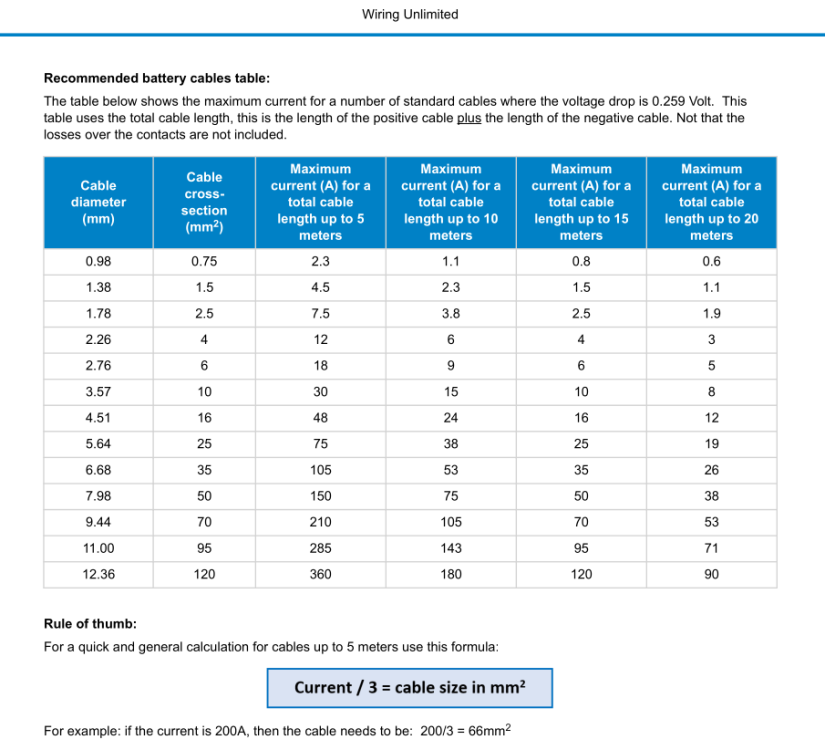
So then, just to confirm: If the cable core (copper) diameter is ~8mm, that gives a cable cross sectional area of ~50mm2 according to the Victron table that I provided in my last post. If that is correct, than according to the Victron Toolkit app, at 24V and 2.0m total cable length, a 100A current will result in a voltage drop of ~0.7V, which should be acceptable - but I will stand back and let a qualified electrician confirm this.
-
And still you don't have an answer - likely because you have still not confirmed the current you will be running through the cable (as @Kalahari Meerkat asked), or the length of cable (between battery and busbar or inverter)... Anyway, here is some info that you can use to get an approximation... From a Victron publication titled "Wiring Unlimited: The app referred to above (Victron Toolkit) is quite handy... And here is a lookup table From the same document:

-
This is not my field of expertise, but I would think that if your products are of good quality and value, and your service is outstanding, then Word of Mouth advertising from your clients would be much cheaper (free...) AND much more effective than any online marketing. I tend to skip anything that remotely looks like marketing online, and if it cannot be avoided then I ignore it. It really amazes me that companies would spend huge amounts of money on advertising online, and then treat their customers badly by not responding to inquiries, not honoring warranties, and just simply not be absolutely honest with their clients. One negative report about such a business in Hello Peter, or in a post in an online forum such as this (see e.g. this link https://powerforum.co.za/topic/30787-pylontech-swollen-batteries/ ) can undo any amount of paid-for marketing.
-
We really suffered in the Free State when we experienced the sh**ty unseasonable Cape Town winter weather the last two months - I'm really glad this is the exception, and not the rule... Even though we dropped down to -2 - -3 degrees the last few days, clear winter skies still allowed for very good yield this past week. Regarding night-time heating, the only practical solution would be to store heat (electricity) during the day for use at night. I also like the idea of building a "sand battery" heater, but unless one is prepared to make a large container with sand a feature of your living room or study (or bedroom...), there is no practical way to a) store the container out of the way while it is "charging" during the day and b) moving the container around to where it is needed whilst hot (and heavy...). One practical method would be to use an oil-based radiator heater (like they use(d) in schools and hospitals), have the large sand battery located outdoors, and run a heat-exchanger type system between the radiator heaters and the sand battery - quite possible, and relatively easy to construct, but expensive.
-
This could turn into a very interesting discussion... My thoughts: One would obviously have to consider daytime (good solar harvest) and nighttime (and bad solar harvest daytime when e.g. it is very cloudy or raining) separately. Daytime with good yield: Simply use electricity generated by your PV. This assumes that your system was properly planned and "over sized" for this eventuality. I switched on my 2kW electric blower heater at 08:30 this morning, and just charged the batteries a little slower. Currently (11:00) my solar harvest is just over 5.3kW, and I'm comfortably running both my 2kW geyser and the heater from solar, and a 8000 BTU inverter type air conditioner set to heat whilst still charging the batteries at a low 640W. Around 12:00 the heater will be switched off so that my wife can use the stove (the batteries will be fully charged by then). I planned for this when I designed my system larger than normal (12kW inverter), and even though the ROI might not be as good as some people would like it to be, I am enjoying the "luxury" of being practically off-grid and warm during the cold Free State winter 😁 Daytime with bad solar yield: We use the gas heaters. Nighttime: Now this is where we can have a serious discussion about draining the batteries vs running the risk of not having power if there happens to be an electrical outage or load shedding the next morning... and where the esoterics can be thrown around 😉 (How about a "sand battery" heater?). We have under-carpet heaters in the house that are run off the battery for an hour or so at night if really needed, although I don't like to drain my batteries lower than 50% SoC. Looking forward to inputs from other Forumites...
-
I am quite aware of the calcs... Guess you did not see the word "acceptable" before the voltage drop... Not serious, though - what is important is the fact that an acceptable drop of "x" % in a 12V or 24V system is a much smaller number than the same x% drop in a 48V system, and one should thus not solely rely on the four "factors" that you mentioned, but should also take into account the voltage of the system that the cables will be used in. As an example, if a voltage drop of (say) 1% is acceptable (and I know this is not, but makes for easy calculation...), then on a 48V system this would be 0.48V, but on a 12V system it would be only 0.12V, and if you had a drop of 0.48V on the 12V system the inverter or BMS would surely complain...
-
And perhaps an "E" for Acceptable Voltage drop. An acceptable voltage drop of (say) 1% on a 24V system will be much less than a 1% drop on a 48V system, and one might have to use a thicker cable on a lower voltage system with the same current (depending on cable length and resistance). Solid advice Gerhard 👍
-
... And, of course, if you are primarily interested in saving money, and if you pay "peak" and "off-peak" rates, then it makes sense to only switch the geyser on during the "off-peak" times. Once you can generate your own solar electricity then obviously your geyser should be switched on during good sunshine periods when you are generating free electricity, and off at night and/or during heavy cloudy days when it would require grid electricity. Most of us on this Forum are probably in this latter category of users. My geyser is set (through the smart controller) to switch on at 10:00 and off at 14:00 during winter with normal good weather, but I manually change this via my smartphone app as required to make use of any sunshine and/or bright indirect lighting. Tell us a bit about the company you work for - how do they manage home energy?
-
Hi Emma, and WELCOME to the Forum. You already have two options for your geyser - I am controlling mine via a CBI Astute smart controller such as this: https://www.voltex.co.za/product/cbi-astute-smart-controller-asc-wifi-enabled that works via Wi-Fi. As long as my home router is on, I can access the controller from work and switch the geyser on or off as I like. I can also check the power used for the day, and check daily historical power usage for some months. Best way to learn is to ask questions right here on the Forum.
-
Apologies to @Deanos for all the confusing posts - we do tend to dive in deeply, and forget that there are also "normal" people on the Forum... You do have a challenge finding the Goldilocks system that is "just right" for your unique situation: You already have a 24V PWM type inverter, and that does not work well with your modern high-power solar panels Upgrading to a modern hybrid-type inverter than would work well with your solar panels will require a 48-52V lithium battery (very expensive...) AND perhaps two more solar panels of the same type, and facing the same direction - you have confirmed that this is not a viable option Adding another battery or two would work if you are prepared to charge them from the grid, especially in winter, but this will be rather expensive Buying a simple generator to charge your existing batteries would also work, but would again be costly. I had such a system with my old 24V 2.2kW original inverter that I ran for nearly 10 years without solar panels, and that worked perfectly for me. My inverter was powered from a normal mains plug socket, and whenever I wanted to charge the batteries (I still had a bank of 12V lead-acid batteries) I would just plug a lead into the generator, and plug the inverter into the other end, and everything worked fine. Can I just bug you with one more question/suggestion: Looking at the two photos that you uploaded, there appear to be sufficient space for one solar panel in landscape orientation across the center section of your house above where your two panels are currently mounted. Judging by the size of the panels in the photo, you should easily be able to mount two panels either side of the center ridge. If this would be possible you would be able to upgrade to a 3kW, or even 5kW inverter with 4 solar panels if you buy just two additional units of what you currently have. This will be more costly than the additional battery, or the generator options, but will save you money in the long run by putting your study completely "off grid", and even supplementing the rest of your house - think about it...


