RikH
Members
-
Joined
-
Last visited
Everything posted by RikH
-
That's what I'm doing as well at the moment. You can read more here. About your plans concerning the 18650 batteries I was on that course as well. Learned a lot from secondlifestorage. AFter a while I came to the conclusion that it was simply to much work and changed plans. Now I'm still building my own DIY battery but with new LiFePO4 cells. Questions: - Are you planning to feed your entire house with solar and battery? - How much PV did you connect to your inverter?
-
Hi Stefan, can you tell us a little more about your current PV system? Just curious, especially for the powerwall. Gruess, Rik
-
Hi Antony, is this floor heating a pure resistive load? That is a LOT! Why do you heat this way for god-sake? 😃 And what is your source? Eskom, inverter? Have a nice weekend, Rik
-
Danny,I cannot give you an answer on all the questions but I'll give it a try: 1). Read @Youda's lab from here. He moved to pylons as well and later on he expanded. Very nice to read! 2). Does your Victron have MPPT inside? What type is it? How much power are you drawing from your system? Rik
-
Well it will as long as you stay on the same phase. So you have to figure out if that is the case in the places where you want to use them.
-
On secondlifestorage you can find a massive amount of info on that. Cell harvesting, testing and discussion
-
NCM because the nominal voltage is 3,7, low cut off 3,0 and max 4,2. That's typical for NCM.
-
Besides that, the methods of mining cobalt, are to put it mildly, questionable...
-
At that latitude I would leave them like that assuming it is lat S and roof NW.
-
Haha, what about esthetics, stormy weather and WAF???
-
This is for LiFePO4. How to indentify... Well it's either NCM or LiFePO4. NCM is the most common for 18650 based batteries like laptops, powertools, Tesla cars and powerwalls etc. LiFePO4 is less common because of their worse weight / capacity ratio. They are mostly seen as prismatic cells but also are there in a lot of other shapes. Identifying, well look at the label I guess... 😉 BTW, here is a nice article about how to get the longest life out of a lithium based battery.
-
In terms of aging from charging and discharging, here is a nice more or less standard charge discharge curve that says it all: What you can learn from this is, don't go below 90% DoD or 3,1V and don't go 90% SoC or 3,45. But as mentioned already balancing takes places in higher regions like 3,55 or even 3,6V so take that into account as well. Now I don't know how and at what voltage these dyness batteries balance but it is important to give them a change to do so after each let's say 10 cycles. And also very important: Do not charge below freezing temparatures at all!
-
Haha yes, but how true!
-
Ok, at that temp your Uoc is 53,13V. Now 500V (max. inverter Uoc) / 53,13 = 9 panels max in a string. 380 Wp x 9 = 3.240 Wp in total. Or: 5000 W (max inverter DC power) / 380 Wp = 13. You cannot make uneven strings so 12 panels is max. Make 2 strings of 6 and parallel them.
-
Ok, yes that's the pdf I posted. Now, in order to calculate the highest Uoc I need the minimum temperature you can expect in winter. Uoc = 48,71V Temp Coeff = -0,3% per degree C
-
This one: db_sm_ja_365-385m_72_jam72s01_pr_5bb_1960x991x40_1200_en.pdf?
-
Forgot to say, so it is not inverter independant....
-
Yes. Especially because you don't want to feed back to the grid, it can't. But in terms of a hybrid, it can blend grid and solar. Nr. 1 is my favorite. No combiner box, no big fat cables, easy and cheap. I have 18 panels with an Uoc of 41,1 Volt. At a freezing 20 degrees below zero that will give a voltage of 874. My inverter (MPI plus 5kW) can go up to 900 so no problem. The PIP-GK goes up to 500 V so dependend on the panelspecs you can make 1 string of 10 or 2 wit 5 panels. Do you know already what panels you're going to use?
-
And this is also a warning; starting with solar and the tech involved can be very addictive! So try to not buy stuff you cannot use when you decide to do everything in a different way or want to expand.
-
Yes. A grid tied inverter will switch off when there is a power failure. So I would recommend @RyanM to think twice before making the decision for a grid tied inverter. When you want to go without batteries you can also consider an inverter that will run without batteries AND without grid power like this PIP-GK.pdf. The advantage is you can still power loads from the sun during load shedding as long as the load does not exceed the power delivered by the sun at that moment. In a later stadium you can always decide to go (partly) off grid by adding batteries without having to buy a new inverter.
-
On all 3 phases? That's 3 x 230 x 1,5 = 1kW = a lot! These inverters draw 80W per phase when idling I remember to have read somewhere on secondlifestorage.com where user daromer has told a lot about his inverter. Anyway, can you see that this 1,5A are going to the battery on the screen or in the software?
-
You can always use the Victron BMV if there is no direct communication possible.
-
Exactly. It looks like they assume all solarpower will be used by the geyser and if that's not enough the grid will supply the rest.
-
These scripts is the best method for switching on and off. You have it running with Fibaro I noticed. My home automation system is running on Hubitat, not sure if there is a possibility to talk to and switch the inverters. How does your hub communicate with the inverters?
-
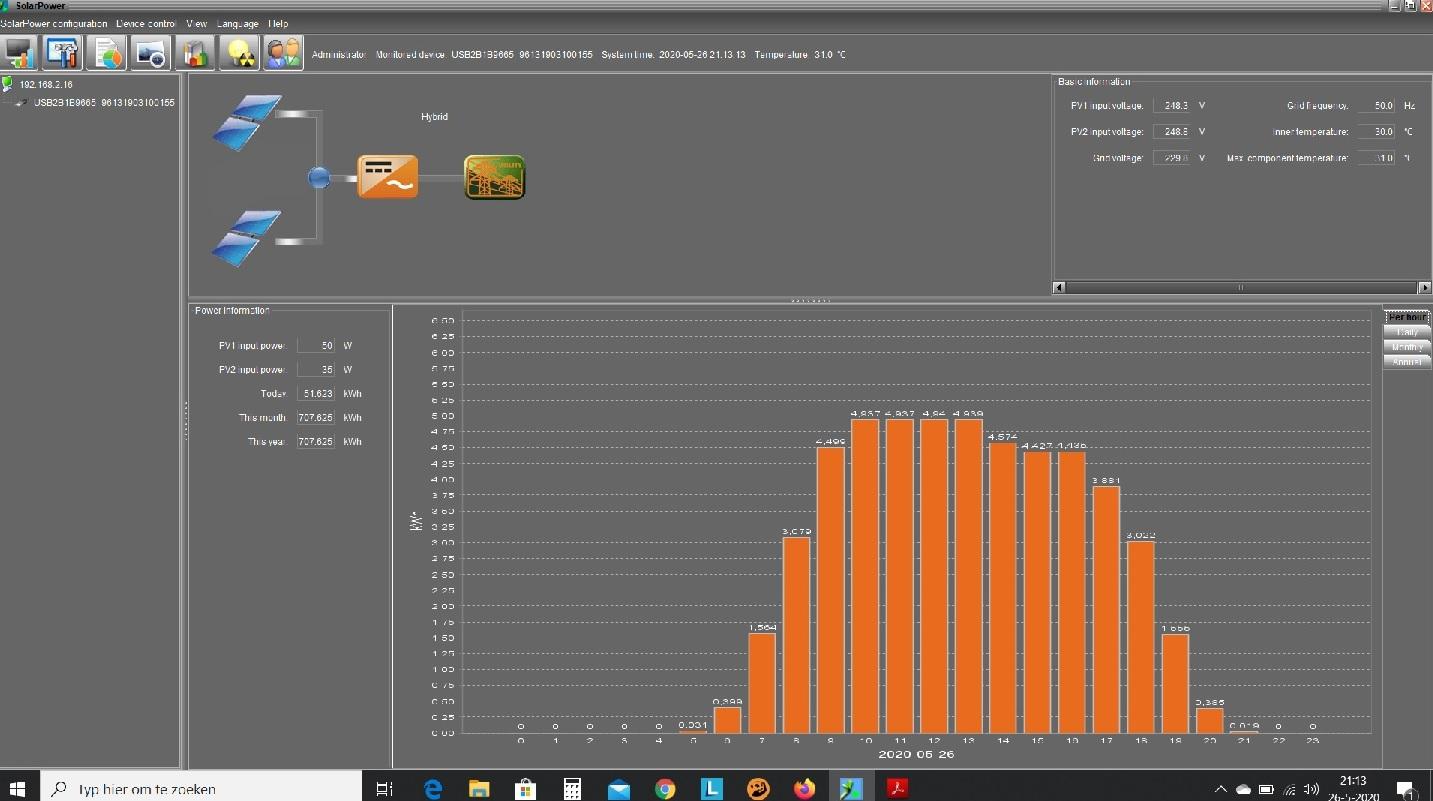
Hi @20VT, yes everything goes well but installation isn't going that fast. The 21st I added 12 of the old 260 Wp panels and connected them to the second MPPT. The inverter is still in grid-tie modus and today was the best day with 51,5 kWh produced! Not bad is it? About the loss of production due to mounting on a porch in stead of a roof I'm not sure I understand what you mean. Panels are on the porch's roof. But yes there is a loss of capacity because of only 5 degrees inclination. Direction is SSW which is almost ideal. Look at this irradiation diagram (is that good English?): This diagram looks upside down for you guys down in SA I guess 😄 but for my location it is suitable and as you can see one can expect 88% of the ideal (which is S at 36 degrees). PV1 = 18*340 Wp and PV2 = 12*260 Wp so in total 9.24 kWp but you can clearly see from the screenshot above the inverter is clipping at 4,95 kW.That's the max it can handle in grid-tie mode. Now we are nearing the longest day of the year it is not that efficient but who cares. It is only Swambo and me that have to live from it.