viceroy
Members
-
Joined
-
Last visited
Everything posted by viceroy
-
Do you have any information on charging batteries. Specifically in high heat environments. I'm asking specifically because my batteries are in the garage which has a mean temperature of 30C, even with ventilation. The batteries I have have an optimal temp range of 20C to 25C where the bulk charge voltage per cell is 2.35V, and the float charge voltage is 2.25V In the battery specs, its stated that at 30C, the float charge voltage should be 2.23V, which is fine, I've made that adjustment, but no mention is made of the bulk charge voltage other than it should be 2.35V @ 20C to 25C. My question is, should I also adjust down the bulk charge voltage to about 2.31V - 2.33V due to the high ambient temps or do they stay at 2.35V?
-
Let me see if I got the logic of this right 48V system * 450Ah (C20) * 50% DOD * 1700 Cycles = 18 360kWh R43 000 / 18 360kWh = R2.34/kWh However I originally paid R21 000 for the batteries which fried themselves, and another R13 000 (in conjunction with the insurance payout) so my current battery bank cost R34 000, and divided by 18 360kWh = R1.85/kWh. This is obviously excluding the new monitor and stand and other bits and pieces. Pretty chuffed with that then, assuming of course my understanding of the calculation is correct.
-
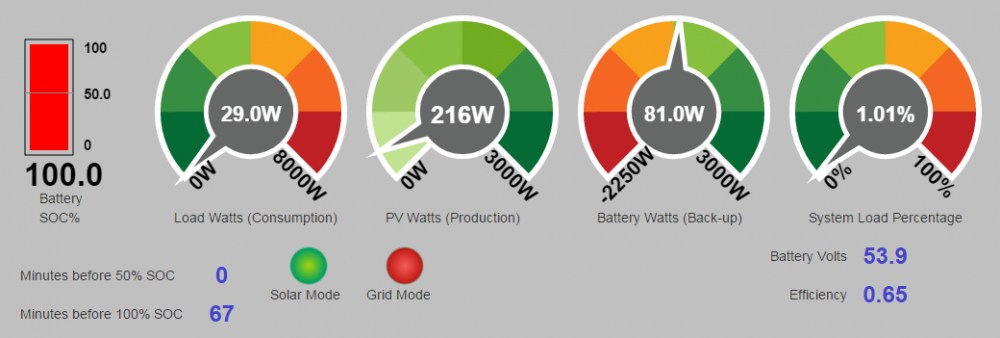
Created a Emoncms.org account and set AICC to export. Since I wanted something up quite quickly for testing, I blatently copied JDP's setup. I really need to get the AC side of things sorted this weekend so I can start testing real numbers.
-
I will do this.
-
Eskom, the impudent child: "You won't give me what I want, so I'll withhold from you."
-
That one also apparently has three wires too. Last point in the specification says so.
-
You could I do that I suppose. I think the pic I posted is slightly misleading as the displays I bought have 3 leads, so the power source for the display need not be the same as the one being measured.
-
I doubt they'll take much, but I will be adding a toggle switch so I can turn them on/off when I want to. Also planning on running them off a standalone 12V 7ah battery, so in my case wont put any drain on the batteries The ones I bought can measure to 100V and cost about R70 each. http://solarandleds.co.za/index.php?route=product/product&product_id=178 I did do some testing of one on various sources (9V batteries at various states of charge as well as a 12V source) and compared to my trusty multimeter and values were pretty much spot on. Claims 1% accuracy, so arguably accurate to within 0.01V. Guess that only trying them will tell
-
Bought myself 8 of these little guys. Going to mount them into a nice box, and will be a nice way to eyeball the voltage of each individual battery.
-
I also experience the same on my Axpert system where the PV is disconnected and reconnected to the MPPT multiple times during dawn/dusk. This doesn't have anything to do with the battery voltage, but more with the voltage provided by the panels. The Axpert MPPT charger has a minimum voltage at which it will accept power from PV. If the PV drops below this voltage, the MPPT will switch to the next source of charging, if any. During the dawn/dusk period, the voltage fluctuates around this cut off, and the inverter constantly switches sources, so I can understand Noobies frustrations. Unfortunately, there is no setting in the inverters to stop this, and short of his idea of a relay the cut power from the PV and a point before the situation occurs, using software is the only way. I got to a point last year of manually disconnecting the PV from the inverters each afternoon around 16:30.
-
Got a bit of work done this weekend in between my normal 9-5 and family commitments. The wood for the stand was cut and fitted, and the whole thing put in place. The DC cabling was shortened between the batteries and the fuse box and the shunt installed in a nice little box. I'll be flipping the box around so the top hole is on the bottom just to hide cables a bit better. *Please excuse the exposed connection in the pic above. It's since been covered with electric tape while I source bus bars. I also moved the inverters down on the wall and began shortening the cables but I ran out of lugs. I also have a new DB box for the AC side of things and a nice little switch over do I can bypass the solar system entirely but still keep power to the house if I need to. Unfortunately I don't have further pictures at this point, but will post once things look neater and I've completed all the new cabling. Finally I got AICC working with the BMV700 on Windows Vista. Not much to report on that side of things since the AC is not connected yet, but it looks to be working smoothly except for some strange animation issues, but the actual numbers seem solid.
-
I still prefer the use of a bus bar rather than the "opposite connect" method when using parallel strings.
-
Are there peak and off peak rates? The only way it would make any sense at all would be to pull from the grid during off peak and put back during peak. Being in JHB, we dont even have the option to do this.
-
For the sake of R2400 (price difference between used and new), I'd go new. Call it the cost of some insurance.
-
I'm glad to hear that. We had an engineer friend come up with the specs for it, so should be pretty sound. I asked him today how much weight he thinks it should hold. His response was "about 2 tons"
-
This should help Update the firmware
-
The new battery stand is scheduled to arrive today just arrived, so cant wait to see how much better and stronger it is compared to that other piece of crap. 5mm steel allround, except the top sheet which is 3mm. Overall dimensions is 950mm x 1150mm x 600mm The batteries will be supported on 114mm x 600mm x 38mm wooden sections.
-
8x Omni Power 12V 260ah Gel/AGM hybrid in a 48V bank
-
520ah C100 and 400ah C10 So which do I use?
-
Exactly, so do I use C10 or C20 C100 rating for this calculation?
-
When sizing the battery bank, would I use the C10 or C20 capacity?
-
I only mentioned the breaker as that's what was there, and I assume only there as a switch rather than some sort of protection. From the breaker to the inverters is about 1.5m at most
-
Where the cable from street enters the propery it is in a box with a 60A breaker. From that breaker it would normally go into the house to the DB board. I intercept it here to the inverters, and then from the inverters to the house DB. I've just phoned the local cable supply company and they only have the 6mm in stock, so that's what I'll get.
-
To this end, the 16mm2 solid core cable I want to replace is the cable from the street connection > Inverters > house. Is the 4mm surfix suitable for the entire trip?
-
You setup the charging individually on each inverter.