


frivan
Members
-
Joined
-
Last visited
Everything posted by frivan
-
Agreed. However, I think some municipalities don't have contracts and are not paying... When will the law of Transvaal kick in?
-
So, if the monopoly is over, who will be subsidising non-paying entities and smelters?
-
You could connect Axpert for essential loads and Sunsynk as grid-tie so save on energy. In outages you will lose out on solar panels.
-
If the Sunsynk controls a grid-tie or hybrid inverter on the aux port, it will still manage total solar pushed back into the house while on grid and it will utilise all solar for the battery while off grid. I suspect your Axpert is an off-grid/UPS type inverter. This means that it can only use solar for downstream loads.
-
Make up a long jumper lead (bridge 4 panels) and test various 4S configurations.
-
Some people have a habit of using hot water for rinsing dishes and washing their hands... Connect the hot water tap to the cold water supply, that solves it.
-
You are contradicting yourself. System design has an upper limit. Domestic expectation implies a limit. If anyone wants to open a tap and expect warm water forever, I suggest a fire tube boiler. @King_M I suggest having the Minister of Hot Water describing her expectation and then deciding on the most efficient solution.
-
If your love does not have limits, you don't have love. Same applies to hot water.
-
Is there a neutral to earth bonding device?
-
In another thread I posted my battery charging. The battery is only used for backup purposes. It charged to 90%, then after 20 minutes the BMS decided it isn't at the required SoC and initiated another short charge.
-
I don't see voltage control and communication as being equal. If a cell in the battery has lost capacity, the BMS can reduce charging rate to accomodate this cell with communication. Without communication, the BMS has to make the battery go open circuit to protect the cell. The latter seems more crude.
-
3.4V, 3.7V... I don't mind but the BMS should enforce the value and protect each cell.
-
True. SOC was set to 90% between 06:00 and 09:00:

-
Gradually over the timeslot, at maximum charging amps initially or how?
-
Manual voltage settings can't beat direct BMS integration. Sunsynk comms does support Shoto batteries. I would set the charge voltages high, and monitor the BMS charge current. Once this gets close to 0A, use that voltage value for the charger settings but still keep the CAN connection.
-
Your settings look conservative compared to the 15s version below:

-
Glad I could help. Just check that the neutral to earth bond is downstream from the inverter and that your earth leakage units still work.
-
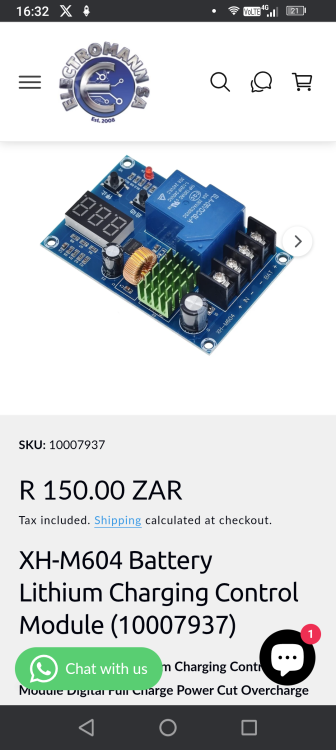
Invert the logic and this relay for charging will work:
-
If the timer requires a higher SoC than what the batter has, grid will be used for loads. If grid charge is ticked, the grid will also charge the battery to the required SoC by the end of the time slot.
-
Slot 2 has SOC 5% higher than slot 1 and requires the grid to charge the battery if it is below 45%. That looks like you are planning to charge the battery a bit every morning. Rather put slot 1 (and 6) higher but leave grid charging off for slot 2. I would also leave grid charging off for slot 4. Slot 5 will do grid charging if need be.
-
Yes. BMS protection should prevent the smoke coming out. Sure, my solution is unconventional and may have less degrees of protection... But measured against what? Please provide better solutions.
-
Remove the battery RS485 comms, set each as master on the dips, then move the CAN cable between batteries to see the state of each one. Set the battery to lead acid and voltage control to utilise all four... What could go wrong?
-
No, this is not worth while. Losses in conversion is insignificant against free solar power. You could make a DC board just like an AC board but utilising DC rated breakers... No earth leakages. You could make a board out of fuses... Or nice big knife switches. You could use control voltages to regulate DC-DC circuits. DC arcing and hot connections are probably the highest risk. I saw a YouTube clip of someone using solar PV directly in the house (I think around 80V DC). If you want to go for higher DC voltages, you can go up to 230V DC and use suitable AC appliances directly. Plugs, switches and safety remains a concern.
-
Run the inverter off-grid and disconnected from the grid-earth until the grid neutral to grid earth voltage is basically zero.
-
Yes, put max battery amps in battery type but reduce amps in battery charge (for grid). If you limit the power on system 1, battery should assist. I would rather build a profile for SOC during the evening and night that meets your backup needs. If grid charge is off and the battery SoC is lower than the profile, grid power will supply the house.


