


PhilFM
Members
-
Joined
-
Last visited
-
-
Hi GregIsh Sorry for only answering now, I will check the invoice details for you and revert a.s.a.p.
-
-
-
-
-
For a start I would say adjust your gas geyser temperature to the desired temperature and not "piping hot". Remember gas geysers heat on demand and does not need to be kept at extremely high temperatures. If you have this sorted, you can only open the hot water tap in the shower and won't need to adjust with cold water, this will then immediately show if your pressure is to low. But I do agree with Thunderbolt, if you only rely on gravity for pressure here, you are going to struggle as you will be needing more than 20m height or some kind of a pressure pump.
-
-
Hagu13, I think you are set up nicely and as you said when there is loadshedding, you can plan for that with the needed SOC Unfortunately for us here in rural Limpopo, infrastructure maintenance is a huge problem so it's almost always a gamble with how deep you discharge your batteries as one storm, one gust of wind, one fart in the wrong direction can mean anything from 1 to 24 hours without grid, and this happens a lot. So I run my batteries from 2am (can probably start at midnight rather), then wait for PV to start up after 6am, charge batteries during the day, which is usually done around mid day on a good day, then we add load as needed to maximize PV and switch back to grid around 5pm. I can extend my night hours on the batteries, but then we have no backup should something go wrong and there is a rainy day or two. Here in the Lowveld it gets seriously overcast some days, we had two weeks now with very little sunshine and lots of rain, but we do not complain as we are coming from a severe drought. Unfortunately it is under these conditions (wet/damp) that we experience most of the grid cable faults, potentially leaving you without grid for a long time. All this said, it basically just comes down to different circumstances, there is no one correct answer for everyone and it seems you understand your needs and risks well and plan/run your system accordingly
-
-
I think you are at a good level currently, given that your panels are able to recharge completely during the day and you do not need grid power to do so
-
Picture of the mounting system used, worked really nicely on the IBR sheets

-
A quick update on this project So we installed another US3000, making it a total of 3 of them as well as installing 6 more panels. The extra panels is not really needed to carry extra load as we managed well with only 6, but double the capacity just increases the time we can run on batteries at night and charge them up quicker during the day, as well as stretching a few more watts at the end of the day. We find we are also now going to be able to switch the old "heavy load" circuit to the inverter and just balance our load more during the day in order to now use the solar for the washing, coffee machine etc. Have been running these loads off a lead from the other circuits just to test and the system is really doing well with the extra loads. We are learning more and more every day about how our consumption works and where we can improve and balance loads a little better Some pics of the new equipment installed
 Really looking very neat. Makes me want to redo some stuff on my install 🤐Mine is also not that old, but I doubt it will change, might become worse as I love to tinker 🤣https://www.gntc.co.za/products/solar-4-string-combiner-box?_pos=2&_sid=60b7785af&_ss=r Contact Geoff, he is always a great help and best serviceHi John, easiest way is to connect with a combiner box, this will already have the parallel connections in as well as fuses for every string. They also include a DC breaker. I attach a photo of my setup. This combiner box is for 4 strings. 6mm Solar cable will be sufficient
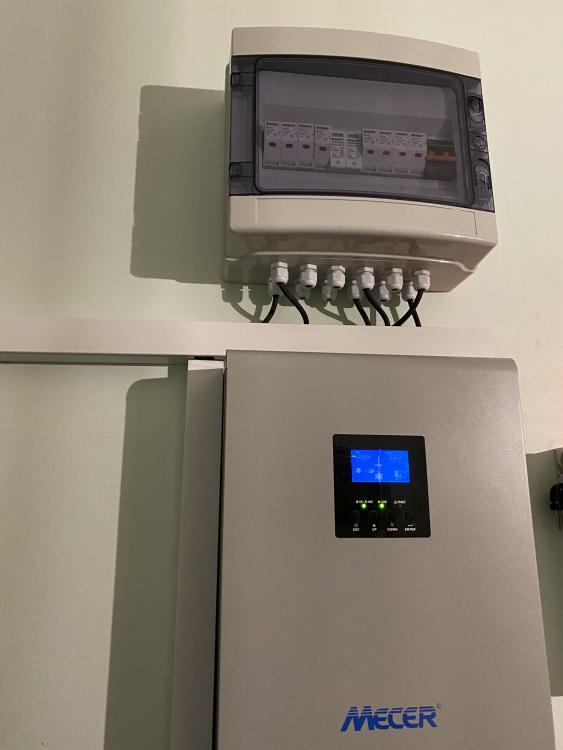 Cuzz, what inverter are you running?Hi Cuzz No you need to connect 1 to 0, see attached
 Swartkat, yes I agree with those figures, but Voltage under load will read lower if I am right, and that would be the voltage the inverter uses to determine when to switch back to utility So what I am basically saying, voltage on a battery not connected to anything will be higher than if it was under load. Same thing as you will see with your panels, no load, high voltage, the higher the load gets, the lower the voltage gets


