PsyCLown
Members
-
Joined
-
Last visited
Everything posted by PsyCLown
-
Yes, majority of 48v inverters will work fine with the 51.2v batteries. Reason I would recommend the 16 cell batteries is because they are more common so finding another battery with 16 cells later on is more likely. You can also add another 16 cell LiFePO4 battery in parallel if need be (maybe not with comms though). There is also the slight increase in capacity, although this does not make much of a difference I feel but it does add up - especially with multiple batteries. For example with my 3 batteries that is an additional 0.34kWh per battery and a total of 1.02kWh so it can help provide a little more usable capacity.
-
So according to the spec and considering you have 3 batteries. Max discharge rate would be 450A and max charge rate would be 240A - both very high figures and chances are your inverter is not even capable of reaching the 435A discharge limit (435A x 51.2v = 22.2kW). With that being said, it may not be a bad idea to adjust the discharge rate (not the same as the limit) to a lower rate to help prolong the life of the batteries. The higher the charge & discharge current, the more strain it puts on the cells and in turn reduces their lifespan. With 3 batteries and a single inverter you have the benefit of the load being split between the batteries.
-
My first thoughts was also a thermal paste of sorts, although that does not make sense. Perhaps it is more of a fire retardant paste? With regards to the temps, well, not too much one can do about that here in South Africa. Unfortunately it gets hot here in summer and a lot of people (myself included) have their equipment installed in their garages and my garage gets really hot - I even installed an extraction fan to help remove hot air from the garage and draw in some cooler air and allow for some air movement within the garage and this does help a little but temps still get uncomfortable at times. My view is that you can only do what is reasonably practicable, installing an aircon in the garage just to keep the inverter and batteries cool does not make sense as the electricity cost will be far greater than a replacement battery would be over a few years. Not to mention the initial aircon purchase & installation cost. Fans only do so much, bringing the temperature below ambient temperature is unlikely. Therefore, it is just what it is and having multiple batteries and/or reducing the loads and strain on the batteries will help keep them cool and help extend their lifespan. With all of this being said, the lifespan of you Akkutech battery does not seem right, way too short of a lifespan. Also is the area you keep your batteries in reaching 45C? That is really hot! I can believe the cells could reach 45C for a bit while under a heavy load for a bit of time but that is unlikely to be for extended periods of time. Similar concept to taking your car to redline every now and then vs driving it while its bouncing off the rev limiter constantly. It is not continuous heat or strain on the battery. My batteries do have some vents in the enclosure to help allow for hot air to escape, how much of a difference it makes I am not sure. It does not bother me all that much as there is little I can do about it high temps are not constant.
-
I can recommend the Svolt batteries, I have 3 of them and they have been working well so far. They also make use of the Pace BMS like the Freedom Won eTower, although Svolt make use of cells which they manufacture themselves - not sure which cells Freedom Won use in their eTowers. Freedom Won do seem to be of good quality but are not the cheapest, I recall the eTowers being their cheapest battery though. I purchased my Svolt batteries from Snaga and would recommend the 51.2v (16 cell / 5.43kWh) batteries over the 48v (15 cell / 5.09kWh) batteries: https://www.snaga.co.za/product/svolt-51-2v-106ah-5-43kwh-lifepo4-battery-wall-mounted/ Another battery worth considering I feel is the BSL Batt, I saw a special on their pricing recently but I have yet to find a quality battery cheaper than Svolt. I personally would not purchase a CFE, Nenergy, Hubble, Shoto, Pylontech or FiveStar battery. I have heard, but cannot confirm, that the Volta batteries still experience issues with charging after a couple of months even after the new firmware update - lots of people with Volta batteries so I guess we will hear in a few months time if the charging issue is still a real problem or not.
-
I would not recommend waiting for the Sodium-ion batteries, go with LiFePO4 for now as 3 to 5 years is still quite a long wait and new products are often priced at a premium price. You can look at replacing your Lithium batteries with Sodium batteries in around 10 years time when you are due for new batteries. By then we'll have a better idea in terms of performance and pricing as well. I feel you'll have wasted a lot of money in the next 3 to 5 years if you buy lead acid batteries. Lithium batteries are not badly priced at the moment. 24v 106ah lithium batteries for around R10k is pretty good I feel and keep in mind you'll be able to get more discharge out of a Lithium battery compared to lead acid (80% DoD vs 50% DoD), you could even push the lithium battery a bit further and it will handle higher current better and obviously take significantly more cycles. (6000 cycles vs around 150 to 250 cycles for lead acid).
-
So I do have take load together enabled (PV & AC). Yes, I cannot tell the direction of the flow - so cannot confirm whether it is feeding back or not, however the issue is with some meters if you feed back you get charged as if it were usage. If this were the case I expect to be able to see a difference when I adjusted the CT offset - as mentioned it was on 20W by default. I changed it to 199W and then to -199W (basically the 2 extreme ends) and did not notice much difference in the reading so I set it back to 20W as per the default. Yes, power factor needs to be considered but there should not be any load. Getting a reading of over 3A seems quite high and unlikely? I could try again this coming weekend and reduce my loads, these are my normal loads and they are generally high - my geyser was on which added to the load and brought me over the PV limit. I could check again with the geyser off and can turn off some devices to bring the load down. I am on postpaid with a smart meter but never received my CUI, I must still go to Eskom to get it - although not sure how much info is visible from the CUI.
-
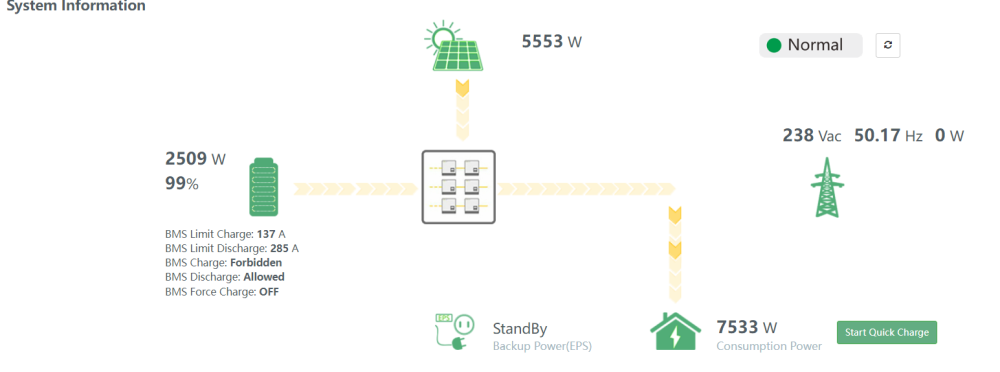
Hey all! So something has been bugging me about these Luxpower inverters for a while now, today I finally decided to investigate a bit further and this seems to have confirmed my suspicions and its quite frustrating... I have a voltage protection device connected before my inverter circuit breakers (where Eskom gives power to the inverters). The voltage protection device allows me to see the voltage & current in realtime. I noticed a couple months ago that even when the load for the house is being carried by PV or if I am running on PV & Batteries, there is always current draw being displayed on the voltage protection and this current draw figure varies from time to time and is anywhere from 2.8A to 3.8A when there should be no draw from Eskom. So I decided to stop being lazy and investigate further. I removed the cover of my DB board and used my clamp meter to assist me. Now I do not expect either the voltage protection device or my clamp meter to be 100% accurate but I do expect them to give me a fairly accurate reading. I understand the clamp meter is probably less accurate in this instance. So before I started this test, I ensured that my inverter settings were as such to force the inverter to use PV & Battery only, no grid usage as per the below screenshot. So below you can see a comparison of the clamp meter & voltage protection device both detecting current. One reads 3,9A and the other 4,5A - this confirms to me that there is definitely current flowing So I gave the Luxpower inverters the benefit of the doubt, maybe the voltage protection device is somehow consuming the power... although it seems a bit odd, lets try confirm this. So I turned off the breakers giving Eskom power to both my inverters and suddenly there was no usage displayed on both the voltage protection device & my clamp meter as can be seen below. Now this does concern me and puzzles me a bit, I can understand that the Luxpower does not have an external CT coil and you have the CT coil offset to assist with calibrating it. By default mine was on 20W, I adjusted this (after I turned on the breakers, so my inverter had grid) to 199W and then to -199W and I did not see much (if any) difference to the readings on the voltage protection device or the clamp meter. If we call it an average of 3,2A, since this is basically 24/7 that usage adds up quickly. 3,2A x 230v = 736W 736W x 24 hours = 17,66kWh per day 17,66kWh x 30 days = 529,8kWh in a 30 day month... Its a significant amount. To be fair, this would not all be offset by solar anyways, there might only be around 7 hours in a day where this usage is offset by solar. 3,2A x 230v = 736W 736W x 17 hours = 12,51kWh per day 12,51kWh x 30 days = 375,3kWh in a 30 day month... A potential loss of 154,5kWh per month because of this. At around R4 per kWh on the higher tier, this works out to around R618 per month. So now, does anyone know why the Luxpower does this? Why does it draw soo much from the grid when the loads should be covered by PV or PV & Battery and it should not be drawing from the grid? Also does anyone know whether the same is applicable to the Sunsynk/Deye inverters & Solis inverters?


-
Awesome! Please let us know in say 6 months time whether you have experienced any issues or not, the common issue being the SoC not going to 100% or the inverter not being able to / wanting to charge to 100%. Seems to be BMS related this issue, apparently fixed with a firmware upgrade but people say its still a problem over time even after the firmware upgrade.
-
Gobel power make "DIY" type of batteries and options can vary - they can use different brands of cells and different cell capacity too if I am not mistaken. Companies like Hubble, Freedom Won, Fivestar, BSL, Svolt etc. are more on the already built side of things, the cells are generally not changed out to different brands of capacities. Some of the manufacturers will share what cells they use, I think Hubble shared this info a while back and Svolt use their own Svolt cells. Majority of batteries use the Pace BMS, this includes the Hubble & Svolt batteries. Some like to keep things more of a secret for whatever reason. Not knowing what is inside the battery isn't great but for the average consumer they do not care as long as it works.
-
PWM or MPPT controllers would both work to use the solar panels to charge the batteries. I assume they are 12v batteries and run in parallel? https://www.victronenergy.com/solar-charge-controllers I think the smart solar controller would work well for you. EDIT: MPPT would be more efficient than a PWM charger although cost is a little higher. I'd spend the extra money and get one of the Victrons as it offers a decent amount of features.
-
Congrats! Please do let us know how the battery is once you have had it installed! What inverter is it going to be paired with and what battery do you currently have?
-
Yes, please do! Will be nice to have that info available. If it really is that bad with little to no tilt, then I guess I will need to make a plan to tilt them and must double check how many panels I can fit on my roof. Perhaps look at 6 additional panels instead of 8.
-
Do you have some panels with a better tilt angle which can be used to compare against the relatively flat panels? Like, how much power is being lost due to the lack of tilt angle?
-
Nobody have any feedback or comments on this?
-
Hey all! So just want to run this idea past you guys before I decide to take further steps. I am wanting to add some more panels to my setup, roof space is limited. I have a flat concrete roof, so current panels use A-frame mounts and are held down by concrete ballasts. Since it is a flat roof and panels are tilted, they cast a shadow which further reduces usable space, especially considering there is bunding around my roof - being a flat concrete roof. So I was thinking of trying to add an additional 8 panels to my roof and to help create space and reduce the risk of a string of panels casting a shadow on the panels behind them I was thinking of laying them rather flat, although still elevator off the roof - since I am based in Johannesburg the wind is not as hectic as it is in Cape Town but I do not want my panels to have a chance of flying off if there is a strong gust of wind. I was thinking of keeping it simple, purchase the concrete ballasts and use some drop in anchors and use that to secure the aluminium rail to the ballasts and use multiple ballasts per alu rail for weight and then lay that down on my roof and secure the panels to the rails as per usual. This would also lead to some cost savings as I would not require the A-frame brackets. I think this could work, just looking for some additional feedback - comments are welcome
-
Inverter, battery & panels would come to around R52k to R60k depending on brands and each supplier would have slightly different mark up. There would then be costs for the labour, switch gear, cables, panel mounting equipment and sundry items and this would vary based on each install and situation. I'd reckon you're looking at a minimum of R20k upwards and R20k is definitely on the cheaper side. So R90k to R99k is not unreasonable but you may be able to get a contractor to do it for a little less. Whether its worth trying to find a contractor who offers better pricing is up to you, you definitely do not want them to cheap out on the switch gear or cables or avoid having certain protections in place such as AC & DC SPD's, E/N Bonding etc. The link is a good price, adding an additional 2 panels should not increase the price by an extra R15k+ though.
-
Hmm, best option is kind of up to you. There are pros and cons to each option. Selling the system and buying a Sunsynk inverter & new batteries and panels will likely be the most expensive option. However the Sunsynk offers a bit more than the Axpert inverter I believe. End of the day, what will you actually be gaining for the extra money and is it worth the amount of extra money spent? Adding a 2nd inverter in parallel will likely be the cheapest option and will offer some redundancy incase one inverter dies you at least still have a system in place, albeit with limited output compared to what you want / need. Replacing the current inverter with a larger Axpert is a reasonable option if you do not want to take up additional space with a 2nd inverter and this offers slightly more headroom compared to 2x 5KW in parallel and a fair bit more compared to the 8KW from the Sunsynk. I decided to go for 2x Luxpower SNA5000 in parallel and this was due to budget reasons. 10KW of inverter for around R22k is pretty good value for money I feel, when compared to SunSynk, Solis or the crazy expensive Victrons. With that being said, sometimes the cheaper inverters do not have the same functionality of the more expensive inverters - some people are fine with this and it does not affect them and for others it can be a bit frustrating at times. So end of the day, you need to weigh up the pros and cons and decide what is most important to you and what makes sense to you. All 3 options are good options I feel. Selling your batteries will lead to more money being "lost" and having to fork out more money to purchase new batteries. I would personally suggest Solis or Deye over Sunsynk and a different brand of battery - perhaps Svolt or BSL Batt if you decide to go this route.
-
Congrats @Marius Halgryn Not going to lie, I am very jealous! Enjoy the battery. My fingers after keeping them crossed for so long (not actually my fingers)

-
I used a contactor, when there is Eskom the E/N bridge is not connected and when Eskom drops then the Earth & Neutral is bonded. So a contactor which is NC, when the coil is energized (Eskom grid is available) then then it is open.
-
I do not have first hand experience with the Volta batteries but have recently seen people complaining about them again and having issues with SoC and the battery not taking charge after the firmware update was applied previously. If you do not want to go Svolt, I saw that BSL Batt is doing a bit of a special on some of their batteries and I have not heard anything bad about the BSL batts and I personally would pick BSL Batt over Volta and pricing is similar to the Volta at the moment. BSL Batt: https://www.diygeek.co.za/product/bsl-battery-51-2v-3u-100ah-canbus-5-12kwh/?utm_source=Google Shopping&utm_campaign=All Products&utm_medium=cpc&utm_term=21967&cmp_id=18046938637&adg_id=&kwd=&device=c&gad_source=1&gclid=CjwKCAiAlcyuBhBnEiwAOGZ2SwKmoWwJd2Jsni-6Eug2AQoxHbJd-tx2_puCei6CZrGkzpf5jEUUkBoCtjwQAvD_BwE Svolt Battery: https://www.snaga.co.za/product/svolt-51-2v-106ah-5-43kwh-lifepo4-battery-wall-mounted/ I have not ordered from DIY Geek before but have heard others on the forum have before without issues. I have personally ordered from Snaga before and all was good and went smooth.
-
@Powerforum Store Who is the winner? My heart can't take the suspense anymore and keeping my fingers crossed is starting to hurt.
-
@FFJG Do you know how the panels are wired? Are they all in series, all in parallel or 2S2P? If they are all in series, its possible that the current is exceeding the 40A limit or perhaps its getting very close to 40A and the breaker is a bit sensitive.
-
Haha, all good man. Thinking back to when I had to put a claim in around 2018 I think due to a power surge from Eskom which blew some of my equipment I also had to take the equipment in for assessment and both assessments stated that it cannot be repaired and then insurance paid out. So I guess in theory it is as simple as getting someone in to assess, give a report and I feel that if repair is possible but parts are not available then the fact that parts are not available should be stated. A garage door motor is part of security for ones house and if there is a break in due to this then insurance have another claim to fulfil and I'd push back to get a new unit based on this. Unfortunately it would likely be a bit of a fight but sometimes one needs to fight to get what is expected.
-
Haha, yes - higher end Inverter & cheaper batteries. Not knocking the SNA5000 due to its warranty, what bugs me more is this fuse issue and the transfer time. I have heard transfer time does increase when you parallel the inverters so might be the difference between your situation and mine. Also the design aspect with the fans not running at night when you are running off grid only until temps reach a certain setpoint (which is high). I have had to add some extra fans to keep my inverter temps down at night when the inverter is basically sitting idle. Heat is never good for electronics. During the day when there is a high load on the inverter the inverter temps are lower than at night when the inverter is sitting idle and just passing Eskom power through to the house. This does not make sense to me and decreases my faith in the inverter. I have been monitoring my grid frequency & voltage around loadshedding time and it has never been an issue like in your above screenshot. I experience the same issue if I turn off my Eskom mains breaker - the lights still flash & fuses can pop. I suspect the fuses blowing is possibly due to the transfer time being a bit slow but cannot confirm this. I also had the misfortune of having a 4 day old SNA5000 blow on me, I eventually managed to get a brand new replacement but it took 4 weeks and having to go to the distributor and speak to them and explain the situation. I understand out of box failure can happen (not quite out of the box in my situation) and the same could happen with just about any other inverter brand out there but that also did not leave me with a lot of faith in the inverter. When I was at the JHB Luxpower distributor I was speaking to the one guy there and he said they had quite a few warranty claims on the Luxpowers, most due to incorrect installs and also voltage issues due to loadshedding. It seems as if the Luxpowers can be sensitive to under voltage / over voltage and he recommended a under/over voltage protection device and another installer told me that his supplier would force you to purchase a OVP/UVP device with the Luxpower otherwise they would not honor the warranty - despite me not having voltage issues in my area I purchased such a device for added peace of mind afterwards. As I have said, apart from the above mentioned issues and concerns my SNA5000 inverters work well. They are loud with the fans but in my garage its less of an issue. Functionality is great, easy to integrate into Home Assistant too. Probably the best budget inverter with some "smart" functionality. As for the Svolt batteries, I do not feel Volta is a high end battery and their pricing does not say this either. I also have no clue who manufacture the cells in the Volta batteries. Svolt manufacture their own cells for their batteries, they are a larger cell manufacturing company and have secured a contract to supply BMW with cells for their upcoming EVs. I have no reason to doubt the quality of life expectancy of my Svolt batteries and I will happily purchase more Svolt batteries once funds allow and I have added more panels to my system. I have dealt with Svolt support and they are fantastic and a warranty claim would not be an issue. I see the Svolt warranty as a no nonsense warranty, no need to jump through hoops and I would rather have a 5 year warranty where I know I will get a replacement battery under warranty if need be vs having a 10 year warranty where they may look for loopholes to get out of a warranty claim or not want to honor the warranty due to "incompatibility" between the inverter & battery or because I did not use comms between the inverter & battery or some other BS. Based on my experience, I have faith and trust in Svolt. I do have my concerns regarding my Luxpower SNA5000 inverters and those concerns are listed above. I am simply providing feedback based on my experiences and what I have heard as well. I own a SNA5000 and Svolt batteries. I am not saying that I would never recommend the SNA5000 inverter as that is not true, value for money it is a great inverter but I would definitely recommend having an OVP/UVP device in place if not just for peace of mind and that one be careful with what panels you pair with it. With a 2.5 year warranty and being roughly half the price of a Solis S6 5KW and SunSynk 5KW inverter, if it dies after the 2.5 year warranty is up you could buy another Luxpower and be sitting at the price of a Solis S6 or Sunsynk. So for someone in a budget, it is still worth considering but there are some things to take into consideration first I feel. Rather go into it knowing the possible issues you may experience and make an informed decision.
-
Only if your entries goes towards me!