Gnome
Members
-
Joined
-
Last visited
Everything posted by Gnome
-
------ P = IV P = 110A * 0.14v = 15.4 watts P = IV P = 50A * 0.062v = 3.1 watts P = IV = 110A * 0.27v = 29.7 watts Most of the "professional" installations I've seen run even more than 1 meter of wire between the battery and inverter so I put the 2 meter cable there too. --- Lastly because @JustinSchoeman claims that the German inverter, namely Victron are "sensitive" to voltage drops (of 0.14v, doubt) and that is why they recommend thicker cable, here is ANOTHER German inverter company, except they don't use a "low frequency" design. SMA Sunny Island inverter. Apparently if you buy an inverter in China the physics are just different than if you buy an inverter in Germany 🤷🏻♂️


-
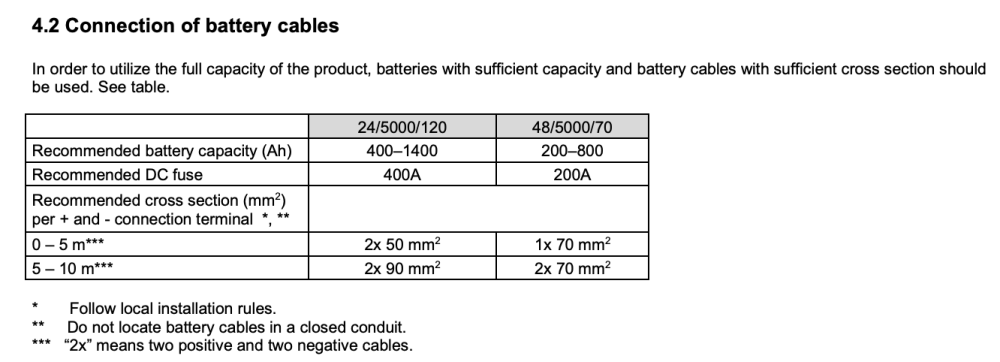
CoC is self reported by people who often have no more than a high school diploma (if that). You can get a CoC for any installation. And a quick look at theforumsa where electrical installers post pictures of CoC'd installs shows just how bad it can get. Source This is from the 5kVA installation manual for Victron Multiplus II. Basically what you are saying is, I know more than the engineers who designed this product. You've never seen an installation done according to what the manufacturer recommends for Victron? Arguing with you is like punching a brick wall, you've come to a forgone conclusion and you are quoting SANS standards intended for low voltage AC installations (ie. 220v) as if they are applicable to extra low voltage, high current, DC battery systems. You debate based on personal anecdotes and "evidence" like "well it hasn't broken yet"/"works for me"/"everyone has <...>"/"nobody has <...>". At least use datasheets from reputable companies or research papers to substantiate your claims. As far as I can tell your entire approach to advise on this forum is based on personal dogma rather than scientific method backed by qualified individuals.
-
Batteries are an ongoing chemical reaction, this is not like buying a tool and you get a good one or bad one and then you are set. Batteries fail on a curve and the curve is strongly dictated by the chemistry and cycles. So essentially you are betting that those batteries will last their 10 year stated life or be replaced during that time. Downtime is also a factor in that 10 years. I use 10 years because with LiFePO₄, 10 years is actually a pretty good life expectancy. If you lower your expectations and factor in that they probably won't honor the warranty later in the life of the battery then that is fine (or not be around anymore), but I'd be careful naïvely assuming it is a just all well now. Car companies like Tesla have also started opting for LiFePO₄ because of the longer life. This is much more akin to buying a new VW and it uses a lot of oil, you take it to VW, they say, no this is acceptable and once the warranty expires the engine is completely buggered. (this actually happened with some of their TSI engines)
-
I did use this guy's tutorial as a reference: https://www.saminiir.com/lets-code-tcp-ip-stack-1-ethernet-arp/ In 2001 would have been much harder, these days everything is very well document. For example, on wikipedia I was able to get the layout of each layer's packet which makes it pretty easily to code And really the code was far from perfect, ie. Aruidno had 2k or 4k of memory or something. So you can pretty nearly only fit 1 or 2 frames of memory in RAM (that ethernet "controller" is barely a controller. It only implements layer 1). So out of order packets I just ignored so that they'd be retransmitted 🤷♂️
-
I wouldn't use an Axpert in a solar configuration. Their UPS are great and arguable better than many other brands even. It is where they came from, they made UPS. ie. if you compare to a Sunsynk, the Axpert accepts a wider input voltage. They offer more options in terms of change-over time (ie. Axpert King can run in double conversion mode). UPS is their strength. I would be hesitant to go so far as say Sunsynk or Growatt is better in UPS capability. I haven't owned a Growatt but Sunsynk for example would be a downgrade for me from the UPS point of view (which is how I'm using my Axpert). In my opinion, the Axpert MPPT is not worth it (or PWM, or any of their "solar" offerings) for use in Solar. Great as UPS, bad as a Solar. I mean it work(ish). But people who have had their Axpert inverters blow up were all running in Solar. Their engineering margins for the MPPT/PWM components seem to be really tight causing them to run at the limit and not last. Just to be clear, I wouldn't buy another Voltronic UPS, I would still buy a Voltronic Axpert but treat it as a UPS. (Voltronic is the manufacturer, full circle solar and whomever else just make a big order and then get to put a name and logo on it) Lastly the financial outlay for a UPS system vs a Solar system is pretty much an order of magnitude larger. You can get a UPS system as seen here for a good price. A solar system starts at 100k (and I could go into some detail as to why that would be a bottom of the barrel kind of system). It also has a much more significant installation burden. I would just go Sunsynk or Victron if I were to go solar. I don't really trust these other brands for that sort of thing.
-
This is one of the big issues on the Daly if I'm not mistaken, it actually only "balances" one cell at a time by burning some of the current as heat (and small amount at that).
-
Definitely more generic solution, so I still think it is the way to go if it is stable! Honestly, I've needed that with any ESP code I write. The ESP, due to their network stack (which they wrote themselves), is not the most stable. The ethernet stack they write in code (any arduino for that matter) adds a lot of stability problems to Arduino. The stack isn't very mature, too few resources and so on. (I could talk hours on this. I wrote my own implementation of TCP for learning using an Arduino UNO and ENC28J60 and it just brought to bear the complexity and problems of the space in embedded) What is your poll interval?
-
I'm confused, are these Lithium cells or lead acid cells? They look a bit like lead acid. Where did you buy them and at what price if you don't mind my asking? Some thoughts: Daly are not great BMS. You have what you have, so I guess that ship has sailed, but for someone starting over I'd look at other options. It is kind of bad at everything 😅 BLE is both the strongest and weakest part of this design IMO. It is super flexible because you can easily add support for more batteries. Almost all of them support BLE these days. The weakest being that BLE is quite unreliable IMO, I prefer RS232/RS... based protocol but I think if you can get BLE to work reliable it is much more robust in the sense that it doesn't require creating wiring looms & pin diagrams. Doesn't need to worry about voltage levels, isolation, etc. I'm torn. If I did this I'd start with serial. But I actually think BLE is likely the more universal solution. How reliable are you finding the BLE communication to be?
-
What do you mean it isn't working. Did you buy it this way or did it stop working? If it stopped working you have a more serious problem. You should look if the cable is still correctly attached. It doesn't just stop working and just fix it self with a firmware update. If you bought it this way send it back. Before doing a firmware update your equipment needs to be working 100% else you are setting yourself up for failure. It's a bit like having a computer that doesn't turn on and then saying you should try fix it by reinstalling Windows. It is backward. Get it turning on, then update the software.
-
So to be clear, the OP wants a UPS, not a solar setup. Axpert works perfectly fine for that. I've been using an Axpert in that configuration since 2015. I've also installed Axpert in a couple of family/friend situations for that. And they are sold as power trolleys for a reason. DO NOT use their solar, it sucks, but as a UPS they are really solid https://www.fullcirclesolar.co.za/product/5kva-vp-5000w-unit-vat-incl-copy/ Then battery options: https://www.fullcirclesolar.co.za/product/pylon-tech-li-ion-up5000-battery-pack-vat-incl/ https://www.fullcirclesolar.co.za/product/pylontech-li-ion-battery-pack-3-5kwh-vat-incl/ Goes without saying I trust that fullcirclesolar. I've bought from them a number of times.
-
I said you have posted there, not that you said anything about PBMS. Re-read the sentence 🙄 🤣

-
What does that mean? (legit I've not heard the term before) A bunch of different customers all saying the same thing, what more evidence do you want? You want a Zondo commission? There is overwhelming evidence from multiple people with no reason to come and post it other than getting screwed. Do you see the same kind of thread for other batteries? And yeah, I work for a MAJOR online US store. Let me tell you right now that a single customer reaching out, typically means you've usually had 100+ customers impacted. I'll freely admit the number of people complaining here are probably not a factor of x100, but it is definitely not 1:1. For every person posting here there will be 5 others who haven't posted.
-
I mean you've posted there, surely you know they gave a bunch of people the run-around and ridiculous claims like if you use PBMS they'll deny your warranty and so on. Your opinion is highly biased since you own many of their units. I also have no doubt your units will fail sooner than the claimed 10 year warranty at which point you'll have issues with them. All the data in that thread has pretty much convinced me they have a problem on all AM2 units due to choosing a bad chemistry. It isn't a matter of am I affected but when will you be affected. There is a reason why all Lithium companies, even for cars are switching to LiFePO₄ More importantly, many installers themselves no longer wanting to touch Hubble (and when they do definitely not AM2). So if this was "industry standard" failure rates, installers would be having problems with other companies too. Yet the posts are all about their dismal support and problems on their batteries. I could go further and talk about sneaky behaviour like their overpriced cloud link that actually lost features instead of got more, suddenly became a requisite for warranty claims and so on.
-
No matter what Hubble says, there is plenty of evidence they'll try their best to void any warranty claim. So if you think you can put any trust into their warranty wording, you've got a lot of faith (or maybe you think you'll be the one guy they'll honor the warranty for). Either way, I'd recommend you stick with a reputable company, like Sunsynk.
-
Haha I didn't say that. This quote system just allows anything 😛
-
I assume you've seen all the threads here about problems with their batteries, right?
-
-
I used steel wool and then NoAlox. Haven't had any issues. I can't really see a voltage drop across my battery pack, even at 4kW of inverter load. Did you actually have a measurable drop in performance?
-
Don't get me wrong, installing a "modified sine wave" inverter for someone who is a layman is a bad idea. Like really bad. Because there are a LOT of devices that WILL get damaged by them. Not to mention that modified sine wave inverters are the lowest of low quality products, they offer no extra protection. That should be the reason not to install them. But I have my doubts as to the validity that they damage SMPSs. Old school 50Hz transformer/linear supplies, vacuum cleaner, fridge, microwave, etc. couldn't agree more that running that on your "modified sine wave" is just asking for it to break down. I shudder to think what happens to a microwave on a "modified sine wave" inverter. That idea scares me. I've installed inverters now for a number of friends and family and basically they don't walk around thinking to themselves. Hey, you know what, I shouldn't plug my microwave into this plug. Or I shouldn't put everything on all at once. Sure later when it all goes wrong, they are like "oh yeah". But they aren't the problem there, in my opinion. They are reacting how a normal human would react. Your install should behave such that anything that goes into a plug will not break your install or the device or you are doing it wrong (in my opinion). If not you are setting your customer up for failure and yourself. I did those installs so it would at worst shutdown with an overload and restart or trip a breaker. And I would sincerely hope that installers think the same about it.
-
Well the inverter isn't running from inverter power 24/7 (such inverters/UPS do exist, called double conversion) Instead the inverter has a change over switch. When the grid loses power, the inverter switches a relay between utility and inverter. So while the power is on from Eskom, the router power supply is connected to the grid. Once the grid connection failure occurs it takes around 25ms for most inverters to detect and switch. That is essentially a full 50hz sine wave cycle. So during this time, it is considered a brown out, power was missing for a full cycle. In addition to that, transients on the network due to the loss of power are fully transmitted to all consumers on that leg of the grid. So if there are surges due to the power loss, it ripples across that part of the grid. Because they are basically disconnecting your area from the grid. Any inductors would discharge back into the grid at that point. It is how a boost converter works. You power up an inductor and then disconnect it, it then discharges current back causing a momentary spike in voltage. Done in a controlled manner you can boost voltage. Done in an uncontrolled manner you have a surge generator. Insurance companies have indicated load shedding is causing a significant upturn in surge related claims, so this isn't some hypothetical I'm making up, there is data to suggest surges are experienced during grid loss and reconnection to the grid. Only double conversion UPS are protected against surges and the instantaneous loss of power caused by a brown out. All other UPS are completely susceptible to surges and to some degree brown outs (those that offer brown-out protection have a reaction time greater than 0ms and are thus at least partially susceptible to brown out). I highly suspect that is the problem.
-
I doubt this is true. THD in AC is measured expecting a sine wave. So obviously modified sine wave will have high THD. It doesn't look anything like a sine wave. But to somehow claim that because of that it has some crazy rogue output doesn't ring true to what I've observed from most tear downs, even of really low quality "inverters". The wave form basically becomes a complete square wave but I don't buy that it would be a problem for a capacitor. When you read the word "total harmonic distortion", it creates this idea of crazy spikes. Instead it is a measure of how it measures against the expected sine wave. It seems much more likely that when the power goes on and off from the utility there are surges on the line and/or the brown-out. Both things that really cheap UPS and modified sine wave inverters don't filter nor deal with.
-
What he said. A switch mode power supply's first step is a rectifier. And in those cases you can run it on any frequency down from DC and up to near 1kHz and it would make absolutely no difference. As eluded to some very old PFC circuits can get damaged by non-sine wave inputs but small AC-DC converters and power supplies like those made by Meanwell, etc. are exempt so they simply don't put PFC on those. Mostly older computer power supplies and TVs used those and they have long since gone away. This is not legal in most electronics. It has no isolation. There are few exceptions where the device is completely enclosed and there is no possibility of interfacing with it. ie. it is wifi only. But if it allows something to be plugged into it and it isn't isolated it is not legal to sell in South Africa, US or EU. It is easier to list the countries where that would be legal. Also "transformerless power supplies" is a marketing wank name. I've not heard it before. I would refer to the topology used or non-isolated. The problem with using the term "transformerless" is that marketing wanks like to use that in relation to inverter also and there aren't any inverters that don't use transformers.
-
Or just use Aluminium. It is about 60% the conductivity of copper, let's say 50% rounded. But you can go basically 5x the amount of material for like R200 that would cost many thousands for the same conductivity in copper. (and that is at builders warehouse prices). Most batteries have Aluminium terminals these days for a good reason. For my battery I had equivalent of something crazy like 150mm² copper wire in aluminium busbar and it cost me around R200 if I recall correctly. Probably would have cost much less if I hadn't just bought it from builders. Oh also, the reason they plate the copper busbars is exactly because Lithium batteries have Aluminium terminals (lead for car batteries, so even better). The two metals galvanically corrode with each other So nickel is thrown in to reduce the rate of corrosion to near non-existent levels (subject to moisture and temperature)

-
You will pay an absolute fortune. I looked far and wide and you are going to pay R5k up for that. But if you find a better source, don't hesitate to post here. Would like to keep that in my back pocket.
-
A shunt is a low value resistor, the thermal and age drift will be in the parts per thousand at worst. As far as the ADC is concerned, a shunt circuit uses a differential amplifier and voltage reference. Drifts in shunts, ADCs and amplifiers are things people in metrology are interested in, in other words a 0.0001v change is considered significant. For a shunt in a BMS that kind of drift will make 0 difference. The kind of drift you are conflating this with is the batteries. They are a chemical reaction and they aren't perfect buckets of water. Some energy is wasted as heat and they lose efficiency over time. That is where your so called "drift" is coming from. But that has nothing to do with the shunt drifting, it's accuracy and repeatability will be far beyond what a battery requires. These differential amplifier ADCs aren't unique to battery systems they are used in a LOT of applications, cars, planes, machines, lab equipment, hell your TV probably has some. And the drift there is measured in years. A car for example is expected to drift some amount in 10 years but not enough to materially cause a difference in the operation of the engine management system. That is how little these things drift. A ongoing chemical reaction in a battery on the other hand significantly drifts even from one month to the next. But to say that is "shunt drift" is invalid conclusion. The software is simply unable to determine accurately the true state of the battery without being reset because the battery has chemical changed.