


Scorp007
-
Joined
-
Last visited
Posts posted by Scorp007
-
-
4 minutes ago, TaliaB said:
Not sure if interrupting dc voltage to the mppt under load would be a problem for the inverter maybe our electronic specialists @BritishRacingGreen and @Coulombcan give advice.
Switching dc under load is not a problem if correct switchgear is used but like @Scorp007has mentioned it would be pricey. Albright Dc contactor with blow out magnets would be a safe bet.

What is the going rate for these contractors?
-
-
Edited by Scorp007
22 hours ago, terkazarian said:Hello
I've got 2 separate solar panel systems with 2 inverters.
System A is the bigger one with more space available on the inverter for adding extra panels.system a got a better feed in tariff.
System B is the smaller one with a lower feed in tariff.
I want to be able take about 10 panels from system B and automatically (programmed by hours) connect them to system A during the morning and also the after noon.
Then i will maximise the production of system A that got a higher tariff.
The inverter in system A is big enough to handle the extra panels.
Is someone can provide with a diagram and the necessary parts for the system?
Thanks
Arthur
Switching the high voltage of DC and also disconnecting them from an inverter is never a good idea. DC contractors are also quite expensive.
Doing what you want entails switching the DC from the panels while under load from both inverters and drawing a larger arc/flame.
The circuit is not a problem if members can come up with suitable rated switching relays/contractors.
My personal preference would be to 1st switch off the inverters before doing such a switch over.
While considering the options perhaps you can supply the make/model of the inverters and panels.
Our electronic guys can perhaps come up with ideas using FETs + relays.
Also indicate how many panels do you have and how they are now connected and how after switching. Strings? Series/parallel etc.
@TaliaB give your input please.
-
1 hour ago, Bobster. said:
That's how I understand it.
Other municipalities have fixed fees, but in Johannesburg
1) They are way higher
2) Unit costs are actually on the low side
So now those fixed fees in COJ end up really punishing people trying to keep their bills down, and become a handy way to get some more for electricity even when that pesky NERSA is saying "only so much".
How it got that way, the decision making process and when it was made (it surely must be when the Metro was formed) would be interesting. But the consequences may not be what was envisioned.What is really worse than sad is that CoJ are using the treasury rebate given to them for the poor to run their system without paying it over. This came out in a radio interview a week or 2 ago with one of our great power gurus.
In a way the R230 fee does not look too far out of line compared to other munics that are also charging a service fee. Here I think Eskom direct consumers are the hardest hit but then their unit cost is lower.
-
38 minutes ago, Chris_S said:
You must be inland. Down at the coast it's halved already
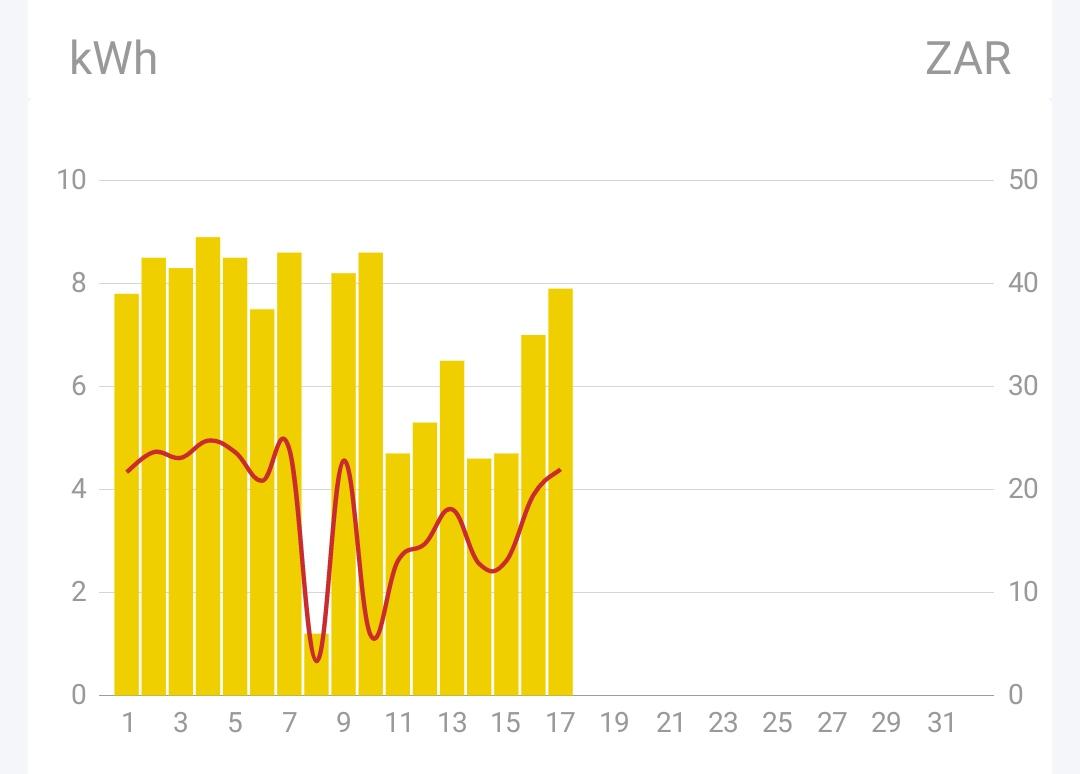
Yes this time of the year there will be a disconnect between different areas. The last 2 days were close to the beginning of the month. My 8 May was very low due to my data running out and the dongle did not record the production.
My MTD for 17 days is close to the Jan-Mar full months just because we are not having LS which affects my yield. During summer clouds and LS together can give me a double whammy.

I used about no grid in 20 days but 1 weekend with family visiting caused me to use 15 units from grid for the 2 days.
Graph below from my main string of 1.62kW.
-
Edited by Scorp007
1 hour ago, Bobster. said:So I could stretch things a bit further if I could switch the grid off at night and not have to worry about remembering to turn it back on.
Shouldn't be hard really. A relay that handles > 50A, and a timer to control that. Or a 50A timer if there is such a thing.But maybe it's a complication too many. And it would take another 5% or so out of the battery if my thumbsuck calculations are correct.
From my memory I would not have thought you actually need 11.5 kW peak power for the low energy used?
If not needed you can use a WiFi smart switch that you can easily override from remote. At our age we need to get gadgets that can help where we might forget. Further could it not work to only switch the grid to the inverter off instead of the whole DB?
If afraid of battery being discharged to low the smart switch could perhaps switch the grid to inverter on say around 05h00 or a suitable time based on discharge level.
@Chris_SChris_S if one uses a constant amount of hot water then I feel gas can turn out expensive. If only a few times during the day then the keeping a element geyser on temp without PV can be costly.
Following the laws of physics gas does convert less heat than direct electricity. This will always be an ongoing debate.
Apartments with 2 people can indeed be cheaper on gas.
-
2 hours ago, Chris_S said:
Grid charge ticked shouldn't make the PV drop as the inverter will prioritise using PV over grid.
What if as the OP mentioned little sun and your load is higher than PV can provide and you have ticked USING GRID to keep the battery between 30 to 45% during the 24hrs time settings?
-
Edited by Scorp007
7 minutes ago, Virwat said:Yes, but what about the missing piece at the bottom of the moon?
We are in the 1st quarter.
-
-
@TheCoal.isWet tell us more about your PV like direction and angle and also more or less coordinates. It seems you had a sunshine day yet you are only getting 3kW and with a large battery bank more PV might be generated but the above information needs to be provided.
As you already indicated the PV is weak and one needs to zoom in into that area of your system.
-
@Intaka I guess you will have to consider spending time/getting input as to change your various DBs in order to take care of limiting power to each unit. The distribution will be key to going forward.
Even if you use 1 big DB with circuits marked clearly for the grid power and the limited power for each unit.
Just what I would do.
-
-
1 hour ago, Attila said:
Hi ,my VMII 3.5Kw plus inverter fail to start from grid (AC input) after a short moment of overload and the display indicates fault code 58 ?!?!
From PV and Battery is working normaly !
When i connect the mains (AC input) to the inverter,the differential circuit breaker goes down and the inverter fail to start !
Thanks.
With differential circuit breaker do you mean an earth leakage (RCD)?
Is the inverter AC input wired to get power after this unit?
-
Edited by Scorp007
11 hours ago, pieter.fourie said:Conderenergy s-2435 --hiccups
My batteries gets depleted every night as the inverter fans are running continually non stop -- 30w no-load power usage according to specs
My previous inverter 4kw did not deplete the batteries.
However in the morning when the panels start to get some power the inverter cycles on and off continuously until i pull the breaker on the solar panel wire connection
I have adjusted some settings yesterday morning but the same happened this morning.
The priority setting was SBU ---default is SUB- but this is an offgrid install
So this morning i changed to UBS priority -- will see what happens tomorrow morning.
The inverter basically switches on but there is not enough solar charging yet and it switches off again.
I cannot think of any means currently to cause a delay in the inverter switching on
The solar charge voltage is min-60v nominal-240v and max-500v
So if i was able to adjust the 60v higher it would switch on when there is enough power from the panels mainly to drive the 30w fans
Battery voltage is 22v in the morning- it only switches off at 20v.
No matter what i tried the only way to stop the inverter cycling was by disconnect solar panel wire.
As with all my previous inverter experience they always lock you out somewhere.
Never full control
Somehow I am making some assumption which you can correct.
As you are off grid the 1st thing to consider is to switch the inverter off if you can to reduce the drain from the fans. With always on WiFi one can use the low voltage 5-32V DC Sonoff to switch the on/off switch of the inverter. This is if the switch is a stay put switch and not just a trigger. If a trigger one can use the inching setting.
Next will be a extra battery to be able to supply the load and fans during the night.
If you can be without the inverter on via the above Sonoff and inverter is off you can get a external MPPT like a Epever with lithium setting to charge the battery when there is sun without affecting the inverter. You can then remotely switch the inverter on say 45min later than it is switching on to allow some power into the battery after the night time discharge.
Lastly a question. Your reading show PV as around 400W. Increase the PV with another panel.
Does the battery charge to high SOC before sunset? What size is it?
In your case it is self power as well as the 30W of the fans

-
Edited by Scorp007
5 hours ago, McKracken said:Just for the record, Mako and I are talking about the same installation.
When using the 'Kod' (Kodak) settings in parameter 5 the SoC displays matches the batteries LED indicators. The problem comes after a night of running on battery power, the SoC has dropped significantly more than expected.I ran a test with only a geyser element running for 3 hours, and the batteries lost 7.4752kWh, while the geyser consumed 6.51 kWh- a difference of 962Wh
The inverter won't be drawing 320W and all the other breakers were tripped
the USE settings are being run with the battery sticker values at the moment as an alternative (but the SoC is more or less meaningless) it would seem that the USE settings are utilising more of the battery capacity, however the Battery LEDs are still showing lower than they should after a night.What size of geyser element have you got?
I presume you did not check if the geyser element was heating the whole 3 hrs?
I would take a flyer without knowing the battery or it's BMS that the battery LEDs are perhaps the more accurate SOC. As Steve indicated the USR setting will not be accurate.
-
29 minutes ago, Shockin said:
Hi, need some help please, inverter is installed, now trying to do the initial setup. Up to batter settings all is OK, move to CT settings ct is set , ratio is 2000, try to do ct test and get the following message: test results- does not meet the test conditions. Cannot go any further with the setup.
Any ideas on this?
What load did you have switched on when you did the test?
-
17 minutes ago, Giel said:
I am in Pretoria and my son in Somerset West. I hope the additional panels will be installed within a week or so. Then we will see if the response regarding the 500W is the same or not.
As myself and @GreenFields suggest the unticking grid use is quick and cost no moolas.
-
Edited by Scorp007
After good replies I will just add to perhaps have a dedicated socket say at the TV which is wired via a DB that is fed from the inverter but limited via the adjustable setting of a Sonoff pow2/3 say at 4A. This is fed from the inverter. Then have the fridges on another socket circuit which might not be on the inverter. Sonoff controlled via phone for on and off and power allowed before tripping. Using this gadget means you can from remote switch on the socket if it did trip. I take it there is WiFi on via inverter 24/7.
Provide a green/red pilot light and guidelines that when red is on the premises are on LS and normal sockets will be off but the TV socket has power 24/7 but with limited output for TV, phones and laptop only.
No suggestion yet for the future aircons. That could be part of a future expansion.
-
6 hours ago, TaliaB said:
From which inverter mppt is the pv drop coming from? Also is see on the master pv string is very close to the startup voltage of the mppt without having your specific panel specs the master4string 425w) is just about 10v above the mppt startup. Add the extra 2 panels to the 4S1P string to make it 6S1P.
The one thing why it is perhaps not the 4 panels if the MPPT did produce(150V) is that after starting the PV can drop down to 125V before it would stop producing. As per specs but one can add a bit of margin like 5V and expect to keep on working as long as the voltage stays above 130V which it should if a clear sunny day during peak hours.
-
Just now, Giel said:
Hi Scorp007
We are using grid time settings as shared with Tim. I cannot remember wat the SOC was when the grid came on.
Giel
Untick the charge from grid during good sunshine and do the test again.
- Giel and GreenFields
-
 2
2
-
9 hours ago, Giel said:
My son had 2 x Deye 5kW inverters installed in parallel with 2 x Deye 5.32 kWh batteries. The slave has 8 x 425W panels (3400 W) on one string and the master has 4 x 425W panels (1700W). We will be adding busy to get this 1700W changed as the voltage is a bit low. We will be adding 2 more 425W panels as this is what the roof space allows.
This was installed in a new built house and the grid was not conencted yet. My son moved in a few days ago and could track the production. Yesterday the grid was connected. The moment the grid came on, the total PV went down by about 500W. This morning I noticed that the PV power curve is starting later than yesterday. I montired it and then asked my son to switch off the incoming grid mains switch. Immediately the production increased by about 500W.
Is this normal? If not, why is this happening and what needs to be changend?
Did you perhaps had a time setting on the timers and ticked to use grid charge?
What SOC was the batteries at when the grid was switched on?
-
7 minutes ago, Intaka said:
@Scorp007, thank you.
I own a guest house with 14 rooms. In Aug 2018 we had a 3 week period with no electricity which forced me to install gas geyesers and a small 6.5 kva generater.
This was also the time of loadshedding more often so the decision was made to change electrical hotplates. All hot plate and kettles were replaced with gas stoves and non electrical kettles.
After all the changes usage history of over a year showed daily kwh usage of between 50 and 70 during peak periods. This depends based on the nuber of bookings we receive. So monthly usage average out on 1800. In our quiet times it can drop as low as 900 a month.
We run a water harvesting system with 1.0kw Tallas inverter pump and a 1.5kw pump for moving water to the main holding tanks.
I decided on setup of a SunSync 16kw Hybrid inverter, 36 Canadian 555W pv and 3 x 10kw Volta batteries. Would have prefered the SunSync battery but its Rk10 more per battery. That Rk30 can contribute to the pv mounting structure.
Any suggestions re the above setup would be appreciated.
In order for assistance based on information provided can you just give a approximate area and the angle and directions of the panels.
-
Edited by Scorp007
10 minutes ago, Stefan Cornelissen said:Mind dropping me the link? I only see the non grid feed ones listed
48V version. Not sure about the feed back.
Also have a look at the Must SA products link a posted earlier.
-
Edited by Scorp007
15 minutes ago, Stefan Cornelissen said:Just wanted to ask where did you buy the inverter from? I don't see that model online(offtopic)
https://www.mustenergy.co.za/product/ph1800-plus-series-2-5-5kw/ gives the information.
May be just add ph1800 plus or pro to your search. Many sellers.
.webp.0bb61bde128ba41be346e98299095ac7.webp)


conderenergy s-2435 insides
in Inverters
·
Edited by Scorp007
Personally I would not try and run on a 3 x series string with 325W panels. Although the MPPT range is 60-500V it is common that you need more than 60V as a starting volts to get the MPPT to kick in.
Without seeing that the inverter does not want to start when the voltage is high with 6 x series I don't think it's worth tinkering with starting at 60V and moving it up gradually in order to start. High current at a low voltage would normally not get the MPPT going.
It is normal if a dongle could not use the WiFi that the data during this time is lost. The inverter normally keeps this data for the day but what could not be sent to the cloud is normally lost. Refer to my post under the winter PV production when my data ran out.
If the inverter is faulty and not operating as it should ask for a replacement.