Modina
Members
-
Joined
-
Last visited
-
-
-
-
-
-
-
 Basil Katakuzinos reacted to a post in a topic:
Can I connect a hydro-electric generator to a Axpert inverter?
Basil Katakuzinos reacted to a post in a topic:
Can I connect a hydro-electric generator to a Axpert inverter?
-
-
-
-
@PsyWulf I don't read or follow any publications anymore. I have divorced myself from technical stuff. I refuse to listen to this post-Covid bullshit. What happened is that a lady I know in Cape Town still is battling with a roof repair before installing a new Victron system. On hearing that she is still not sorted, I mentioned that with the shitty weather we are having, any solar panels would anyway not produce anything meaningful. It's then that she forwarded me that link. I would not be worried about Chinese or Russian propaganda.... @Garthox I didn't even reach so far into the article or webpage, well noticed. 😅 However, it doesn't matter if this is the Fantasy and joke of someone. With the UN Chief Antonio Guterres saying that we are now in, I quote, "Global Boiling" the so-called real news is more fake than the most outlandish fantasy could ever be. I resign.
-
-
More laughable, fake, dis- and mis-information for a brainwashed, gullible world that will believe anything and everything that the MSM dishes up. This time about rain-drop power harvesting. You must be kidding me.... The below article was only published a few days ago. https://thedebrief.org/forget-solar-panels-here-come-rain-panels/ ...proof that the IQ of some people has evaporated into nothingness. BTW. This tech will work. It will produce some power for a small microprocessor project. The problem with this story is that the sheeple will think they can boil the kettle with it, if and when it rains. Even if it could, this is so dumb-ass stupid.
-
-
It is really no challenge to make a boost inverter that takes 4 or 5VDC and boosts it to 26V or even 56V. I mean, a typical taser will run from a rechargeable 3.7V and make 12KV or more. 😁 My first statement is not meant to mean that I suggest you build your own, but rather that your MPPT should have no problem boosting a voltage from say 4.5VAC to 26...27VDC required to charge a typical 24V lead-acid battery. I think your problem is likely to be found with that MPPT. I realise that wind generators do not have a huge selection of MPPTs available.... MidNite Solar seems to make some decent ones, but I think they are American and will likely cost a fair bit of money. An alternative would be to buy a buck/boost converter with voltage and current limit adjustment capability and then use that as your battery charger. You would also need to buy or make your own 3-phase full-wave rectifier but that is cheap and easy. The only downside is that this setup would not include a turbine brake system, for times that your battery might be full and high winds might cause the turbine to over-rev. For that you could use a over-voltage protection module which could switch a ballast resistor across the rectifier output at a certain pre-set voltage. My view is that wind generators are only for very specific applications. If you are really 100% off-grid in a very remote location. If you really know how to safe every last watt and you desperately need a backup to a solar panel system. I personally would first want to get this current system to work and get some experience with using it. See how much power you can get during a specific season. Upgrading can be considered at a later stage. There seem to be a lot of unhappy wind turbine owners that sit with systems that have been completely over-sold and fall far short of power expectations.
-
@Scorp007 Yes, agreed. But you get much cheaper battery under-voltage cut-out modules than the Victron. The following two are under R200 and don't need a multimeter to adjust, as they contain their own volt meter. https://www.robotics.org.za/XH-M609?search=battery protect https://www.robotics.org.za/YX-X0001-1 The real problem is that with todays L/S, people unknowingly discharge at X-Ah and then want to use a X/2.... X/10 Ah charger and then wonder why the battery can't cope. There is absolutely nothing wrong with using lead-acids if you have small loads such as a few LED lamps. But if you want to run a 80W TV plus auxiliaries for 2 to 4 hours, that's when things start getting problematic. As I have mentioned here in the past, I have a 24" HD-Ready LED Sinotec TV that can run straight from 12VDC and draws aprox 1A. Firstly one can save on the inverter cost, one doesn't sit with the inverter losses and at a power rating of less than 15W that TV will run for many hours from a 100Ah LA battery and still remain within the 50% SOC. Set-top boxes can normally also be run straight from a 12V battery or, to be on the safe side, connect a cheap buck/boost regulator. The only down side is that it requires some very basic DIY capability, to make cables and own a multimeter, so as to be able to adjust the output voltage of the regulator.
-
Note that I have no practical experience with wind turbines so accept the following as common sense opinions, some of which could be inaccurate. I am not sure what pickup device you are talking about. If the 3-phase generator uses permanent magnets there should not be any sensor or controller and the output voltage will likely be a linear function based on rotational speed. Permanent magnets cost money. I would expect an alternator to have lower production costs. Alternators use a field coil that needs to be excited, i.e. it needs power and that can be controlled if desired. I am in no position to make claims as to what sort of generators / alternators are used. I don't know the market, but I suspect that permanent magnet generators are likely. At least this is the impression I get from some youtube channels. I would expect the system to react immediately. You might be able to remove the blades and then drive the shaft with an electric drill for measurements and determine the output voltage curve. A dirty slipring on a new wind turbine. Mmm, that doesn't inspire confidence. 1.5 ohms is a substantial resistance. If you get this setup to work, it might be a good idea to apply some special-purpose grease as those sliprings will not see any action in some sectors, so self-cleaning will be limited. No. The regulator should contain a boost converter and it should start charging at substantially lower input voltage. I would expect charging to commence at 6 or 7VAC. At least for a 12V battery. It sounds as if that MPPT doesn't work properly. I know you said you have already replaced it.... If I was in your position I would do some basic tests on the turbine itself, as you appear to already have done. I would try to spin the turbine at different speeds and plot a basic transfer function of RPM versus output voltage. With the confidence that the turbine can actually generated a decent voltage, I would hope that it can produce power (i.e. an output voltage under load) and I would first set aside the turbine. I would then use a bench-top variable power supply - something like 0...30VDC at 1 or 2 amps should be fine, and test the MPPT charger. I would connect the PSU to two randomly selected input phases. Your charger will have a 3-phase rectifier at the input, so it will be safe to connect a DC voltage with any polarity to any of the phases. With a 12V SLA battery connected on the output of the charger, I would expect charging with an input DC voltage of no more than about 8 to 9V. Then experiment by increasing the input voltage. Note that depending on the voltage, battery SOC, etc. your bench-top power supply could/will run out of current and drop it's output voltage. So a PSU that can output many amps would make for easier testing, but even with only 1 or 2 amps you should be able to confirm basic working of your charger. If you don't have a bench-top power supply, see if you can borrow one or maybe buy a supply 2nd hand on ebay or whatever.
-
This makes little sense. Why 3x routers? And why do you power 2x DSTV decoders if you only power one TV. The first rule in L/S is to reduce your power consumption by as much as you can, especially if using lead-acids. Your Telefunken TV is an old LCD. LCD, by definition, uses cold cathode fluorescent tube backlight technology. New TVs use LED backlighting. LED TVs consume approx. 50% less power. Considering how super cheap a new TV is (in comparison to batteries) it would be a wise choice to replace your primary TV. You have a 120Ah battery. Even if the battery is only discharged to 50% SOC, that would mean you would need to replenish 60Ah. That intelligent charger seems to be a PSA008 - it can charge at a maximum of 8A. So it would take 60Ah / 8A = 7.5 hours. recharge time. In reality it is even worse because the battery has losses (converted into heat). You need to put more than 10Ah in if you want to draw 10Ah.
-
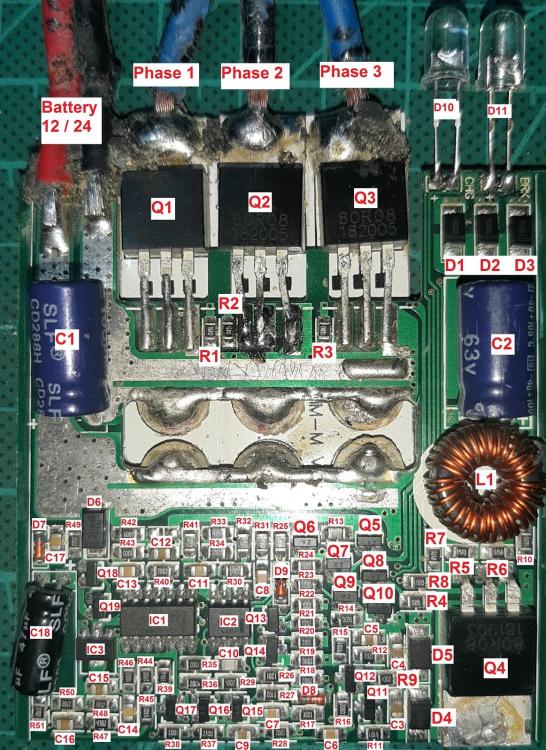
No, these are different. It has a extra LED (brake LED) It might be from the same manufacturer. A newer model. For the one I have posted, I have a back-engineered circuit diagram. I have downloaded it some months ago but cannot remember the source. I think it was a Youtube video with a link to the schematic. It is referred to as a MPPT charger but it has no microprocessor. It only contains a quad op-amp and a dual comparator with many bipolar and four MOSFET transistors. Because it has no processor and not even preset potentiometers, I can only conclude that it is dedicated for lead-acid batteries. Your MPPT seems to be made for Lithium batteries. Judging by the very similar physical appearance, I suspect that it might still based on the same circuit, but with modifications for the charge voltage and some other tweaks. Yes. Small wind generators do seem to normally have a boost-converter topology. And yes, it is possible to auto-detect your battery and adjust accordingly. After all, many PWM Solar Charge controllers are also rated for dual 12/24V operation. I first thought that your battery(s) might be Lithium (you didn't say what chemistry) and that the slightly higher voltage might be detected as a battery "full" condition by the charger. Seeing that your charger is for, or at least supports LifePO4 batteries, that theory doesn't hold water. You say there is no AC current. I presume you measured in-line with one of the generator phases? I would expect the AC to be loaded, i.e. an AC current flowing, even when no DC current is flowing into the battery. This would likely be under the following conditions: (1) battery voltage high (fully charged, and (2) AC voltage is over a certain threshold. The reason that you measured zero current could be that the AC voltage was not high enough. You will most likely not be able to read schematics, but I will attach the one for the other controller for the benefit of others on this forum. Note that this is a back-engineered schematic and it is quite a complex analog circuit, so there could be some errors. One would be able to connect a bench-top variable power supply to any 2 of the 3 input phases. Then slowly increase the DC input voltage and monitor what the input/output current/voltage is doing. For such a test I would first connect a small 12V lead-acid battery. Then maybe repeat the test with a 24V battery.

-
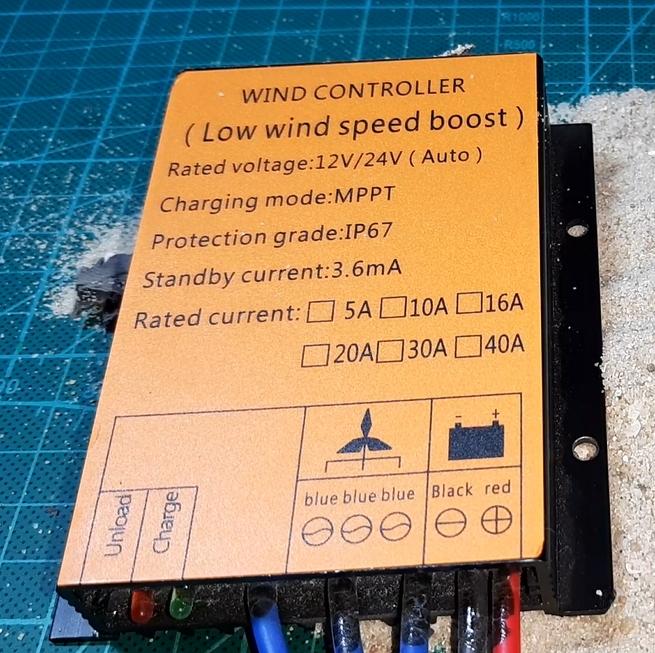
What MPPT are you using? Is it maybe the one below? There is not much info on this, but it seems to be quite popular for low cost systems.
-
There is a new pink collapsible rubber traveling kettle available. I would not consider it high quality but certainly low power. I wish it was made from stainless steel or glass. Pink silicone should rather be used for different toys..... It is mains operated, rated at 600W but was measured as 720W by Bigclive who reports that it will boil 500ml in about 5 minutes. R484 at Takealot https://www.takealot.com/portable-silicone-collapsible-travel-electric-kettle-pink/PLID73071560 Bigclive test https://www.youtube.com/watch?v=_6iDNP3QPxc
-
-
You only tested to about 51 degC. I presume that the PTC is still rather linear at these low temperatures. As a PTC is an engineered material with special, purposefully engineered characteristics. I presume it is made with an exponential transfer function at temperatures over 55 or 60 degC, so that it can self-regulate, if the blurb is to be believed. So congratulations, you have just prooven Einstein wrong. You have shown that all that we ever have learned in school and varsity is a lot of fake crap and that we should not "follow" or "believe" in the so-called science. Especially not the post-Covid science (!) So let me get back to the 24/7 movie I have been watching - Life in the 21st Century.
-
The conventional element is resistive. It will change it's resistance (slightly) as the temperature changes but this is linear. So you can measure the current drawn every 4 minutes and then calculate the average current consumption over the total measuring period. No problem. The PTC is designed to change it's resistance more, but what is important is that this is non-linear. If you take a current measurement every 4 minutes, you cannot simply work with the mathematical average. Instead, you would need to integrate the value over time. One day, when the Cabal/Elite will allow us to speak to the aliens and learn from their wisdom, we will make a quantum leap of science knowledge and learn the secret of traveling faster than the-speed-of-light, unlimited energy, etc. Until then, we are still ruled by the various scientific rules as laid down by Newton, Faraday, Einstein and others. In this case Einstein: The conservation of energy - Energy cannot be created or destroyed.
-
-
I have no problem with home automation as long as it is not connected to cloud servers, In fact, I personally would not even leave it connected to the internet 24/7 and only enable the connection for certain periods. The story below broke a few days ago and numerous channels have reported on it. It concerns Amazon accusing a customer of racism and purposefully shutting down the entire smart home. PS. I prefer not using and not sharing Youtube links. I prefer Odysee, Bitchute and Rumble, but I could not find this Louis Rossmann link on the other channels. https://www.youtube.com/watch?v=NfiIXooD77s
-
(Thermal) fuses are rated for voltage and current and can be used for AC and DC. By convention, a fuse is normally connected in series with the positive line in DC circuits and with Live in AC circuits. In practise it will work equally well connected in series with L or N, but for shock hazard safety, I would strongly recommend to keep to convention. No, don't use car fuses. They are not rated for such high voltages. Use a 20mm or 32mm glass-envelop fuse. You get various type of fuse holders for these. Any electrical wholesaler or a good hardware store should keep them. For your application I would keep the fuse out of sight and out of reach of your tenants. This is to prevent the McGuyvers of the world from creating their own fix with tin-foil or other crap, or even to bypass the fuse all together.
-
MCBs have two trip mechanisms. One magnetic and one thermal. The magnetic one is instantaneous (well as fast as a mechanical contraption can be) and it will act on a massive over-current. The thermal trip is intended for loads that are slightly over the rating. This could take up to a few minutes to trip, depending on how far over the limit the current goes. Being an electro-mechanical assembly there are tolerances and even the ambient temperature will have an bearing on how long it would take to trip thermally. You do not want a 5A MCB to trip at 5.5A or even at 7A. This would trigger nuisance trips due to in-rush currents.
-
Correct, but actually much worse. CBs have B- C- D- curve ratings. As far as I know domestic CBs in SA are all C-curve (correct me if I am wrong). A C-curve rated CB will only trip at 5 to 10 times the rated current. See here: https://www.se.com/au/en/faqs/FA290880/ Here is what you do - an expanded idea based on @Scorp007 fuse idea. You provide TWO standard outlets EACH being fitted with a 2A fuse. You tell your visitors NOT to plug in anything more than 300W. Obviously many will not listen and blow one fuse. They then have a second plug that still works. If they still don't get the message and blow the 2nd fuse, then they deserve to sit in the dark. This way you don't need to come out to your BB every time it trips as there is a backup. Once your visitors have left, you just check if both fuses are still OK.