


ghatikar
Members
-
Joined
-
Last visited
Everything posted by ghatikar
-
Hello In all my enthusiasm and keeping in safety in mind, I got a Ziehl Islanding relay ( in Victron islanding box) Now after pouring over manual and other forums for the life of me I cannot find answers to following questions - Please keep in mind I am using in Abuja /Nigeria so no regulations are enforced neither any practical experience exists yet to guide me 1. If used in 1 Phase AC system do I adopt Set 1 ( 3Ac with N) Germany SET 7 (2/1 AC with N) or the UK 20( 3/2/1 AC with N) - UK G59 seems more stringent with dual level protections. - I did not see any settings for SA ( NRS-097-2-1) 2. Is it just my relay or the Lock and Unlock lever is really tough to push and has it's own mind on when to activate 3. Does the relay switch on its output /power contactor immediately on all the while counting down what seems sampling time or after a time delay - The behavior seems different on German and UK settings but no mention in Manual about switch on behavior except brief mention of " Delay Enable On time" 4. in SA do you keep RockOF ( Df/Dt) on or OFF I have attached the handbook for handy reference - manual ( 5 MB) - https://drive.google.com/file/d/0B6eOIBrQmTfLdVVvLUgzY001dlk/view?usp=sharing p.s - I am planning a crazy scheme where my 800 Watt solar and 600-watt wind will be fed back using a grid-tied microinverter ( capable using battery instead of panels) back to the main Victron on ACout 2 - The ACout 2 of quattro is already connected to 500 watt system microinverter which cuts out through a power contactor using an assistant at SOC above 99 % and comes back on at 97% - as a backup ACout 2 is also set to switch off at Voltages above 57 volts ba_ufr1001e_kurz_e.pdf Anti-islanding-solutions-EN.pdf
-
Ifr no batteries are needed then Look at SMA http://www.smainverted.com/what-is-a-photovoltaic-diesel-hybrid-system/
-
From 2013 to now I have had 3 ( 4048 MS- 5 KVA 48 V) of them fail All in the middle of Night ( cool, no Solar but on inverter duty as no grid available). Every time it was caps blowing out. ( 09 Error DC BUS Fail Every time solved by dealer by replacing the whole motherboard at my cost I have now started paralleling two and keeping one around handy. Still cost of three together is less than one Quattro 5 KW ( not evening adding the MMPT or Venus , mk3 etc)
-
I am considering BYD Bbox pro 10 - http://www.byd.com/energy/bbox.html - 6000 Cycles 10 KWH my challenge is to manage 30 Kwh /day with 6 KWp and BYD At least the solar water heater will help somewhat. No permission from Better Half yet to replace the telly and all lights are already LED with most of them automated.
-
Envious andSAD . I wish somebody sold Victron compatible batteries in Nigeria ! The kind of hoops I am jumping through before I can lay my hands on one
-
I think the crippled capacities are the main reason why many suppliers refuse to support off-grid use - Tesla, LG resu , Samsung SDi all currently do not allow off-grid use ( They are Li -On cells I think) BYD, for example, recommends only one 2.5 KWH for 5 KVA inverter when used in on grid/grid Tie setup but 3 units of 2.5 KW for the same inverter when in off grid. I found a supplier Herewin from China who are very upfront about the capacities and loading. 2000 cycles with 80 % DOD at 0.5C rate.- 10 KWH at 3000 USD 48 V . I beleive all suppliers will be close to these figures as the chemistries cannot be so different from different suppliers And the suppliers who claim to be drop-in replacement to Lead acid simply oversize the battery with clever BMS
-
The Other kind of cheaters should be also avoided for home use in my opinion. I am not sure if you really want to invest in a battery with 5000 cycles.( or even 3200) Who knows in 10 years what technologies will come to market. I found for off-grid use BYD was the best match in terms of energy density and no of cycles for Blue inverters. For Axpert the sky is the limit as you are not dependent on CANBUS BMS control. But then also I found buying directly from the supplier is cheaper as you are actually not paying for the aftermarket integration. Also How sure we can be if the companies who are buying the known brands and putting it in steel enclosure with custom BMS will be around to support it in 10 years time
-
A cheaper and long lasting solution may be Evaporative cooling. Like the swamp air coolers. Put some material which wicks water or gets water fed at a very small rate below the panel. - Force air over the material. The heat of the air will evaporate water and cool down the panel and surrounding air. http://www.breezair.com/us_old/index.php/en/evaporative-cooling-scientific-facts But considering all the energy losses and maintenance I think the same money will buy additional wattage If space is at premium may be energy efficient panels like LG neon2 which take less space and use both sides of panel http://www.lg.com/us/business/solar-panel/all-products/lg-LG315N1C-G4
-
One important factor to consider is the LOAD or the power source the batteries replace and the cost involved - do you need to cycle the battery fully every day to meet your load requirements n terms of ROI ( return ON investment ) it makes sense to prolong the life of your investment ( CAPEX) since obviously you are taking the money for batteries that came from somewhere even if it is your own funds they could be put to better use. So generally accepted practice is to use the 50 % DOD and get average returns and life I have enclosed a sample simplified model for project IRR /NPV. you can put your numbers to see which model is best to follow considering the cost of energy you will have to pay which the batteries replace ( Grid , Generator, net metering ) Or alternatively, use this website where terms are explained in simplified versions http://www.free-online-calculator-use.com/npv-calculator.html basically the higher the NPV ( Net Present value) the more desirable the solution Example NPV IRR.xlsx
-
@plonkster Thanks, I am on the right track somehow my supplier did not supply the assistant tank and has no idea what I am referring to I have already ordered the assistant tank. So now I have 15 days to adjust and measure the EV tubes efficiency wbr Anil
-
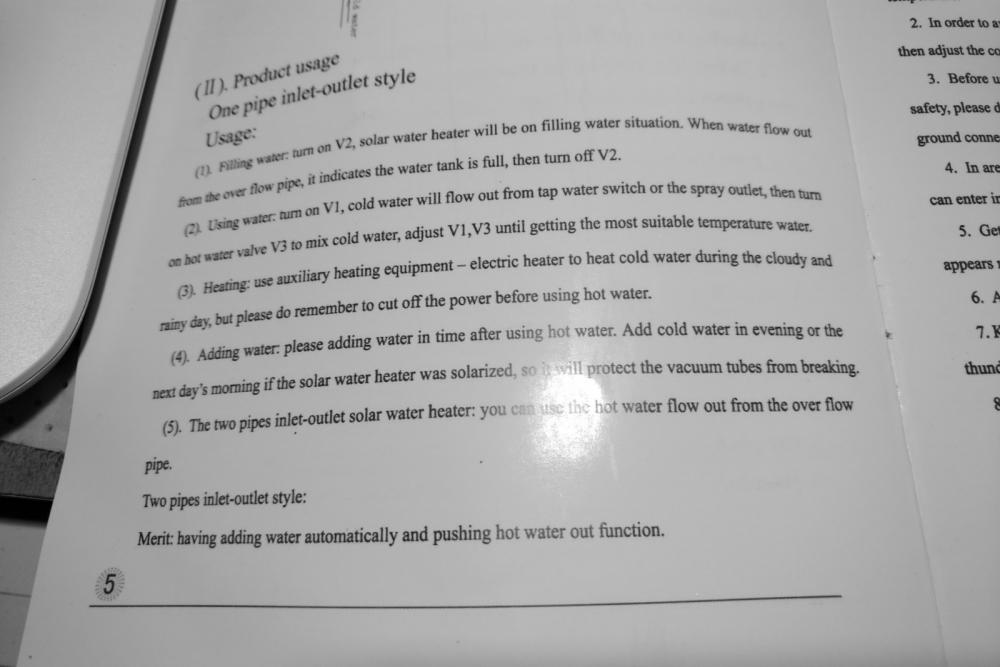
Pages from the manual




-
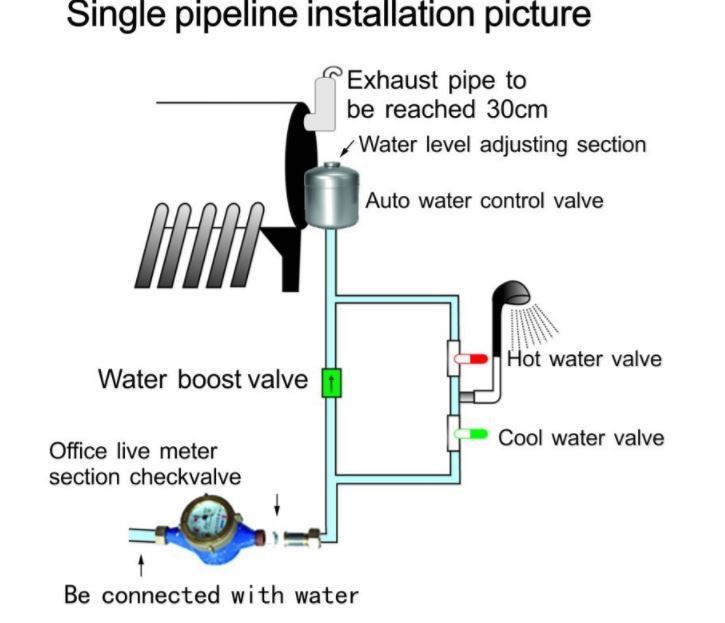
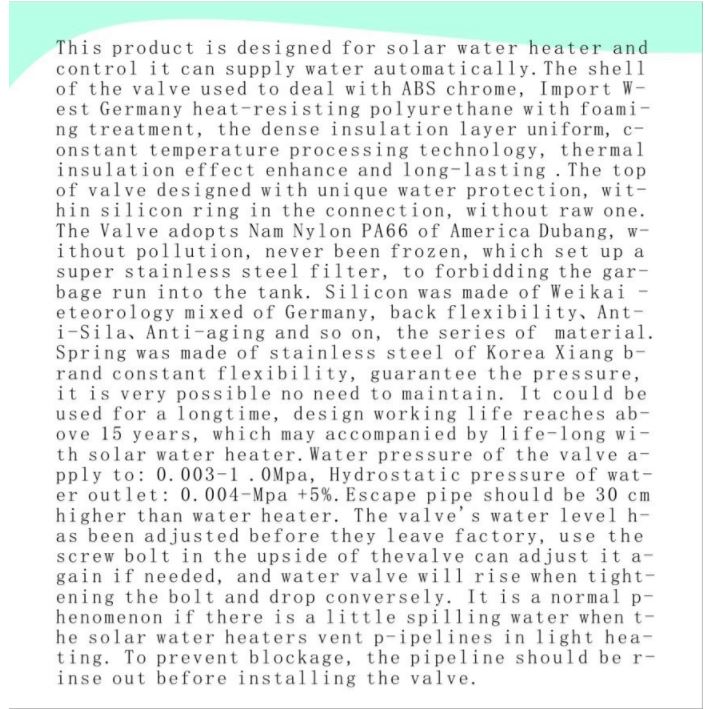
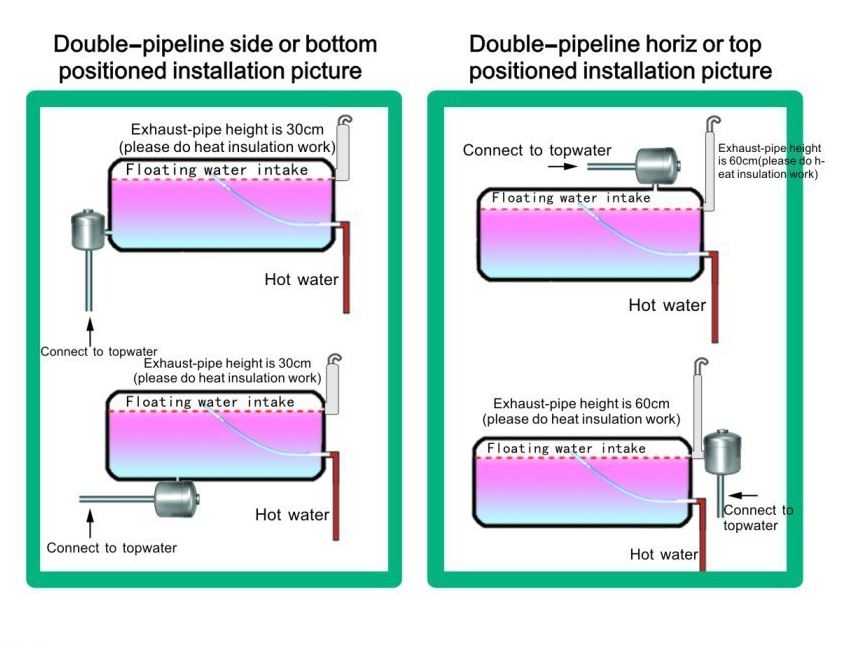
Solar Water users? and gurus in the house How did you connect the inlet of the tank ( cold water )? Direct to Overhead tank, to the borehole, manually fill using a tap In my solar heater user manual ( Simba make 120 L - looks like made in China) the manual recommends all filling methods which are manual and the tank has overfill discharge outlet which means if I connect to water source the water will flow out from discharge outlet.I also believe the tank and tubes can take max 0.7 bar operating pressure. In addition, the water when heated expands 3 to 5 % which means it needs space to go The reason I am asking is I came across this https://www.aliexpress.com/item/Automatic-water-control-valve-solar-water-heater-feeder-assistant-tank/1935638063.htmlThere is a single and double pipeline model The system I came across only fills at 0.5 bar and the overfill outlet has to be connected to the 2-foot pipe above water level. I believe the water coulm works as counter pressure stopping inlet water.I intend to drain the tank from top outlet using a small 300 watt booster to match my house pressure of 2.5 bar
-
This product can detect if excess PV |Energy is being fed back into grid and use it to heat water ( upto 3 KW) https://www.aliexpress.com/item/3000W-Excess-plus-Solar-I-boost-Alternative-Energy-saving-for-water-boiler-infrared-heating-system/32613200769.html PV panel users applying net metering or grid ties should benefit from it I just found it while browsing for Solar Hot water products

-
I would suggest if possible use flooded lead acid as they have much longer cycle life - may be possible to buy the 6 V 410 Ah Trojan which is perfect for your size requirement. from your datahseet, it looks like the visions are designed for standby UPS and other generic application and not deep cycle solar I have a similar Siz system with Sukam and Luminous mixed ( all moderate quality Deep cycle lead Acid ) 200 AH x 8 running for past 4 years with Axpert and batteries have shown no sign of problems. It has two 5 KVA Axperts in parallel My midpoints normally is 0.1 % or 0 and goes to .3 % during charging Few things I am doing differently than you 1 charge rate C20 - 20 amps in my case - no change in temperatures 2. Do not leave them discharged idling even for an hour - the moment SOC is blow 70 % my generator kiks in till they are 100 % again 3. I use a cheap PWM morningstar charge controller 45 amps to equalize them every 3 months - The way I do it is to disconnect the Axperts after batteries are charged and then connect the morningstar till it completes the equalization cycle ( typically 3-4 hours )
-
Victron Energy units ( maker of Pheonix) is commonly used in Yachts and RV's as well as service, catering vans. Vibration is common in these scenarios. In fact, recently a Boat powered by Victron inverter and batteries won the race - https://www.victronenergy.com/blog/2017/09/08/solar-boat-racing-clafis-victron-energy-unstoppable/ I use a 350 VA Pheonix to run my critical loads ( NAS, Router, switch etc) as the thing consumes less power while inverting than an APC ups which is on standby. it is running nonstop for last 6monthss without any issues at 50 % or more load
-
apply any mechanical pressure on the pump - I think refers to mechanical load from joints/ from the pipes/misalignment etc.
-
I have been using my well water for over 5 years. for garden adn washing Treat it with 20 and 5 micron , Water softener and UV filter - The UV is installed per machine so Washing machine gets it's own and dishwasher it's own. That way they remain on when only water is supplied. Softner is mainly for clothes and car washing as the water is quite hard For drinking, it is 5 stages RO filter + UV Have a look at the new Samsung model - uses 20 % less energy and water! ( cycle time is half of normal) - https://www.cnet.com/uk/products/samsung-quickdrive-washing-machine/preview/ for some clothes you can also use the steam clean mode which uses very little water - https://www.houselogic.com/by-room/bathroom-laundry/steam-washers-dream-come-true-jetsons-style/ I mainly got the Samsung steam model for allergy ( and no the allergy never went away turns out it is pollen )

-
At 50 KW with multiple units, it gets very sensitive to Size and length of cabling both AC and DC due to sharing limitations. Also, the addition is not arithmetical Unless it was an upgrade /addition to existing it is always preferred to have less no of big units. I think Victronhas some thread on the Discuss but I can not find it for now
-
at 50 KW you may be better off with HYBRID PV Diesel - If you have not used I highly suggest using homer to do the Sensitivity / LCOE analysis - http://www.homerenergy.com/ - 30 days is evaluation even SMA has nice calculator with only their products - https://www.sma.de/en/products/planning-software/sunny-design-web.html HYbrid inverters due to high DC currents are much costlier than grid ties. One sunny tri-power - https://www.sma.de/en/products/solarinverters/sunny-tripower-core1.html may be enough and cheaper than supporting full 50 KW with batteries. Critical loads can be offloaded to Quattro or sunny =island Is HYbrid PV diesel an option? what about the night load
-
The optimum charging rate for a 600 Ah battery bank is minimum 30 amps ( C20) or even 60 AMPS (C120) for most of the GELS. Keeping cushion for loads in future You can get either 80 Amps Victron or Midnight solar ( 80 Amps very few models) or to keep budget lower get a 40 /45 amp Victron, Morningstar, EPEVER and add one more in future with additional bank what is the make of the battery or datasheet
-
May be It's time for Victron to consider moving the APPS to Windows UWP ( universal apps platform) then people can run them on Pi with Windows IOT, or even PC's with Windows S
-
I will try to d that at some point in future. using Ac coupling - basically, feed the Victron Quattro 5KW ( lithium Ion) from my Axpert 5 x 2 KVA with 400 Ah battery bank on AC/IN 2 Potential losses 30 % along the way DC ->AC and thenAC->DC. Since the Axpert Feed only AC and water pumps I can afford to drain the Lead ACid and keep house lights on in Emergency And Yes I know it will be more practical just to install a manual change over to feed the house from Axpert. but this will be in the name of Science and will be easier to implement. Only two additional wires MCB and some clever assistant Logic
-
@Hannes7212 I fully agree. In fact, even if the Gennie comes on often it goes off also faster as the charge times are shorter with max 1 H absorb. Sometimes my lead acid sits on absorbing for 2-3 hours all the while drawing less than C20 in the night. With lithium, I can just leave it on 20 % charge and not worry about partial SOC and battery degradation. Like computers mix SSD and spinning drive for capacity and speed, somebody should come up with Hybrid. Lithium contributing to Charge currents and high current discharge cycles while Lead acid contributing only to overall capacity
-
Based on the price I guess Blue NOVA and Freedom won quote cycle numbers at 70 % DOD ( also warranty conditions are for 70 % DOD) Bleunova claims 3600 cycles @ 100% DoD 5000 cycles @ 80% DoD 7000 cycles @ 70% DoD These are fairly similar to 3700 claimed by USA based SimliFi and Battelborn and even LG Chem Resu - https://www.altestore.com/store/deep-cycle-batteries/lithium-batteries-c4441/ In contrast, the Chinese Herewin claimed only 1000 at 80 % DOD !! I guess we will only know after few years
-
If you see my comparison of costs you will find that Lion is quickly closing the GAP to Leaacid . Lead acid is typically higher mainataince and two years warranty while lithium is fit and forget and 10 Year warranty - I think the small difference is worth paying for peace of mind especially for a person like me who is out of house 15 days in a month on the road If You increase Lithium capacity the cost /cycle comes down as BMS and installation costs are shared. For Lead acid ( wet) the installation and maintenance costs are fairly liner to capacity Also, note that often the losses resulting due to inefficiencies of Lead Acid and longer charge times are not calculated in cycle costs. Factoring those in the Lithium will make more sense provided you can have the money to spend initially Make Model price USD/Cycle/KWh FREEDOMWON HOME 10/7 0.29 FREEDOMWON HOME 15/11 0.25 BLUENOVA BNV52V-154-8K 0.23 BLUENOVA BNV52V-230-12K 0.22 BattelBorn 12 V x 4 0.26 SimplyFi Power Phi 2.6 KWh 0.28 Herewin 0.58 LEAD ACID Trojan RE200-B 0.20 LEAD ACID Trojan L16-RE-B 0.15


