


Youda
Members
-
Joined
-
Last visited
Everything posted by Youda
-
 Early detection of arc faults in the electrical installation can contribute to fire protection in residential and commercial installations, resulting in additional safety for people and valuable assets. Compliant with the international product standard “IEC 62606 – General Requirements for Arc Fault Detection Devices”, ABB's AFDDs mitigate the risks of fires caused by faulty electrical installations. The following guide will help application users to understand the physical phenomenon of an electrical arc, the functioning of the devices, the main features and benefits.
 -
Light in the DB? Oh, not really :) AFDD does not work on the principle of detecting light from the arc/sparking. It listens for high frequency currents and distorted waveforms on the connected circuit loop as HF and distortion is the common product of arcing. Should there be arcing anywhere in the whole length of a circuit, then AFDD will detect it and trip. On the other hand, yes, AFDD will increase installation costs a bit. Not only because the price of AFDD itself (normally, you will need roughly 4 or more AFDDs per house) but because AFDD might start tripping based on false-alarms in some not-so-well-done home installations. Very same like RCD/RCBOs are. So, some houses might need at least partial rewiring in order to put AFDDs in.
-
Speaking of community, I am offering free EV charging already (as described somewhere on the previous pages). Originally it's meant as a help to those with a flat battery, but some drivers even made a habbit of comming and charging their EVs regularly here 😁
-
In my country you don't really need to have CoC, nor anything else, for private off-grid installations under 50 kWp. On the other hand, once you want to have your solar connected to the national grid, there's a TON of paperwork you have to go thru, CoC being the first. On top of that, they limit not only the export power, but the maximum installed kWp too. (I recall that max for private installations here was 10kWp a couple of years ago, now it's a bit higher but still limited somehow). And that was basically the reason why I decided to go off-grid with my solar. There are some advantages having ongrid or hybrid solar, but the real economic incentive is smaller and smaller every year. I know a lot of ppl who made some some nice profits on selling their excess production in the past, but currently the price difference between the case when you need to buy power vs when you are selling power back is so huge that they just feel being ripped-off and abused. The only notable advantages of going ongrid/hybrid that are still here are these three: need no batteries for ongrid = very affordable can have just a small inverter and small battery for hybrid, since all the load-spikes will be covered by the grid seamlesly can ask for a subsidy (up to around 5 000 USD per installation I think) Luckily, nothing from the above is compelling for me :) Yeah, the crypto mining is something that I was looking into, but in order to make sense you have to run your gear 24x7, I learned. Otherwise the gear becomes obsolete over the time, as the amount of work needed to calculate each new block is getting higher. Does not make sense to buy 5 000 USD miner(s) and then let them being powered-off half of the time. A friend of mine has 100 kWp on his farm and has racks full of miners running 24x7. What he said to me is, that with this scale, heat and space starts to be the main problem.
-
A bit sad thing is, that apart from occasional charging of EVs I have no use for all that power during the summer. Batteries are full way before lunch, water geyser is hot too and therefore the production falls down, just to cover ambient needs of the house: On the other hand, on the rainy days it's great now. Even if I consume a lot on that particular day, solar is still able to keep-up, power the loads and charge the batteries at the same time: But what I am really looking for is to see how the new setup will operate during winter. Of course, there still will be a plenty of days with the production nearing zero, but I hope that on the other winter days it might work good-enough. Let's see!

-
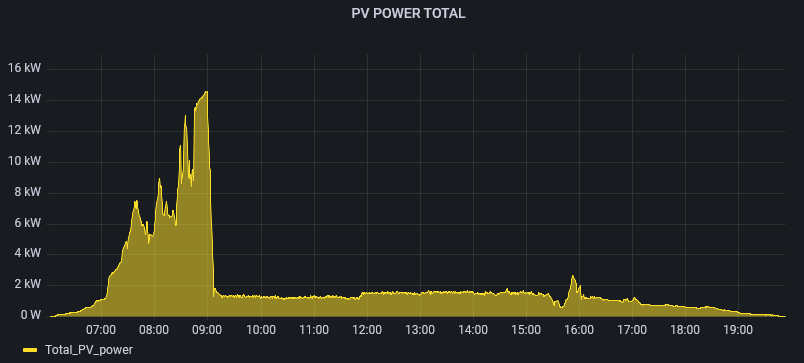
While at it, I rerouted all the PV cables from running inside the house to new metal conduits that I've slapped on the outer wall. Added some more fuse disconnects, SPDs and used almost 200m of additional PV cable. From the start I was a bit affraid of the fact that my inverters (infinisolar) can handle just 10A of PV current per MPPT input, but after some investigation I decided to take a risk and plug these new 15A string in. Works like a charm - infini just cuts all the excess power, limiting to roughly 5kW per MPPT input. Looks like even the spikes are handled without a glitch:


-
Hi guys, let me share the recent update of my solar lab! Originally I had 20kWp of PV on the roof, which was great, but the available space was not utilized optimally. Namely because there was the chimney blocking part of the west roof. Not to mention long shadows it casted each winter. After a couple of years I demolished that chimney (with the big help of my friend Kobra) and built a new fireplace, plus new chimney that freed the space on the roof. For a shame, width and height of the panels that I had was not ideal, so even with the chimney removed I was still unable to utilize space optimally: Therefore, I was continuously looking at the PV modules market each year, in order to find new panels that would fit better. As you might know, the manufacturers of PV modules are introducing new models each year, with their dimensions derived from the physical size of the actual solar cells used. And as solar cell makers are gradually able to produce bigger silicone crystals (that the cells are cut from), the PV modules are getting bigger and bigger, even when the number of cells per module stays within the standard amounts (like 72, 144 etc.). Finally, in 2025 I found PV modules with the size of 1961 x 1134 mm, which was perfect for me as it would fill the roof from side to side almost completely, while still allowing me to put 4 rows of panels on it. So I went for 500Wp double-glass/bifacial, all-black panels and bought 3 palettes of them. Although these panels are bifacial, they are NOT transparent as the space between the cells is of opaque black color. On the other hand, putting bifacial panels on the dark roof makes no sense anyway. The price was excellent (for me) 77USD + VAT per panel. Let's see how these double-glass panels will hold up in the long run. Firstly, I had and idea to remove all the old panels by myself, but found it being too labor-intensive. Looks like I am getting old, to be honest. So, after removing 18 panels out of 72 (with the help of my friend Vitek) I gave-up and called a third friend of mine, David, who is running a business of building large PV power plants for factories and other commercial customers. David's guys were amazing and after a couple of days, all the old panels were down, aluminium rails repositioned and leveled. Also, the new rails for fourth row of panels were added and finaly there was 86 panels installed. West roof: East roof: Now it's 43 kWp of solar, composed of 6 strings: East: 14s + 14s +14s West: 14x +14s +16s To be continued...


-
No. Most of the all-in-one's do, as they can and it makes sense. Including Axpert, InfiniSolar, Deye. But when comes to modular systems they always convert PV to the battery voltage first, even when using high-voltage PV strings. For example: Victron RS450 (450V) Studer VS120 (900V) Anyway, for smaller systems it's advisable to stay with low-voltage PV strings. But when you go for let's say 40kWp and above then the low-voltage strings will start to be a real complication. For example, having roughly 40kWp with 520V per string (13S) needs just 6 strings. But with 120V (3S) you will need 26 strings. Not to mention that you need SPDs and fuse disconnects for all of these. And once you try to lower the amount of these components by paralelling more and more strings together, then you end up with extreme currents on the PV side, that will need thick cables and will have voltage drop losses due to cable length and resistance. Long story short - each use case needs a different approach. Sometimes LV PV is the best, sometimes HV PV is. And that is the reason why the portfolio of available products is so broad.
-
@Slarty do you have a "PV diverting" device installed in your setup? Something what is able to heat the water in geyser for example, based on the excess PV generation?
-
Hi @wernerlombaard INVERTERS: MODBUS (or MODBUS TCP) is available only for modern inverters, like SolaX, Victron, Deye etc. Contrary, all the machines from Voltronic like Axpert, InfiniSolar etc are speaking via RS232 and proprietary protocols, that differ between the actual models. They don't have MODBUS registers at all. Just google for Axpert Serial Protocol and you will find a number of PDFs with a different versions describing these. For example here: https://ftps.voltronic.com.tw/E/Easunpower-93CB312922AC474787C6/RS232%20%E9%80%9A%E8%A8%8A%E5%8D%94%E8%AD%B0(communication%20protocol)/Axpert%20KS&MKS&V%20RS232%20Protocol-C(20170821).pdf There's also a lot of projects that use communication libraries where you have all the commands included. Therefore, if you find a right Axpert Protocol Library on GitHub, you can port it to your PLC ;) BATTERIES: Speaking of batteries, even the most modern consumer-grade batteries are not using MODBUS. Normally, they run RS485 or CANBUS, and on top of it there's another proprietary protocol. For example just search for Pylontech LV protocol and you will find CAN and RS485 versions PDFs. I already uploaded some of these PDFs in one of my previous posts here. ALTERNATIVE: Anyway, if you find homebrew integration being too difficult, then one of the most popular solutions is SolarAsisstant: https://solar-assistant.io/ Runs on RPi too and if you have a good PowerSupply with solid cables and a sufficient cooling then there should be no stability issues.
-
Understood. Personally I never heard of anyone doing this on Pylontech BMS, not even a repair center. Like with many devices, bootloader is a separate code that does not get rewritten with the standard FW upgrade. Therefore, you should still be able to unbrick your BMS.
-
Just one note to add: 1) Once you click "connect" the software will reply with "connected", but actually it means that the COM port was opened, nothing more. It DOES NOT mean that the connection to the battery itself was successful. 2) Once you click "program" you have approximately 2 seconds to turn on the battery. If you are not quick enough, procedure will fail and you have to repeait.
-
@Sagy89 -> https://powerforum.co.za/topic/32836-pylontech-us2000-bricked/
-
Hi @Sagy89 These are the instructions given by Pylontech support for cases like this. For a couple of ppl they worked okay. Connect the debug cable to this software and the battery (attention: at this time please do not switch the battery on) Cpen the software, check Immediate Update checkbox Click Connect. Click Browse to select the correct firmware. Then click Program and switch on the battery by hard switch and the red soft start button immediately. Pylontech Upgrade Tool.zip us2000b _v2.9_Crc.bin
-
The question is, what is creating the sludge. Is it just the impurities and debris? Product of bacteria and other organisms? Product of elements that are naturally dissolved in the water itself, like Ca, Mg, Fe atc? I would go for the LAB analysis of the sludge sample first, before spending too much money on something that will not solve the root cause of the problem.🤔
-
Totally agree - investing in battery-building-tools makes sense only if you will need like 10+ of these. For building one or two batteries, it does not make sense financially. BTW: I used a car battery instead of spot welder once. It worked surprisingly good 😁
-
There's a lot of these battery kits available on the AliExpress, where some of them even don't need spot welding, as they contain precut spring-loaded contacts. On the other hand, IMHO, for daily usage the spot-welding would be much more reliable. As for welding 18650 I would say that almost any spot welder for just a couple of bucks will be sufficient. BTW: one has to decide whether it makes sense for him to put some work and effort into saving on batteries, or whether it's better for him to invest in the original, despite being a bit pricey. Personally, I would go for originals, but I do understand that different ppl migh have different needs.
-
What about a kit like this one? Just add a couple of 18650 batteries, spot-weld them and you are good to go :) https://vi.aliexpress.com/item/1005008807403453.html
-
How about to search for an adaptor to support 3rd party battery in Makita tools? For example, this one is for Hitachi batteries:

-
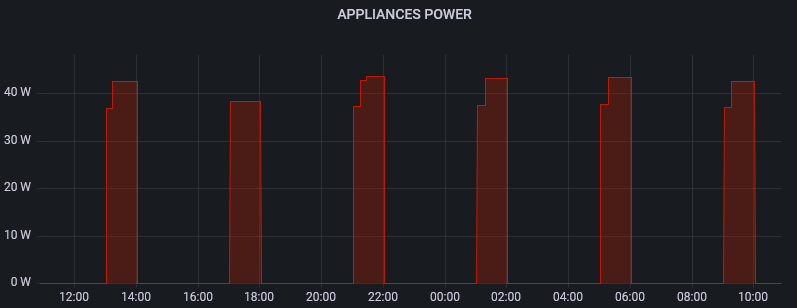
Hi guys, thanks for all the feedback! I spend around 100L per day, so after a week or so the contents of the tank are refreshed Flow-thru UV sounds like a great addition RO would be great, as it's essentially a silver bullet, but I'd like to keep this as a method of last resort because of implications; need to replace RO membrane frequently produces quite a lot of "brine" when compared to yield watter stripped of all the minerals is not the best for long-time drinking BTW: This is current submerged UV cycle that I've set up, 6hrs total per day. Consumes around 8kWh per month, which is nothing: Q: If you have an RO, how often do you change the membrane? Q: If you have a tank, where do you have it located and what is the ambient temperature of surrounding air?
-
Hi guys, How do you store and treat drinking water in order to be safe for use? I have a village-source that is clean, cool, chlorinated, safe to drink, but the pressure is quite low and a few times during a year there's an outage. Based on the above, I installed a small non-pressurized tank of 650L to bridge these outages and to improve pressure via automatic pump (DAB Divertron). The tank is located in the basement, where the ambient temperature is 14°C normally, 23° in the hotest week of summer. Already added submerged UV lamp to the tank (45W with 1/4 duty cycle), but I'd like to know what else I should consider. What worked for you?
-
Actually, an inverter can rely on the speed of the CPU to limit the PV current on the fly only if there's enough margin between "power capping" level and actual limits of the inductors and silicon used in the MPPT. For example, many Victron's MPPT chargers are designed for 70A of PV current, while their "power capping" happens way before that limit. Therefore, it's safe to put many more panels on them. SolarEdge (ongrid inverters) have a similar feature - their MPPTs are designed to safely cap 30% of power (and current) that is above rated power of the inverter. Old standalone MPPTs that were designed for charging lead-acid batteries were able to avoid overcurrent issues too, because lead-acid batteries don't like to accept charge when the SOC is high (contrary to lithium which sucks any amount of current supplied, although being at 99% SOC). And when there's nobody to suck the excessive current from the battery-side of the MPPT, then there's no way for current to appear on the PV-side of the MPPT. (I saw guys having like 12kW of PV modules on a 4kW MPPT, just to survive EU winter) Speaking of Deye, SunSunk, JASolar and other rebrands - base of the firmware is identical, casing and topology too. But each large-scale OEM customer of Deye can alter some of the parameter based on the target market. Including logo, quality of selected components and FW limits. For example, there are Deye models with MPPT designed for 2x 26A and others designed for 2x 50A, while the rated AC output is the same. Long-story-short, as a technician I always try to follow the manufacturer's spec sheets when designing a system.
-
28A going thru 20m loop of 6mm2 copper cable will create voltage drop of 1.7V and power loss of 47W. At 14A load, outside the peak-hours, its 24W. So the power loss will be less than 100W for all your panels combined....and only during peak hours. Will work ok, you will not even notice. BTW: Use ElectroDoc Pro mobile phone app for the calculations. It has all the resistance tables for various metals built-in, together with proper formulas.
-
This will work OK. It will be 28Amps at Isc, which is okay for 6mm2. (I can calculate voltage drop and power drop at various loads, if you want to know)
-
I assume that you have APL mode set, as mentioned in your very first post. So, the stop of exporting power to the grid is not being controlled by opening the relay, but by lowering the voltage produced by the inverter once the grid falls under 175V. If so, then fiddling with the relay has no point.🤔


