


JacquesVDM
Members
-
Joined
-
Last visited
Everything posted by JacquesVDM
-
I have two US3000's. The one had a heavily swollen cell which I managed to remove by cutting it out with a side cutter as I could not get it out with just soldering it out. Now on the other US3000 there are some cells which overvoltage when charging before it reaches full charge. There is one cell in each of the three packs inside the battery which are problematic. I tried swopping the packs between the two batteries. The only option left is to try and remove (de-solder) the problematic cells and swap with ones that are in a better state until I have a working US3000. At least know which ones need to be removed, as it can easily be identified with Batteryview. The swollen cell that I had to cut out, I first tried desoldering, but it seems those connections (tabs) of the cells are bend back and it is not just a simple process of applying heat and removing. Has anyone done it? Any suggestions to make it easier? Could be that I need to apply more heat, but it seems dangerous to apply heat at the cell connections.
-
Where are you located?
-
Did you have a look at Luxpower inverters?
-
Hi. It will only start if SOC is below the "AC Charge Start Battery SOC(%)" But then the "On Grid EOD SOC(%)" setting must also be below the "AC Charge Start Batter SOC(%)" else it will start using Eskom, but not charge battery. My settings: Discharge Cut-off SOC(%): 25% (For shutdown if no eskom and no PV to protect battery) On Grid EOD SOC(%): 35% (Start using eskom, if battery low and no pv - early morning just before sunrise) AC Charge Based On: SOC and Time AC Charge Start Time 1: 15:00 AC Charge End Time 1: 17:00 AC Charge Start Battery SOC(%): 80% AC Charge End Battery SOC(%): 95% So what this last batch of settings does is: if the PV does not charge it to at least 80% @ 15:00, eskom will charge it to 95% until 17:00 I believe you need to lower the "On Grid EOD SOC(%)" setting (where you want to run off eskom and not charge battery) and raise the "AC Charge Start Battery SOC(%)" (where you want it to start charging)
-
I am in the same boat. 4x US3000 5 years old. Also have that sudden SOC drop near about 35%. What is concerning though is just before two of the batteries reaches the charge voltage / 100%, the highest cell voltage goes 4.65V. After a few minutes it falls and I have a difference of about 20mv between highest and lowest. For now I have lowered the charge voltage to 51.7V as 52.5 (which I was running from the beginning) let those high cell voltages go to 4.7V. It seems I have some bad cells. Pylontech says warranty is void because there was a time my charge voltage exceeded 54V. Because it is an Axpert inverter, it overshot briefly (54.2) when I once tried to "balance" the cells at 53.2 V which is the voltage they "recommended. How easy is it to swap cells between batteries? I can solder and are a diy'er. It is concerning to see a lot of swollen / faulty Pylontech batteries on the internet. Another question: on the Deye inverters the charge voltage is "fixed" by the BMS at 53.2V. So what will happen if there is cells that are lagging in a few years? Then other cells will overvoltage? Or will the BMS communicate to the inverter to reduce charge? Anyone have such a setup with a Deye and Pylontechs and graphs of the cell voltages?
-
One thing that I noticed on a system which does not have comms and uses voltage as control, when using a voltage of 52.5V, just before reaching end of charge at 52.5V, some cells goes to 3.65 and some are still at 3.45. Some would say that they are not balanced, but after a while all cells are nearly at the same voltage (within 10mV). So the balancer does work and I suspect the difference in voltages (before end of charge) could be aging of some cells. What I still need to investigate is if it would do the same if there is comms or would the inverter lower the charging low enough to prevent the cell voltage going so high.
-
The main issue was the MPPT clipping at 13A causing overheating of the IGBTs and possible failure of the MPPT. The hardware was updated some time ago (after serial no 133....), but now with the software also updated is it not clipping at 13A. So now it can support larger panels / higher current panels.
-
Hi everyone. A friend of mine has a US3000 with a bad cell. Currently the system have 5x US3000's and on one battery when the SOC reaches about 70%, it drops rapidly to about 30%/20%/10%. When checking the voltages, only one cell is lower than the rest: 3.19V vs 3.28V. Is there anything I can do? Or does anyone have some spare cells for me?
-
Your picture is correct. No earth leakage on the inverter input. (Neutral/Earth bond will trip it.) Earth leakage on output of inverter (essentials). Earth leakage on circuits not on inverter (non-essentials). Two separate neutral bars (for each earth leakage)
-
I could be wrong, but did fuses not originate from the time before high voltage MPTT's? On the older Axperts, the maximum PV voltage was like 145V and then strings were paralleled. On such a system, if for some reason a PV cable is damaged/shorted, the fault current would be the "other" strings combined current which would be blow the faulty strings fuse. Example: 5 strings, each Isc of 10A and a fuse of 15A. If a string developes a short, total current would be 4x 10A (40A) resulting in the shorted strings fuse to blow. On the newer single string per MPTT's, I believe a fuse would not easily blow. As you state, even with shorting the leads together, the fuse would not blow. Only if there is some kind of induced current such as a lightning strike, the current could increase and blow the fuse as the SPD suppresses the spike. The reason I see fuses are still being used, is that they are much faster than a circuit breaker.
-
On the older low voltage MPPT inverters, where string were paralleled, I have seen: Panels-> Fuses on each string of panels-> combined into a single SPD -> isolator -> inverter (I believe having the fuse first was to protect when combining strings if one string were to go short circuit, the fuse would blow because of the combined current of the other strings)
-
What about a third option? Option 3: Panels -> Isolator -> Fuses -> SPD Isolator to switch off to work on fuses / SPD Fuses before SPD to blow if a surge is suppressed by the SPD
-
Hi guys, I see the Deye is suppose to charge the Up5000 up to 53.2V when reaching 100%. However the BMS voltage and inverter battery voltage shows 53.54V. Anyone with a Deye and Up5000 which can check what their battery voltage shows? It is kind of running too high too my liking. I don't think I can override the charge voltage setting if there is comms between battery and inverter. Have not updated the firmware yet and not sure if that would make a difference as the inverter just does what the BMS tells it.

-
Essential or non-essential? I have a thermo syphon and in the winter have to "top" it up a bit. Also have it cranked up to heat midday to last throughout the night. But I have mine on inverter / essentials to heat with PV.
-
I was wrong. Those are DC. The 400v ones that you can get online will also work. I would go for them to have some kind of margin as they would protect at 400v before reaching the mppts max input of 500v.
-
The value of 275V lets me think it is a AC type for the 230v AC supply. Is it DC rated? I could be wrong. I would go with a 500V one as the inverter is designed for 500V.
-
@Steve87 Thank you.
-
It is off grid so supply is not a problem. Have you done such a setup or know if someone have done it? Just worried that there will be some kind of error if the system expects sets of 3 inverters in the comms.
-
Hi everyone. Currently have 3x 16kw Sunsynk inverters in a 3 phase setup. Would it be possible to just add one additional inverter? Due to space constraints it is only possible to add one. The 3 phases are about equally balanced, but just need some more output to add an additional single phase load. On one of Keith's videos he did mention it to be 3,6,9 for three phase, but maybe someone has done it with four?
-
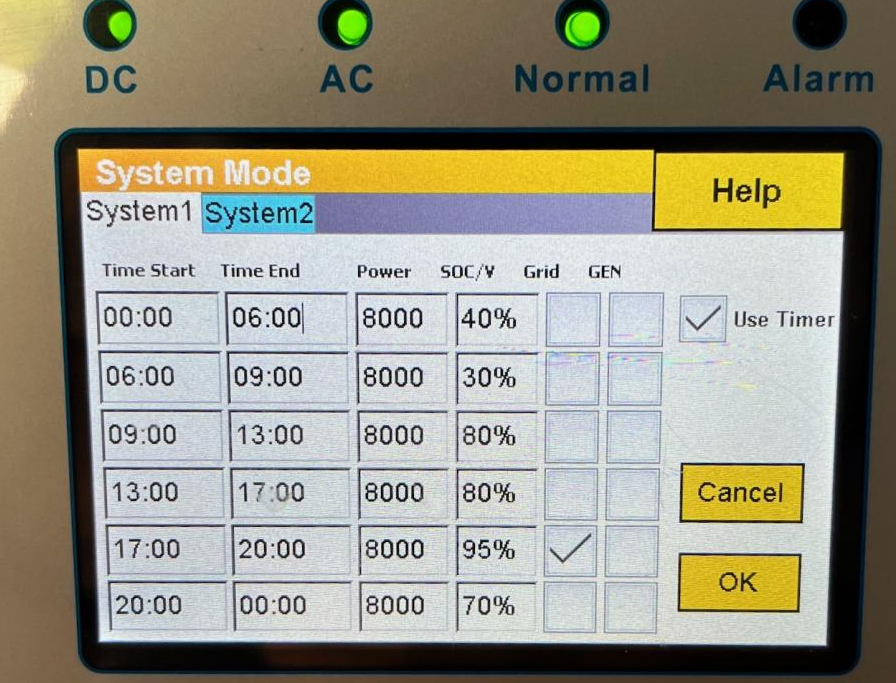
The 8:00 to 16:00 slot is conflgured to use eskom power to supply the load until the batteries reach 95%. So the PV is just used for battery charging and not for the load during the day.
-
No workaround yet. Just ticked "zero export to load" and now I don't power non-essentials with PV and also don't drain batteries with the non-essentials.
-
Would it not use eskom from 9am before there is enough PV and batteries are below 80%? Would it not be better to have a setting of 30% during daytime? (to rather use PV and not make use of eskom). That late afternoon slot to 95% I agree is a good one.
-
Sans 60364, Section 712.542.102 (page 49) .... If a separate earth electrode is provided for the PV array, it shall be connected to the main earthing terminal of the electrical installation......
-
Can you post a photo of how they are connected? It must be positive of first battery and negative of last battery to inverter. (Or other way around). Thinking that maybe the inverter is connected to the first battery and the others just paralleled from the first.
-
It was mentioned long time ago somewhere in the forums of someone else having the same situation, but can't get that post. So now my US3000A's are displaying 106% when fully charge. They are nearly 4 years old. What is strange is that it is all 4 of mine and both at my in-laws system. They are still balancing at the 89% and that point has not shifted. As I don't have comms between inverter and batteries, I run it at a charge voltage of 52.5V. I have no issues and they are still performing good Also never had a fault led come on. Anyone else experiencing the same? Also I see the SOH is 94%. Maybe it has something to do with that?


